Saturday, April 29, 2023

Dandelion Delight...

April is coming to an end, and unfortunately the vast expanses of dandelions that left the roadsides a flurry of gold have been unceremoniously mown. What a shame that the presence of this remarkedly robust plant is seen as so undesirable because once you overcome the 'weed' aspect, these golden flowers really do brighten the early spring days. And then, of course, they lead on to these marvels; the dandelion clock. How can anything be so perfect?

The Enduring Beauty of the Butterfly...

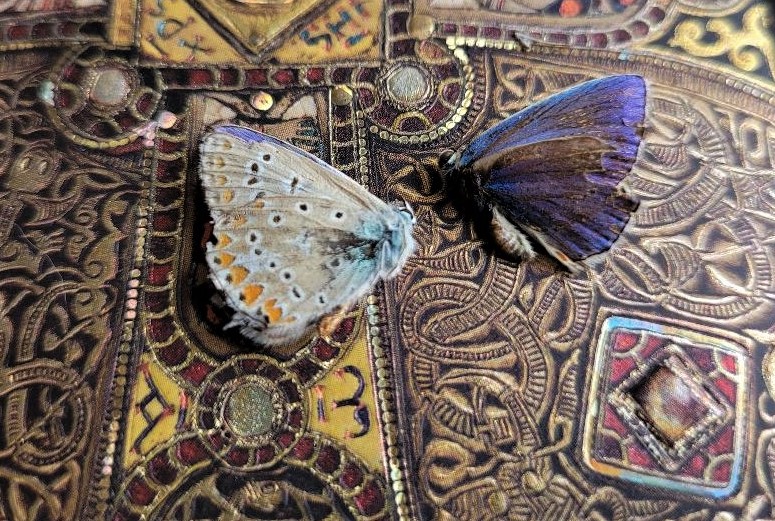
As Spring wakes up, it is magical to watch the different forms of life likewise emerging and to think about those which will soon make their appearance, however fleeting, as the months go by. One of the most magical of these has to be the humble butterfly.'Humble', as they once seemed such a familiar sight, yet these modest, little creatures of great beauty now appear to be getting rarer and their delicate presence can no longer be taken for granted as a staple of the sunnier months of the year. All these specimens here below are precious finds - found dead, I should add - that date back years and decades even. Although some of these - the Red Admiral, Peacock and Tortoiseshell - are still to be found in the wild, I wonder if they are commonplace today?
Clouds of butterflies fluttering around flowering plants and bushes were truly mesmerizing in my childhood but now I have to content myself with my old, tattered collection! Some of my butterflies are now over forty years old, but the magic endures. How can Nature be so perfect? Of course such perfection and the magical metamorphosis that leads to the emergence of such beauty have always fascinated Man and given rise to mythological and spiritual beliefs that have intertwined in such a manner that even pure logic and the rationality of science cannot dismiss. Even today, many people believe that the butterfly has some rather 'other-wordly' significance to the extent that a specimen that suddenly wakes up in Winter must surely represent someone or something 'other'...
In fact, the full life cycle of the butterfly, from the order of Lepidoptera (from the Greek 'scaly wings') is seen to reflect Man's transformation from earthly to spiritual Life itself, commencing with the caterpillar that symbolizes the ties of our physical needs. Following this comes the seemingly lifeless chrysalis phase, referred to by the Ancient Greeks as nekydallon, meaning 'the shell of the dead'. Indeed, the creature lies dormant in this sarcophagus which will finally split open to reveal the fully-formed adult within; a butterfly ready to unfurl its wings and fly free of all the physical binds of life. Again, this transformative stage is drawn upon in Buddhist belief; 'What the caterpillar perceives to be the end, to the butterfly is just the beginning'.
Set free from an earth-bound existence and mortal death, the body breaks away and upwards, soaring to the heavens. Not surprisingly, the word for butterfly and soul in classical Greek is psyche; the soul of the dead. Anima is the Latin word for 'soul' and 'breath', with the air-borne butterfly coming to symbolize the soul’s exit from the body.
The ancient myth of Psyche and Eros signifies the soul, the butterfly and divine love that must endure the hardest tests before attaining unity and immortality. It is based on the fable of the Latin prose writer Apuleius, from The Metamorphoses and tells of the trials and tribulations that this beautiful young mortal girl must undergo in order to be with her beloved Eros. Having drawn the ire of the Goddess of Beauty, Psyche is set on a long, convoluted journey that is both hindered and helped by various different gods - Aphrodite, Apollo, Zeus, Zyphyr, Persephone and Hermes being just a few who figure in this meandering tale...
Punished for her beauty by the jealous Aphrodite, Psyche is sent on a mission to the dark abyss of the Underworld before falling into a state of permanent sleep until she is eventually brought to life again by one of Eros' arrows. Finally given ambrosia, Psyche is granted immortality as winged goddess of the soul and from her union with Eros was born Hedone, the goddess of pleasure. Strangely enough, I don't think I was even familiar with this particular myth, and yet it was a source of inspiration for much later works of literature and flights of fancy such as the fairy tale of Beauty and the Beast and likewise Shakespeare's A Midsummer Night's Dream.

Wednesday, April 19, 2023

Ordinary Exotic...

As always at this time of year, the local garden centre is ablaze with the most amazing displays of exotic flowering plants, and true to form, I just can't help being drawn to them.
Each year, I just gaze at these incredible forms, with colours that defy description, as if I had just discovered them for the first time.
And yet varieties of these plants can be found for sale anywhere and everywhere, sold off to the public at cheap prices that seem an insult to the beauty of these exotic specimens.
As a consequence, these extraordinary flowers have become seemingly commonplace...
And yet nothing could be considered ordinary in these beautifully complex living forms.
Even the simpler varieties are little works of art...
And then the most extreme are just astounding!

Friday, March 31, 2023

A Gentle Escape...

As I wandered around the Tate Britain a few weeks past, I felt as if I were again encountering and reconnecting with what had once been the foundations and fabric of so much that I had loved in art. Looking at the paintings that had so fascinated me all those years ago, I had the impression I was revisiting places or people precious to me. Stepping out of busy 21st century London streets, and into this vast art gallery enabled me to escape from the less savoury aspects of modern life in a realm far removed from the pettiness, paltriness and often plain ugliness of today’s civilized society. There was something soothing and gratifying to be surrounded by the art of centuries past, a reflection of History that gives the present day, our lives and even mortality itself another perspective. Like Nature itself, History just is; and as such is deaf and blind to our perceptions and reactions to rights and wrongs; the good and the bad that punctuate its substance finally seem to highlight the words 'This too shall pass'. In one of the rooms, a small painting caught my attention with its curious jewel-like quality and tranquil air. Coming from Evening Church by Samuel Palmer (1805–1881), painted in 1830, somehow seemed to possess a strange essence unlike any other of the works that were familiar to me and were certainly more well-known. Its combination of tempera, chalk, gold, ink and graphite on gesso creates an almost enamel aspect, and the colours both calm yet curiously vibrant, with ocre, reds and dark blue in the clothing of the procession of worshippers winding their away towards us, away from the church. The latter has a bizarre almost childish cone-form nave, that is repeated in several other oddly-shaped buildings, but its spire stands tall, moonlit in the night sky. The whole scene is framed by trees with delicate leaves and branches that are silhouetted against the huge full moon which is set in skies that are pale blue, in contrast to the stark forms of dark green bushes and outlined trees. In the background, strangely steep hills tower up with their undulating forms that pick up the curves and rounded shapes in the valley scene below, and of course the moon itself. The gallery inscription next to the painting cited Palmer himself - describing the work of William Blake (1757–1827) - pointing out that these words could indeed be applied to his own art and vision; “There is in all such a mystic and dreamy glimmer as penetrates and kindles the inmost soul”. Samuel Palmer was an admirer of Blake’s visionary art, and is known today for his images of rural scenery that were based on an imagined, sensory reality rather than disciplined observations of landscape before him. Born in London in 1805 to a bookseller father and a devout mother, Palmer grew up with literature but had no formal academic artistic training as such, yet at the age of 14, his work was exhibited at the Royal Academy. Despite this achievement, he himself was increasingly inspired by art that seemed to flout a staid, conventional approach and he was influenced in part by work displayed at the British Museum.
Key influence on his early life was his meeting with landscapist John Linnell (1792-1882) in 1822. Linnell not only saved the young artist from “the pit of modern art” by enabling him to learn from ancient Italian and German masters, but more importantly introduced him to William Blake. Palmer’s vision thus grew from art “as old as time”, with Gothic art and the Northern Renaissance artists such as Van Leyden and Dürer but also Turner and Blake himself. Wishing to experience the same spiritual visions as Blake to fire his art, Palmer earnestly devoted himself to his work, becoming a member of the Ancients, an artistic brotherhood that preferred a more primitive approach to life and art over the slavish, descriptive Classical pieces so favoured by the Royal Academy. He moved to Shoreham, Kent in 1827, where he produced his most other-worldly images of the rural lands that he found more mesmerizing than any other. Drawn to the night skies, moon and stars, he and his fellow Ancients wandered in the dark to capture the nocturnal landscapes. With Palmer dressed in archaic clothing, complete with flowing beard and a Christ-like allure, the group must have made quite an impression on the locals who referred to them as ‘astrologers’!
The seven-year period in Kent were in fact to be his most productive as he was drawn to the mystic, Romantic qualities of nature, seeing the spiritual all around him, transforming the visible through the lens of his heightened imagination. He mourned the demise of the pastoral way of life and the land itself that was being transformed by the Industrial Revolution. Having returned to London, his subsequent marriage to Hannah Linnell (daughter of John) in 1837 marked the beginning of a new stage in his life, and indeed his art… Unable to support his family, Palmer sought to pursue a more conventional approach to his art, and was obliged to pander somewhat to public taste and give private lessons to increase his income. His mature work – often watercolour – was artistically accomplished but never quite captured the same sensory essence as his Shoreham art and Palmer was largely a commercial failure during his lifetime. Much of his work and studies were lost due to their destruction by his son, after Palmer’s death, in the belief that “…no one would be able to make head or tail of what I burnt; I wished to save it from a more humiliating fate". And so one individual’s decision to whitewash the past deprived the world of a piece of collective history. Hmmm...

Crochet Comfort..

Although I seem to have achieved very little this month, I have managed to make a start on a new crochet blanket which was initially an endeavour to use up the leftover wool from previous pieces. However, as I soon realised that I do not want a mini replica of these past works, I have ended up buying new colours and so I suspect that the process is destined to go on in a never-ending circle. Still, I do know two precious beings who will be quite content with that state of affairs as they seem to take a great deal of comfort from the actual wool itself and from taking centre stage in any kind of creative activity, usually depositing a few stray hairs in the process!

Monday, March 27, 2023

Nocturnal Blossom, Branches and Buds...

I thought March would be a month of calm but that has not been the case and all the positives of the end of February fizzled away... As always, however, there was beauty to be found, even on the coldest evenings, as I trudged home...
With the night lights shining through the branches and blossom, another delicate world of magic seemed to come to life and take me away from dull routine...
And even in the darkness, the spring buds are visible, bursting open again as another year begins...
And the blossom appears...

Monday, February 27, 2023

Calm away from the Cold...

The desire to hibernate has got the better of me this year, and I cannot wait to get back to the warmth and calm of home - or my favourite haunts offering those creature comforts and above all the essential element in the mix; actual creatures in the form of cats!
When I travel, cats are somewhat rather few and far between - certainly in the winter months - so I turn to coffee shops to give me an alternative fix - typically of cafeine and coziness.
This time, the beautiful flowers of Spring in the café windows in Penzance were the perfect antidote to the bitter cold outside and just looking at them even now makes me feel calm, though the fact that I have returned home to my cats does help towards that general feeling of well-being!