Far from the beach, but still surrounded by treasure of all kinds just ready to be found, looked at, gloated over, gleaned and swiped or simply created! Here are my latest finds....
Just over a hundred years ago, this long alleyway led to the grand Château de Toussicourt, set behind a majestic central pond and looking down over the sweeping landscape that is now indistinct agricultural land. I had learnt of Toussicourt a number of years ago, when looking into the history of the area of Hermonville and its unwitting involvement in the Great World - 1914-1918.
Finding itself at the heart of hostilities from the very beginning of the war, the region around Hermonville and further beyond was the focus of many brutal - yet ultimately futile military missions - with lives, land and livelihood literally obliterated. The village itself was employed as army training base in espionnage and the numerous châteaux (of which there were initially seven), served as encampment grounds.
These impressive domains were cruelly damaged during the war years and some were left in ruins - as was the case for Toussicourt. Having belonged to the Krafft family in the final chapter of its life, the château was abandonned to the wilderness as Hugues Krafft dedicated himself to the preservation of the architectural heritage of Reims with the foundation of the Société des Amis du Vieux Reims (SAVR) and the purchase of the Hôtel Le Vergeur.
I managed to track down Toussicourt a few years ago, in winter months, just weeks before global lockdown made such walks in the countryside seem illusory... The visit of the final remains of this once-grand residence was dreamlike in itself and now in the summer months, years on, there was a similar feeling of halted or suspended reality, as if you could somehow conjure up the past if only you find the correct opening.
The stark branches, stripped foliage and visible stonework of the winter have now been clothed in shrouds of vivid green with darts of sunlight breaking through the leafy canopies above whilst dense undergrowth carpet and conceal paths underfoot...
Moss and ivy are draped everywhere, as is lichen, whilst Nature takes its claim on these traces of human history...
No indentifiable structural vestiges remain of the château itself, apart from the odd turret-shaped form that originally stood near the pond, and is now sumberged by the trees and saplings that stand where once the main building rose up. The stonework of this final construction is gradually being carved up by inclement weather that drives in cracks and crevaces where the war hostilities had failed...
Although hidden from view in summer months, the pond still offers a peaceful glimpse of what once was; past elegance and tranquility. I couldn't help but reflect on that loss in the present too as we have entered unchartered territory in almost every aspect of life since my last visit.
As I left, feeling a little wistful, I caught a glimpse of this strangely faded Peacock butterfly; vanishing beauty indeed!
The stunning sight of a sea of crimson poppies always takes you by surprise, causing you to catch your breath in wonder. Swathes of vivid colour stretch out before you, cloaking the most unassuming terrain or wasteland with such intensity that it is difficult to believe that this will be just a fleeting moment in time. The delicate papery petals will shortly wilt and die off, one by one, flower by flower until the whole expanse has vanished for another year.
The strange mixture of ephemerality and intensity, complexity and simplicity, forcefulness and fragility makes this phenomenon all the more incredible and it is not surprising that fields of poppies are synonymous with the battlefields of World War 1, which would bloom overnight with flowers that seemed to draw from the blood spilt on the foreign soil of France and Belgium.
Not surprising either then, that the poppy should have inspired a number of war poets, one of whom being the Canadian, John McCrae, who wrote In Flanders Fields in 1915, a few years before his own death, in 1918.
In Flanders fields the poppies grown,
between the crosses row on row,
that mark our place; and in the sky,
the larks, still bravely singing, fly
scarce heard amid the guns below.
We are the Dead. Short days ago
we lived, felt dawn, saw sunset glow,
loved and were loved and now we lie
In Flanders fields.
Take up our quarrel with the foe:
to you from failing hands we throw
the torch; be yours to hold it high.
If ye break faith with us who die, we shall not sleep, though poppies grow
in Flanders fields.
10,000 poppies were knitted or crocheted to create a blood-red cascade of colour that drape the walls in one of the passage-ways in Canterbury, so that people might stop and think of the thousands upon thousands of lives lost in the Great War. I do hope this is the case, but suspect many simply sweep past on their shopping quest, caught up in the flow of their material concerns, phones welded to their hands, much as myself this Saturday. However I did pause to think how strange it is that we unwittingly allow ourselves to be carried away by this frenzy of consumption - feeding our minds on the prospect of the latest fix, ever driven by this unsatiable thirst for easy entertainment and acquisition. In so doing, we no longer take stock of our lives, except to find it wanting in some respect, when we do in fact have so much to be grateful for.
Aftermath - Siegfried Sassoon (1886-1967)
Have you forgotten yet?...
For the world's events have rumbled on since those gagged days,
Like traffic checked a while at the crossing of city ways:
And the haunted gap in your mind has filled with thoughts that flow
Like clouds in the lit heavens of life; and you're a man reprieved to go,
Taking your peaceful share of Time, with joy to spare.
But the past is just the same—and War's a bloody game...
Have you forgotten yet?...
Look down, and swear by the slain of the War that you'll never forget.
Do you remember the dark months you held the sector at Mametz—
The nights you watched and wired and dug and piled sandbags on parapets?
Do you remember the rats; and the stench
Of corpses rotting in front of the front-line trench—
And dawn coming, dirty-white, and chill with a hopeless rain?
Do you ever stop and ask, 'Is it all going to happen again?'
Do you remember that hour of din before the attack—
And the anger, the blind compassion that seized and shook you then
As you peered at the doomed and haggard faces of your men?
Do you remember the stretcher-cases lurching back
With dying eyes and lolling heads—those ashen-gray
Masks of the lads who once were keen and kind and gay?
Have you forgotten yet?...
Look up, and swear by the slain of the war that you'll never forget!
Ever since hearing of Peter Jackson’s 2018 documentary film of the life of the British soldiers on the Front in WW1, I had been very keen to see it. They Shall Not Grow Old was aired on BBC television on the one-hundredth anniversary of the Armistice of 11 November 1918. It came out in France this July…
Stunned viewers are immersed in a first-hand experience of the trenches, based on the impressions left on those who had experienced the «war to end all wars» between 1914-1918. The faded distant past is brought vividly into focus, and injected with colour, sound and lifeblood through the digital restoration and remastering of original 100-year-old footage. Film director and producer Jackson was asked to take on this project which was co-commissioned by 14-18 NOW (the UK arts programme for the Great War centenary) and the Imperial War Museum in association with the BBC. From hundreds of hours of British war footage, taken from the archives of the BBC and the Imperial War Museum, this unique film emerges, captivating us as the voices sound out from the past, and the colour seeps out from the frames to swamp all our emotions.
Not intending to be a historical documentary, with set factual detail of names, dates and place, the film first plunges us into the anticipation and flurried preparation of war. This is presented in stark black-and-white, as hordes of civilians finally set off as ordered troops of soldiers.Veterans’ voices rise up throughout the film, recounting their experience in a harrowingly frank, matter-of-fact way which has not been dulled down and flattened by political correctness. The accents and attitudes vary, yet the sense of camaraderie is overwhelming, uniting a motley crew in the most unlikely manner. As the mud and horror grows in the confusion and inhuman conditions of the trenches, colour suddenly flows into the scenes so that we feel the pulse of life in all this devastation. The red of the symbolic poppies burns out of the dull backcloth of tortured landscapes, just as the blood lies vivid on mud-splattered bodies. All sense of bearings, purpose and logic is lost in the morass of warfare, with its seas of mud, stagnant water and spilt blood. In this blur of lost boundaries and identities, the soldiers start to perceive little difference between themselves and their foe. All are ultimately soldiers in the same war, «getting a job done» on different sides, yet experiencing the same hardships and thus drawing a strange humanity in the most inhumane circumstances.
Horse bust - Birmingham Museum and Art Gallery
Peter Jackson dedicated the film to the memory of his grandfather, but as he said, it could have been created in the name of anyone’s loved one from the Great War, irrespective of class, race or nationality. There have been a number of criticisms directed at the film – from the French public at least – claiming that the work fails to mention les Poilus (French infantrymen) and as such is too chauvinistic. However, this was indeed an English film; the numerous mentions of the nice cup of tea and sentiments towards the battlefield beasts of burden – horses, mules and dog leave the viewer in little doubt of that! It offers an account of the Tommy impressions and images of the Front within regiment, based on many voices, not just one narrator who tells his own story of the war. Yet those impressions and images were shared by all the soldiers of the 14-18 War. Furthermore, this generation which sacrificed so much largely drew the same conclusion ; the Great War had led to unprecedented slaughter and had achieved very little. The cruelty and carnage of war have been captured here in this great film, but so too has humanity and beauty, arising like the light, sound and colour under the master direction of Jackson.
They shall grow not old, as we that are left grow old: Age shall not weary them, nor the years condemn. At the going down of the sun and in the morning We will remember them.... For the Fallen - by Laurence BINYON (1914)
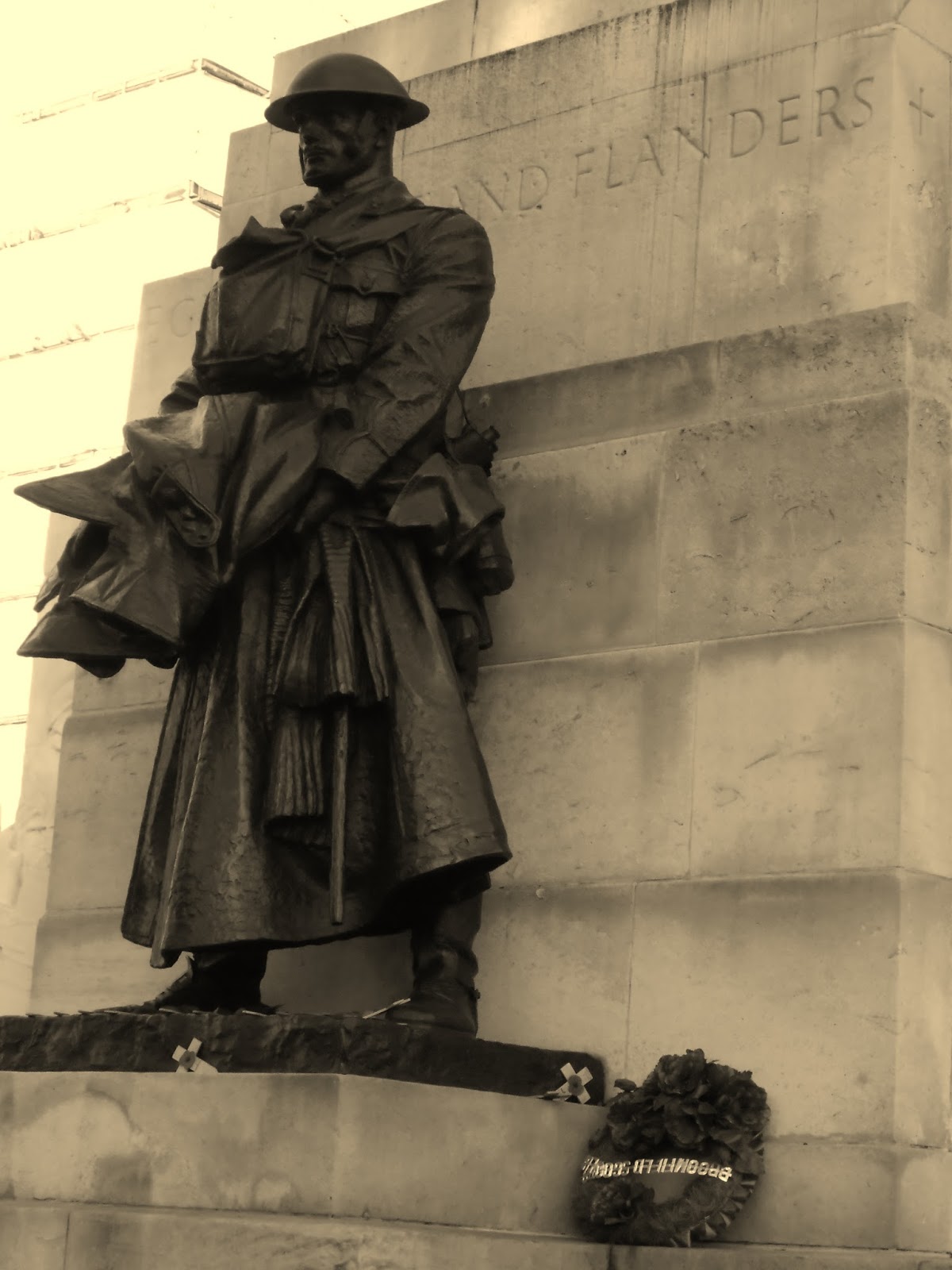
Royal Artillery Memorial - Hyde Park Corner - London
Little by little, as the years pass, the original purpose of this public holiday in France on the 11th November seems to be overlooked. And yet it is Armistice Day, and whilst I'll be undoubtedly and very, very grudgingly doing even more work, I do want to remind myself of all that I have, and for which I should be grateful. Actually, I think that I am already aware of that, but am far more conscious of the fact that I have to limit my active appreciation of what I possess on every level due to an enormous proportion of my time being eaten up by ever-increasing workloads that do not 'pay' in any sense of the word. Time might well be 'money', as the saying goes, but when you have no time you really are impoverished.The concept of 'free' time is something that I've lost sight of, as it seems to be more a case of stolen time, for which I feel guilty. So today I will try to refocus and think of people and populations, from the past and present, who have lost all freedom and have known true deprivation.
The Driver
Over a number of years, I dragged the big suitcase, children in tow, from Victoria coach station through Hyde Park and towards Paddington station... Invariably, we would pass the memorial to the Great War on the corner of Hyde Park, but daunted by all that traffic, and eager to enter the main park grounds, never crossed over to see it at close quarters. Literally each time, I swore we would do so, especially once we'd read Stoneheartby Charlie Fletcher and were more observant of the impressive statues that are part of the city landscape. Even from afar, the striking form of the Driver, who looks on from the west flank of the Royal Artillery memorial, draws your attention. Finally, when I travelled to London alone last year, I seized the opportunity to look at the statues on this traffic island.
This was at the beginning of December, and therefore poppy wreathes still lay at the feet of the four soldiers who are positioned like sentinels around the massive memorial block of Portland stone. This itself bears sculpted reliefs showing uncompromising scenes of conflict. These were in line with the sculptor's intention to depict the events of war which would not shy away from its brutal reality and could in no way be taken as a symbol of Peace. Charles Sargeant Jagger (1885-1934) was commissioned to carry out the work to commemorate the fallen Royal Artillery servicemen in 1922, and he duly stated that “experience in the trenches persuaded me of the necessity for frankness and truth”. The result attests to this, but its refusal to present anything that could comfort or reassure the public of the nature of 'the Great War to end all wars' drew mixed reactions from the public and press alike. The spectre of Death, symbolized in the form of the fallen artilleryman, lain out and shrouded by his trench cape, was perceived as "a terrible revelation long overdue" (Manchester Guardian) but also as 'inappropriate' by other parties. Jagger was insistant that this figure be an integral part of the memorial, and refused to give in to disapproval.
The fallen artillery man
A large sculpted howitzer, the heavy siege gun that was prevalent in trench warfare, is set on the top of the monument, its cold stone overshadowing the artillery men below - cannon fodder indeed. The Driver seems to stare onward towards the continual flow of pedestrians opposite him, oblivious to the noise of cars and buses, but his eyes are virtually covered by his metal helmet, and you have the feeling that underneath that, his vision is glazed. As one of the military ranks, his duty was to drive the teams of horses. Here, he is supposedly resting, although his pose is more that of exhausted resignation, rather than true respite.
The Driver
As he leans back against the stone, he holds the whip used to force his beasts onwards and the chains to shackle them to their fate, but he himself seems to be no more than a human cog in the inhuman machine of war. Man and beast all belong to the "fellowship of Death", that is alluded to on the plinth of the dead gunner and is fact drawn from lines in Shakespeare's Henry V in reference to the losses at Agincourt. As the other two standing forms, the Driver's poise seems both bold, here with his arms out-stretched and legs apart, yet ultimately is truly vulnerable.
The Artillery Lieutenant
An artillery lieutenant stands facing south. Initially, he too looks bold and full of aplomb, but this impression soon gives way to the feeling that he is weighed down by his duty, just as he is loaded down by his cumbersome clothing and wartime kit. He may lead men with his swagger stick, but he is led by events and must follow passively.
To the east stands the Shell Carrier, aptly named for huge cannister shells shored in the pockets of greatcoat. With feet firmly planted in heavy miltary boots he looks invincible, yet his sinewy arms look unprotected and the vulnerable veins on his clenched hands contrast the vein-like cords that hold the shells in place, ready to pulverise flesh on the 'other side'.
The Shell Carrier
The hobnails visible on the soles of the dead gunner's boots show the fraility of all things, as do his fingers, slightly crooked, no longer trying to keep a grip on life itself. Apparently Jagger was greatly inspired by the sculpture of Rodin, and this is seen in his study of hands. We cannot see the dead man's facial expression, but the hands say enough. Even the rough fabric of the clothing seems to speak to us - carefully created by Jagger's modelling technique of building up layers of clay to leave a textured finish.
The Gunner
The memorial is dedicated to the artillery men who died in service, and the names of the countries and regions where they fought are inscribed in its stone - France, Africa, Persia, Egypt, Central Asia, Palestine, Russia, Italy, India, Arabia, Mesopotamia, Macedonia, Dardanelles and Flanders.... Almost 50,000 men died.
Jagger's career only spanned 16 years, and war seems to have shaped much of those, directly or indirectly. Son of a colliery manager in a pit village near Rotherham, he became interested in sculpture as a young child, and later went on to study metal engraving, before attending the Royal College of Art in 1907. Although he won a prestigious scholarship to study in Rome in 1914 (Le Prix de Rome) he declined this and chose to serve King and Country in joining the Artists' Rifles. He was injured several times in service, was awarded the Military Cross for gallantry, yet survived the war years. Nevertheless, he never freed himself from war in the sense that his eventual career largely centred on depictions of the Great War in the numerous memorials for which he was commissioned. Jagger died of pneumonia at the age of 49, just a few years before the start of the Second World War....
Paddington War Memorial - Jagger - photo by Cnbrb - English Wikipedia
What I did not know, until looking into Jagger's career for this post, is that the imposing statue in front of which we have always passed when boarding the train at Paddington station was also sculpted by Jagger... That one has always caught my attention, but I had never made the association between that figure and those of the Hyde Park memorial.
On the site of the village of Fleury-devant-Douaumont which 'died for France'.
Fed up with all the stifling, petty problems of my
(city-based) life I wanted to put these into perspective by getting out into
the country in order to breathe another air. As most of the regions in this
part of France were the scene to extensive offensives during the First World
War, it is almost impossible not to come across military cemeteries.
Fleury-devant-Douaumont
Although
these graveyards once rose from barren land that had witnessed the worst war
atrocities Mankind had ever inflicted on itself, today a strange tranquility
reigns in these now wooded areas.
The surrounding landscape still bears the
scars of the battles, but the effect is strangely beautiful as nature cloths
and accommodates forms that can only be artificial.
Probably the largest of
these areas is the battlefield of Verdun, which strikes you with its woodland
beauty and shocks you with its stretch of military crosses that unfolds before
you, into the distance.
Verdun - In front of the Ossuary of Douaumont
In order to reach Verdun, you may follow the RD1916. This
seemingly unassuming road nevertheless has a remarkable history and played a
vital role in the Battle of Verdun of 1916.
Pocked-marked battle terrain in the mist.
Named in reference to the Via Sacra -the ancient Roman
road leading to the Coliseum - the Voie Sacrée of North-Eastern France led
thousands of men towards gladiatorial combats of mythological proportions in
the 20th century. During the First Word War century it was not slaves or beasts
that were forced to enter the battle arena for the entertainment of the public,
but young men who had often willingly enslaved themselves in order to honour
their home land.
Le train (convoy) on the Voie Sacrée.
The Voie Sacrée, thus named at the end of the war by
Maurice Barrès, was to act as a vital artery to the French army in the Battle
of Verdun. A never-ending stream of men and arms circulated to and from the
Front, thus feeding the war machine, keeping it alive and literally supplying
it with lifeblood in this giant clash of the Titans. The gods at war here were
the Teutons and Gauls in a deadly racial feud that Lloyd George rightly termed
"one of the most gigantic, tenacious, grim, futile and bloody fights ever
waged".
Large road-side sign on the Voie Sacrée.
Erich von Falkenhayn, the mastermind behind the German offensive
called it Operation Gericht - meaning 'judgment' or the 'administration of
justice'. He hoped that this battle of attrition would "bleed the French
army white" and that such a strategic strike would deal a fatal blow to
the morale of the whole of France.
Convoy on the Voie Sacrée
Ultimately it was hoped that France, as "England's
best sword, would be knocked out of her hand". This, along with the
widespread use of submarine warfare, would literally starve Britain to
submission and would serve to crush the Entente whilst protecting the Habsburg
Empire.
In the whole deadly Verdun experience there could be
no victor or vanquished. There was no justice to be dealt, no judgment to be
made. Mankind lost in this battle since the only victory possible for civilisation
would have been peace. Yet war requires the cold process of dehumanisation
which leads men to simply act out its faceless battle tactics and moves, even
when a battle has lost all sense or logic. These gestures took on unprecedented
proportions of brutality, inhumanity and futility at Verdun in 1916.
Monument to French Minister of War - whose name honours the Maginot Line
The town of Verdun had always been of great historical,
strategic and symbolic importance to the French nation. The name itself comes
from the Latin 'verodunam' meaning 'strong fort'; even Attila the Hun had been
unable to penetrate this citadel in the fifth century. Ironically perhaps,
until 1648 Verdun was not even French as it had been part of the Holy Roman
Empire following the division of the Charlemagne empire in 843. What never
faltered over the centuries was Verdun's interest as a strategic point marking
the frontier between Gallic and Teutonic empires and acting as barrier, or
potential gateway, to Paris. To withstand attack, Verdun's antiquated medieval
defenses were updated during the Thirty Years' War (1618-1648) to resist enemy artillery.
From 1670 the military engineer Vauban improved this defense further by a sophisticated
fortification programme. Unfortunately these were not sufficient to safeguard
the city in the first Battle of Verdun in 1792 which pitted the French Revolutionary
forces against the Prussian army. Captured by the enemy and released again,
Verdun suffered a similar fate in the Franco-Prussian war of 1870. As a result
of this humiliation, and in an endeavour to protect the eastern border, a
strong line of fortifications was built between Verdun and Toul, and between
Epinal and Belfort.
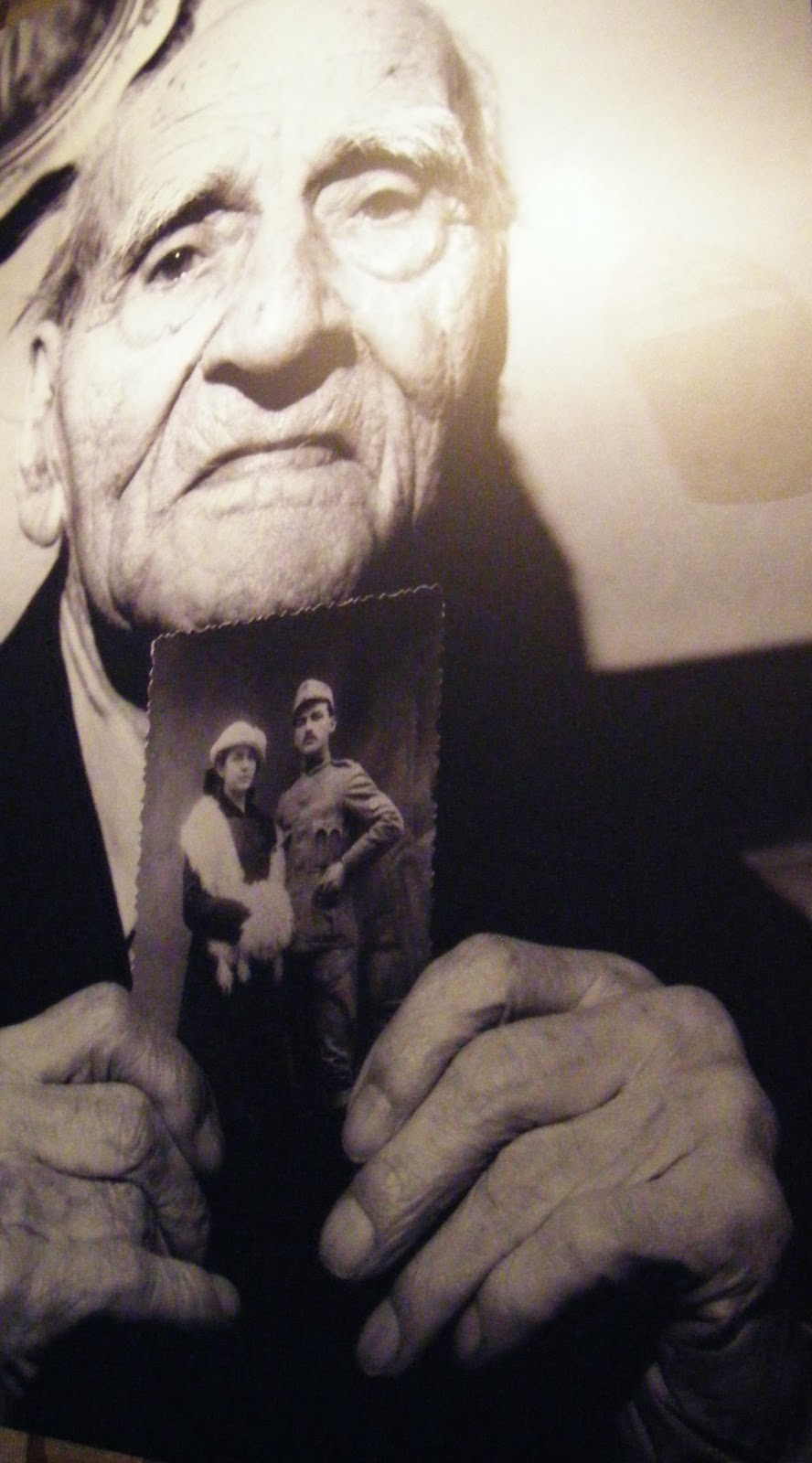
Ex-Poilu soldier with a photo of his former self.
As a salient, protruding into German territory, Verdun
was the tantalising northern gateway to the Champagne region, with Paris just 260km
beyond. Its defense was vital. A ring of 19 forts was constructed several
kilometres from the town shortly before the turn of the century, and further reinforcement
work was later carried out on the sites to the north and east of Verdun, namely
Fort Douaumont and Fort Vaux.
Ossuary of Douaumont
Despite its initial reputation for impenetrability,
Verdun was to have notable weak points for which it would pay dearly. Exposed
as it was on three sides, in theory Verdun needed all the fortifications it could
muster, especially if exposed to heavy German artillery. However the capture of
several Belgian defense forts had shown how ineffective such sites could be
when faced with such powerful munitions and it was felt that their supplies
could be put to better use. Indeed, by mid-1915, arms and equipment were required
elsewhere. The enemy attack had been countered on the Western Front yet
stalemate had ensued. As Verdun was ironically considered to occupy a 'quiet
zone' at that period, it was thus decided that many of its forts would be downsized
or dismantled (or even designated for destruction). Fort Douaumont was the most
notable example. In addition, Verdun's single-track rail system had been
weakened by German forces since 1914, and where it was exposed to enemy fire
could not be relied on for the transportation of significant supplies. Little
did the French realise, but as such, Verdun represented a deadly bottle-neck
trap set up to ensnare them, and was a strategic trophy for the Germans, ready
to be taken.
French intelligence knew that an attack was imminent
at the very beginning of 1916. The die had been cast. Reinforcements in men and
munitions were therefore hurried into the area, aided in their convoy by a
delay in the German offensive due to bad weather. Instead of the 12th February,
the attack was held back until the 21st February. Despite this delay the sheer
disparity in power on every level left little hope for the French. The Battle of
Verdun started in earnest with an apocalyptic 10-hour bombardment of the front
line. This "trommelfeuer" (drum fire) attack churned up the land and
pulverised its occupants. The deafening drum call, felt as a rumble even 160km
away, sounded the emergence of a living hell. Indeed, this baptism of fire and
blood was followed by advancing flamethrowers and storm troopers who cleared the
trenches of any remaining defenders.
Veteran 'Poilu' soldier.
The defeat of the French seemed to be
merely a question of days. In this extreme state of urgency the French Second
Army, under General Pétain, was summoned to the Front to reinforce the Verdun
sector. The
fort of Douaumont, not surprisingly perhaps, fell to the triumphant Brandenburg
regiment on the 25th of February. Its capture highlighted the errors in
strategic decisions on the part of the French war masterminds, notably under
General Joffre, and dealt a hard blow to French morale. Crueler still were the
physical blows which rained down on the actors in this very real theatre of war
through weapons and warfare devices which had barely been used before or rarely
to such an extent.
Even before the staging of this apocalyptic scene took
place in late February 1916, another frenetic activity had been triggered off well
behind the front line, several days earlier. It lead to a previously unseen
feat of logistics and would provide the French battleground with a vital
lifeline in the form of a serpentine convoy of men and material to and from the
Front. Following an emergency meeting on the 19th February the Automobile
Regulatory Commission was formed in order to respond to the army's transportation
requirements. It was decided that the modest road leading from Bar-le-Duc to
Verdun would be the centre of this mission, and immediately all concerned
ensured that the objective was achieved.
Monument to the Voie Sacrée
From the 21st February all horse-drawn
traffic and infantry were prevented from using the road, which was then devoted
solely to motorized vehicles. The narrow route itself was widened to
accommodate the two lines of movement, wholly focused on Verdun, there and
back. This continual flow never slowed over the following months; on the contrary,
the movement over the 75km distance built up in momentum and capacity. A slowdown
in the advance of Germans troops due to adverse weather conditions was used to
great advantage by the French. Just in the first two weeks of hostilities 132
battalions were transported along the route, in addition to 20,700 tons of
munitions and 1,300 tons of general supplies. In March 6,000 trucks passed each
day - roughly signifying one every 14 seconds, day and night. The drivers of
such vehicles were expected to work for up to 18 hours a day, for up to 10 days
in a row in order to maintain the rhythm. Any vehicle that broke down would be
hauled to the side of the road so as not to hinder the flow of traffic. To
counter the problems resulting from the poor road surface and the dire weather
quarries were opened up to supply stone chippings. When these proved inadequate
to maintain the most basic of standards for the convoy , stones were placed on
the route itself, to be crushed by the passing trucks themselves. Patrol planes
were flown overhead to avert or crush German attack.
The same soldier with a bicycle, many decades later...
'The Road', as it was
simply called during the battle, reflected the ingenuity and sheer
determination of all involved. In this manner, the Voie Sacrée led to the
logistic legend of 'French trucks over German rail systems'. However, this
legend is somewhat skewed since it does not give due recognition to the
narrow-gauged rail track that ran virtually parallel to the Voie Sacrée. Although
the Road did indeed bear the vast majority of traffic (approximately 78%), the
remainder was carried by the Chemin de
Fer Meusien. This modest line which transported supplies in food, horses
and munitions to the Front and brought the wounded back, was seconded by the
Nettancourt-Dugny line. In a prescient move, Pétain had ordered the
construction of this standard-gauge track in early March 1916 and it is was
duly completed and functional in a mere four months. Running beyond the reach
of enemy fire, it eased the pressure on the Road which had already reached full
capacity by the end of March. In this manner the Road gained in efficiency as
it was able to concentrate further on the flow of lighter freight and vehicles.
Together road and rail led to the rotation of some 2 million soldiers over the
following months and the heavy rumble of transport was ever-present.
From the Monument au Morts at Meaux.
Likewise, the deafening war machine of Verdun
continued relentlessly. The Germans appeared to have the upper hand, with
French soldiers outnumbered by almost two to one and armed with weapons that
could not match the heavy enemy artillery. Nevertheless the French put up a
brave defense and hindered the attack on the village of Douaumont on the 29th
of February, making the most of bad weather to further accelerate the advance
of convoys. When the village finally fell to the enemy on the 2nd March, German
losses were considerable and revealed shortcomings in their strategy. Perhaps
too sure of victory, the Germans had advanced fast in the initial stages of the
offensive and had made themselves vulnerable. The front line had been
transformed into a quagmire which resisted the movement of heavy German
artillery, especially in hilly areas. Equally bogged down in mud, the German
infantry exposed itself to French artillery on the opposite side of the river
Meuse. Unable to progress frontally, the Germans decided to attack via the
flanks of the hills of Le Mort-Homme and Côte 304. These offered a vantage
point over the battlefield and also housed many French munitions and were the
focus of a huge enemy attack followed by a counter-attack on the part of the
French. The site was ravaged by the hostilities and the hills scalped to become
volcanoes in a lunar landscape that swallowed up any human community or indeed
any form of life.
Although now taken by the enemy, Fort Douaumont
remained a focal point of French concern on a both strategic and symbolic
level. The Germans managed to hold onto the fort, but at considerable human
cost. Despite the affectionate name bestowed on the fort - the "Old Uncle
Douaumont" - its capture certainly did not necessarily bring them much shelter
or luck as it turned out. It became a German safe haven for troops and
operational base in spite of the French Second Army's valiant attempts to
recapture it in late May 1916. However, the danger for the Germans came from
within as a relatively banal accident over a cooking fire set off grenades and
set alight to flame thrower fuel to then cause all the munition supplies to
explode in the fort. The catastrophic consequences were instantaneous and
resulted in the death of nearly 700 men. Although morale must have been crushed,
this did not deter the Germans in the mission to advance on Verdun. Their
offensive turned from Mort-Homme and Côte 304 and focused on Fort Vaux.
In
spite of the vast numbers of German shock troops( almost 10,000 men), and their
successful occupation of the top of the fort at the very beginning of June, the
bottom levels of the defense system were still courageously defended by the
French. Over the next five days, the ensuing hostilities in the labyrinthine
underground tunnels must have been worthy of an ancient tale from Greek
mythology, combined with the cruel weaponry of modern times. The French defense
was finally obliged to surrender when the soldiers simply ran out of water.
The symbolic wounded Souville Lion.
The
German victors of this stage of the Battle of Verdun could hardly be considered
to be winners as the losses suffered by both sides were horrendous. Since May,
General Pétain had tried to avoid the unnecessary loss of French troops by
remaining on the defensive. In addition, he rotated soldiers in a 'turnstile system' over several weeks so that the men gained in
experience or used that which they already had, yet maintained their morale. His
address to the troops in April 1916, "Courage ! On les aura !" was
intended to congratulate and above all encourage the continued war effort in a
period marked by devastating loss. Due to this system of rotation, 70% of the
French army passed through the "wringer of Verdun", whereas only a
quarter of the German forces did so. Needless to say, such trauma meant that
the majority of these war veterans, "les Poilus", were old before their
time - worn by the physical and psychological hardships.
Lion de Belfort - Bartholdi (Statue of Liberty) - Paris
It was soon decided that an offensive approach was
required to assure French success through a series of counter-attacks under a
new commander. In the early summer the replacement of Pétain by General Nivelle,
a man of artillery training, further added to this battle fatigue. Over the
summer a feeling of discontent spread across the Verdun battlefield and
resulted in sporadic bouts of indiscipline within the French ranks, the
consequences of which did little to boost morale. Indeed, shortly after General
Nivelle's appointment two lieutenants were executed without an official court
martial at Fleury-devant-Douaumont. Nevertheless, the army obeyed General
Nivelle's callto
crush the Germans' intentions on the last bastion in the Verdun stronghold:"You will not let them through, my friends" ("Vous
ne les laisserez pas passer, mes camarades!").
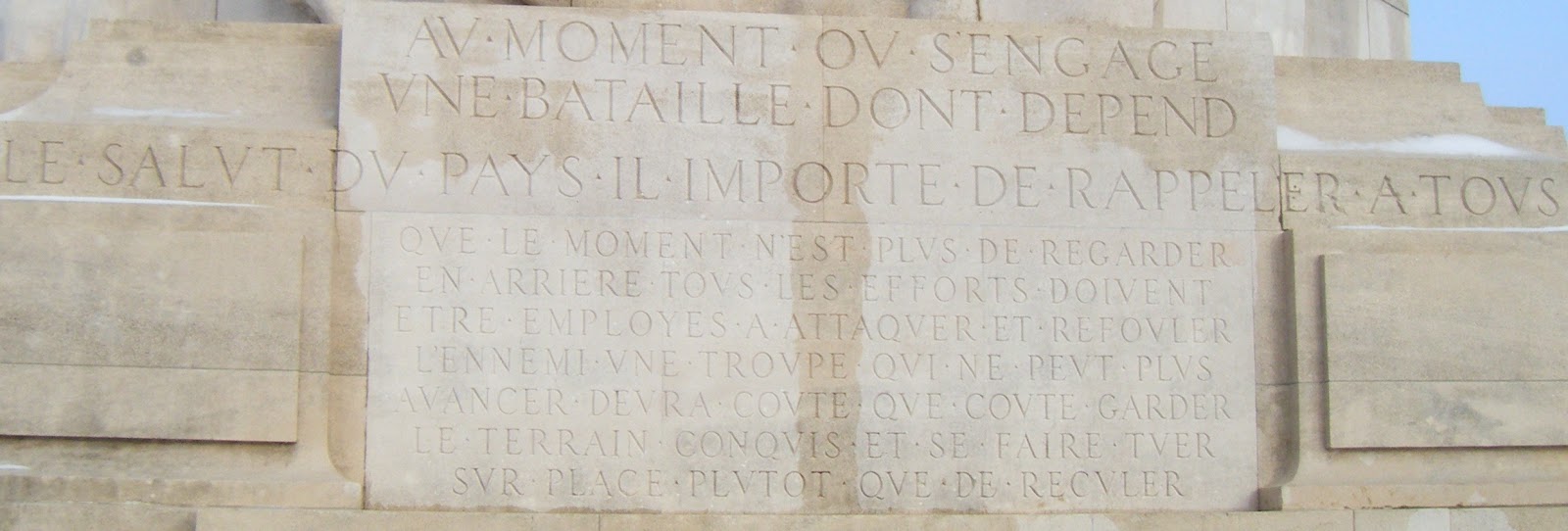
Blood-chilling inscription of the Monument aux Morts at Meaux - see below...
"Au moment où s'engage une bataille dont dépend le salut du pays, il importe de rappeler àtous que le moment est venu de ne plus regarder en arrière; tous les efforts doivent êtreemployésà attaquer et à refouler l'ennemi.
Une troupe qui ne pourra plus avancer devra, coûte que coûte,garder le terrain conquis et sefaire tuer sur place plutôt que de reculer. Dans les circonstances actuelles, aucune défaillance
ne peut être tolérée." Maréchal Joffre
German morale could hardly have been much higher than
that of the French, yet they continued their southerly advance on the city of Verdun
believing that their extensive use of diphosgene gas would enable them to
overpower their last major obstacle, Fort Souville. This strong point had
already been destroyed on the upper level, so on the 22nd June 1916 it was
simply a question of taking the underground tunnels. However, the attack did
not go to plan. The gas had dispersed with little effect on the French defenders
who themselves were then able to annihilate the large concentration of German
infantry heading to the fort by the use of heavy artillery. An additional
aborted attempt on the part of the Germans to capture Fort Souville on the 5th August
appeared to mark a new phase in the battle.
The failure to capture Fort Souville saw a shift in
positions and strategy as the French took up the offensive whilst the Germans
were forced to adopt a defensive approach. The German army was further
disadvantaged by the need to respond to the Allied offensive on the Western
Front by extra sending men and munitions. This was a strategic diversionary
coup set up by General Joffre. By obliging the British war general Haig to
bring forward the intended offensive in the Somme Joffre hoped to ease the
pressure on the Second French Army at Verdun. The conflict commenced on the 1st
of July rather than the initial date one month later. From this diversionary point
of view the opening of the Battle of Somme may have achieved its objective,
although it must be remembered that on the first day of hostilities alone one
third of the British Army soldiers lost their lives.German resources at Verdun were furtherdrained when
troops were withdrawn in order to fight a Russian offensive on the Eastern
Front. The Souville sector was yet again the target of another German assault
on the 12th July, but the mission failed to take Fort Souville from the French.
It was easily apparent that none of Falkenhayn's objectives had been achieved
and his German troops were exhausted, having never left the hell-hole of
Verdun. In August of 1916 Falkenhayn was replaced by von Hindenburg.
Nevertheless this change of commander did nothing to alter the German position.
Tombstone from a Muslim soldier - Douaumont
Following Nivelle's
commands, General Mangin led the offensive that was directed at Fort Douaumont
in order to prise it out of the enemy's hands on the 24th October. The Germans
had already started to evacuate the fort, and the attack carried out by the
Regiment of Colonial Infantry of Morocco was a success. On the 2nd November
Fort Vaux was also evacuated and General Mangin continued his offensive to
reclaim territory that had been captured by the Germans from the outset of
their attack on Verdun. At the closing stage of the Battle of Verdun over 10,
000 German prisoners were captured and Hindenburg saw further retaliation as
futile.
In the mist - headstones of the Muslim soldiers at Douaumont - all facing Mecca.
The hostilities at Verdun ended on the 15th December
1916, 10 months after its dramatic commencement. The outcome; 700,000 deaths,
which is to say approximately 70,000 men slaughtered for each month of battle.
The German losses were only slightly inferior to the French. No strategic advantage
was gained on either side. A commemorative statue of a wounded lion is situated
on the site which marks the furthest point the Germans reached on their advance
on Verdun. Dedicated to the French soldiers from Fort Souville garrison, this
tragic lion is a painful reminder of all that was lost in terms of human life in
order to defend or gain several kilometres of terrain. The Souville lion also
recalls its defiant compatriot in Belfort. The famous Lion de Belfort monument
commemorates the valiant defense against enemy attack in the Franco-Prussian
war of 1870-1. Nevertheless, the sculptor Bartholdi said of his work that "It
is neither a victory or a defeat that it should recall". The tragic
Souville lion can only represent the defeat of all those involved in the Battle
of Verdun.Pétain
remarked of his soldiers;"Their expressions seemed frozen by a wisdom of
terror; they sagged beneath the weight of horrifying memories". The same
could have be said of the German soldiers too.
The very land of the Verdun region itself was twisted,
torn and tortured beyond recognition. Villages were captured, recovered and
captured again, all traces of community and civilisation were choked, churned
up or simply obliterated in the process. This scarred landscape became known as
the Zone Rouge where whole villages and swathes of farmland had been swallowed
up and spat out again by the war machine. Contaminated with corpses of beast
and man alike, rendered toxic by chemical weapons and made potentially lethal
due to unexploded ordnance, the land was uninhabitable and unworkable. A string
of villages disappeared in this manner having "died for France" in a
series of tragic death throes. Fleury-devant-Douaumont exchanged hands 16 times
before it fell silent, and the calm and peace that reigns there today belies
the clamour and frenzy of the past.
A decision to plant trees on an extensive scale in the
1930's means that much of the battleground is tranquil woodland today. The
craters and trenches that were scorched or scratched into the bare land during
the hostilities now appear to be a curious undulations amongst the green
foliage. Occasionally the land returns the remains of unknown soldiers to the
present so that they may leave their burial ground in the wilderness to lay at
rest in the necropolis at Douaumont. The strange form of the ossuary recalls
that of a rounded bunker, or the curves on a combat helmet, with the central
tower rising up like a vertical chrysalis. From the outside, the whole has a
Germanic Art Deco feel which seems sober yet a little menacing in the absence
of all colour except the overpowering grey of the stonework.
Art Deco form of the Ossuary - even more oppressive in the mist...
Through the small
windows looking inside the building are alcoves bearing the skeletal remains of
around 130,000 unidentified soldiers. The interior of the building appears more
like a classic spiritual place of peace and reflection, again in an Art Deco
style. Plaques on the walls and ceiling of the cloister commemorate the fallen,
whilst large black-and-white photos show veterans of Verdun, holding photos of
their younger selves during the war period.
Bell tower - Douaumont
The bell tower can be
visited and offers panoramic views over the former battlefields. The bell
itself is the 'Bourdon de la Victoire' ringing out over this eerie burial
ground at official ceremonies but also seeming to call to the dead, just as the
rotating red-and-white rotating 'lantern of the dead' seems to lead the lost to
a final resting place.
Cloister of the Ossuary at Douaumont
In front of the ossuary,
leading down and away to the distance is the largest French WW1 military
cemetery. The Ossuary of Douaumont was created in response to the public need
of an official commemorative site to house the remains of the fallen soldiers in
dignity shortly after the Armistice. The first stone was laid in place by
Pétain in August 1920.
A monument to the Voie Sacrée was
inaugurated in 1967 to mark the arrival point of troops coming from the rear to
reach the plateau of Moulin-Brûlé, some 8 kilometres from the battlefields.
Monument to the Voie Sacrée.
This final distance had to be carried out on foot and saw thousands of men
trace the same path to the same hellish destination. The monument was erected
by the Fédération Nationale du Train and depicts the intertwined logistics of
road and rail. Indeed, contrarily to what one might suppose, the term 'train' means 'convoy', not simply a railway network. The work was that of a Commercy sculptor, François Barrois, and
the architect Gaston Schmit from Toul.
A curved wall bearing a sculpted frieze
represents the transportation of man, beast, machine and munitions heading to
the Front at Verdun along La Voie Sacrée. This form is intersected mid-arc by a
large vertical obelisk representing the route itself which seems to rise up
both independently and yet intertwined with the horizontal frieze.
La Voie Sacrée
While the
obelisk is massive and rather rugged in its stonework, it is in harmony with
the wall's smoother surface and seems to draw attention back to the human
activity of the frieze. Near its summit the vertical form bears the 'indented
winged wheel' (roue dentée ailée), which is the insignia of the Arme du Train.
In the central part of the curved wall,
behind the obelisk form is an inscription addressed to the veterans of the convoys
- road and rail - "Le train à ses anciens, à tous ceux de la Voie
Sacrée". From this central point two convoys set off in opposing
directions, representing the movement to and from the Front.
The train feeding the Front...
Both are led by a
small group of Poilu soldiers bearing either munitions on their way out to
battle or returning, loaded down with haversacks and leaning on walking canes.
Trucks, a horse-drawn cart and a locomotive feature on the frieze and all bear
the valiant soldiers who had fought, or were going to fight at Verdun.
Returning from the Front on the Voie Sacrée...
There is
no other life form represented here - no trees or plant adorn the frieze of the
Voie Sacrée or detract our attention from the human activity.
Apart from a distracting hum of traffic on
the road today, the calm of the tree-lined setting seems to make the memorial
of the Voie Sacrée even more sober, and the site more serene. The Voie Sacrée was
made a national route in 1923 and symbolic milestones decorated with sculpted
helmets of Poilu soldiers mark out the kilometres from Bar-le-Duc to Verdun. In
2006 the route was renamed the RD1916, in memory of its past.
Above the entrance to the Ossuary of Douaumont
Each year the Sacred Flame from the Tomb
of the Unknown Soldier is taken by relay-runners from below the Arc de Triomphe
in Paris to the Monument aux Morts in Verdun to mark the memorial ceremony of
the 11th of November; Remembrance Day.
Lest we forget...
Ode of Remembrance from Laurence Binyon's 1914 poem; For the Fallen.
They shall grow not old, as we that are left grow old:
Age shall not weary them, nor the years condemn.
At the going down of the sun and in the morning,
We will remember them.
Next year will be the
centenary of the beginning of the Great War. I hope that after all of these
years it will be remembered as a tragic event brought about by the folly of
Mankind, irrespective of nationality. The film that best brings this aspect
home, for me, is All Quiet on the Western
Front. Everyone lost, on every side, in every way...