Far from the beach, but still surrounded by treasure of all kinds just ready to be found, looked at, gloated over, gleaned and swiped or simply created! Here are my latest finds....
Showing posts with label Stained Glass Windows. Show all posts
Thursday, August 15, 2024
Glorious Glass - Sainte-Chapelle...
Having visited Sainte-Chapelle a few months ago, I keep gazing at the glorious stained-glass windows that seem to make up most of the structure and space of its upper chapel. There seems to be so much modern-day ugliness on every possible level today, be that socially, culturally, or politically speaking, that I want to retreat from it all and find solace, peace and pleasure in pure beauty.
How is it possible that such a beautiful jewel could have been created and consecrated centuries ago - around 1248 - and indeed survived to the present day?
Ascending the narrow, time-worn stone steps up from the lower chapel below, which once served as a parish church for those living in the Palais de la Cité, visitors have little idea of just how magnificent this vast glass vessel will prove to be. What must this sensorial experience have been in centuries past, well before eyes and spirits were jaded through an incessant glut of 21st century screen-induced stimulation?
Commissioned by Louis IX to provide a palatine chapel in the Medieval royal residence, to house the sacred Holy relics in the most venerable manner, the upper level of Sainte-Chapelle stands on the lower chapel, in a two-storey design also found in Noyon Cathedral. Constructed in the Rayonnant Gothic style, the architectural design is staggeringly lofty; a tower of light, twice as high as it is wide, sending out a myriad of colour, even under darkening skies.
No supporting pillar obscures the long expanse that leads to the apse at the far east end, where the Holy relics were held in the grand châsse - an imposing reliquary casket - beneath the ornate baldaquin and surrounded by seven bays of towering stained-glass windows.
The west end of the chapel, is dominated by the vast rose window that was created in the Flamboyant Gothic style in the 15th century, with a flame-like design in the stone-work details and enamel-painted glass. The ceiling that runs from east to west above is divided into vaulted sections adorned with dark blue paint-work with rich gold stars...
The apparent weighlessness of the curtains of glass, without the use of masonry walls inside or buttresses outside, is reliant on bar tracery and iron rods and chains that provide tension and support. Furthermore, the pillars employed are cleverly 'disguised' by a series of slender stem-like structures that soar above, thus emphasizing the height as opposed to the thickness of the whole.
At the base of these ribbed columns stand apostles, and you cannot help but wonder what and who they have seen over the centuries! Having witnessed damage and destruction by the fire and flooding visited on Sainte-Chapelle, its desecration during the French Revolution and then disolution in the aftermath, these silent witnesses have also observed the pre-emptive measures taken in WW2, with the windows removed and later returned to avoid damage. Incredibly, two-thirds of the stained glass that we see in Sainte-Chapelle today are the original pieces from the Medieval period, whilst the spire is, in fact, the fifth to have adorned the monument!
Although Sainte-Chapelle managed to survive the social and political turmoil of the Revolution years, by the early decades of the 19th century there were plans to destroy it completely in order to make way for a new palais de justice. Fortunately, Victor Hugo swayed public opinion and Sainte-Chapelle was the object of a vast restoration project that went on from 1840-1863.
Much of the paint-work had to be recreated or restored, along with the sculptures, but models were taken from other monuments of the period in order to respect the original design. Typically, the fleur-de-lys image figures significantly, in reference to the royal heritage of Louis IX to the Capetian dynasty and then the castle of the kingdom of Castile in reference to his mother, Blanche de Castile.
A visit to Sainte-Chapelle is an immersion into an exquisite golden chamber of light, colour and weightlessness that is the perfect antidote to the dark, bland, heavy void we seem to have thrust upon us nowadays, whether we like it or not...
Wednesday, November 30, 2022
Stained-glass Windows in the Heart of Birmingham...
I recently rediscovered one of the most famous sets of stained-glass windows by Edward Burne-Jones 1833 – 1898, within the small cathedral in the heart of Birmingham city centre. I always remember the grounds of this site as being quite atmospheric, whatever the weather, with old dark gravestones engraved with ornate yet now barely legible inscriptions. The stonework of these graves has been worn away by time and blackened by centuries of grime since the consecration of the initial parish church of St Philip in 1715. Even as a child the place felt truly old, overlooked by tall trees which attracted the starlings at dusk that left a dank smell in the air. Far older again than the grand facades of the redbrick Victorian architecture in the city and perhaps more so than the cathedral itself but now I can see how they were indeed very much of the 18th century, when Birmingham began to thrive as the world’s ‘first manufacturing town’. These remaining graves, along with the majestic Georgian and Regency buildings that survived the devastation of the Blitz years and the ravages of post-war urban modernization reflect the years of the Midlands Enlightenment and the Industrial Revolution when industry and trade transformed the Black Country, making Birmingham the ‘city of a thousand trades’. As the population grew in line with commerce, so too did the number of parishes and the obligation to have further administrative centres to cater to the growing congregation’s needs.
Designed by Thomas Archer in an Italianate style, the Baroque parish church of St Philip was named in honour of the benefactor who had donated the land on which it had been built. Not long after the town of Birmingham had become a city in 1889, it was decided to make this existing church a cathedral, as opposed to building an entirely new edifice for the purpose, as was the case in Liverpool and Truro. Of only 45 metres in length, St Philip’s is, as a result, one of the smallest cathedrals in the country, set in the Colmore Row district. Despite its modest proportions, it houses the three vast Burne-Jones windows that have been described as the greatest stained-glass works of all time. I am not sure you can ‘rate’ art in such a way, but these certainly are beautiful pieces, whether they are compared to others or not. When the initial church was enlarged in 1883-84, extending it eastward and producing a full chancel, the large central window required appropriate decoration, and Burne-Jones was commissioned for its design.
In fact, Burne-Jones had been born in Birmingham and baptized in this very church and therefore readily took up the commission. Furthermore, having studied theology at Oxford University and considered life as a church minister, it is not surprising that he accepted to depict scenes from the life and death of Christ. While he is said to have grumbled at the modest payment for the work rendered “ a flagrantly inadequate sum” , so admirative was he of his finished stained glass piece – The Ascension of Christ (1885) – that in 1887 he carried out the design for the other two windows, on the left and right; the Nativity and the Crucifixion, respectively. He later completed a fourth window, the Last Judgement, set in the western part of the church; the baptistry. The four works were therefore carried out over a twelve-year period between 1885 and 1897.
Burne-Jones was one of the founding partners, with William Morris, of the furnishings and decorative arts manufacturer and retailer Morris, Marshall, Faulkner and Co. He worked prodigiously in a vast array of the crafts, including the design of ceramic tiles, mosaics, jewelry, tapestries, and stained glass. I had seen his paintings and drawings well before any of his other work since many of these have been exhibited at Birmingham Museum and Art Gallery for all my life. He was a second-generation Pre-Raphaelite, likewise taking inspiration in Arthurian legend, medievalism and poetry and sharing the movement’s love of delicate, jewel-like colouring. I used to love looking at the elegantly elongated forms of his characters and their strangely serene expressions– especially in The Wizard (1898) and King Cophetua and the Beggar Maid (1883), displayed in the museum. In fact, the same aesthetic is seen repeatedly in his art, whatever the medium, and his work is always populated with beautiful other-worldly figures of men or women, or indeed angels, whether they be on Earth or in heaven. The windows at St Philip’s are no exception, of course, although in their case, there is the added dimension of luminosity, as the light flows in through the intricate panels of vibrantly coloured glass.
Thanks to Burne-Jones the tradition of stained-glass art in Britain was revived, especially in churches and cathedrals, and I was stunned to see just how much of this work he produced in his lifetime. Although the photos I took during my recent visit do the windows no justice whatsoever, the mastery of the glasswork was incredible. The colours, forms and even the leaded cames are all used to create a flurry of movement, either tension or calm, so that the myriad of glass panels swirl above us to great effect. I just wish I could have got a little closer to get a decent photograph - however the link here provides many!
Sunday, November 22, 2020
Sainte-Chapelle....Paris.
As I was hurrying back to the railway station at the end of my extremely brief day-trip to Paris, I noticed the very visible lack of visitors waiting to enter Sainte-Chapelle. Where there would typically be a long queue, snaking down the street, there was nothing. But nothing is typical for the time being and this was indeed the last free day before lockdown. The usual throngs of tourists were largely absent.
This being too good an opportunity to miss, I quickly entered, racing up the ancient, worn steps for fear of missing the last daylight and my train back home! The beautiful stained-glass windows towered above, still jewel-like bright, despite the grey, rather menacing skies outside. Inside the gold arcades and richly-decorated columns glowed against the regal blue. Also visible on the photos are the pale, ghostly apparitions of the visitors' facemarks...
Sainte-Chapelle and the nearby Conciergerie - where Marie-Antoinette was held prisoner until her execution in 1793 - are the last visible vestiges of the oldest palace of the kings of France. They were once part of the Palais de la Cité, the residence and seat of power between the 10th and 14th century, but now form the Palais de Justice.
The first Capetian king, Hugues Capet had set up the royal government and council in this palace at the end of the 10th century. By the time the first foundation stones were being laid for Sainte-Chapelle, the cathedral of Notre-Dame was already much as we know it today.
Built around 1242, the Sainte-Chapelle held the holy relics of the Passion of Christ - the most valued of these being the Crown of Thorns. The relics enabled Louis IX to elevate Paris as it became known as a New Jerusalem, second capital of Christianity.
The edifice is composed of two structures; the upper and lower chapel. The holy relics were displayed in the upper sanctuary, reserved for the royal family and friends while the place of worship below was destined for staff.
Throughout the chapel, the regal fleur-de-lys blooms, recalling the political as well as the religious importance of the site.
A semi-circular apse is at the head of the basilica form, opposite the rose window at the other end of the chapel and the fifteen stained-glass windows that flank the space enable light to flow in, a myriad of colour.
Although the royal family would have had a privileged existence, you cannot help but wonder if they too were astounded by the sheer wealth of beauty before their eyes.
The mesmerizing shock of light and colour from the chapel is made all the more powerful today, as then, by the contrast with its stark exterior, where dark gargoyles peer down from jagged architectural forms that cast a strict outline against the city skies.
Yet these seem to offer a strange sense of timeless resilience; these wonders have survived the centuries, the passage of all that time, and faced all nature of adversity. It felt quite fitting to be there, on the eve of lockdown...
Wednesday, October 16, 2019
Chapelle Foujita - All Things Great and Small...
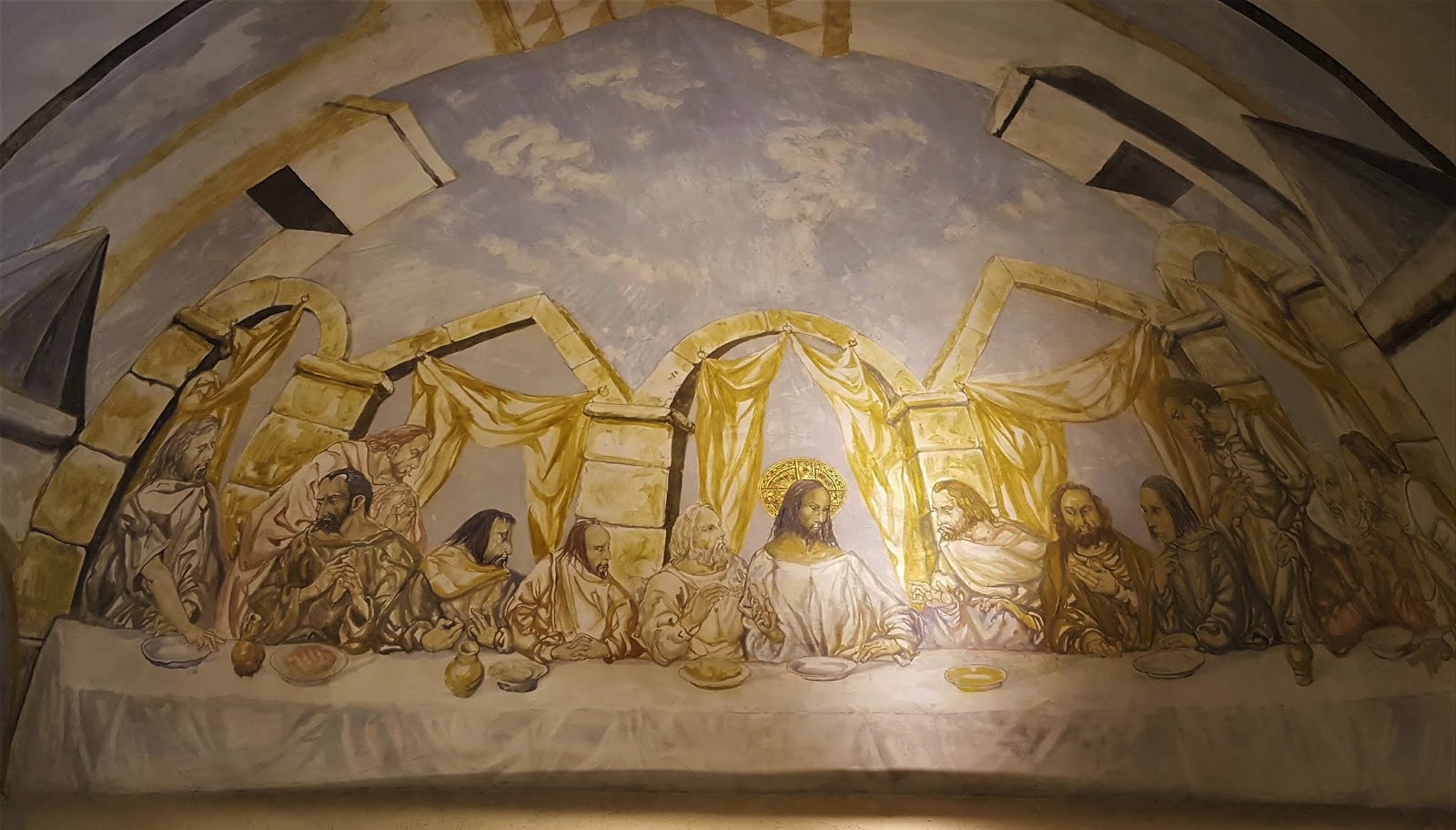
I finally managed to visit La Chapelle Foujita, Reims, before its closure for the year. What a beautiful, bright day it was, both inside and outside this remarkable little edifice, whose decoration was the last project of the Japanese-born artist Tsuguharu Foujita (1886-1968) who spent a large part of his life in the country of his adoption, France.
The chapel, known as Notre Dame de la Paix, was a symbol of his conversion to the Catholic faith and a reference to the message of Peace on Earth issued by Pope John XXIII in 1963, with its emphasis on human dignity and equality.

The Romanesque architectural style of the chapel reflects the desire of the artist to recreate an evocative atmosphere of purity and tranquility, whilst allowing Foujita to express the Christianity that was central to his life in later years. Indeed, following a final trip to Japan in the late 1950s, he experienced a mystical enlightenment in the Basilique Saint-Remi in Reims and was baptised at the Cathédrale Notre-Dame there in 1959, some 60 years ago.
The last years of Foujita’s life were spent in the rural setting of Villiers-le-Bâcle, where a ruined country house was carefully transformed to become home and workshop. Designed to his own specific plans, the house allowed Foujita to devote all his time to his final work – the vast preparation of the chapel.
Far from cloistering himself away in cold, austere surroundings, however, in this deeply spiritual period of his life, Foujita seemed to have taken as much pleasure and inspiration from aesthetics as he ever did. His home, now the Maison-Atelier Foujita (awarded the title Maison des Illustres in 2011), is decorated with a wide collection of artifacts and art that were lovingly picked up during his travels, or designed and fashioned by himself.
These were not selected for any specific monetary value, but were dear to him, satisfying and stimulating the artist’s eye and hand. Thus, furniture, furnishing, crockery, curtains were all confected by this keen craftsman, and found their place next to the eclectic objects and oddities that had caught his eye, such as the door to a Spanish monastery or a Peruvian jar…

As a unrepentant magpie, I find this quality admirable and endearing especially in today’s climate wherein pleasingly aesthetic treasures tend to be dismissed as pointless clutter, so that many homes today resemble bland showrooms for Ikea. Worse still, magpies are made to feel guilty or inferior for their desire to covet and collect…
Already admired for the multi-facetted nature of his talent since the early Parisian years of Les Années Folles, Foujita continued to apply his far-reaching magical artistic and aesthetic touch up to the very end of his life. Referred to as ‘the Lewis Carroll’ of painting by Jean Cocteau, Foujita had been an important figure in the avant-garde art movement, the Ecole de Paris, in 1920s Montparnasse, yet had not limited himself to merely drawing and painting.
Indeed, throughout his life, Foujita continually turned his attention to an array of different activities; engraving, book illustration, sculpture, ceramics, photography, fashion design and the cinema. His very appearance was an art form in itself and his unique style of clothing and grooming made him a highly distinctive, influential figure. The round glasses, earrings, moustache, basin haircut and eye-catching sense of dress left its mark on the café society that artists and writers frequented in the between-war years.
Women were instinctively drawn by his feline grâce, Asian reserve and a certain dandified sophisitication. The name Foujita is often associated with the artists’ model and muse, Kiki de Montparnasse and naturally with the many studies of nude female forms for which he become famous due to the opalescent luminosity of his depiction of feminine flesh.
Nevertheless, his work on cats is also highly valued for its expressiveness and fluidity of the draughtsmanship that convey the softness of feline fur and form. His innate ability to use the rigour and discipline of traditional Japanese linework in drawing and painting was combined with the fluidity and freedom of the Western artists from whom he drew inspiration.
Such influences spanned the centuries – from the great Classicist masters such as his name-sake Leonardo da Vinci to contemporaries like Matisse, Picasso or Modigliani or those much further-afield such as the Mexican muralist, Diego Rivera.
In fact, the chameleon quality of the franco-japanese artist is observed in the extensive body of his work, all of which bears the imprint of the multitude of influences left from his travels, studies and encounters. One constant however, remains Foujita’s love of cats.
Feline forms appear in his work and life, either as detail or main subject, in paintings, drawings, photos and even as a tattoo on his fore-arm. I don’t know if this feline fascination is a particular Japanese trait, as the present-day author Haruki Murakami shares a similar love. Admiration of cats is certainly nothing new in French art and literature – the lives and works of Art Nouveau painter and printer Théophile Steinlen (1859 – 1923) and poet Charles Baudelaire (1821-1867) famously reflect this…
Miké, the stray tabby cat with a protuding canine that Foujita is said to have found around the Parc Montsouris, appeared in numerous self-portrait paintings and photos. For Foujita, this cat as all felines, artfully combined the qualities (often contradictory) that Foujita admired and ultimately embodied himself; fussy and fastidious in grooming yet resistant in hardship, fierce but gentle, both wild and tame, haughty yet warm, approachable yet unattainable at the same time.
![]() |
| Self-portrait in oil paint - Musée des Beaux-Arts Lyon. |
![]() |
| Foujita: Dora Kallmus |
The mermaid plaque at the entrance of the building honours her, and she also figures in a portrait in a fresco scene.
Foujita himself is also presented, as was the commissioner of the work, René Lalou, President of the champagne house Mumm.
The cathedral of Reims, basilica of St Remi and the surrounding vineyards of the Champagne region are also featured.
Throughout the chapel, each decoration – be it mural or window – bears some reference to nature in small but significant detail. Beyond floral decoration, insects, butterflies, fish, warm-blooded animals of all types emerge from the vast surfaces and the smallest too...
Foujita may have devoted his last years to his reverence of Mary, his spiritual beliefs did not exclude the other keystones to his existence, and they actually appear to have embraced these too. Even the small mouse encountered during the painting process and subsequently fed by the artist, appears on a fresco!
The decoration of the chapel was finished remarkably quickly – within two months after the completion of the building itself – with Foujita himself climbing the scaffolding in order to paint his frescos on an area of almost 200 m2. This was no mean feat since he was already advanced in years (80 years old) and would die less than two years later in 1968.
Once started, a mural study would have to be finished that same day which meant that execution of the work allowed for little error or hesitation and demanded deft, light work. The chapel radiates love, light, warmth – even more so when the sun illuminates the natural brightness and colours of the murals and its rays shine through the stained glass, casting beautiful jewel-like colours on the wall and floors.
The people studied are alive with emotion and movement – with expressions and hand gestures that seem inspired by the elongated forms of Mannerism, for example. The eastern-looking eyes however, are unique to Foujita as is the will to include the collection of creatures that look out at us…
This again, is one of the aspects that I probably appreciate the most about Foujita – the fact that any admiration of the animal kingdom does not need to be explained or somehow apologized for. The love of cats, or any other beast, does not make us any less human ; it makes us more humane. Love for life on Earth does not detract from spirituality – in Foujita’s work it is part of its expression.
Subscribe to:
Posts (Atom)