Showing posts with label The V & A. Show all posts

Thursday, May 29, 2025

Sculpted Intricacies... The Nigg Pictish Cross

My last visit to the V&A museum found me back in the Cast Court, gazing in wonder yet again at these incredible 19th century plaster reproductions of originals from centuries past! Standing against the wall, surrounded by the towering casts of sculptures, architectural features and monuments from across Europe, was a relatively discreet sculpted cross slab, dating back to the late 8th century AD. The Nigg stone is one of several fascinating carved stones of early medieval western Europe, created by the Picts who were a people formed by a confederation of tribes from the lands north of the Firth of Forth in what is today Scotland. The Nigg cross is Pictish Class 2 work ie cross slabs and free-standing crosses bearing Christian iconography as well as symbols in relief used by the Picts, as opposed to 'Symbol stones' (Class 1) and crosses without Pictish symbols ( Class 3). The work on the stone is so intricate that it was mind-boggling!
Nigg - from the Scottish Gaelic word meaning 'notch' - is a reference to the indent in the surrounding hills that are found on the north shore of the entrance to the Cromarty Firth. The Nigg cross once stood in the grounds of the 8th century Christian site to be occupied by the parish church of Nigg some thousand years later, in the 18th century. The stone was damaged in the 1700s, with a section lost from the top part of the cross, yet recovered from a nearby stream in 1998 and reattached to the disfigured work. The sculpted design and detail on the cross bear similarities with other Pictish works from the era, including free-standing crosses on Iona, the St Andrews Sarcophagus and the illuminated manuscript; the Book of Kells. The stone is composed of an elaborately decorated great cross in high relief on the front, set against an asymmetrical background of interwoven serpent forms that create raised bosses. On the pediment above the cross is a scene depicting Saint Anthony and Saint Paul being fed by a raven, as recounted by St Jerome. Looking at the sculpted detail, I find myself in awe at the skill from over a thousand years ago, yet charmed by the quirky figures and forms that seem somehow relatable.

Wednesday, December 25, 2024

Peace and Beauty... Assumption of the Virgin

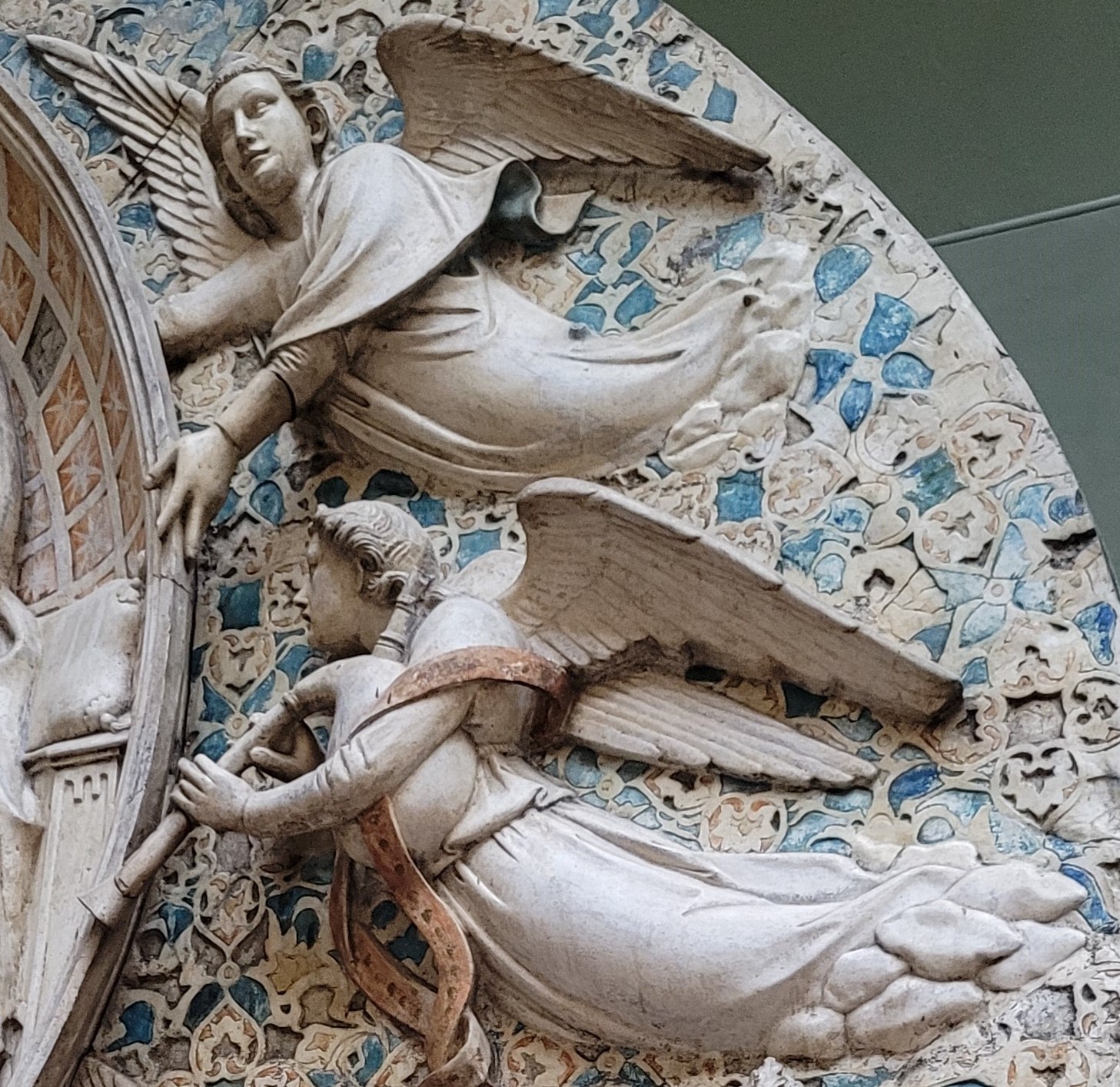
Wondering why I just cannot 'feel' the Christmas mood anymore, be it in France or England, nor experience any desire to spend time trudging around shops, I wandered around the Victoria and Albert Museum for hours instead! Although I failed to recover the festive spirit in any sense whatsover, I did have a wonderful visit, especially on returning to the stunning Cast Courts. This time, the calm and beauty of one of the vast copies on display caught my attention; a section of a Baldacchino (tabernacle) representing the Virgin and angels, in a sculpted depiction of the Assumption. Almost 700 years old, the original work completed in 1359, is set in the Orsanmichele Church in Florence, commissioned just after the passing of the Black Death. The tabernacle structure served to frame a painting of the Madonna (by Bernardo Daddi), but I think it wholeheartedly stole the show! The details of the cast of the carved marble, with intricate features further highlighted by what was originally inlaid gold, glass, and lapis lazuli, creates a uniquely delicate effect that perhaps reflect the influence of the artist's background as son of a goldsmith. The sculptor responsible for its creation was Andrea di Cione - known as l'Orcagna - (c. 1308–c. 1368), and although he was known for his work as painter, poet and, of course, sculptor, his name is perhaps largly overlooked today...
In fact, the Assumption is just one of two scenes represented on the large sculpted relief of the tabernacle for in the lower section of the work is the Dormition of Mary, with her demise. In the upper section, as shown here, we see the Virgin as she levitates within the oval form that is symbolic of sacred figures - the mandorla (Italian for 'almond') - which is grasped by the angels that bear her to heaven. I love the angels' expressions and postures as they busily accompany Mary in her spiritual ascent, their forms floating on the clouds that shroud their angelic feet! Well, after over 4 hours in the museum, my own feet were feeling decidedly unangelic but I felt so elated to see such incredible works that lift you no matter how you initially feel....

Thursday, October 26, 2023

Cast Courts at the V&A...

Over the summer I discovered the Cast Courts at the V & A and whilst I must have visited these lofty exhibit rooms in the past, I had never really considered what was actually on display. As I went around the courts, I was stunned by the size of some of these works, towering above the visitors, and the number of these collection piece, all gathered together to great effect.
I could only imagine how Victorian counterparts must have felt when they entered these spaces - then known as the Architectural Courts - that were open to the public from 1873. It is said that the encounter was comparable to the first sighting of the Mont Blanc mountain in the Alps, leading to "impressions that can scarcely be effaced".
Since the majority of such 19th century visitors were unlikely to have been on a Grand Tour of Europe, with its majestic sights and scenery, they had likewise never had the opportunity to see the great works of art and architects from which the casts were taken.
The courts were initially conceived as part of the Governmental School of Design in 1837, with a collection of casts of ornamental art from across the ages and countries. This was largely in response to a report issued by The Select Committee on Arts & Manufactures in 1835. Therein, significant questions were posed concerning the nation's art, its importance to the individual and usefulness to country as a whole, with regard to the increasingly industrialized manufacturing industry, and more relevantly here, the role art education could play.
Indeed, from the early decades of the 1800s it had been recognized that English manufacturing, although deemed superior to that of other nations, was somewhat 'deficient in taste' in its forms and decoration and that, according to one article in the Illustrated London News , from 1843 "This national inferiority has arisen from our neglect of nature in the education of our ornamental designers, and from a mercenary habit of leaving the invention of our putterns to the accidental, unpaid, and uncultivated imaginations of the poor foremen of factories".
Hence, a number of Governmental schools were established in the great industrial cities of Britain. Whilst the economic success of the land was proven and showcased to international acclaim in the Grand Exhibition of 1851, more discretely perhaps, the School of the Design had marked a milestone in art education and appreciation. Casts were studied in their full dimensions - as opposed to drawings with their obvious limitations - enabling both male and female students to learn from their unique ornamental architectural details replicated from original works dating back centuries to the Renaissance and beyond.
In 1852, the Museum of Manufactures was set up, taking over the cast acquisitions of the School of Design and enlarging the collection since it was now a vital educational tool in the study of art and design. One of its aims was to improve public taste in matters of design and, like William Morris in the Arts and Craft Movement later, to lead the 'application of fine art to objects of utility'.
The collection grew significantly over the ensuing years to include figurative sculpture, with its volume and the size of certain reproductions requiring new rooms for display. When the South Kensington Museum (today's V&A) was created, the museum director, Henry Cole, ensured that the monumental casts were finally placed in the purpose-build rooms that we can enjoy today in their recently-renovated form. The original glazed roofs, ceiling, walls have now been returned to their former stature; the ceramic floor tiles created by Victorian female prison inmates - ironically refered to as an 'opus criminale' by Cole, bring together the whole space.
From 1873, the Architectural Courts displayed the cast collection to great dramatic effect so that pieces could be shown fully assembled rather than laid out in dismembered parts throughout the galleries and corridors. Hence the Spanish 12th century Portico de la Gloria from the cathedral at Santiago de Compostella greets us, as visitors past, to take our breath away by its sheer size and beauty. The spaces were likewise specifically designed to house the vast full-size plaster reproductions of Trajan's Column, towering to 25 metres.
One of the main exhibits in the collection is predictably the cast of Michelangelo's David, his gaze looming over admirers from a 5-metre vantage point. Drawing in the crowds eager for a selfie, with a similar type of hyped fame as the Mona Lisa in the Louvre, David stands proud in all his glory today. Since his arrival in the mid 19th century, he has earned somewhat of a succès de scandale following Queen Victoria's disapproval of his nude form and demand for modesty. An aptly-placed sculpted fig leaf was obligingly positioned to conceal the offending parts from public view...
The skill with which the casts were created largely beggars belief and the fact that these monumental, architectural, ornamental and figurative works are 'mere' reproductions takes nothing away from their artistry. How could such vast pieces be carried out in Victorian times when means were supposedly far more rudimentary than anything we have today? But then that is a question that frequently arises when considering Victorian achievements in almost every field.
The casts were intended to inspire and educate their public, leading Great Britain to attain even greater accomplishments, using the most impressive artwork from other ages and areas across Europe to further jewel the crown of the British Empire. The reproductions reflect the same driving force behind much of the Victorian thirst for culture and knowledge in every possible domain.
Through the quasi-religious study and, above all, collection of artifacts and facts themselves, the Victorians sought to understand and thus master the world around them. In this manner, the very limits of the world were conquered, often using methods and means that demonstrated the very best and worst of human undertakings.
The collection was not, however, safe from the vagaries of time and certainly taste. Already, concern was raised during the acquisiton of the casts in the 19th century, with the fear that the original works would be damaged in the complex casting process of reproduction. Furthermore, changes to the academic study of art - drawing and sculpture - meant that the casts were considered redundant to educational purposes in the early 1920s and were even at risk of being dismantled entirely.
Fortunately, the cast court was maintained and has even gained in importance over time as the original pieces were often destroyed in wartime hostilities, or damaged by the ageing process and the impact of weather extremes, pollution and shoddy or clumsy restoration work.
Finally, the fact that these are 'fake' pieces is irrelevant since they are genuine works of art in their own right and a testimony to the skill and mastery of the Victorian age, which, for all its ills, was capable of marvels.

Sunday, October 22, 2023

Genteel Pleasure; Observing the Tea-drinking Conversation Piece...

On this year’s trips to the V & A and the Tate London, amongst the vast collections of paintings I was drawn to the conversation pieces in their various forms, largely from the 18th century British collection. Characterized by the simple anecdotal quality of their domestic or landscape scenes, with sitters conversing together in small social groups as they share in common activities, these works have a certain intimacy. Whether the individuals portrayed are from the same family, or are friends or members of some group, we catch them in collective gatherings such as tea parties, meals, card games; musical events or hunting. Yet, just as much as we observe them and remark on the often-strange dynamics of the scene, they too look out on us, watching us quizzically or avoiding our gaze defiantly.
This unsettling eye contact, or lack of it, seems to bring another dimension to these works through this odd connection and silent exchange with these figures. Some family members have the same watchful expression, with similar, eerily beady eyes staring out, whatever the age of the individual! Even the horse studies of George Stubbs present magnificent beasts with solitary riders who stare out at us directly in an indefinable manner.
William Hogarth worked in the same genre, and even though his pieces largely pointed to the satire of the given situation and its hapless actors who fell prey to their own shortcomings, this particular eye contact is still present, as seen in his Strode family below. The conversation piece, as indeed the genre of the fictional novel itself, departed from the epic classical themes and forms to focus on the daily existence of the rising mercantile class. Although Joshua Reynolds worked in the Grand Manner, he would do conversation pieces, albeit with vast proportions featuring life-size figures. Meanwhile in France, Antoine Watteau in some ways perpetuated the conversation piece in his fĂŞtes galantes but his characters are typically so engrossed in their amourous antics and caught up in the bucolic scenery that they have little time to waste engaging with us, the viewer! In England, the commissioned conversation piece enabled the rising moneyed classes to indulge in their self-satisfaction at their social position and impress society likewise; the ultimate ostentatious consumption! In the place of the aristocracy’s allegorical allusions to Classical antiquity and its values, was the reflection of genteel contemporary pleasures, focusing above all on those enjoying these activities.
Playing a key role in the conversation piece was the social etiquette that surrounded the ritual of tea drinking. As a genteel social activity, the consumption of tea en famille or preferably with guests was a means of demonstrating social manners, and of course displaying status in society and economic standing. Tea was first introduced to Europe in 1606, when the Dutch established their trade routes to Asia, and a shipment was sent to Amsterdam. In Britain, the rise of the East India Company led to greater imports of such exotic goods and the marriage of the tea-drinking Portuguese Catherine to Charles II in 1662 assured the success of this drink.
By the mid-17th century, tea was thus establishing itself as a genteel beverage in the upper classes. Indeed, Samuel Pepys mentioned it in his diary on Tuesday 25 September 1660, when he was offered a 'Cupp of Tee (a China drink) of which I never had drank before'. As an apparent avid coffee drinker, Pepys was not won over by this foreign import that proved to cost 10 times the price of coffee, although he did laud its reputed medicinal properties. When Thomas Twining, famous tea purveyor expanded his existing store to create the Golden Lyon Tea and Coffee House, he helped change conventions and the role of women. Whilst social taboos prevented the fair sex from entering the typically male domain of the coffee house, women were allowed to shop for the high- quality dry tea offered by Twining. Eager to purchase this fashionable, elitist drink, ladies not only led the craze for social tea-drinking but were at the heart of the tea ritual in the home, when receiving and thus entertaining guests with tea and pretty conversation.
Serving tea was the female prerogative and much importance was attached to the preparation, pouring and ceremony of tea-drinking for this was the perfect way to demonstrate the hostess’s impeccable savoir-faire and enviable social position. As she In turn reflected the power and influence of her husband, only the best would do. Tea was indeed a costly commodity to purchase, and one which also required considerable paraphernalia – tea 'equipage' – in order to serve and drink it in the most fitting manner. The indispensable teapot and tea service had to reflect the excellent taste and limitless means of the lady of the house and therefore, porcelain was de rigueur for elegant cups (bowls) and saucers whilst the teaspoons and sugar tongs would of course have been in silver, perhaps with original designs. Again, women were often given the right to select the family tea equipage and thus expressed their identity through their preferences. All this is apparent in Joseph van Aken’s 'An English Family at Tea' (1720).
To up the ante, a genuine Chinese redware teapot would be used in place of a silver one, alongside a blue-white porcelain tea service whilst the tea caddy, kept under lock and key by the mistress, was typically made of mahogany or leather-covered wood with silver inlay or details in mother-of-pearl or tortoiseshell. In many of the conversation pieces, the caddy has pride of place, in the foreground of the painting, near the hostess... A silver sugar bowl would complete the set and give a final cachet to the whole, all the more so as sugar was likewise an expensive good. The tea table itself was extremely expensive as it was a key statement piece to highlight wealth and taste; usually made of exotic hardwood with carefully crafted legs and inlays designed to impress the guests. Finally, what I found most fascinating in the tea-drinking conversation pieces is that they are almost a mise en abîme; the image of an image of self-glorification coupled with a certain need for validation, in which we play a role too, at a remove of around 300 years! Just take a look again at those enigmatic stares!

Thursday, July 27, 2023

Cast Creatures - Medieval Footrests at the V & A...

Recently wandering around the marvelous 19th century Cast Courts at the V & A, I saw more examples of footrests on sculpted Medieval tomb monuments, from the original pieces copied around Europe.
The gisant figures of the departed lie fully clothed in all their worldly or spiritual finery, with apparel that reflects their rank, religion, wealth and worth.
On the voluminous folds of their clothing rest both hands, joined in prayer on the chest or clutching some spiritual, social, chivalric artifact, or simply crossed on the body.
These notable beings appear to sleep peacefully and in great dignity. Noble husbands and wives repose next to each other yet apart; religious individuals lie alone, clasping a holy script or ecclesiastical object. Knights proudly grasp their sword and shield, their bodies twisted as if ready to spring to action.
Some figures are shown lying on crib-like structures that are richly decorated with sculpted draped cloth, and several are represented in the bright colours that were wildly employed on the stonework of churches and cathedrals alike.
With the exception of a few figures, the majority of the departed are accompanied by a beast, symbolic of their standing; be it a lion, bear, dragon, dog, or unicorn.
Rare are the individuals who have no creature crouched or nestled at their feet or nothing on which to rest their often impressive footwear.
It is more customary to see one or two creatures that look up to their masters with devotion and obedience either from a high-relief sculpted plaque or a 3-dimensional sculptured piece.
The lion, symbol of power and pride, frequently appears next to venerable male figures although not always gazing at the gisant or postioned at foot level.
The king of the beasts is not exclusively reserved for men-folk as women too could be accompanied by the regal lion although in that case the ferocity appears somewhat toned down to the point of docility!
Likewise the dog – representing loyalty – could be shown lovingly guarding over his mistress...
... Or fiercely watching over his master...
In the case of a married couple, both lion and dog would be appear together.
Sometimes the interaction between the beasts is one of domination but at other moments is rather comic...
... Or quite strange...
And finally you have some departed who simply refuse to lie down and sleep, with or without an accompanying animal!

Friday, March 4, 2022

Beastly Goings-on in the Victoria and Albert Museum - The Dacre Beasts...

Whilst in the Victoria and Albert Museum, I came across the following four imposing figures, guarding the steps leading to one of the exhibit rooms of the British Galleries. The Dacre Beasts, as they are known, are the last remaining specimens of Tudor heraldic carving dating back to the reign of Henry VIII. Standing tall and proud at around 6ft in height, the red bull, black gryphon, white ram and crested dolphin tower over the visitors, much as they must have done in their former setting in Naworth castle in Cumbria from the early 16th century. There, the beasts loyally stood below a ceiling decorated with paintings of the sovereigns of England in a sign of the allegiance of the Dacre family to the king, and thus highlighting the Dacre motto: « Fort en Loialte » (Strong in Loyalty). The name Dacre, is said to originate from an ancestor, Acre, who served in the siege of Palestine at the end of the 12th century…
Unfortunately, due to the tightening of financial circumstances in the 21st century Dacre family, the beasts were taken from their noble ancestral home that had been their ‘turf’, so to speak, for almost 500 years. In order to finance the upkeep of the Dacre castle, the descendant, Hon Philip Howard, felt obliged to generate funds through the sale of these historic pieces. Put up for auction at Sotheby’s in 2000, they were bought up by the V and A at a bargain price and are now visible to the public. The image of cattle to market did come to my mind at this point as I learnt of their history but at least they have been preserved, unlike the majority of similar works that have not survived to the present day. But if only they could talk ; what would they say of their change in identity, as one man’s insignia has become a rather anonymous, albeit impressive prize for a museum in the new millennium ? Although we visitors have gained in this exchange – I had certainly never heard of the Fab Four prior to my visit – they are perhaps a little lost in their present setting and may even be experiencing an existential blur.
Not so in the past, when the beasts set in their rightful domain were said to have inspired the illustrations of John Tenniel (1820-1914) for Lewis Carroll’s Alice in Wonderland during the artist’s stay at Naworth. Even those unable to see the actual beasts in flesh and fur within their castle setting would have seen printed works, driven by the Victorian thirst for Medieval imagery, heraldry and that Gothic touch. At one moment in their history, such illustrations were nearly all that was left of these magnificent carved forms when a devastating fire swept through Naworth in 1844, and yet the beasts escaped being reduced to charcoal. Nevertheless, whilst they may have thankfully lived to tell the tale, their current location renders them somewhat speechless and the small museum notice next to them does not tell us a great deal of their story. And what glorious beasts these are !
Carved from a single oak tree trunk by unknown craftsmen at the very end of the 15th century or first part of the 16th, these figures were made for Thomas Dacre (1467-1525), the 2nd Baron Dacre of Gilsland to reflect the dynastic alliance of two powerful families in Northern England through marriage. Indeed, each beast is a ‘supporter’ ; the creature that is shown on either side of the shield of arms. The exact function of the beasts is not known, for although they were apparently used in Dacre’s funeral, it is believed that they were intended to be displayed during tournaments to mark his considerable military skill and valour. Dacre had been a soldier in the last episode in the English Wars of the Roses during which King Richard III was defeated and killed by Henry Tudor in the Battle of Bosworth in 1485. He then went on to fight in the Battle of Flodden against the Scots in 1513, thus earning his reputation of staunch defender of the English crown, with the battle cry "A read bull, a read bull, a Dacre, a Dacre".
Thomas Dacre appears to have been a decisive man of action off the battlefield too, for in 1488 he eloped with Elizabeth Greystoke (1471-1516), a landed heiress. The Dolphin therefore represents the Greystoke family, as it carries the banner which displays Elizabeth’s arms – three cushions of argent – clasped between its decidedly fishy fins. Indeed, I must admit to having great difficulty in believing this was actually the portrayal of a dolphin – it looks more like a sizeable salmon, even given artistic licence ! The ram meanwhile, is the supporter of the De Multon family – from Ranulph de Dacre’s wife – and it bears a banner with a lion ‘passant’(walking with right fore paw raised) with three bars gules (heraldic tincture of red) upon argent (silver). The rather closely-shorn fleece and lack of horns make the ram look somewhat sheepish - not to say lacking in virility - but his very ostentatious male appendage would appear to define and display his ancestral power and position, presumably in a manner similar to (the rather more discreet) portrayals of Henry VIII in the royal portraits of Hans Holbein the Younger.
This same feature is shared by the two other beasts - the bull and the gryphon – whilst the Dolphin must content himself with a crown; fair is fair! The red bull of Dacre bears gilded horns, hooves and tongue in honour of his ancestry and wears a chained crown collar around his neck. He clasps the banner between his cloven hooves, displaying the arms of the Dacres – three white scallps on a red field. The black gryphon is the supporter of the Dacres of Gilsland and bears three rose chaplets (garlands of leaves with flowers) that are the 19th century arms of the Greystoke family. After the fire in 1844, the four beasts were repainted using Victorian colours that sought to recreate the initial tinctures, and the coats of arms were added at this stage. The architect in charge of restoration also saw fit to to gild the bull’s 'pizzle', an act that shocked the Victorian sensitivities of certain visitors to the castle at that time. I fear that the photos here may be banned due to ‘inappropriate content,’ which would be the ultimate dishonour to these fine beasts. Since they were on full public display in the Victoria and Albert, in all their finery, I trust they are ‘safe’ on this post too. How else can we learn about historic heraldry, with or without the infamous pizzle?