Showing posts with label Mythology. Show all posts

Sunday, January 7, 2024

Helleborus Charm...

The end of the holidays and therefore just beofore plunging back into the madness of the working day, what more fitting as an antidote to all of that, than the sight of the beautiful Helleborus? The white Hellebore flower - the 'Winter rose' - is reputed to possess healing qualities in addition to an ability to ward off negative energy. In Greek mythology, the tears shed by the bereaved Aphrodite - goddess of love - resulted in the blooms of white flowers springing up from the ground.
However, it was the red Hellebore that caught my attention, with its typically discreet flower, bent gracefully down as if in modesty or perhaps hiding its face away. Again, it was cited in Ancient Greek mythology, with its name coming from heleîn - 'to injure' - and borá for 'food', since when ingested it could either combat bouts of madness or cause them, depending on the myth in question.
Despite there being various diffent sorts of flowerhead , either relatively plain or ruffled, common to most are the delicate veins traced through the papery aspect of each petal. The fact that you have to contort yourself in order to admire each flower makes the experience all the more special as they play 'hard to get', unlike a typical rose which radiates its full glory plainly and self-assuredly for all to see...

Monday, April 13, 2020

The Search for Sphinxes...


My last trip to Paris turned out to be a half-hearted attempt at hunting down the enigmatic sphinx in its varying forms. This was the beginning of March and meetings and meet-ups had been cancelled, and whilst the city appeared to be functionning as usual, everything seemed to be under a spell - a strange mood and sense of foreboding reigned. Enjoyable as it was, to be strolling around the beautiful historical places and spaces, I knew then I shouldn’t be there and would not be returning for some time.

Château de Maisons-Laffitte in the Yvelines department offers a number of regal sphinxes dating back to the 17th century, in the late Renaissance – early Classicist style. These I had seen in February during a magical visit of a temporary exhibition and their proud sculpted forms made me realise how amazing these figures are and set me on my search for the ellusive sphinx a few weeks later. 
Fontaine du Châtelet - 1808
By then, of course, the Louvre was closed and the 'City of Light' was already under the shadow of something quite dark. Even the Seine seemed menacing, with its abnormally high waters flooding the quais and giving an even more knowing quality to the gaze of the sphinxes that watch over the streets and bridges in the heart of Paris. 

The sphinx looks ahead in an unfocused manner at some invisible force, creating a mysterious, sometimes haughty impression. It is a ‘therianthropic’ creature from Egyptian and Greek mythology - combining human and animal characteristics and physical attributes, in varying proportions. 
Fontaine du Châtelet - 1808 (from photo in 2010!)
United in the whole are four symbols and qualities – the head and bust of a woman (knowledge and insight) the body of a bull (might and willpower), the paws and claws of a lion (daring) and the wings of an eagle (ability to be silent). Like the regal lion figure in mythology, the role of the sphinx is centred on the protection and guarding of the sacred, and it watches over gateways and thresholds to other worlds as a fearsome obstacle to be tackled by the fool-hardy alone.
La Sphinge de Sébastopol - Quai des Tuileries
The first and most famous sphinx is, of course, that of the Valley of the Kings. He sits on his haunches, in front the vast pyramids dating back to Ancient Egypt, situated just outside the sprawling streets of Greater Cairo. Oblivious to the noise and commotion of modern life, the Great Sphinx looks on towards the necropolis as he always has over the millenia. Unlike many of his classical counterparts, he does not have wings and manifestly has no intention of going anywhere, regardless of what civilisation, choking pollution or climate change may surround or submerge him in. He just stares ahead, knowlingly. As the largest monolithic monument in the world, the creature’s massive form was sculpted directly into the bedrock of the Giza plateau, which also served as a quarry for the pyramids. The work required to realise these monuments leaves you in awe…
Château de Maisons-Laffitte
The Great Sphinx incarnates and protects the souvereign power of the pharaon, hence one interpretation of the word as meaning ‘living image of the king’. He is therefore taken to symbolize the close relationship with the sun god Ra - through the attributes of a lion's body - and with pharaon through the human (male) head and pharaonic headdress. Sadly, these human attributes have suffered the ravages of time and human intervention – notably the sphinx’s missing nose !
Château de Maisons-Laffitte
The sphinx took on a rather more participative role in the worlds of Greek mythology. Summoned away from Africa by the Greek gods, the winged sphinx held a reign of terror over the city of Thebes, guarding its entrance and preventing any traveller from passing as an act of revenge for some past injustice. 
Château de Maisons-Laffitte
Thus the sphinx dropped the enigmatic, contemplative aspect for which it was known in Egypt, watching over the gates to afterlife. In Greece, he had taken on the female gender and there was certainly no mystery as to her intentions ; they were clearly murderous!
Château de Maisons-Laffitte
The female sphinx was far more concerned with cleansing the realm of the living with blood than protecting the entrails of the underworld. The word sphinx was thought to be derived from the verb ‘to squeeze’, as in ‘throttle’ and the Greek sphinx duly put this into practice as she pinned down and strangled her prey in the manner of hunting lionnesses. Before putting these hapless beings to death, however, this monstrous creature liked to play with her quarry, just as any other cat. Her own particular amusement took the form of setting riddles that were impossible to solve. The stakes were high ; those who lost the game paid with their lives. Predictably, no one had survived prior to the arrival of Oedipus…   
                                              In response to the question :

"Which creature has one voice and yet becomes four-footed and two-footed and three-footed?" 

                                              Oedipus gave the correct answer ; Man. 
Château de Maisons Laffitte
Unable to accept defeat, the Sphinx threw herself off a precipice, thus showing that she was indeed a bad loser of epic proportion. There were mitigating circumstances to her criminal nature however, since she had been born of the incestuous relationship between Echidna – a flesh-eating 'she-viper' and the latter’s son ; the two-headed dog Orthros.
Unflatteringly, yet aptly referred to as the ‘mother of monsters’, Echidna had numerous fierce offspring, according to Greek poet Hesiod. All of the Sphinx’s siblings (Cerberus, the Hydra, the Chimera to name but a few…) shared similar blood-thirsty traits and all seemed to be involved in the guarding over some realm or another, leading to the same outcome, should anyone dare to enter uninvited or uninitiated... 
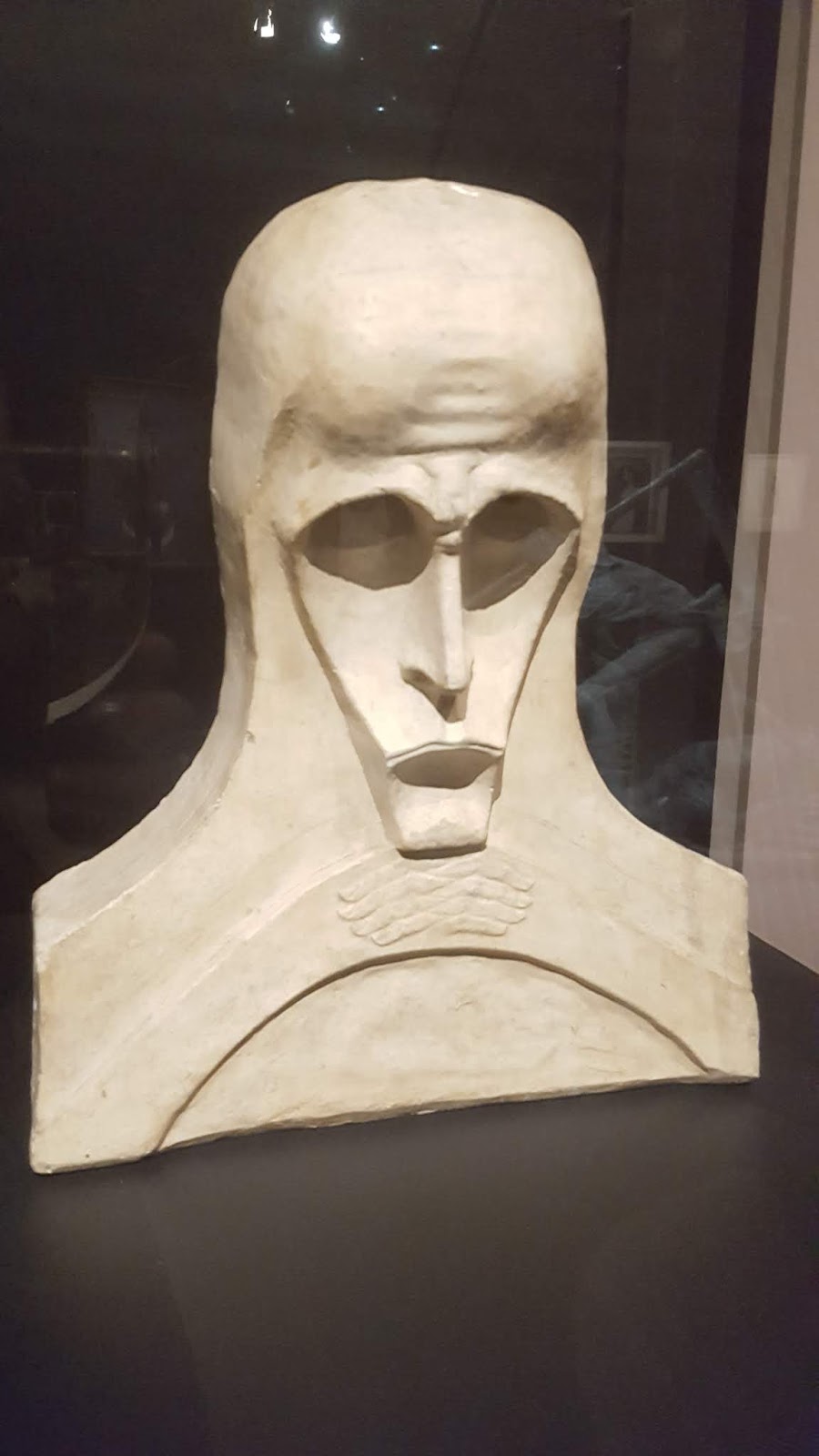
The Late Renaissance beasts of mythology at Château de Maisons-Laffitte are highly refined descendants of the Greek family. The sphinx made its grand entry in French art in the 1520s in the School of Fontainebleau and took up a far more dignified pose than its unruly ancestors. The human head was sometimes replaced by a hawk’s head - Hieracosphinx - or that of a ram – Criosphinx - but still maintained a sense of decorum and order. The sphinx remained a popular figure up until the Late Baroque style of the French Régence at the beginning of the 18th century. It again emerged in its more troubling form in the art of the Symbolists, notably Gustave Moreau (1826 – 1898) and the Polish sculptor Boleslas Biegas (1877–1954). The rather enigmatic, ellusive symbolism of the sphinx has also been employed in the imagery of the Masonic Order.
The Enigma -  Gustave Doré - 1871
And now of course, I will have to wait to go back to Paris and beyond to track down the sphinx in all her various shapes, sizes and forms!
Le Sphinx - Boleslas Biegas - 1902

Tuesday, January 31, 2017

A Solitary Satyr in the Streets of Reims - Les Bacchantes d'Euripide...


I caught sight of this figure from the corner of my eye during my driving lesson but I didn’t dare lift my gaze from the road ahead and thought it was the sculpture of the devil, bursting out from the façade ! That probably says a great deal about my state of mind when behind the wheel, as I still go into freaky panic mode at unpredictable moments. As the road in question is just perpendicular to my street, I tracked down the building to have a better look. Although the character is less diabolical than initially thought, the statue itself seemed to be quite mysterious. This jovial-looking character is set on the angular façade of this post-First-World War building. Like Atlas, it appears to prop up the balcony, yet does so with ease and merriment, surrounded by the vine leaves and grapes. The latter are an obvious allusion to some form of bacchanalia – the ancient Roman festivals that were characterized by boisterous, drunken revelry, and also to the status of Reims itself, at the heart of the champagne region. Why this particular figure had been chosen to decorate modest early-20th century architecture was not apparent. However, as it turned out, the name of the street, Rue Geruzez, was an indicator for the choice of theme.


The building is one of a great many that were erected during the Reconstruction de Reims in the aftermath of the Great War. In this case, the date is clearly indicated as 1924. At this period of rebirth many ambitious social housing schemes - les cités-jardins - were realised. These were destined to accommodate the citizens who had fled Reims during the war years and had found themselves homeless on their return. Many of these quarters still exist today, and their bands of garden and park-squares offer welcome greenery in an ever-expanding urban landscape. Furthermore, there was a certain recherche in the aesthetic design and decoration of this post-war architecture ; much of the work was carried out by men ‘de l’art’. Thus Reims has numerous Art Deco buildings and an ecclectic selection of façade work that means that it really is worth your while to look up as you stroll around the city now, just as much as when these were first unveiled. Unfortunately, such extensive programmes came at a cost. By 1926, the budget could no longer support such demand and construction came to an abrupt end. The inscription Cité Normand, on the façade here, refers to one of the several quarters built for the workers employed in the local factories around the canal area. At first, I wondered if ‘Normand’ referred to the style of architecture that figures on the seaside resorts in Normandy, for example, but in fact, it simply comes from the name of the entrepreneur. Much of the original architecture in this part of town has been lost or altered greatly. The two streets of which this façade forms the corner are a joyless affair. There are non-descript rows of houses that may or may not have been attractive once upon a time, before being stripped of their original features. Then there are the series of blocks of flats, not unlike the one that I live in, that continue to sprout up out of the concrete. Therefore this building, with its last fine Art Deco details, really is a little treasure, set in a 21st century sprawl.


As many of the streets in Reims, this one bears the name of a once well-known writer. In this case, it commemorates the literary professor, Nicolas Eugène Geruzez (1799-1865), born and bred in Reims itself. The satyr we see on the street corner is a reference to one of his works, Les Bacchantes d’Euripide (1832), which offered an analysis of the ancient Greek tragedy of the Athenian playwright. The central figure of the play was Dionysus, god of Greek mythology, also known as Bacchus. Today, we generally think of this figure as a portly, jovial type, draped in animal skins and ivy, ever content to slug back his wine, like a rather inebriated version of Father Christmas. In the same way, his attendants, like this half-man, half-beast, generally look quite amenable too – this one certainly does, with his broad smile. However, the origins of this god are somewhat darker, linking him to the wild, the weird and the wanton. The worship of Dionysus involved rituals that were performed by the ecstatic, intoxicated revelers of the thiasus – his retinue. This was largely composed of bearded satyrs, such as this one, and female attendants, known as the bacchantes or maenads – literally meaning the ‘raving ones’. These would all participate in the Bacchic festivals during which wine would flow freely. The creativity, free expression, mystic revelation, enthusiasm and enjoyment that such limitless imbibing favourised soon veered to something far shadier. Unfettered follies led onto madness, instinctive drives brought brutal acts and excited singing and dancing would slide into frenzied chanting and transe-like states. Far from being gently-flowing female figures praying in marble temples, the bacchantes were bloodthirsty hunters, running wild in the woods, ready to slaughter their prey and devore their quarry raw.


Les Bacchantes d’Euripide demonstrates the duality of human nature as we observe the two facets of Dionysus. Within the play, the cultivated, mystical ‘human’ attributes of the protagonist cohabit with the raging, feral, ‘animal’ aspects. Dionysus is described by the chorus as god of festivity and creativity, yet he appears as a character on stage, driven by ‘mortal’ weaknesses, of anger and desire for revenge. Indeed, he represents duplexity and polarity on many levels. If the free, creative, spiritual qualities of the individual are fully repressed, this will thwart his growth. However, should the untamed, limitless and licentious be given free rein, this will lead to debasement and debauchery. The play of opposites needs to be balanced ; one cannot outweigh the other for extremes will always bring havoc. Throughout the play, we see the intertwining of what is godly and/or human; beastly and/or divine; masculine/feminine; virile/impotent; real/irrational; authoritarian/anarchic; blind/clear-sighted.


Dionysus has come to wreak vengeance upon family relatives, in the place of his birth, Thebes. King Pentheus of Thebes and Agave, Pentheus’ mother, will be made to pay for their slanderous remarks about his line of descent. They deny his divinitiy and yet his blood line links him to Zeus, king of the gods, and a mortal mother – Semele – the sister of Agave. Dionysus survived the rage and wrath of Hera, Zeus’ wife, who wished to eliminate this living proof of her husband’s infidelities. Having being ripped to shreds by the Titans, at Hera’s request, Dionysus was brought back to life, and was born forth from Zeus’ thigh. He was then raised by mountain nymphs and centaurs, which helped him forge a bond with the magical and mystical and to follow the natural cycles of life and death. Dionysus was indeed one of the few gods who was able to bring back the dead from Hades, the Underworld and moreover, creation and rebirth are symbolized by his symbol; the vine plant.
The unwielding refusal of Pentheus to accept Bacchic festivals in Thebes, and thus his blunt rejection of Dionysus as a god leads the revengeful deity to take action. Like a strange Pied Piper, a disguised Dionysus lures the womenfolk into Mount Cithaeron to devote themselves to a cult in his honour. Similarly, the king’s dogged adherence to masculine politics in order to crush this flouting of his authority represents the suppression of his own femininity and leads to his own destruction at the hands of the ultimate female figure; his very mother. The voyeuristic desire to watch the activities of the Bacchantes, including Agave herself, render Pentheus blind to his own reality and unable to see ahead. His retentive nature has given rise to impulses that drive him towards irrational, insane behaviour. Had Pentheus been more flexible, less extreme in his stance, he would surely have survived, but through dramatic guise and performance, Dionysus plans to teach him a lesson. Here indeed is the art of Dionysus being played out to the full, as he toys with the fate of Pentheus, staging the king's death as a ritual sacrifice of the Bacchantes. As we follow Euripides’ tragic play, we too are taught a lesson through watching this god of the theatre as he acts out his life role. To quote this playwright from another of his tragedies, Medea, “Not too little, not too much: there safety lies.” In response to Pentheus' refusal to lessen his tight grip over the status quo, Dionysus meted out the most extreme of punishments; death by the person who had initially given life; Agave. Yet surely Dionysus' cruelty is another proof of the dangers of the extreme? Cadmus - the father of Agave and Semele - remarks to him "We have learned. But your sentence is too harsh". The sentence does not just concern the 'punished', but the 'punisher' too. Slaughter affects the prey and the hunter. It is not clear if Dionysus himself has learnt to read the full significance of his behaviour. It is left to Cadmus to conclude that "Angry gods should not act just like humans." Dionysus seems to have employed the full extremes of the polar opposites within him - he has indeed used his ultimate god-head to wreak havoc in order to satify his mortal emotions.


Perhaps the most incredible aspect of Greek mythology is how relevant its observations on human nature still are today. How little Man has changed over the centuries. I just can’t work out if that is tragic or comic!


Saturday, August 8, 2015

Bayart and The Four Sons of Aymon - La Statue du Cheval Bayart et Les Quatres Fils Aymon des Ardennes...

Statue of Les Quatre Frères Aymon (one hiding!) and Bayart the magical horse.
The forested lands of the Champagne-Ardenne region, with the river Meuse snaking through the valleys, have long been the source of legend and folklore. The most famous of these is that of the Four Sons of Aymon, a tale of great valour in the face of injustice and adversity, and which is one of a number of Medieval chansons de geste, sung or recited by les trouvères (minstrels) in the north of France. Depending on the emphasis given to the key characters, it is also referred to as the ‘Legend of the Knight Renaud of Montauban’ or the ‘Legend of Bayart’, but the main elements remain…


It is not surprising then, that a large monument dedicated to the heroic deeds of the four brothers Aymon and their magical steed, Bayart should be found in the heart of this region, high above the town of Bogny-sur-Meuse, overlooking the sinuous river and the forests beyond. The legend, with its story of defiance, determination and the strength of blood ties seems to symbolize the lands itself, frequently at the heart of strategic manoeuvres in power struggles and warfare. The sculptor, Albert Poncin, received the Médaille d’Or at the Salon des Artistes Français in Paris, 1929 for his statue, Les Quatres Fils Aymon. Whilst it was hoped that the piece would honour its ‘rightful’ lands – placed either in Charleville, Monthermé or Château-Regnault along the Meuse – lack of resources meant that it was nearly erected in Lyon instead. Sufficient funds were eventually raised, but the monument that we see today was only inaugurated in 1950.


Although the statue initially met disapproval due to the stoic aspect of the valiant protagonists of the legend, it seems most appropriate today, as it stands proud and imposing, high above the meandering river. Each character has a particular stance and expression whilst Bayart, with eyes rolling, ears back and teeth bared, seems ready to defend his masters in their fight.


In the legend, the treacherous adversary of the four brothers Aymon is none other than Charlemagne himself; King of the Francs and Emperor. Duke Aymon of Dordonne, vassal to Charlemagne, brings his sons Renaud, Allard, Richard and Guichard to the court so that may serve the king honorably and become knights. Almost immediately, Renaud is granted this honour and given a noble steed to mount, thus inciting the jealousy of the King’s nephew, Bertolais. A fight ensues during a game of chess, ultimately resulting in Bertolais’ death. To escape the subsequent wrath of Charlemagne, Renaud feels, quite accurately, that he must flee the court and hide away until calm is restored. Strong sibling loyalty, and the canny feeling that Charlemagne might somehow stop at nothing to avenge himself of Bertolais’ death, the three brothers accompany Renaud on his flight from Paris. Into the story enters Bayart, the trusty beast, however it must be remarked that this is no ordinary horse.

Overcast skies: Bogny-sur-Meuse - site of the monument.

As the offspring of a dragon and a snake, Bayart is naturally doted with extraordinary physical force along with a conveniently wide range of supernatural powers. Not only is he large enough to bear the four brothers on his back, Bayart is also able to cross valleys and rivers in one leap and swiftly carries them away to the mysterious forests of the Ardennes region. Any attempt by the enemy to pursue the brothers is quickly thwarted by Bayart, and the Aymons soon find refuge in these obscure lands. Here, with the help of Maugis the magician, the brothers build the fortress of Montessor which dominates the Meuse and live safely therein for a period of seven years until the grudge-bearing Charlemagne learns of their whereabouts. Through treacherous acts of cunning, the fortress of Montessor is stormed by enemy troups but all five heroes - Bayard being a key player in the action – escape via a tunnel to seek refuge in the deep forest, yet again. Seeing the fortress burning behind them, Renaud swears that henceforth the edifice shall be known as 'Le Chastel Regnault'.

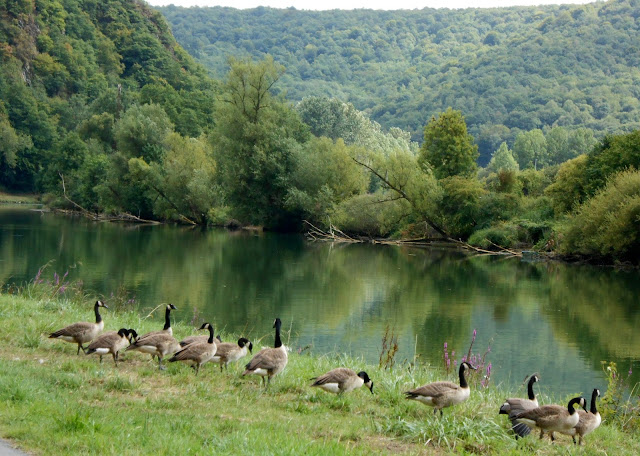
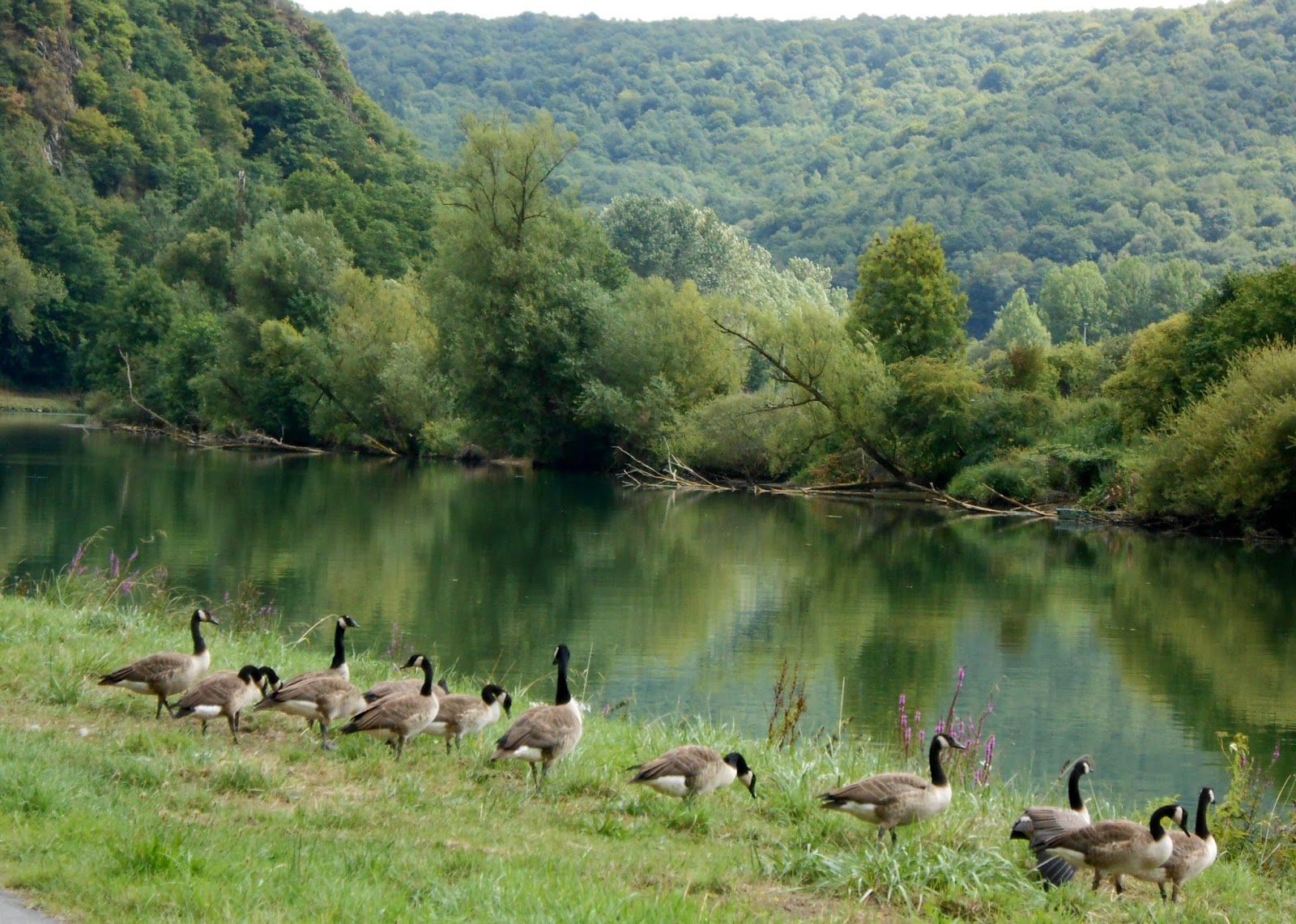
Canadian geese along the cycle paths of the Meuse...
Tired of never-ending flight and wishing to serve a noble cause, the Aymon brothers finally go to the Gascony region in order to offer their services to King Yvon in his fight against the Sarrasins. With the brothers’ aid, and that of the multi-tasking magical Bayart, the king soon defeats the enemy, headed by the Emir Beges. To mark his appreciation and to reward their valiant efforts, King Yvon erects the castle of Montauban, while Renaud takes the king’s sister as his wife. However, the ending ‘And they lived happily ever….’ seems a little flat and unfitting for a legends of such great chilvalry... Furthermore, let it be said that Renaud is not one to retire calmly , and so our hero decides to snub Charlemagne even further.

Fallow herd next to the path...
 Indeed, Renaud does so by going to Paris to enter a competition that aims to find the best war horse possible for Roland, yet another of Charlemagne’s nephews and yet another sworn enemy of Renaud. Thanks to Maugis’ wizardry, Bayart is deftly transformed into a lame nag whilst Renaud becomes an unexperienced teenager. Naturally, both horse and rider resume their normal forms and demonstrate their great prowess, winning the race and earning the prize; the King’s crown. It is hardly surprising that Charlemagne is now even less willing to let bygones be bygones nor that his anger fails to subside with time….

Indeed, pretending to propose a truce, Charlemagne attempts to trick the four brothers who resolutely refuse to pledge their allegiance to their king. With King Yvon’s help, Charlemagne ambushes the brothers in the castle of Vaucouleurs, but fails to kill Maugis who is therefore able to save them in extremis. Returning to the castle of Montauban, the injured brothers are finally besieged by the enemy troops and almost die of hunger. Although they eat all other beasts, the brothers draw the line at slaughtering Bayart, and decide to merely drink his blood. All appears to be lost, when suddenly Renaud miraculously discovers yet another tunnel and off they go on one more adventure.

However the prospect of yet another bout of cat-and-mouse pursuit proves to be just too much for all concerned. And so it is that when Charlemagne eventually sets out the two conditions in his offer of peace, Renaud accepts. The knight must not only go on a pilgrimage to Jerusalem, he must also hand over Bayart back to the king. Thus after years of loyal service to the Aymon brothers, the heroic beast is quietly given to Charlemagne who then promptly orders him to be weighed down with a millstone and thrown in the river Meuse to drown! Surely realizing a little late in the day that the ingratitude and cruelty of humans towards fellow creatures knows no bounds, Bayart kicks off these shackles and leaps from the waters.

One of the weirest tree trunks I've ever seen...
Perhaps not surprisingly, the noble beast is no great hurry to resume his rather thankless service under the brothers and is said to have haunted the forests of the Ardennes ever since, his neighing clearly audible during the night of the summer solstice. As for the great Renaud himself, on return from Jerusalem he decides to devote his life to God and therefore becomes master mason in the building of Cologne cathedral. Sadly, he is never to live a peaceful life on this Earth and yet again manages to incite the ire of jealous individuals who kill him and throw his body into the river. Fortunately, in true legendary spirit, even the very fish of such waters are able to recognize a martyr when they see one and promptly decide to float his earthly remains to the surface, surrounded by burning candles and the singing of angels, no less! From then on, the mere Knight Renaud of Montauban becomes Saint Renaud. And so ends the legend of the Four Sons of Aymon...

Grand Horloge of the Institut International de la Marionnette.
The Four Sons of Aymon are to be seen on the clock tower of the Institut International de la Marionnette (IIM) at Charleville where the Grand Marionnettiste operates his puppets – Bayart, Renaud and his brothers – and each hour of the day is marked with one of 12 different panels of the legend.


To get to Bogny-sur-Meuse from Charleville-Mézières, there are cycle paths along the river Meuse that winds its way through the wooded lands. No sign of Bayart, of course, but the landscape is spectacular and there are touches of the magic to be found in Nature; namely the herd of fallow deer and the light that suddenly floods through heavy skies...


Monday, December 31, 2012

Syrinx by Debussy - Pan's Pipes... Le Flûte de Pan....

Syrinx - Arthur Hacker - 1892
A haunting piece of music was used in a 70's television dramatisation and from the minute I heard it all those years ago it absolutely captivated me. Shortly after that I came across a version of it performed by the flutist James Last, but with time I lost the cassette, and worse still could not even remember the title of the piece in question, despite all my attempts to follow its elusive trail ever since. I did get sidetracked by the fact that the television drama had been set in India, so I thought there was some vital Asian link.
In fact, Syrinx, written by Claude Debussy in 1913, elaborates the ancient Greek myth of Syrinx and Pan and the musicality born from their unfortunate encounter...


Debussy's ethereal music creates a plaintive, soulful sound that is literally enchanting and joyful too in all its magical beauty. It still makes my skin prickle just as it did when I was a child! It is a relatively short piece, of around three minutes in length, which seems to make it all the more haunting because it does not get diluted in any way. Syrinx was unusual for its time (just before the First World War) since it was an avant-garde solo flute performance. Originally called Flûte de Pan, it was intended to provide atmospheric background music to the uncompleted play, Psyche, by Gabriel Mourey.
Faeries -Brian Froud and Alan Lee 1978 Pan Editions
Syrinx relates the tragic end of Pan's pursuit of the nymph Syrinx and the melodious creation that results from this. Son of Hermes and a wood nymph, the bearded, horned Pan was a deity of woods and mountains, symbolizing shepherds, pastures, spring and fertility. Half-man, half-goat, Pan was one of the companions of Dionysus, the god of wine, and wished to pursue his love/lust interests. Despite being a well-endowed satyr, Pan's physique did not meet with much success and he was frequently ridiculed and his amourous advances spurned. He left Mount Olympus in order to try his luck in the rustic beauty of Arcadia, free to roam the woods with his unbridled sexuality. Still repeatedly rejected, the over-sexed goat was prone to fits of frustrated anger which would inspire panic (panikon deima) all around him. Stamping his cloven feet, he would stomp off, ready to vent his frustration in yet another amourous mission only to find his bestial love unrequited and his love interests literally slip between his fingers. Although Pan did manage to seduce the moon goddess, Selene, by concealing his hairy back, this was a solitary conquest. Spurned by the nymph Echo, who scorned the love of any male, Pan had her torn to pieces and scattered all over the world, forever repeating the words of others. As for Pitys, she was turned into a sacred mountain fir tree by the piqued Pan. Turning his attentions to Syrinx, the lecherous goat was to witness another metamorphosis when yet another potential lover fled his carnal advances. As Syrinx was a follower of Artemis, the goddess of chastity, she was little drawn to Pan the phallic god!
Not Pan, but a Scottish Urisk (Faeries - Brian Froud and Alan Lee 1978 Pan Editions)

There are variations to the sequence of events, but Pan chased the fleeing nymph who successfully escaped him until she reached the river Ladon. Finding herself in front of an unsurmountable obstacle, she begged the water nymphs to turn her into water reeds so that she could hide in the marshes.

Unable to locate his prey, Pan was only able to lay his greedy hands on the reeds. Noticing the plaintive notes produced by these through his sighs of desperation Pan cut the reeds down, using nine pieces to fashion himself a pipe to play, only then realizing that he had just killed Syrinx.

From Faeries - Brian Froud and Alan Lee 1978 Pan Editions

Although it was Ovid who first wrote about Syrinx and Pan in his Metamorphoses, but the English poet John Keats (1795-1825) also gave an account.. 
     
... fair trembling Syrinx fled  Arcadian Pan, with such a fearful dread. 
Poor nymph- poor Pan - how he did weep to find 
Nought but a lovely sighing of the wind
Along the reedy stream; a half-heard strain, 
Full of sweet desolation, balmy pain.


So with a haunting melody I'll say goodbye to 2012 - not a great year - and will look forward to 2013!

Friday, August 5, 2011

Serpent staffs, snaky goddesses and serpentine labyrinths...

Caduceus - Façade in Reims
Most of the interesting features of the older buildings here seem to be well-above eye level and so a large majority escape our attention. I was waiting for the bus this winter, and looked up to come across this detail in the town centre, adorning the façade of one of the first department stores here - one of the four Docks Rémois, this one built between 1924-1928 by Pol Gosset.

The detail in question is that of the Caduceus - the herald's staff with two intertwined snakes which I initially took to be a variation of the snake-and-rod emblem, symbol of medicine. This duality of association seems to reoccur in much of the symbolism concerning the snake - the most well-known in Christianity, is of course that of the snake in the Tree of Life in the Garden of Eden linked to the pre-lapsian state of innocence and the fall. However, this was certainly not the first split association/split image. Indeed the snake, dual or solitary is seen in many cultures - one of the oldest double-serpent images represents the ancient Sumerian deity Ningizzida.
The Sumerian Ningizzida

The winged double-snake Caduceus was the staff carried by Hermes, the messenger god in Greek mythology depicted in the Odyssey. Isis, divine messenger to Hera portrayed in the Iliad, also bore the Caduceus and herself was the symbol of dualism as she linked the gods to humanity, criss-crossing the ends of the world, the depths of the seas and the Underworld. However, it was with the Roman god Mercury that the staff took on further meaning. Bearing the staff in his left hand Mercury acted as guide to a somewhat motley crew - shepherds, gamblers, liars and thieves being just a few examples...

The snake-entwined staff thus symbol of Hermes/Mercury was used to represent many trades, occupations and actitivities associated with the gods and with the notion of commerce in general. It is in this latter capacity that we see the Caduceus on many commercial buildings - here in Reims, the building later became the main office of the local newspaper - again in keeping with the symbol which also represented the art of printing.

Caduceus detail - The Louvre - Paris.
A single-snake, wing-less staff is very familiar to us even today, although it has a quite different symbolism to that of the dual snake. Indeed, the two have often been confused as the Caduceus has been used by the U.S  Medical Corps on its insignia. The single-snake form - the rod of Asklepius - is the ancient symbol of the Greek god of that name. Son of Apollo and deified practitioner of medicine, worshipped by Hippocrates himself, his rod was thus associated with all medical issues and healing. The single-serpent figure reflected the duality of medicine with its capacity to both heal or harm, its 'bite' offering both life or death. The very word pharmakon demonstrates this since it could be interpreted in Greek as meaning both healing drug or lethal poison. Asclepius had learnt the secret of preserving life through watching serpents healing each other with medicinal plants, but he was later to be killed by Zeus who did not wish mere mankind to become immortal like the gods. In the Bible, the serpent 's role as healer, bringer or harbinger of death is seen in the Book of Numbers with the image of a serpent wound around a pole, erected  by Moses on God's command to heal ...
"Make thee a fiery serpent and set it on a pole; and it shall come to pass that every one bitten when he looketh at it shall live".
Double-serpent feature - door handle - Reims.
The snake had a vital role in the mythology of Ancient Egypt where serpent imagery and deified snakes abound, reflecting the process of life, death and finally immortality. Wadjet the cobra was the protectress and patron of much of Egypt, its deities and pharoahs. Wadjet's image surmounting the sun disk, uraeus, was the symbol on the crown of rulers. It is thought that this rich Egyptian mythology heavily influenced aspects of the subsequent Minoan culture of Crete which flourished between approximately 3000 - 1100 BC. The most renowned Minoan serpent image today is most certainly the Cretan Snake Priestess statuette (Heraklion Archaeological Museum).

Excavated at Knossos at the turn of the last century by British archaeologist, Arthur Evans, the small faience statue (38 centimetres tall) has led to huge speculation over the years with regard to its identity and exact significance. Since the Cretan alphabet has still to be deciphered there can be no recourse to written scripts to give a clearer understanding of many aspects of Minoan culture - above all, perhaps, the religious rites and beliefs. It is not known if the Snake Priestess statue indeed represents a veritable goddess or a priestess, although as it is a votive offering rather than a cult figure it is more likely to be a priestess. This statue was in fact one of three figures, brandishing snakes, and was surrounded by other religious objects scattered around. As the temple had been greatly damaged during the volcanic eruption of Thera and subsequent earthquakes in approximately 1500BC the reconstructed forms that we know today are based on Evans' speculations and are perhaps not as the originals would have been.


The Snake Priestess herself was found without her headdress and one of her arms, but in the debris certain remains were discovered and by deduction she was reassembled. Even if simply a priestess, the Cretan Snake Priestess is dressed as a deity. Her clothing is decorative and  provocative - the wasp-waisted bodice fully exposes and emphasizes the more-than-ample bust. This is completed by a heavily flounced skirt bearing patterns and sacred symbols and a pelmet focusing on the life-giving forms of the body. It is not sure if the animal form, thought to be a lion cub, that sits on the headdress was originally there, but it is believed to reflect the influence of Egyptian lionness crowns and headdresses. The poppy heads and and pomegranates that border the Cretan headdress are considered to be a reference to fertility and the opiates used in ceremonial practices. Her dark hair hangs long and loose down her back while her expression is transfixed as she stares in front of her, bearing the two snakes in her uplifted arms. It is a striking image - the symmetry of the arms, the geometrical forms of the clothing and the glassy regard leave a vivid impression.
Amid all this calculated guesswork and speculation regarding this particular female there seems little doubt that women in general were of extreme importance in Cretan society, culture and above all, religion. Women dominated the priesthood and in this matriarchal set-up the image of the Earth Goddess, representing fertility and the cycles of life and death was all-important. Like the snake, dual figure of mortality and immortality, rising from the fertile soil, the Earth goddess image seems to link the underworld and Earth.
Theseus fighting the Minotaur - J.E Ramey. 1826. Paris
Women priestresses performed many religious rituals, including sacrifice, often using the Labrys - the double-headed axe. The labrys was the emblem of Royal power and women's importance and its bilateral form referred to the butterfly, itself symbol of the ressurection of the soul. The labyrinth is thought to mean 'place of the labrys', where ceremonial dances and rituals were performed on a unicursal track that induced a comtemplative spiritual state. Like a bee-dance, the labyrinth is believed to have led worshippers to carry out intricate steps and patterns in order to reach an awakened spiritual destination.
Theseus fighting the Minotaur - Ramey. 

Although the vast palace of Knossos was initially thought to have been the site of the original labyrinth of mythology, designed by Daedalus, that theory is now discredited. Born to Mino's wife, Pasiphaë, as punishment for the king's own dishonesty and thirst for power, the half-man, half-bull Minotaur was hidden away in the labyrinth where it lived off human flesh. The cunning Athenian hero, Theseus, aided by his lover Ariadne, finally slaughtered the Minotaur and freed the labyrinth of its resident beast. Even if the labyrinth and its monstrous inhabitant did not actually occupy the palace of Knossos,  the importance of the bull in Minoan culture appears undeniable.

Emblem of the sun and symbol of Zeus, the bull is depicted in many of the artifacts that have survived. The bull would be worshipped, revered, used in bull-dancing and bull-leaping demonstrations and finally sacrificed - with the women and more specifically priestesses, of course, playing a vital role in these ceremonies...
Bull-jumping fresco - Palace of Knossos - Crete


Finally, no duality here, but simply one of the labyrinth drawings by my son who creates fantastic forms and yet receives very little encouragement with his artistic endeavours.
An amazing maze by my son...


Please, any ideas how he could get his work recognized? He was only 13 years old when he drew this piece - so he's got huge (untapped) talent... Any suggestions?
An amazing portrait.