Showing posts with label Insects & Butterflies. Show all posts

Thursday, February 26, 2026

Gorse and Gold....


As Winter was drawing to a close, I idly pondered over the question as to why so many early Spring flowers seem to be yellow in colour - and then asked myself why I had never wondered about this point before! Apparently this is typically down to evolutionary adaptation, since such early flowering plants need to attract as many of the few pollinators that are available in the harsher, shorter daylight hours.

Yellow offers a distinct advantage as it is clearly visible and stands out against drab vegetation and undergrowth. However, it should be remembered that the human eye is unable to detect the same colour range as insects to the point that those with compound eyes make out colouration that does not exist for us! Not only that, but the production of yellow pigments - principally carotenoids - do not deplete the limited energy reserves of plants just emerging from the Winter months thus enabling them to thrive.

Beyond that, there is naturally very little physical resemblance between the wide selection of yellowing flowering plants, but each has its unique charm that is synonymous with Spring. The clusters of Lesser Celandine border the banks and hedgerows, with heart-shaped leaves of such an incredibly vibrant green. The flowers with their bright, lacquer-tipped petals marked with the same polished finition as the Common Buttercup, are set to burst open during the sunlit hours before sealing up at dusk. 

How different is the Primrose, with its pale rounded petals surrounded by a rosette of elongated leaves whose furrowed, puckered texture reminds me of a strange cow's tongue...  

The perfume of many of these flowers - when present - also bears a strange scent that is not typically floral. Gorse flowers are said to smell of coconut, wild daffodils have a curious powdery perfume whilst primroses release a light honey tone and as for celandines, well, I will have to check those! In the meantime, it is enough just to look at all those different shades of yellow...

Sunday, June 29, 2025

Wonder and Warmth from Lantern Light...

During a recent return trip to the Tate Britain, I was yet again almost inexplicably drawn to three specific paintings, much as a moth to a flame. Painted between the end quarter of the 19th century up to end of the first quarter of the 20th century, these works have very little in common, apart from their respective representations of the irresistible glow emanating from lantern light. From there, the 'moth effect' operates, as the visitor is mesmerised by the visual effect that almost becomes a physical sensation, radiating a restful warmth of wonder. The first painting shown here, A Fishergirl's Light (1899), by an Austrian artist - Marianne Stokes (1855-1927) possesses a quasi-mystical air with the female figure shown in striking profile against a seascape of muted colours crisscrossed by the nets and sails of the fishing boats. She glances down, as if in prayer, to the glowing painted paper lamp she holds in her clasped hands, leaving us to ponder over the significance of its religious character. Another lantern illuminates the fishergirl's back as with the beads and crucifix of a rosary strung over the bow of boat. The collective lantern light picks up the warmth of the girl's face, neck and hands, offset by the stark crisp white of her coiffe headdress.
The second painting here, is the work of John Singer Sargent (1856-1925) that ensured his success when he arrived in London from Paris; Carnation, Lily, Lily, Rose (1885-6). The glow of the lamps draws both the girls and us likewise into the garden scene, with a sense of childlike fascination with the play of light of flame on paper. The girls in their starched white clothing are caught in the twilight, patchily lit up by lanterns and surrounded by convoluted flower petals and the darker carpet of stalks as night starts to fall. The effect again is peaceful yet with a slight tension as the opposites play against each other...
Pastoral, painted after the First World War in 1923-4 by Frederick Cayley Robinson (1862-1927), offers a wistful image of peace with a family group set by a meandering, moonlit river. The air of timelessness is highlighted by the lack of direct cultural references or realist narrative, as the figures stand by their sheep, the father bows his head, thus overting his eyes; the mother holds the lantern down to light up the lambs, whilst the daughter gazes out at us from the silver birch trees. By their feet, moths gravitate towards the lantern, caught in the light...

Saturday, April 29, 2023

The Enduring Beauty of the Butterfly...

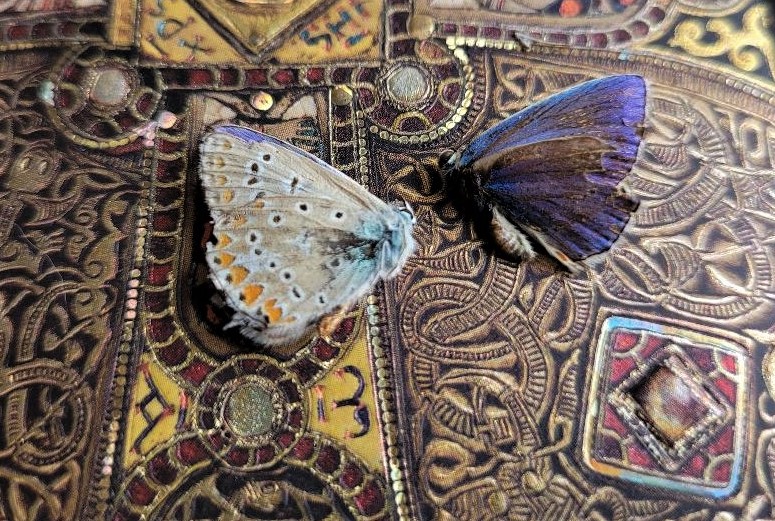
As Spring wakes up, it is magical to watch the different forms of life likewise emerging and to think about those which will soon make their appearance, however fleeting, as the months go by. One of the most magical of these has to be the humble butterfly.'Humble', as they once seemed such a familiar sight, yet these modest, little creatures of great beauty now appear to be getting rarer and their delicate presence can no longer be taken for granted as a staple of the sunnier months of the year. All these specimens here below are precious finds - found dead, I should add - that date back years and decades even. Although some of these - the Red Admiral, Peacock and Tortoiseshell - are still to be found in the wild, I wonder if they are commonplace today?
Clouds of butterflies fluttering around flowering plants and bushes were truly mesmerizing in my childhood but now I have to content myself with my old, tattered collection! Some of my butterflies are now over forty years old, but the magic endures. How can Nature be so perfect? Of course such perfection and the magical metamorphosis that leads to the emergence of such beauty have always fascinated Man and given rise to mythological and spiritual beliefs that have intertwined in such a manner that even pure logic and the rationality of science cannot dismiss. Even today, many people believe that the butterfly has some rather 'other-wordly' significance to the extent that a specimen that suddenly wakes up in Winter must surely represent someone or something 'other'...
In fact, the full life cycle of the butterfly, from the order of Lepidoptera (from the Greek 'scaly wings') is seen to reflect Man's transformation from earthly to spiritual Life itself, commencing with the caterpillar that symbolizes the ties of our physical needs. Following this comes the seemingly lifeless chrysalis phase, referred to by the Ancient Greeks as nekydallon, meaning 'the shell of the dead'. Indeed, the creature lies dormant in this sarcophagus which will finally split open to reveal the fully-formed adult within; a butterfly ready to unfurl its wings and fly free of all the physical binds of life. Again, this transformative stage is drawn upon in Buddhist belief; 'What the caterpillar perceives to be the end, to the butterfly is just the beginning'.
Set free from an earth-bound existence and mortal death, the body breaks away and upwards, soaring to the heavens. Not surprisingly, the word for butterfly and soul in classical Greek is psyche; the soul of the dead. Anima is the Latin word for 'soul' and 'breath', with the air-borne butterfly coming to symbolize the soul’s exit from the body.
The ancient myth of Psyche and Eros signifies the soul, the butterfly and divine love that must endure the hardest tests before attaining unity and immortality. It is based on the fable of the Latin prose writer Apuleius, from The Metamorphoses and tells of the trials and tribulations that this beautiful young mortal girl must undergo in order to be with her beloved Eros. Having drawn the ire of the Goddess of Beauty, Psyche is set on a long, convoluted journey that is both hindered and helped by various different gods - Aphrodite, Apollo, Zeus, Zyphyr, Persephone and Hermes being just a few who figure in this meandering tale...
Punished for her beauty by the jealous Aphrodite, Psyche is sent on a mission to the dark abyss of the Underworld before falling into a state of permanent sleep until she is eventually brought to life again by one of Eros' arrows. Finally given ambrosia, Psyche is granted immortality as winged goddess of the soul and from her union with Eros was born Hedone, the goddess of pleasure. Strangely enough, I don't think I was even familiar with this particular myth, and yet it was a source of inspiration for much later works of literature and flights of fancy such as the fairy tale of Beauty and the Beast and likewise Shakespeare's A Midsummer Night's Dream.

Monday, February 27, 2023

Butterflies and Beauty from your Fingertips...

Walking home last night, the fading light behind the strangely pollarded trees outlined the spidery boughs with the silhouettes of their spear-like branches and forceful buds, fighting against the cold in order to burst out for Spring. This reminded me again of the painted fairy-tale scene that my aunt had worked on about 70 years ago. While the image itself is quite intriguing, with its eerie atmosphere as the delicate dancer performs her arabesque - her features so similar to a Aubrey Beardsley drawing - the volume of her gown mesmerizes and draws you in as the lustrous crumpled satin catches the light and makes it glow.
That magical iridescence is of course from the butterfly-wing background that creates a mesmerizing effect unlike any other. Although I would not wish to endorse the trade in mounted butterflies and insects, I did recently acquire a beautiful framed Morpho 'Menelaus' at a local antique market using the flawed reasoning that as I did not buy this specimen first-hand from a shop, my act is not quite as condemnable. Its bright blue wings, bordered in black like the framed picture, catch all and any light, giving a strange metalic sheen and density to their papery substance in a almost contradictory way.
Meanwhile, my aunt recently showed me some of her other work that pre-dates the butterfly piece, when she was just 18; watercolour and oil paint miniatures set in a gold pendant and a brooch.
One is a Pompadour courtesan in her flowery finery - with features quite like those of the butterfly dancer - and then the other, based on a Gainsborough lady, dressed in her flowing dress as a dog prances at her feet in the English countryside. Even after all these years, the delicate paintings are still intact, even though the watercolour has flaked a little. These reminded me of the Elizabethan portrait miniatures, one of which can be seen on this beautiful painting that I happened to see this weekend at the Tate gallery in London.
And so what has my aunt been doing over the decades? Well, she has continued to produce beautiful art that has been exhibited in galleries in Birmingham and London, although perhaps her moment of glory was shortly before her 90th birthday... Her version of Vermeer's Girl with a Pearl Earring - Bubby the dog - led to her acceptance in the Summer Exhibition at the Royal Academy. Just goes to show, there is no age for creating beauty - it is in the eyes and fingertips!

Wednesday, August 24, 2022

Jewelled Butterflies, Beetles, Bees and Dragonflies...

After several months' delay, the butterfly mobile is finally performing its fluttery dance in the draughts of air, beads glinting in the sunlight as the papery wings turn in the breeze. Hanging suspended from my ceiling, the butterflies surely feel disoriented as they spin, as yet lacking antennae, but weighed down by their crystal beads just like an entomologist's mounted specimens, captured in a dizzying eternal flight.
Making this latest version of the mobile led me to reorganise the first one (above) that I made around ten years ago, its paper napkin base surprisingly resilient after all this time. As I still have a number of butterflies left over, I will certainly make another mobile, yet again giving into my weakness for all insect forms.
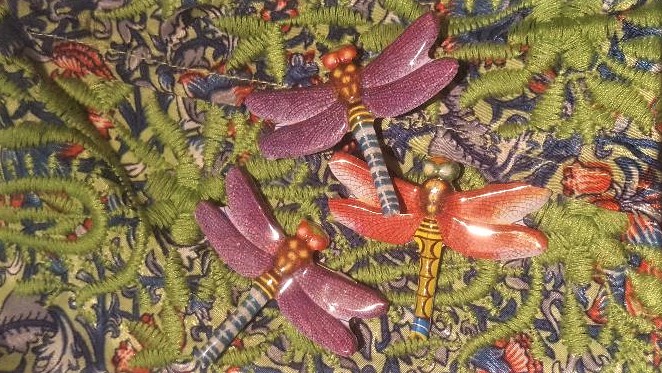
As a child, I remember seeing antique insect jewellery that so mesmerised me that over the years I went on to build up my own collection in the form of brooches, necklaces, earrings and bracelets. Although dragonflies are the main specimens in my hoard, butterflies, beetles, bugs and bees came along too, sometimes worn or otherwise laid out as curiosity cabinet treasures.
My first dragonflies were simple tin Chinese pinbrooches that I loved - and I was recently delighted to discover that they are still in production some fifty years on! Whilst my first childhood pin dragonflies came from England, my last one came from Marseille, no less. I couldn't resist buying another as it gave me such a strange time-warp experience.
Others, meanwhile, are a little more elaborate and seem to have art nouveau inspiration. Above is a beautiful necklace that I was surprised to find in a UK high street store at a very cheap price... I didn't hesitate to snatch it up, suffice it to say.
The dragonfly bracelet was made by a jeweller here in France who produced such delicate pieces for sale on the art and culture fairs prior to her retirement... I was lucky to catch this specimen and have fond memories of wandering around les Fêtes Johanniques were I ensnared it!
The copper cricket was a distant present from my father, made by a friend of the family, and has been a faithful companion to many an item of clothing since then.
My bees all have special memories attached - from time spent at home in Cornwall when my children were young; a magical trip to Amsterdam last year with my son and then a special visit to Spitalfields where the tiny bee pendant stood out from an array of goods on a market stand on a cold autumn day when the magic of Dennis Sever's House was still buzzing in all my senses.
The ladybird and beetle pinbrooches were more odd high-street specimens, sold for a few centimes, as were my insect earrings that have been my jewellery staple for the past 15 years and have accompanied me through some chequered moments in time but we have got through to the present day, albeit a bit tarnished and worn!
All that glitters is not gold, but who cares? These rather ostentatious creatures all came from a lovely little shop in one of my favourite passages in Paris that sadly closed in the aftermath to Covid. Their showy bodies hold precious memories of Parisian day trips.
And finally my butterflies; the first being a present for my 17th birthday from a friend who is coming to visit me here in Reims this coming weekend and might be a little taken aback to see the enamel brooch still in my possession, even if the pin needs repairing.
This tiny bewelled butterfly brooch was brought back to me from Colombia a few years ago and its delicate enamelled wings are intricately decorated with tiny marcassite stones.
My rhinestone butterfly is a prized possession but its sparkling abdomen reminds me of a large tear drop and indeed the brooch comes from a tearful time that I have now thankfully left far behind me so that its pretty form is now set out amongst other magpie stashes...

Tuesday, May 31, 2022

Butterfly Ball...

End of the month, and this project has certainly not taken flight yet! Having being grounded for the last few months, I now hope that these butterflies will soon be up, dancing in the slightest breeze and glinting in the sunlight...

Wednesday, April 15, 2020

The Thieving Magpie...

Deyrolle window display - Paris
The chattering goldfinches have not yet appeared in the streets below, and I never do manage to see any magpies from my window but I did steal a photo of this feathered beauty a number of weeks ago from the window display of Deyrolle, Paris.


Deyrolle window display - Paris
Photography is banned inside this incredible shop, but maybe tolerated from outside... The combination of jet-black magpie feathers with their midnight-blue reflections and the dazzling iridescence of the Blue Morpho wings drove to my act of felony...

Thieving Magpies in various forms made me think of Marillion's album and got me listening to the music I loved back then. Who stole all of those years? Actually, I only initially got into Marillion because of some boyfriend who stole (and broke) my heart  - or so I thought at the time - but at least he left me with a parting gift which has endured the passage of time. I felt he had killed me off back then, but no... And the music lives on some 36 years after his crime! I used to play this track very loud, thinking about him.... Assassing. 
         
               Never saw the ex again!  Years later I did get to see Marillion in concert though. Great!


And just as an after-thought for the strange Easter we have just had, here is Marillion again - singing Easter.


Saturday, September 21, 2019

In Harmony with Insects - Anima (ex)Musica...


This summer I was curious to see what an exhibition of arthopods in a ‘utopic bestiary’ would entail. Insects, arachnids, myriapods (and crustaceans) belong to this phylum and several imaginary specimens were on display for a few weeks to coincide with the annual classical music festival – Les Flâneries Musicales. Indeed, to celebrate the 30th year of the Flâneries were some of the most cunning creepy-crawly creations ever seen! These were beasts composed solely of the parts of old discarded musical instruments which had undergone the strangest metamorphosis in shape and substance.


Here was a collection of creatures which blurred the boundaries between the worlds of entomology, the plastic arts and music as they moved their long, spindly jointed limbs to produce curious clicking noises as they stretched, undulated, pivoted and shuffled. The most animated and striking of these were eerily displayed in a darkened room, with light projected onto the forms of these breath-taking protagonists.


Large transportation crates were also on show, just as if these were exotic, rather dangerous show animals. Inscribed alongside their images were not only the physical  precisions  – width, height, length and weight -  but also lists of the musical instruments that had been used to give body to these unusual beasts.


Parts of violins, organ pipes, tubas, trumpets, trombones, metronomes, cellos, clarinets, cornets, pianos, pianolas, accordions, zylophones, harmonicas, harpischords, guitars, drums, doublebasses, banjos, bagpipes, bells, string bows, synthesizers and speakers were cleverly recycled to emerge as exoskeletal anatomy. Heads - complete with eyes, antennae, feelers and mandibles - abdomens, thoraxes, wings and jointed appendages took on a whole new dramatic dimension!


Presented on their impressive, sizeable stands were a tropical centipede, giant cigale, Colorado beetle, stag beetle, oil beetle, bug, woodlouse, spider and grasshopper - all given the collective name of Anima(ex)Musica. These are all fascinating representations of the animal kingdom on a very imposing scale but become all the more intriguing as you try to identify the difference components.


Suffice it to say, this exhibition would probably not attract many arachnophobics or indeed anyone with a pathological fear of insects – termed entomophobia. Most people seem to have an instinctive dread of any encounter with a wasp or, to a lesser degree, bees, and their response is generally rather excessive, largely inappropriate and wholly ineffectual. How many times do you risk getting stung due to the dramatic swatting and batting of some third party whose actions only goad the hitherto inoffensive creature to exact revenge on the nearest flesh?


Incidentally, wasp phobia is known by the striking term spheksophobia (derived from the Greek form of wasp – spheco), whilst myrmecophobia signifies the fear of ants; katsaridaphobia is the fear of cockroachers; skathariphobia – the fear of beetles; lepidopterophobia  - the fear of moths and butterflies; scolopendrphobia – the fear of centipedes; orthopterophobia – the fear of crickets; apiphobia – the fear of bees and perhaps the most ‘logical’ of fears - that of mosquitos – anopheliphobia. 


The artists behind the creation of these insect exhibits are perhaps not entomophiles per se, but they certainly understand the importance of these tiny giants. The phylum Arthropoda, is the largest in the animal kingdom with arthropods alone representing 80% of living creatures. Nevertheless, they are generally much maligned and largely misunderstood. The trio of creators – collectively known as Tout reste à faire – have endeavoured to take us into a realm that is usually overlooked since the actors in this theatre are literally too small to scrutinize and are considered to be of little true worth. And yet it was Einstein himself who is said to have warned us that should bees be eliminated from our planet, Mankind would soon perish…


Over five years, Vincent Gadras, Mathieu Desailly and David Chalmain have studied entomological anatomy in order to « make visible the invisible », using the anatomical parts of old musical instruments that are likewise, little known and rarely held up for observation. How often are we able to study the intricate mecanisms and intimate mechanical parts of the instruments that generate the music that surrounds us? Furthermore, this musical recycling also enables the arthropods to find a voice – literally – as they emit strange noises when exposed to the steady flow of exhibition visitors.


The fact that the artistic creators requested the general public to donate their unused and unusable musical instruments by depositing them at the Conservatory of Music in Reims also generated a certain by-word-of mouth ‘buzz’ (sorry !). Finally, Tout reste à faire make clear the aim of this project: to halt the elimination of these tiny creatures that play such a huge role in the eco-system.


Sadly, I have to admit that there are a handful of creatures that I would like to see a little less of in the small universe of my flat and balcony. Insects, bugs and butterflies have come and gone over the months here, but in view of the tattered state of the leaves of the potted plants on my balcony, I feel sure that the vine weevils – beastly black beetles - are still actively feeding on my potted plants during their nocturnal raids, emerging at dusk to reap havoc on foliage and flowers. These resiliant creatures are now simply biding their time, lurking under leaves, fattening themselves up for a egg-laying blitz as they burrow under ground. Once this preparation has taken place, the harm will occur far below the soil surface during the overwintering stage as emerging larvae promptly set about gnawing and boring away at the root systems of my long-suffering greenery until ready to emerge as fully-formed evil weevils next Spring.


An incredibly resistent being, the weevil must be one of the ultimate banes to any gardener since this uninvited guest is unlikely to abandon its host environment, even with the greatest encouragement to do so. They must surely be an example of evolutionary perfection – fit to thrive – and their ultimate sign of defiance is the fact that the female does not need a male to reproduce and can lay hundreds of eggs in one session…


Beetles and bugs are often confused for one another – or are simply referred to as creepy-crawlies and then grouped with spiders, wasps and itchy things as globally-acknowledged unpleasant pests. However, there are distinct dfferences between the two. Bugs, from the Hemiptera order, have sucking mouthparts with piercing ‘stylets’ to feed on sap or nectar. They also have membrane wings, and undergo incomplete metamorphosis to reach their adult phase.


Beetles, of the order Coleoptera, have three distinct body regions – head, thorax and abdomen – in common with all insects, yet these are not necessarily visible when observing from the beetle from above. Transforming from the larval stage to adulthood, the beetle has a complete metamorphosis yet the constant feature throughout each step of their lifecycle appears to be their formidible appetite, aided by munching mouthparts. Powerful mandibles allow the beetle to devour plant or animal substances, as l have learnt from experience and considerable expense. The vine weevil has a strange ‘snout’ arrangement, but that does not make it any more endearing, I have to say.


Meanwhile the other beetle type in this household - the carpet variety – is equally maligned due to the voracious feeding of its larvae – commonly referred to as the ‘woolly bear’. Very little to find cute or attaching in this specimen either – especially once it has pock-marked clothes or any article of animal origin (feather/fur/felt/hair etc), having grown tired of its staple diet; dander.


In common with most adult beetles, the carpet beetle has elytra – hardened forewings that form a shield to cover the membranous hindwings when not used for flight. As the remarkably small adult beetle flies innocently about your home space, it is initially hard to associate this will the greedy grubs that cause criminal damage in the dark recesses of your wardrobe. Just like the vine weevil in your garden, the carpet beetle is devilishly hard to part company with, once it has taken residence in your home and the liquidation of larvae and the bashing of beetles will take up a considerable amount of your time in. All is fair in war, I have no qualms here and take no prisoners.


It seems unjust that spiders should get such a bad press when they do very little damage, destroy insect pests, and spin amazingly beautiful, intricate webs. I had a close encounter with another type of weevil earlier this month – in a Goldilocks moment. « Who has been eating all my porridge ? ». In fact, the offenders were almost eaten by my good self as I mistook the small dark forms in my rolled oats for Chia seeds – until I noticed how they were crawling about my cereal bowl. I resolved there and then to wear glasses for future breakfast preparations!


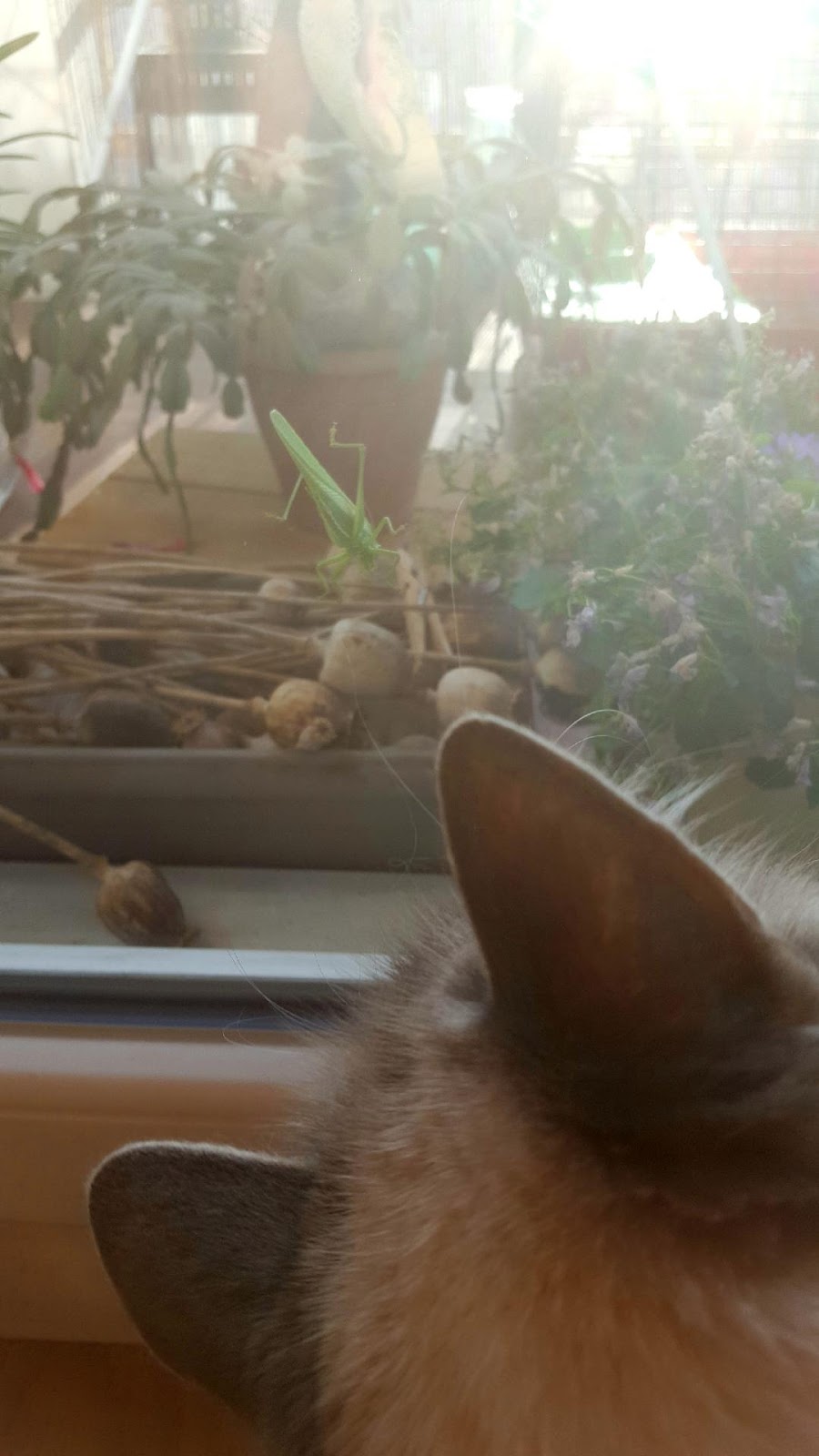
Living on the fifth floor, we rarely have any truly exotic visitors, winged or otherwise, however there are a few exceptional moments. Few and far between, these visits are of great interest and entertainment to the cats.


This summer, the arrival of a sizeable grasshopper on the window  was therefore met with astonishment and a certain amount of feline frustration since the beast in question was on the ‘wrong’ side of the glass, and no amount of scratching would deliver it to eager paws and jaws.


Things took another dimension however that same night, when the grasshopper made its way into the flat and was leaping and flying around the confined space, with both cats in hot pursuit. This was definitely one of the highlights of the cats’ summer and yes, the grasshopper did live to tell the tale as we managed to guide it back out onto the balcony.