Showing posts with label Marionnettes. Show all posts

Thursday, December 24, 2015

In the Company of Unreal Creatures - La Compagnie Créature


In September I went back to see the Charleville-Mézières Puppet Festival... Festival Mondial des Théâtres de Marionnettes, which is held in the town every two years. My first visit was in 2011 and I vowed then that I'd return. During each festival, all the streets radiating out from the vast central square - la Place Ducale - are overtaken by all kinds of performers and performances, of all nationalities.


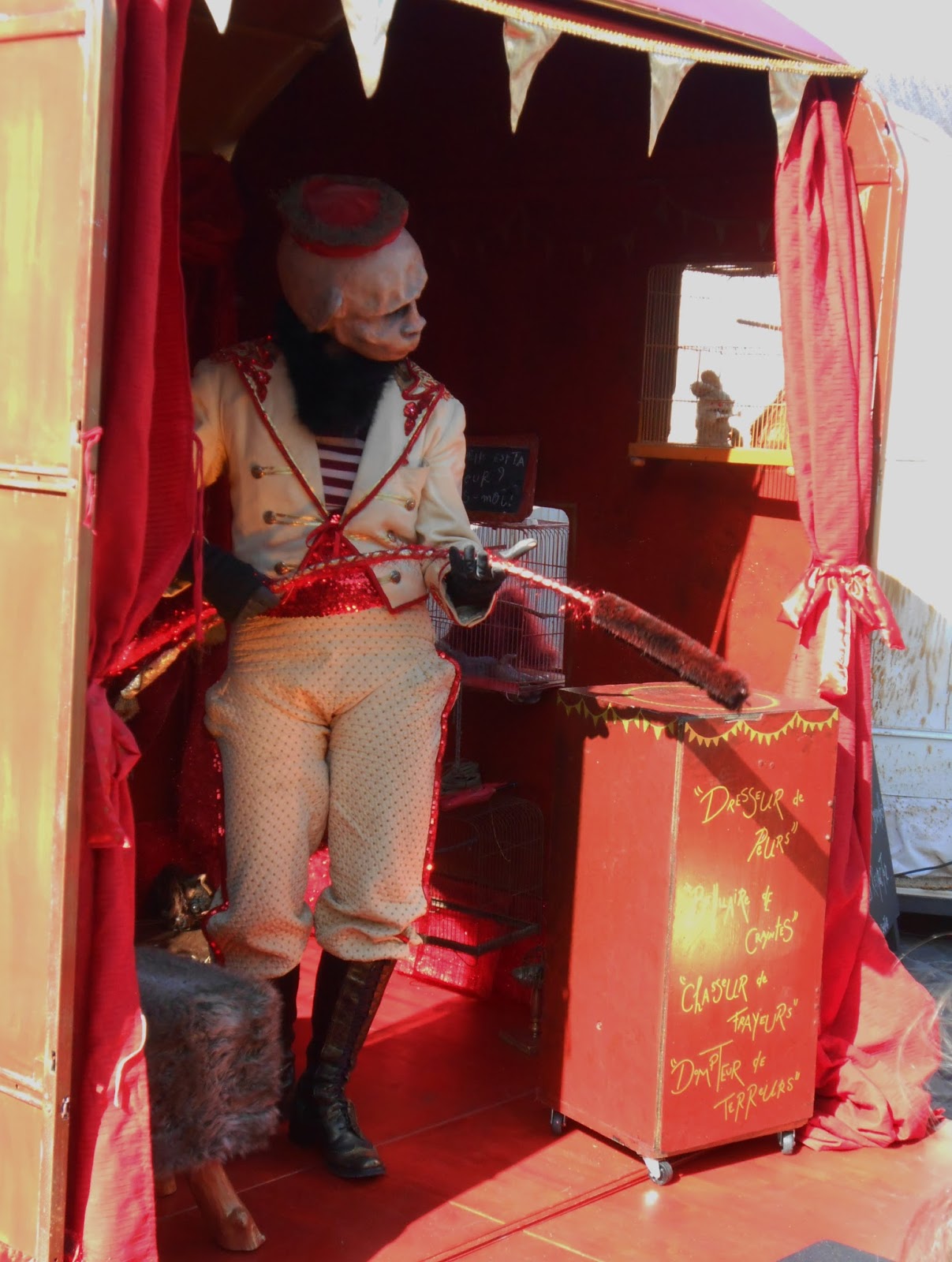
This year was no different, except that one group of performers had taken centre stage in Place Ducale and seemed to be the focal point to all the activity in the square. Compagnie Créature had mounted 15 theatrical 'sets' in an oval formation. Each of these had its own individual theme, yet remained closely linked to all the others to reveal the universe of Les Irréels. This was indeed a strange parallel world, populated by imaginary creatures that were half-beast, half man, yet did not seem to step from ancient mythology or from feel-good anthropomorphism. Sometimes the creatures could be related to a species of the animal kingdom, but this was not always so....


Certainly, there were a great deal of children in the crowds that amassed in front of each 'performance', but in fact Les Irréels seemed to address the infant in every person, regardless of age. It made the adults question all that separates the grown-up world of certitudes from that of childhood trust in make-believe and possibility. Although the majority of the children understood that the creatures were not 'real', the silence and tranquility of these strange beasts gave them a nobility and grace that made them want to interact. These were not marionnettes, but were performers in elaborate costume and facial masks, but that basic fact was soon forgotten due to the mesmerizing effect.


As the creatures busied themselves with their given occupation they drew in an audience fascinated by this odd spectacle of different characters, all inciting varying reactions and emotions. The performance flows over time - literally hours - there is no beginning or end for this is no scripted show; the creatures simply get on with their allotted tasks but are ever-attentive to the audience. Had Les Irréels been upfront and chatty, the spell would probably have been broken. As it was, the lack of words created an incredible proximity and communication with the audience. The reactions of the children were very touching to watch as they interacted as they could, totally absorbed in the whole event.


They were in turns a little intimidated by the grandeur of these beasts, rather frightened of some forms and features (and not without reason!) and just in awe and admiration of others. But however they felt, they went up to the creatures to try to speak to them.


Apparently, the initial aims of the founders of Compagnie Créature was to create a theatrical universe that presents the youngest public with universal, timeless themes that may often seem difficult or too sensitive to approach. Through a world of poetry, gesture and mime, the audience is led by the imaginary to think about the real world around them and find the humane/human therein. The dramatic art here brings us face to face with the dramas that punctuate our lives, and accompanies us as we do so, with warmth, peace and tranquility.


The theatrical artifice of the Irréels seems to bring out the realities of human existence, stripping away the layers of adult 'truths' that cover up reality with a child-like candour. Compagnie Créature was founded at Blagnac, near Toulouse in 1990 by a couple dedicated to the universe of the theatre, the plastic arts and puppetry. It is the daughter of Michel Broquin and Odile Brisset, Lou Broquin, who conceived and leads the project of les Irréels, accompanied by her mother, sisters and an expanding group of fellow performers.


There are 15 themes in the Irréels, each explored by a different identity, set within a unique backdrop, rich in colour, density of detail and heavy in symbolism. The symbolic does not, however, have a stifling, stuffy weight; each theme is intricate yet simple, like a carefully woven cloth that invites you to touch and examine it to see just how it 'works'. Just as these creatures are not some cozy, crazy modern twist on Beatrix Potter's characters, the role of each of these imaginary beasts responds to a very real need in our universe.


In front of each set, the title of each hybrid beast is clearly stated, along with its 'role' in the bigger picture. Yet these are not simply 'explanations' for the benefit of the younger public; they are addressed to us all, so that we may ponder over our own fears, hopes, losses and loves. How do our lives 'work' and what would Life be like if the Irréels really could work their magic in the real world. What separates this imaginary universe from ours? Childhood from adulthood?

There was no fixed beginning or end to the collection of sets and many people seemed to go back to look at these again and again as the magical combination of simplicity, serenity and sophistication took its grip.

La Dorloteuse d'Enfance
One of the first I encountered was the Dorloteuse d'Enfance - The Pamperer of Childhood - whose role, as stated on the sign in a rather more poetic French, is " to give life back to the scraps of childhood years and to make our past states re-emerge in the present"...


Her set is appropriately crowded with the bric à brac of childhood -  old toys and games . The soft nursery colours, just like the Dorloteuse herself, are warm and comforting. The same impression was given by the Réchauffeuse d'Hivers - The Warmer of Winters -  a sleek, feline figure who the children gladly approached...

La Réchauffeuse d'Hivers 
Her role is "to knit hope in order to heat our cold interiors" - both material and emotional - with her gentle demeanor and her numerous spools of thread, spindles of yarn and balls of wool that fill her set. She 'tucks in' her audience with her soft blankets and warm throws in order to get them through the harsh, wintery moments of Life.


In the same vein, but on a more personal level, the Raccomodeuse de Coeurs - the Mender of Hearts  - welcomes her public as she busies herself with her numerous tasks in her colourful space...

La Raccomodeuse de Coeurs
As excellent seamstress, the Raccomodeuse sews up bruised and broken hearts, darning frayed sentiments and repairing the weakened stitches in love stories...


The Raccomodeuse de Coeurs is accompanied by the Brodeuse d'Amour who brings Love back to life in our own lives through her bright sequins, ribbons and pearls...

La Brodeuse d'Amour
The incredible vibrancy and openness of this scene is offset by the closed, shady environment of the Veilleuse de Mystères...


La Veilleuse de Mystères
Inside her hut, the Veilleuse - or the Guardian of Mystery - is barely visible beyond the peepholes, her slow, shrouded movements are just perceptible. We catch a tantalizing glimpse as she turns...


She assures that the mysteries of Life remain intact, safe from the ravages of logical vision that rationalizes everything away to produce the plain, palatable blandness that is often associated with the world of adults.

La Berceuse de Secrets
With a similar desire, the Berceuse de Secrets - the Lullaby-Singer of Secrets - endeavours to soothe and protect our innermost secrets.


With her soft, discreet melodies she incubates these secrets in the depths of her wooded environment, right up their their liberation...

L'Accompagnateur d'Absents
In his lair, the Accompagnateur d'Absents cut an eerie figure that seemed to inhabit the dark, dank corners of a mythological underworld...


Despite evoking the dead, his purpose is reanimate their living memories in us through his music. Likewise, the Rafistoleur de Mémoire - the Mender of Memory - works on the elements of life that have slipped into oblivion yet need to be restored in a mindful present.

Le Rafistoleur de Mémoire
The Mender seeks to patch up our memories of the past and like an archeologist he will piece these together again, so that they are no longer forgotten, buried under the weight of time. His hut is full of the artifacts that make up the scrapbook of our existence. Just as an elephant never forgets, his role is to ensure that we no longer do so either...


In order to wash out or water down any moments that may soil or sour a pristence, sweet existence, the Lessiveuse de Malheurs - the Washwoman of Woes and Misfortunes - offers her services...

 La Lessiveuse de Malheurs
The washerwoman flushes out sadness, and removes the greyness and grime that may dullen our lives. Her cleansing provides the brightness and freshness usually associated with childhood.


Toiling beside the Washerwoman was the Pêcheur d'Espoir  -  the Fisherman of Hope - who indeed resembles an amphibious creature, with his mud-coloured clothing and fishing equipment.

Le Pêcheur d'Espoir
His role is simply to catch Hope and return it to the world so that we regain faith in the idea that everything is possible.


So that we may advance freely with open minds, fed on curiosity and eagerness, the Marmiton de Passion is there to accompany us with his recipes....

Le Marmiton de Passion
This Kitchen-Hand in Passion is ready to cook up concoctions that will fill us with enthusiasm for numerous things, thus liberating us from doubt or hesitation.


So that we can follow our path in life in good company, the Tisseuse de Liens - the Weaver of Relations uses her needlework skills to bring people together...

La Tisseuse de Liens et La Traceuse de Chemins
Once the Weaver's work is done, the Traceuse de Chemins - the Path Setter - will trace out the paths that we will tread together...


The Rêveur d'Amis Imaginaires - the Dreamer of Imaginary Friends -  will ensure our journey in life is not a solitary one.

Le Rêveur d'Amis Imaginaires
His role, as stated on the sign is "to dream, invent and draw the friends that populate his spirit, before they go on to join Humans"...


But to be truly free in life, we need the services of the Chasseur de Terreurs who will help us tame our innermost fears and train our unwieldy trepidation...

Le Chasseur de Terreurs
The Tamer of Terror will enable us to perform in the theatre of our lives, as bold actors not passive extras.


It was interesting to see how the children reacted to the imposing form and impressive facial expression of the Tamer.... But curiosity took the upperhand, and the Irréels had operated their magic.

From tomorrow - Christmas Day no less - the Compagnie Créature will be in Seville, Spain. What a great Christmas present for the locals!

La Dorloteuse d'Enfance

Tuesday, November 18, 2014

Performance and Puppetry in Le Palais du Tau of Reims..


I have an impressive backlog of blog posts that I still haven’t actually got round to writing up, let alone posting on the internet planet. So, here’s one on a truly other-worldly set of marionnette/mime spectacles that I saw in the spring time, as part of this year’s Orbis Pictus festival in Reims .


The festival is organized by David Girondin Moab, founder of the Compagnie Pseudonymo, and qualified marionnettiste from the ESNAM (Ecole Supérieure Nationale des Arts de la Marionnette) at Charleville-Mézières, and Angélique Friant, founder of Succursale 101.


For the past five years Orbis Pictus has been held in the illustrious setting of the Palais du Tau. Indeed, the archbishops’ palace once accommodated future kings of France prior to their coronation – la cérémonie du sacre - in the cathedral of Notre-Dame


Today, for the duration of the Orbis Pictus festival at least, the palace houses a variety of strange beings in its banquet halls, regal anti-chambers, and chapels. The world of la scène is explored in its different aspects with performances which draw all the arts together to great effect; dance, mime, acting, puppetry, plastic arts, music and lighting. Some of these were loud, boisterous and humourous, others quiet, atmospheric and haunting. All played on the senses , using irony, introspection and the unexpected to make us question where art and life, the real and unreal begin and end. The two spectacles that I moved me the most were just incredible, well, breath-taking...


La Femme Blanche, performed by Canadian artist Magali Chouinard, was literally hypnotic. Rows of adults and children alike were squeezed into the floor space of the majestic chapel, yet instead of being distracted by their digital gadgetry, and therefore a distraction to the artistry, everyone was mesmerized. 


The silence was a pin-dropping absolute and even the slightest click of a camera seemed utterly irreverent. Without words, the White Woman drew in her captive audience as she drew out the various objects from her suitcase, liberating these and giving life to their forms. The portraits of the adult, the child, wolf and crow were intertwined in tender tableaux vivants  as the puppet forms and puppet master were blurred. 


The White Woman animated all around her, centring herself around a shrouded, skeletal tree, with a benevolent Georges Méliès-style moon face suspended from its branches. 


The silence of the performance and its monochrome colours completed the ethereal ambiance. I can’t even remember how long this lasted, but it was if the audience had drawn in their breath at the beginning and only breathed again at the very end, when the spectacle ended with a flutter of origami bird forms, composed of written texts.


The performance, Kumo, was equally astounding and also made the audience catch their breath. Yet, as the incredible mime and illusion artist, Romain Lalire, spun a visual web in front of our eyes, the show was punctuated by sighs of disbelief and appreciation. This amazing artist seemingly floated into position, in the great banquet hall of the Palais du Tau


Dressed in a striking black costume, that was of a timeless, genderless form, he proceeded to strike us all dumb with Kumo. This was no rabbit-from-a-hat show; the magician was not only master of the art, he became part of this magic, as he himself seemed to evaporate and then take form in the effects he was creating. Kumo, meaning cloud in Japanese, certainly had the audience held captive in the weightless density of its trompe-d’oeil effects, offset by atmospheric music.

The following clip won’t do the performance full justice, however it will perhaps enable others to discover the world of Romain Lalire. Past and future performances and projects can be followed on the artist's site.


The powerful mix of artistic medium and effect took me back to my childhood experience of Footsbarn Theatre, and not, as it happens, by chance. A number of the performing artists at Orbis Pictus had been influenced to a greater or lesser degree by the essence of Footsbarn.

Little did I know when I went to watch their great adaptation of Midsummer Night’s Dream in 1976, on Newlyn Green in Cornwall, that I would see the modern-day Footsbarn Theatre group performing here in France almost forty years on. 

As a child, the magic of the experience was the unique atmosphere. The Footsbarn big tent was surrounded by inflatable castles and various stands, all of which were positioned between the rather staid bowling grounds and Orion art gallery. This was a case of art and theatre, but not as people knew it, and here was freedom for children and teenagers but not as we’d previously known it either. I can remember the fuggy ambiance of the tent, with the performers looking like living gargoyles or characters from Chaucer (not that I really knew much about either at that age). The adults and children alike were taken over by the infectiously liberating spirit of the event. This bawdy display of updated Shakespearean humour was accessible to all; in fact, the title of the work had been changed in order not to discourage the locals and ended up as Midsummer’s Madness. Just as magically as they had arrived, Footsbarn packed up and left again, to travel around Cornwall, bringing art to their public in other unusual rural venues that departed from the more traditional, haughty settings.


If we thought this first taste of Footsbarn Theatre was a revelation, when the troupe returned as part of the Festival of Fools in 1980 and set up camp on the other side of Penzance, we thought Woodstock had arrived in town. At that time I don’t think Glastonbury Festival was the iconic event that it is today, or certainly was not for young teenagers then. Here again, Footsbarn sought to reach its grass-roots audience, and could do no better than the fields of Ponsandane camp site. The festival offered craft markets, art workshops, side shows, games, music, food stands, beer tents and theatre. 

Sadly, the magic didn’t last; Footsbarn Travelling Theatre took to the high road, leaving Cornwall and indeed England in order to cover the six continents. In 1991, Footsbarn based themselves in a farm in the Auvergne region of France, finally deserting the Cornish barn that the theatre community had used for rehearsals since their formation with Oliver Foot and Jonathan Cook in 1971. 


It is from there that the troupe still prepares its work today, albeit with a far more international set of performers than in its early days. I took the children to see Sorry at the Manège de Reims in 2010 and spoke to one of the original Footsbarn performers from the Cornish days when they used to parade in the streets, singing…


Footsbarn has come to town,
Jugglers, acrobats and clowns.
Footsbarn has come to town,
All the children dance around.
Come and see, it's a very funny play
We'll put on for you today.
Seven o'clock the show begins,
Up my kneecaps, down your shins.