Far from the beach, but still surrounded by treasure of all kinds just ready to be found, looked at, gloated over, gleaned and swiped or simply created! Here are my latest finds....
Showing posts with label Reims WW1. Show all posts
Friday, November 29, 2024
Forgotten Memorials...
One of the main traffic roundabouts in Reims isolates a grassy central island on which is set a monument that is rather hard to see in any great detail, due to the steady flow of vehicles that winds around it, largely indifferent to the sculpted forms it bears or the inscriptions in the rush to get some destination or other. It is in fact virtually impossible to know what the impressive column monument commemorates and for this reason, it tends to be overlooked.
It did however attract attention at the turn of the millenium when a hurricane bore down on the city, destroying the trees that encircled it, as well as wreaking havoc on the architecture of the city as a whole. Today it is difficult to believe that the large trees we see now are 'only' a quarter of a century old, planted in 2000 to replace those uprooted in the days after Christmas in 1999. The monument itself escaped the event seemingly intact, miraculously, albeit strangely exposed, without the trees' branches and leaves to shroud it.
The monument in question - dedicated to the allied nurses of the world - was set in place 100 years ago, almost to the day, on the 11th November 1924. Indeed, whilst each village, town and city in France possesses a commemorative edifice to honour its sacrificed soldiers and civilians, there are but three monuments erected to the memory of the nurses who died caring for others. It was Juliette Lambert who decided to lead a committee to gather funds to assure the building of a monument « à la gloire des infirmières françaises et alliées victimes de leur dévouement » for the nurses who fell in the World War I. Reims was selected as the obvious site for this purpose as the 'ville martyre' had suffered horrendously during the hostilites, from the very outset in September 1914 until the end of the war, with its cathedral being the very emblem of French loss and sacrifice.
On the day of the monument's inauguration several years after the war, Juliette Lambert was present, but her speech was read out for her as she was already 88 years old by this stage. The sculpted relief on the monument shows two nurses giving care with great tenderness to an injured soldier from the Front, whilst on the other side of the cylindrical column stands an angel strewing roses, in a gesture representing renewal. The top of the column is decorated with a sculpted laurel leaf frise with a funerary urn decorated with pine cones - symbols of eternity - while the octagonal base bears the sculpted forms of scallop shells to symbolise hands opened out to other people, emblematic of the gesture of doctors and nurses towards their patients.
The architect Charles Girault, famous for his construction of Le Grand and Le Petit Palais in Paris and the sculptor Denys Puech were responsible for this work. The inscriptions along the column pay tribute to the devotion of the nurses;
"On land and sea they shared the dangers of the soldier. They braved in hospitals, bombed and torpedoed the fire of the enemy contagion, exhaustion.By consoling pain, they helped victory. Honour to them.
They will live forever in the memory of their homelands proud and grateful."
When I finally managed to dodge the traffic to make my way onto the island and look at the monument in detail, I noticed the commemorative plaque just below the symbolic Red Cross relief. This had been added following the Second World War (1939-1945), in reference to tragic losses due to bombing on the 30th May 1944. Although I was aware that Reims had suffered from Nazi occupation, deportations to the death camps and shellfire, I had not heard of any major bombing campaigns. Intrigued, I tried to find out the circumstances and fatal consequences of this incident and what I did discover surprised and shocked me in equal measure.
In order to rid the city of its Nazi occupants and above all cut enemy access and supplies, the American Airforce (USAF) sent over Flying Fortresses to strategically bomb specific sites, namely the Maistre barracks (previously Caserne Neufchâtel), the railroad marshalling yards, locomotive workshops and the central train station itself. Three bombing waves were carried out in May 1944. However, it was the third of these, on 30th May, that resulted in significant civilian losses.
As the first bombs went off, the nurses and young students (14-19 years old) of the Centre de formation Professionnelle in Rue Belin went to offer their help as the area around the station and railway had been hit in the air raid. Most of the streets, literally minutes from my home, were affected but it was Place Luton where the greatest tragedy took place. In order to protect themselves, the group took shelter in a house cellar but as bomb ripped through the building, exploding in the cellar vault, the blast and the thick, asphyxiating dust that followed killed 20 out of the 21 youngsters. Nurses from a nearby dispensary also died, as did ordinary civilians, thus taking the number of fatalities to 55, with far more injured aside. On visiting Rue Belin and Place Luton, I expected to see some mention of this tragedy but there is - apparently - absolutely no trace although a plaque is to be found in a local secondary school Lycée Gustave Eiffel. I actually find that quite sad that a quiet city square should have been the site of such brutal devastation and yet today there is nothing to mark this or indeed to check the actual facts since all is rather vague. As there are plans to revitalise Place Luton and make it greener and leafier, I sincerely hope the local council will take steps to honour these long-departed individuals of whom the city is supposed to be forever 'proud and grateful'. I did try to locate the fateful site on Place Luton, and since the very plain house below was the only relatively 'recent' building in the square - the rest dating to the 19th century or the reconstruction of Reims after WWI - I can only assume this was it...
It was, of course, in Reims that the surrender of the Third Reich was agreed upon and signed, on the 7th May 1945, as General Eisenhower, the supreme commander of the Allied Expeditionary Force in Europe, had previously transfered its headquarters from Versailles to Reims. This may be long-distant history today, but how can we know where we are, or what we have now if the traces of the past are wiped away or overlooked?
Tuesday, October 29, 2024
St Julien in Courville...
From a distance, almost from any direction, l’église St Julien in Courville seems to rise out from its surroundings in a most uncanny manner. As if in defiance of any modern indifference or ignorance towards its past, this church stands out, refusing to be overlooked or brushed aside. And indeed, the whole supposedly modest village - with its proud church - hides far more than we could possibly imagine as mere visitors passing through this picturesque hamlet, typical of hundreds of others in north-eastern France.
Set in a curve in the Ardres valley, on the Route des Sacres in the Marne département, the domain of Courville was once one of eight châtellenies of the archbishops of Reims. The latter played a vital role in the history of the French monarchy - la Cité des Sacres - where all the kings of France were crowned from the 9th century to the 19th. Incidentally, much of the stone used in the masonry of the cathedral would, in fact, come from the quarries around Courville, some 27 kilometres to the west of this major city.
The château of Courville became one of the exclusive residences for the archbishops from the end of the 12th century and it was one of a series of châteaux intended to protect the episcopal territory. Its exact date of construction remains unclear, yet is likely to have succeeded a Carolingian villa which was mentioned by the 10th century historian, Flodoard of Reims. The structure of the chateau was based around the four keeps (les donjons), and despite the modifications made over the centuries by its successive owners, not forgetting its confiscation under the French Revolution as a state asset in 1792 - it survived until the early 20th century. Sadly, as countless other edifices, it fell victim to the ravages of the Great War 1914-1918, although in this case the château des archevêques was all but obliterated from a deliberate act of destruction as opposed to collateral damage.
It is almost impossible today to imagine this peaceful countryside bearing the full brunt of the hostilities in the First World War, but these lands were strategic vantage points over which thousands of lives were lost on both sides. The natural plateau overlooking the nearby village of Unchair was used as a military airbase to send squadrons daily to the nearby Chemin des Dames, site of some of the most brutal fighting, despite its genteel name. The village of Courville was occupied by German forces until May 1918, most of the villagers having fled prior to their arrival, and the château then became the quarters of the military staff.
Although the village was bombed regularly by French and American troops, the château remained intact, but on their departure, the occupying forces ensured that the whole edifice was blown up, in accordance with the order given to destroy all grand buildings, monuments and beautiful homes and apply a scorched earth strategy to all else left in their wake.
Situated in the park of the château, the church miraculously survived the destruction of the residence, despite suffering considerable damage to its exterior structural parts and roof from shellfire. It had served as sleeping quarters for German troops, who, on their departure either destroyed or removed sacred objects, furniture, bells and stained-glass windows. The church was listed as a Monument Historique in 1920, and looking at the edifice today in its calm setting, little gives any indication to its history, be that relatively recent or far distant past.
For indeed, St Julien has stood its ground for hundreds of years, dating back to its construction at the end of the 11th century. Initially constructed to a simple plan with a nave and a high Roman tower built over the narthex, this design was carried out by artisans from Reims then modified considerably from the 12th century onwards. The bell tower was repositioned to stand at the other end of the edifice whilst octagonal apses and side aisles were added too. The archbishops had a double-level gallery incorporated in the nave, with large arcades in Roman style and high window set above in the second level built in the Gothic style. The upper level served as the independent chapel of the archbishops of Reims in the 15th century and was dedicated to Saint Michel.
This was accessible from the grounds of the château via a wooden footbridge that remained in place until 1730. At the end of the 18th century, the years of the French Revolution took their toll on the church as it was defaced and plundered as were so many other religious sites across the country but fortunately it remained standing and suffered no further assaults until the Great War 1914-1918, apart from the relatively recent theft (and recovery) of a sculpted wood statue of Saint Sébastien in 2011.
As a precaution against the deeds of ill-intentioned visitors, the church doors are locked, and therefore I have not yet had the opportunity to explore the interior. Although the entrance is a very sober archway, with minimal decoration apart from simple indented stonework, the exterior of the church bears some interesting sculpted forms that offer a tantalizing idea of what to expect within the building.
Indeed, the capitals that adorn the top of the columns and archways are said to bear highly decorative forms with human heads, animals, flowers and foliage -even a scene of Jonas and the whale! While there is a sculpted altarpiece in the flamboyant Gothic style, the stained-glass windows ‘merely’ date back to the 19th century, only one of a pair to survive the bombing of the château in 1918.
These were a donation from one of the last inhabitants of the domain, the Bracquemont family, and were made by the Atelier Simon-Marq specializing in stained-glass since 1640…. and still running today! The wooden ceiling of the nave was vaulted in ogival brickwork in 1895 but that and all the other architectural features of the church I will discover when I visit. In the meantime, I can’t help but wonder what this region would have been like today, if it had not been subjected to such war-time devastation that willfully destroyed so much of its heritage.
Friday, August 26, 2022
From Hôtel des Sacqs de la Hérissandière, Hôtel de la Cloche Perce... to... Hôtel de La Salle.
One of the older historic buildings here in Reims - the Hôtel de La Salle - dates back to the 16th century. Listed as monument historique one hundred years ago, it is in fact miraculous that it actually made it through the hostilities of 1914-1918 which led to the destruction of most of the rest of the city. Today the Renaissance façade, inset with the benevolent figure of Jean-Baptiste de La Salle tending to one of his charges, stands elegant and proud, with little to indicate the past perils in almost 500 years of existence.
Its survival is not unlike that of the nearby Musée-hôtel Le Vergeur - set on Place du Forum in the heart of the city and in view of the cathdral, itself symbol of Reims ‘ville martyre’ during WWI. Indeed, both hôtels were saved from total obliteration in the aftermath of the war thanks to the intervention of individuals committed to the preservation of the cultural and historical heritage of Reims.
Hugues Krafft, co-founder of the Société des Amis du Vieux Reims in 1909, undertook the restoration of Hôtel Le Vergeur that he had purchased in 1910. Likewise, the biscuit manufacturers, Maison Fossier, of ‘biscuit rose’ fame, owners and occupants of the premises of what we now call Hôtel de La Salle, successfully brought the building up from the ashes during this same post-war period.
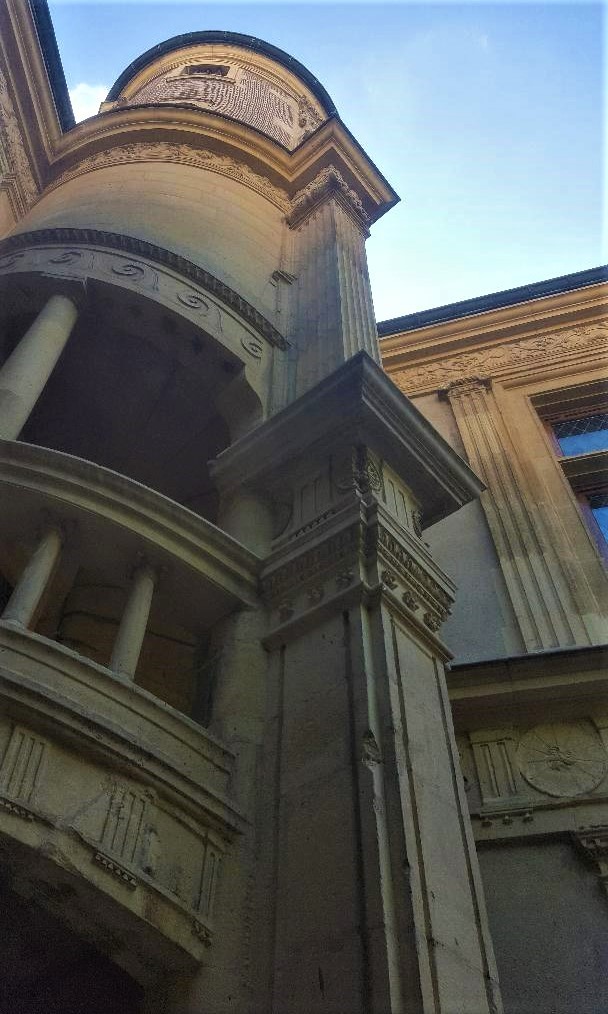
Again, both sites had once housed elements of significant architectural value and beauty and as such their preservation was deemed important to le patrimoine rémois. The hôtel de La Salle still possesses its ornately decorated escalier à vis, an external winding staircase in stone that turns clockwise on ascent, overlooking the court yard with an elegant architectural style reminiscent of the Château de Blois in the Loire Valley.
Constructed on the orders of affluent nobles and merchants of the city, both hôtels attest to the wealth and status of those who had originally commissioned them centuries ago. Although Jean-Baptiste de La Salle was born into an illustrious household in Reims to a father who was a king’s counselor and a mother from the Moët champagne family, the hôtel was not built on their behest nor on their behalf.
Initially known as Hôtel des Sacqs de la Hérissandière, it was in fact constructed in 1545 for an affluent cloth trader, Henri Choilly. And although the statue of Jean-Baptiste de La Salle looks down on us today from the façade of his birthplace - as if it had always been there - this is a relatively recent addition from the 1950s, taking position in an empty niche presumably once occupied by the figure of the Virgin Mary (but not the one below).
The hôtel only entered into the possession of the de La Salle family from 1609. Jean-Baptiste was born there in 1651, the eldest of eleven children. Despite being educated for a life in the legal profession, Jean-Baptiste followed a religious vocation and went on to become the patron of Christian teachers.
Lasallian schools are to be found on the five continents today and indeed a community of Brothers now occupy the Hôtel de La Salle, bought by the lnstitut des Frères des Écoles Chrétiennes in 1956. One of the Brothers kindly showed me around on a ferociously hot afternoon !
Although few of the original artifacts have survived to the present day, the rooms have been set out to reflect aspects of its past and displays show Jean-Baptiste de La Salle's life, work and legacy.
The façade of the building is decorated in the Renaissance style, with pillars, ionic capitals and a frieze running along its length, all bearing symbols of the cloth trade. The oddly-slanted carriage doorway is flanked by two allegorical caryatids, referred to as Adam and Eve. The male figure seems to be somewhat cramped in this tight corner with the wall of the adjacent building encroaching on his space at a rather strange angle.
This can be explained by the fact that the street that we see today only came into existence during the restoration period of Reims in 1921 when the Hôtel de la Cloche Perce, as it was then known, was still in such a sorry state that it might even have needed propping up. And so, as always, I wonder what this city – and others past and present - would be like today without such war devastation and have to be grateful for what remains to us now.
Sunday, November 28, 2021
Remembering, Forgiving and Forgetting...
The jolly village de Noël has just sprung up again at the foot of the cathedral in Reims; pretty with the illuminations and little chalets but pretty uninspiring for me these days, I have to admit with a certain regret. The whole commercial aspect has finally crushed the magic out of Christmas for me, and this frenetic spending spree seems to start earlier and earlier each year. It was therefore not so surprising that a small exhibition in Le musée Le Vergeur caught my attention far more...
Having sustained catastrophic damage at the outset of the First World War, Reims cathedral became the symbol of the suffering of the entire French nation in this war "to end all wars". In the following years of hostilities, the vision of the devastated cathedral, along with countless other images of war-ravaged sculpture and architecture haunted the population. Yet from portraying these passive victims of war-time brutality, the images went on to play an active role in the denunciation of such atrocities and their perpretators. As the title of the exhibition highlights, French art and artists signed up for the war; 'Le Patrimoine s'en va-t-en guerre'.
Reims had been invaded by German soldiers in the early autumn of 1914 and the grandiose Gothic cathedral that towered over the city received its first humiliating blow. Notre-Dame de Reims that had been the illustrious site for the coronation of the kings of France for over 700 hundred years was suddenly used as an infirmary and for storing hay.
When it was hit by enemy artillery shells on the 19th September 1914, the ensuing fire spread rapidly throughout the cathedral which had literally been transformed into a tinderbox. Such was the intensity of the blaze that the molten lead from the Medieval roofing flowed down from the mouths of the gargoyles in what must have been cataclysmic scenes.
In Belgium, the destruction of the centuries-old library in 1914 was referred to as the 'crime of Louvain', an outrage on a parallel with that of Reims, itself an act of barbary against humanity, culture heritage and religion. The image of these martyred monuments was taken up as a powerful weapon of propaganda against Germany.
The remois artist Adrien Sénéchal (1896-1974) produced the work L’Art en Deuil (Art in Mourning) in 1914, having witnessed first-hand the fire at the cathedral. He was one of many artists, writers and intellectuals who denounced the German onslaught led by Emperor William II.
The image of the Kultur Krupp, seen here in a lithography by Albert Robida (1848-1926), was used to present the virtual obliteration of Reims and other towns and cities, by the enemy - the cruel, imperial eagle. Clutching onto the treasures of French heritage with its murderous talons, it reigns proud over the scenes of desolation, like the most nightmarish gargoyle made flesh, brandishing its flag in honour of the might of the arms manufacturer, Krupp.
Over the following years, Reims was the target of intense fighting with the majority of the city buildings finally destroyed and the cathedral left a ruin, with its windows largely burnt and blown out and the roof lost to fire and shelling.
One of the most poignant victims of the damage to Reims cathedral was sculpture of Saint Nicaise, the Ange au Sourire and when he fell, shattered, it seemed to symbolize the demise of the entire monument and all that it stood for.
In May 1915 an exhibition was held at the Trocadéro in Paris, displaying works brought together by the Musée de la Sculpture Comparée. The casts of sculpture, some dating back to the Middle Ages and all damaged and/or lost in the present day, were shown to the public.
The director of the museum, Camille Enlart, selected pieces that left the visitor in no doubt of the anti-teuton sentiment that was highlighted in the most dramatic way in this 'war of images'.
The collection was set out in chronological order, following the various affronts and hostilities committed by the Germanic peoples over the centuries, from the barbarian invasion up to more recent events with the France-Prussian war of 1870 and the Great War itself.
The two casts of original mid-15th century busts that had once looked down from the doorway in the chancellery of Strasburg before destruction in the siege of the city by Prussian troops, were defiantly labelled as 'Busts destroyed by the Germans i870'.
Copies of the four console heads from the cloth hall of the city of Ypres in Belgium that were destroyed in 1914 by enemy fire were likewise clearly labelled.
Fortunately, moulds had been taken of the scuplted wooden heads by the atelier for the royal history museums in the late 19th century. How many works of art were not so 'lucky' as these and disappeared with no remaining trace?
In from late 1916, another exhibition took place, two years after the first that had deplored the loss of art and architecture, symbols of culture and civilisation, to 'German vandalism'.
This second exhibition 'Oeuvres d'Art Mutilées ou Provenant des Régions Dévastées par l'Ennemi' was held in the Petit Palais in Paris and showed the full horror of the brutality of war and its widespread repercussions. There was certainly less need for labels to spell anything out to the visitors this time...
The poignant images of churches and their symbolic decoration burnt and broken seem to underline the overwhelming suffering and incomprehension of soldiers and citizens alike.
Today, we have History and hindsight to help us try to fathom past wars - albeit the bare facts alone for how could anyone track the full depths of such inhumanity in human terms ? What could people have understood back then in the four long years of the Great War ? They must have asked themselves how any God could allow this carnage to happen to their flesh and blood and how anyone could allow it to happen in the face of Faith, directed at their God and their places of worship.
The decapitated Madonna of the Pièta from a church in the Marne region seems to reflect the unbearable loss and mourning of thousands of other mothers, regardless their nationality. The inconceivable had become a war-time reality from which no one would escape without lasting wounds and scars.
When the fragmented remains of the statue of the Christian martyr Tarcisius were shown, the parallel with the shattered bodies of the soldiers on the Front was immediately drawn. The expression of suffering is complete yet there is a sad serenity - similar to the one seen in the Madonna statue from a church in the Somme.
With her skull literally bound with wire, she represents all disfigured battle victims - whatever the war - maimed mentally and physically and yet held together by whatever means...
The same could be said of the cathedral here in Reims, and indeed the Musée Le Vergeur and the fact that they have not only survived but are resplendent today is surely something to celebrate... The exhibition will continue until the first days of 2022 and is well worth a visit in its remarkable setting.
Subscribe to:
Posts (Atom)