|
| A winged bull gargoyle spitting down on visitors... |
A few months ago, I visited the cathedral of Laon, situated in the Aisne department, approximately 70 kms from Reims. Built on a hill, accessible by funicular, the cathedral looks down over the old town, and still dominates the skyline from all around.
The towers have a particular quality and strangely reminded me of old Indian palaces, with their spindly, intricate columns. Impressive today, you can only wonder how its imposing form affected parishoners and passing pilgrims in centuries past.
Although we may tend think that certain Gothic cathedrals are rather like the others in Northern France, each has its own chronological and architectural significance and setting in history. The main entrance here uses a form familiar to us today, yet when we look up, the unique features become more apparent...
 |
| View across the town of Laon from the cathedral façade. |
In the city of Laon, the site of the cathedral itself had been of prime importance since before Roman times. This acropolis offered obvious strategic avantages, from its vantage point of some 100 metres. It was also recognized as a sacred terrain and a Carolingian monument constructed in the period of 800 AD was consecrated in the presence of Charlemagne himself – King of the Franks.
Built in the early or ‘primitive’ Gothic period - the mid 12th century - the cathedral of Laon emerged as many others would do in this unique moment in architectural history.
In the same manner as strange geological formations, the creation and ascent of the Gothic cathedral was largely due to a specific set of circumstances and conditions that led to the emergence of such wonders that would not have arisen without such particularities.
Just as certain factors need to be combined to result in strange rock outcrops, land formations and fossiles, for example, the Gothic cathedral grew from a very particular soil. Quite literally…
On the one hand, the climate was propitious for the growth of a new type of religious edifice. The catalyst for this transcendental upsurge was the decision of the Abbot Suger, to renovate the Basilica of St Denis (some 5 kms north of Paris) in the early years of the 12th century.
The abbot wished to create a spectacular site that would elevate and illuminate the glory of the former kings of France who were housed in this necropolis.
The soaring heights of the resulting edifice and the vast windows that were accommodated therein transformed the concept of religious architecture.
Visitors – humble and noble alike – must have been quite literally dazzled by a symbolic luminosity that Abbot Suger considered to be synonymous with deity. Until then, worship had been carried out in the rather solid, considerably heavier and far more sombre Romanesque edifices, whose votive candles were often the most reliable source of light.
 |
| Spiral stairs leading up one of the towers. |
With the transformation of the Basilica of St Denis, the traditional and customary styles and practices were no longer systematically imposed. This gave rise to a revolution in technological terms and even, to a certain degree, in liturgical terms, over the next 150 years.
The breathtaking architecture of the Gothic edifice would draw the eye upwards in awe and admiration, towards the arches, cross-ribbed vaults, flying buttresses and symbolically to the Holy Spirit beyond.
Likewise, the Biblical stories, the lives of Saints and even the work of skilled craftsmen that were illustrated in the extensive stained-glass windows would edify even the most illiterate of worshipper, elevating him spiritually and inspiring him on a more worldly level too.
As symbolic landmarks, these vertiginous Gothic monuments would stand out from afar, illuminating the darkest of horizons, in the manner of a lighthouse, guiding the faithful and the travelling pilgrims alike.
Secondly, central to the evolution of this ground-breaking style was something more down-to-earth ; the access to ready supplies of limestone around the regions of
Ile de France and
Picardie.
The quality of this stone, as with sandstone, facilitated the intricate work that resulted in ornate sculpted forms and the massive column statues in septentrional (northern) France.
Such was its demand that more stone was extracted in these regions during the 200-year period of Gothic influence than in 3000 years of construction in Egypt.
Naturally, many of the great structural advances made during the Gothic period were born of trial and error ; numerous edifices were victim to the collapse of substantial parts of the cathedral that simply could not withstand the lateral thrust of force from above.
Whilst the early cathedrals, such as that of Noyon, had few flying buttresses, later edifices would rely heavily on their extensive use. Less well known was the key role played by iron, in the form of bands and girders, to provide vital reinforcement to ever-soaring architectural structures.
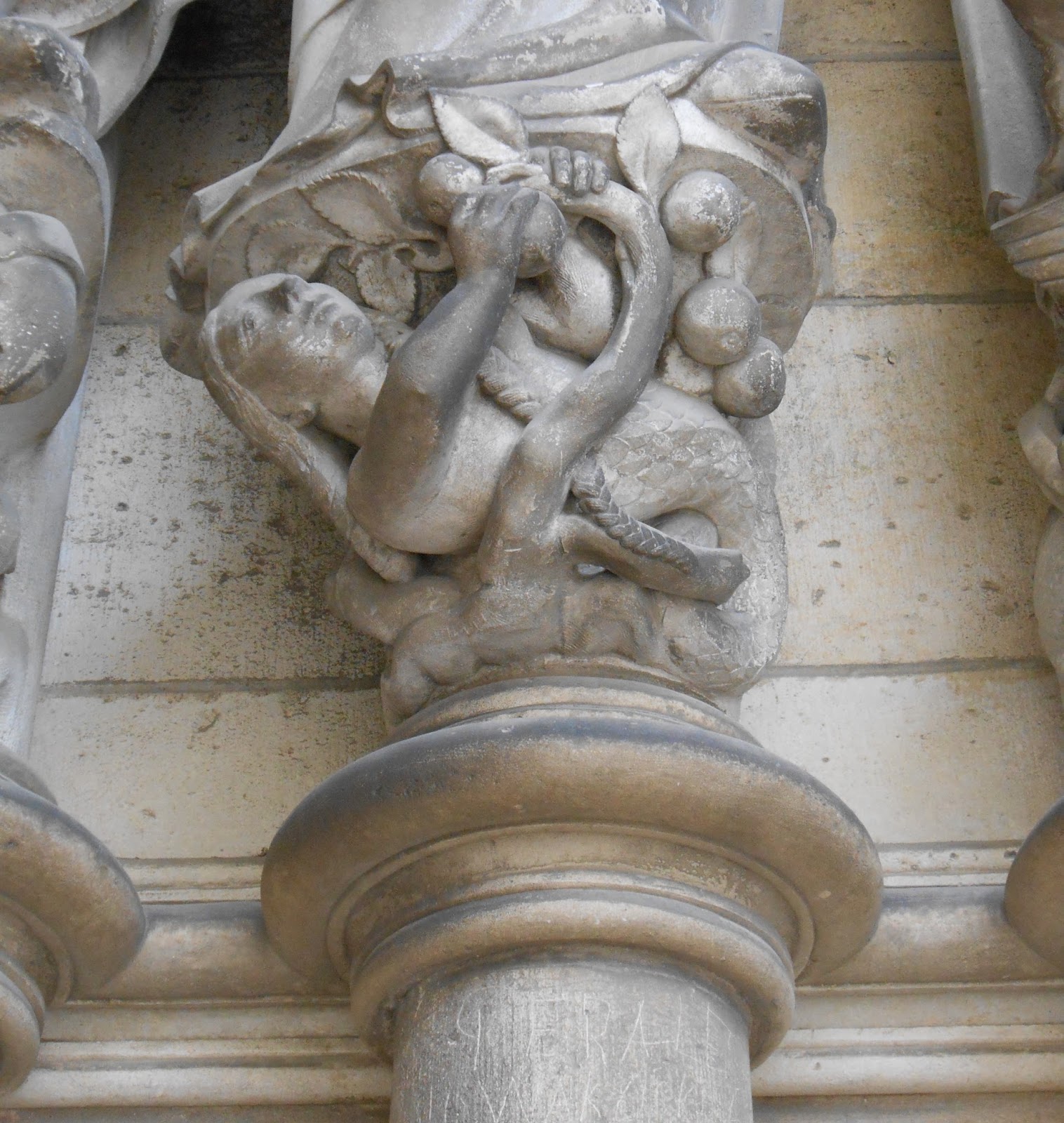
The skilled architects and masons would often travel from one builiding site to another, which would in part explain how certain features might seem familiar to us, from one cathedral to another – not least the gargoyles and characters that peer down from their vantage points.
Unique to the cathedral of Laon, however, are the numerous life-size bulls that dominate the towers above the western facade entrance.
Intended to symbolize a miracle carried out by one such beast, these bulls remind us of its very real, earthly construction of and the hard work performed by the human beasts of burden who likewise toiled on sites such as this.
A third point to bear in mind in the development of the Gothic style was a spiritual and worldly desire and financial ability to build religious monuments to reflect Divine and earthly power in this period of great economic and urban expansion.
Laon cathedral was built after those of St Denis and Noyon, was almost contemporary to Notre Dame de Paris, and yet was constucted before the edifices of Reims and Chartres, and therefore we can trace the evolution of style and the influences running throughout.
Indeed, the cathedral here sees a marked departure from the Romanesque elements that are still visible in Noyon. In the Laon edifice, with its four-level elevation - arcades, tribune, triforium and high windows - the tone is distinctively different.
The writer Marcel Proust (1871-1922) remarked on the « marvelous flower » of the burgeoning Gothic forms, slowly emerging with the first facade in this style. This was further developed in the later cathedrals which drew inspiration from this transitional work that was completed in 1235.
In fact, the work on Laon cathedral never entirely reached completion as the initial plans for the towers that dominate the skyline of this
montagne couronnée were not realised.
Had the seven towers been completed, as intended, rather than the five that we see today, Laon would have borne more towers than any other cathedral and there would have been more bulls than the sixteen visible now. That so much of the structural work has survived to the present day is perhaps nothing short of miraculous.
The bull statues that represent the Divine white beast that stepped in to help the humble creature that had collapsed while transporting the stones for the construction of the cathedral were themselves in danger of collapse. Exposed to all the elements, the symbolic beasts were falling victim to the worst that Man and Nature could offer.
An earthquake struck in 1692, shortly followed by a devastating storm in 1705. The political turmoil of the Revolution years at the end of the century led to the further damage and destruction of spires, towers and statues. Parallel to this, the western facade had compacted, leading to a slump of 80cms in height and a very real danger of collapse.
From the mid 1800, vital restoration work was carried out under Emile Boeswillwald, working for the
Inspecteur général des Monuments historiques, Prosper Merimée (1803 – 1870). The latter is perhaps better known as the writer of
Carmen, yet his work for the safeguard of historical monuments was invaluable… Unfortunately, a massive explosion in a local powder magazine in 1870 resulted in the shattering and loss of many of the stained-glass windows, but unlike at Soissons and Reims, the cathedral of Laon came out of the war years of 1914-1918 relatively unscathed.
In fact, it served as a hospital for injured German soldiers during the Great War, and the black-and-white photos of this period on display today are testimony to the tragic, timeless toll of war on every aspect of civilisation.
Another timeless, or rather ancient aspect caught my attention in a positive sense, this time in the form of the imposing 11th-century baptism font.
Set on a solid base, this massive block of blue black Tournai limestone – called ‘Tournai marble’ due to its potential shine – represents the four rivers of Paradise. The conflict between vice and virtue is shown by a snake-tailed bird...
These four - the Tigris, the Euphrates, the Gihon and the Pishon - branched out from the river of the Garden of Eden and formed its natural boundary. According to different accounts, the rivers were interdependant and the story of Adam and Eve depended on their existence, from the very fig leaf, apple and Original Sin. I am not actually religious in any way, but I love the fluid aspect of this vision of Mankind. And of course, the beautiful ‘naive’ carvings on the stone
bas-relief.
I also like finding the quirky details that always lurk somewhere amongst all the great craftsmanship of such magnificent places. Look at the depiction of those gnarled feet on the tombstone below!!!
I’m hoping to visit the cathedral of Beauvais sometime this summer and do regret that I can’t go back to visit all the cathedrals that I have seen over the past few years - Chartres, Noyon, St Denis, Soissons, and Vézelay being just some of them - and yet didn't really pay them enough attention.