Showing posts with label Medieval Art. Show all posts

Thursday, July 27, 2023

Cast Creatures - Medieval Footrests at the V & A...

Recently wandering around the marvelous 19th century Cast Courts at the V & A, I saw more examples of footrests on sculpted Medieval tomb monuments, from the original pieces copied around Europe.
The gisant figures of the departed lie fully clothed in all their worldly or spiritual finery, with apparel that reflects their rank, religion, wealth and worth.
On the voluminous folds of their clothing rest both hands, joined in prayer on the chest or clutching some spiritual, social, chivalric artifact, or simply crossed on the body.
These notable beings appear to sleep peacefully and in great dignity. Noble husbands and wives repose next to each other yet apart; religious individuals lie alone, clasping a holy script or ecclesiastical object. Knights proudly grasp their sword and shield, their bodies twisted as if ready to spring to action.
Some figures are shown lying on crib-like structures that are richly decorated with sculpted draped cloth, and several are represented in the bright colours that were wildly employed on the stonework of churches and cathedrals alike.
With the exception of a few figures, the majority of the departed are accompanied by a beast, symbolic of their standing; be it a lion, bear, dragon, dog, or unicorn.
Rare are the individuals who have no creature crouched or nestled at their feet or nothing on which to rest their often impressive footwear.
It is more customary to see one or two creatures that look up to their masters with devotion and obedience either from a high-relief sculpted plaque or a 3-dimensional sculptured piece.
The lion, symbol of power and pride, frequently appears next to venerable male figures although not always gazing at the gisant or postioned at foot level.
The king of the beasts is not exclusively reserved for men-folk as women too could be accompanied by the regal lion although in that case the ferocity appears somewhat toned down to the point of docility!
Likewise the dog – representing loyalty – could be shown lovingly guarding over his mistress...
... Or fiercely watching over his master...
In the case of a married couple, both lion and dog would be appear together.
Sometimes the interaction between the beasts is one of domination but at other moments is rather comic...
... Or quite strange...
And finally you have some departed who simply refuse to lie down and sleep, with or without an accompanying animal!

Sunday, April 17, 2022

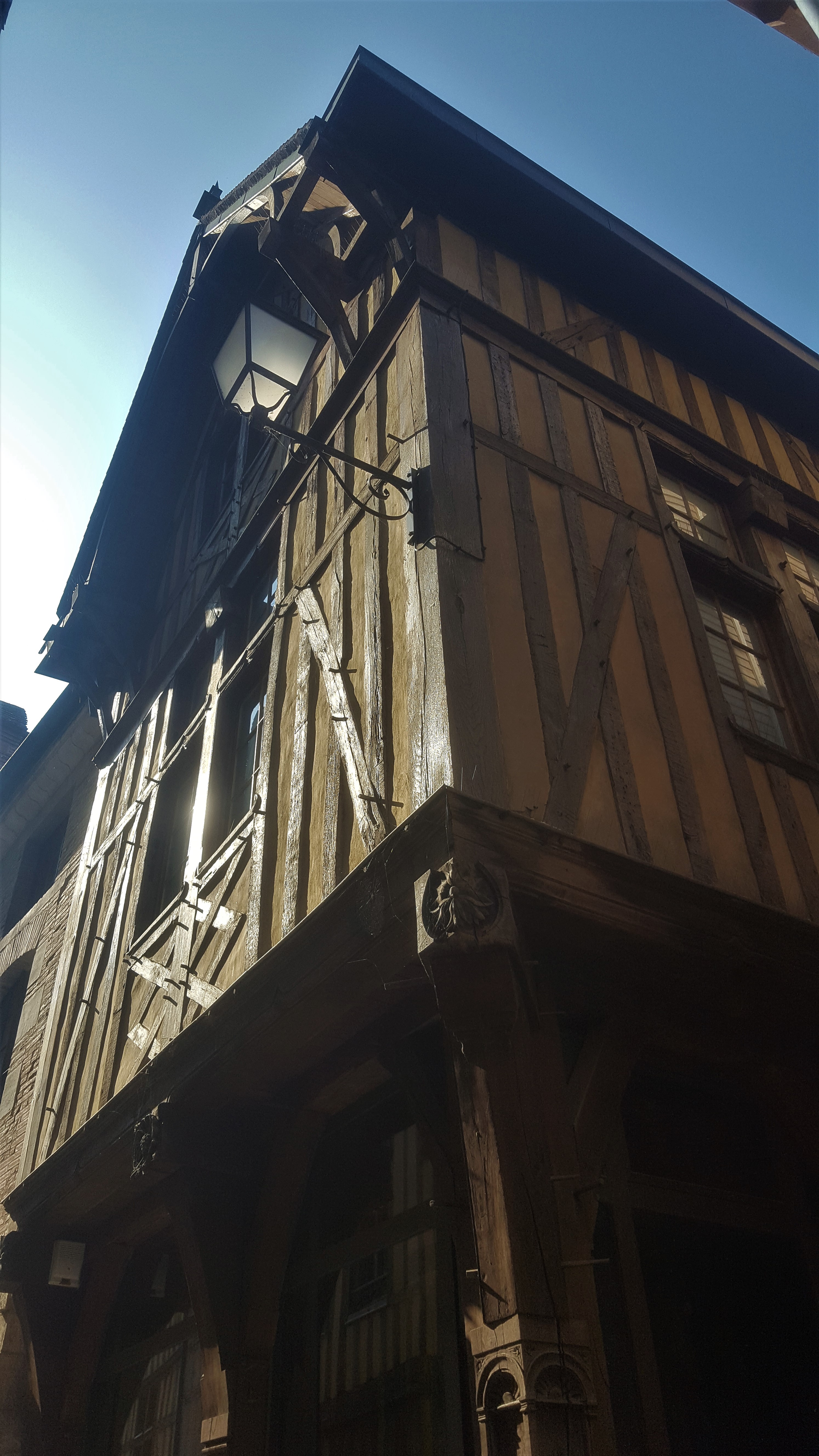
A Quiet Morning in a Medieval Town... Troyes!

A few weeks ago, I returned to the beautiful Medieval town of Troyes, having kept such pleasant memories of this incredible site.
Unlike my last visit, on a Summer's day a number of years ago, this one took place on an early Spring day...
There was one common element however; both trips being made in order to admire the art of painter Jean Marrel. More about that in another post...
Whereas my first visit had led me through the relatively busy streets and alleyways of the town, this time I found myself wandering through the virtually deserted roads and walkways that meander along and around the old town.
The vibrant blue skies brought out all the timber details on the architecture that seemed to tower above.
Despite a radiant light, the Sunday-morning air was bracing ! Hardly surprising then that I initially encountered so few people...
In fact, that suited me perfectly as I wanted to imagine life as it may have been in centuries past, and in the historical heart of the town this is almost possible to achieve.
Over the last few decades, the town municipality has taken measures to protect and preserve the historic buildings and monuments that reflect the former importance of Troyes.
The cash dispenser in the bank above is fairly discreet, and generally speaking the shops and services likewise tend to respect the cultural heritage of the sites that they occupy.
However little indicates the degree of commercial exchange in the town during the foires de Champagne of the Middle Ages or the size and significance of its textile industry of Troyes over the centuries.
The wealth of Troyes today is largely dependant on tourism, accommodating and catering for those drawn to the town. Restaurants and cafés flourish, of course, and some serve the incomparable local meat dish - andouillette de Troyes.
Many visitors come to purchase big brand clothes and other goods at the factory outlet stores outside town, but others converge on the historical centre and wonder at the architecture and negotiate those impossibly narrow alleys.
The Medieval half-timbered buildings - à colombage - with their variety of colours contrast against the striking blue sky and the 19th century architecture that cohabits this space ...
I couldn't help but wonder who lived in all these buildings, what stories lie behind any one of these amazing façades or within the many courtyards beyond. Not to mention the lives of those who commissioned or carried out the building of such archicture and its decoration...
The merman below has to be one of my favourite carved figures. What was his exact meaning?
Forms of man, beast and flower adorn beams, cornices and corners, peering out at us in our 21st century ignorance !
Many, of course, are symbols of the Christian faith and appear on private buildings in addition to the numerous churches of Troyes. I suspect that for the most part, their meaning is lost on us too as we are no longer able to 'read' them.
On this latest trip to Troyes, I soon realized that the town is deceptively big. It may appear light and accessible on first impression yet is as dense and complex as the wooden structures that hold up its 16th century architecture.
I will surely have to return to visit the other magical places of this town - one of these to be found behind this impressive wall - Le Musée de Vauluisant .

Friday, March 4, 2022

Beastly Goings-on in the Victoria and Albert Museum - The Dacre Beasts...

Whilst in the Victoria and Albert Museum, I came across the following four imposing figures, guarding the steps leading to one of the exhibit rooms of the British Galleries. The Dacre Beasts, as they are known, are the last remaining specimens of Tudor heraldic carving dating back to the reign of Henry VIII. Standing tall and proud at around 6ft in height, the red bull, black gryphon, white ram and crested dolphin tower over the visitors, much as they must have done in their former setting in Naworth castle in Cumbria from the early 16th century. There, the beasts loyally stood below a ceiling decorated with paintings of the sovereigns of England in a sign of the allegiance of the Dacre family to the king, and thus highlighting the Dacre motto: « Fort en Loialte » (Strong in Loyalty). The name Dacre, is said to originate from an ancestor, Acre, who served in the siege of Palestine at the end of the 12th century…
Unfortunately, due to the tightening of financial circumstances in the 21st century Dacre family, the beasts were taken from their noble ancestral home that had been their ‘turf’, so to speak, for almost 500 years. In order to finance the upkeep of the Dacre castle, the descendant, Hon Philip Howard, felt obliged to generate funds through the sale of these historic pieces. Put up for auction at Sotheby’s in 2000, they were bought up by the V and A at a bargain price and are now visible to the public. The image of cattle to market did come to my mind at this point as I learnt of their history but at least they have been preserved, unlike the majority of similar works that have not survived to the present day. But if only they could talk ; what would they say of their change in identity, as one man’s insignia has become a rather anonymous, albeit impressive prize for a museum in the new millennium ? Although we visitors have gained in this exchange – I had certainly never heard of the Fab Four prior to my visit – they are perhaps a little lost in their present setting and may even be experiencing an existential blur.
Not so in the past, when the beasts set in their rightful domain were said to have inspired the illustrations of John Tenniel (1820-1914) for Lewis Carroll’s Alice in Wonderland during the artist’s stay at Naworth. Even those unable to see the actual beasts in flesh and fur within their castle setting would have seen printed works, driven by the Victorian thirst for Medieval imagery, heraldry and that Gothic touch. At one moment in their history, such illustrations were nearly all that was left of these magnificent carved forms when a devastating fire swept through Naworth in 1844, and yet the beasts escaped being reduced to charcoal. Nevertheless, whilst they may have thankfully lived to tell the tale, their current location renders them somewhat speechless and the small museum notice next to them does not tell us a great deal of their story. And what glorious beasts these are !
Carved from a single oak tree trunk by unknown craftsmen at the very end of the 15th century or first part of the 16th, these figures were made for Thomas Dacre (1467-1525), the 2nd Baron Dacre of Gilsland to reflect the dynastic alliance of two powerful families in Northern England through marriage. Indeed, each beast is a ‘supporter’ ; the creature that is shown on either side of the shield of arms. The exact function of the beasts is not known, for although they were apparently used in Dacre’s funeral, it is believed that they were intended to be displayed during tournaments to mark his considerable military skill and valour. Dacre had been a soldier in the last episode in the English Wars of the Roses during which King Richard III was defeated and killed by Henry Tudor in the Battle of Bosworth in 1485. He then went on to fight in the Battle of Flodden against the Scots in 1513, thus earning his reputation of staunch defender of the English crown, with the battle cry "A read bull, a read bull, a Dacre, a Dacre".
Thomas Dacre appears to have been a decisive man of action off the battlefield too, for in 1488 he eloped with Elizabeth Greystoke (1471-1516), a landed heiress. The Dolphin therefore represents the Greystoke family, as it carries the banner which displays Elizabeth’s arms – three cushions of argent – clasped between its decidedly fishy fins. Indeed, I must admit to having great difficulty in believing this was actually the portrayal of a dolphin – it looks more like a sizeable salmon, even given artistic licence ! The ram meanwhile, is the supporter of the De Multon family – from Ranulph de Dacre’s wife – and it bears a banner with a lion ‘passant’(walking with right fore paw raised) with three bars gules (heraldic tincture of red) upon argent (silver). The rather closely-shorn fleece and lack of horns make the ram look somewhat sheepish - not to say lacking in virility - but his very ostentatious male appendage would appear to define and display his ancestral power and position, presumably in a manner similar to (the rather more discreet) portrayals of Henry VIII in the royal portraits of Hans Holbein the Younger.
This same feature is shared by the two other beasts - the bull and the gryphon – whilst the Dolphin must content himself with a crown; fair is fair! The red bull of Dacre bears gilded horns, hooves and tongue in honour of his ancestry and wears a chained crown collar around his neck. He clasps the banner between his cloven hooves, displaying the arms of the Dacres – three white scallps on a red field. The black gryphon is the supporter of the Dacres of Gilsland and bears three rose chaplets (garlands of leaves with flowers) that are the 19th century arms of the Greystoke family. After the fire in 1844, the four beasts were repainted using Victorian colours that sought to recreate the initial tinctures, and the coats of arms were added at this stage. The architect in charge of restoration also saw fit to to gild the bull’s 'pizzle', an act that shocked the Victorian sensitivities of certain visitors to the castle at that time. I fear that the photos here may be banned due to ‘inappropriate content,’ which would be the ultimate dishonour to these fine beasts. Since they were on full public display in the Victoria and Albert, in all their finery, I trust they are ‘safe’ on this post too. How else can we learn about historic heraldry, with or without the infamous pizzle?

Monday, July 26, 2021

The Reappearance of La Maison des Musiciens... 100 years later!

A few years ago, I wrote about the Maison des Musiciens that disappeared from Reims in the hostilities of the First World War over a hundred years ago. A copy of the façade has just been unveiled at the original site, some 800 years after the initial construction of the building! For the moment, most of the base is fenced off by metal hoarding so the final effect is not yet visible, but here's a glimpse of two of the five musicians. Hmm.... Not entirely sure what to think for the moment as the project still looks rather too 'clean' and more than a little like a 3D print-out, but perhaps some city grime will lend a greater air of authenticity and age to the whole.

Monday, April 29, 2019

The Lady and The Unicorn - Musée de Cluny

La Dame à la Iicorne: Sight


I recently went back to one of my favourite places in Paris; le Musée de Cluny. I finally saw the newly finished entrance and reception area that are able to cater to the needs of a wide range of visitors and therefore meet the demand for accessibility for all.

Touch
There were certainly many people queuing to enter – far more than I can recall when the public were plunged into one of the last vestiges of medieval Paris the moment they had purchased their ticket in the former hôtel particulier.
Taste
The edifice had originally been constructed to house the abbots of Cluny at the end of the 15th century, thus bridging the Gothic and Renaissance period. Needless to say, it was ill-adapted to hosting visits some 6OO years later and some modernisation work was vital.

Smell
However, I was very sad to see that a hideous bronze carapace has defaced the site outside. Inside, ugly modern functionality seems to have taken precedence over any attempt at aesthetic harmonisation and has obliterated the calm, unique atmosphere of the setting.

Hearing
Climbing the new steps, my heart sank; I could have been in the atrium of any other uninspiring 21st century building, that probably will not make 60 years, let alone 600. Nothing I laid my eyes upon appeared even vaguely noble, attractive, lovingly or artfully crafted, but then that’s my opinion. I couldn't face including a photo here.

Sight
Now, at least, absolutely anybody can enjoy the treasures of Musée de Cluny and one of the most renowned of these must surely be the tapestries of the Late Middle Ages, La Dame à la Licorne. Having been cleaned and restored in 2012 – requiring some 2,3OO hours of painstaking work – the six tapestries are now hung on flat wall surfaces, as opposed to the curved forms in the old arrangement. Furthermore, visitors are now able to take photos, without flash, and so can prolong the pleasure of seeing these magnificent works after the initial visit.

A Mon Seul Désir: Love
With the multitude of details that feature in all six pieces, it is a privilege to pour over these at leisure – discovering new aspects and trying to find their symbolic meaning within the whole or simply appreciating the fine observations.

The Letter: Tapestry from the Southern Netherlands 
These tapestries stem from the long-established custom of suspending vast wall hangings to provide insulation in cold, draughty buildings such as castles and churches, in addition to offering rich illustrations of stories, fables, myths, moralistic tales of religious and/or historical significance.

Smell
Whilst such works were once the preserve of royalty and the church, in Gothic and Renaissance times these tapestries, art forms in their own right, were used by the nobility and the merchant classes too in order to express both material wealth and personal values to affirm status. The Lady and the Unicorn collection is thought to have been a private commission, simply intended for display to the select few, and without a direct ecclesiastic function.


The Unicorn tapestries here display many of the characteristics of other works of the same period – both in France and in the southern Netherlands, with special attention given to foliage, fruits, flowers, animals and the feminine form. A millefleur background, with its profusion of delicate intricate flora and fauna, was common from end of the 15th century, but was rarely of a red colour as is the case here.


I love all the expressive animal forms – going from the relatively commonplace creatures (dog, rabbit, lamb, fox, duck, magpie, bird of prey, heron) to the rather more exotic species (monkey, lion, genet).


The body language and quizzical regards of all these creatures seem to be so familiar to any viewer today, despite the centuries that separate us from them.

Taste
The unicorn and a banner-bearing lion take centre stage alongside their lady. Both beasts were often used in common imagery. The mythical figure of the unicorn was frequently used in allegorical representations from antiquity onwards, lending itself to different symbolic interpretations; purety, chastity, Christ, the Virgin Mary, untamed nature, ferocity. The exact meaning of the unicorn’s role in the Cluny tapestries is unclear, as is the final message conveyed by the overall work. Nevertheless, the core theme of the Senses is manifest throughout each separate tapestry.

Smell
The symbolic importance of the five senses was not the preserve of the Middle Ages nor solely of the Christian faith. It was, in fact, part of a philosophical tradition with roots in classical thought from Antiquity. The Greek philosophers Aristotle (384-322 BC) and Galenus (129-200), had long before developed their theories of perception and intelligence. Later, the ‘father of modern medicine’ the Persian physician and philosopher Avicenna (980 – 1037) had argued that just as there are the five external senses—vision, hearing, touch, taste, and smell—so there were five internal senses; common sense, retentive imagination, compositive imagination, estimative power, and memory.

Touch
Virtue and perfection could be reached through the appropriate use of the bodily senses, leading to an understanding of God, which was the highest level of knowledge, and the attainment of the righteous self and soul. In this manner, to the learned and clerical body of the Middle Ages and the early Renaissance, the five senses were the connecting link between human form and soul.

Taste
The external senses could thus represent the keys to unlock the door to Knowledge or could, conversely, obstruct this entrance by acting as tempting lures to sin and damnation. With their unique power to sweep the being to a higher, spiritual level, or plunge him into an abyss, the senses needed to navigated carefully. It was deemed that the senses were not of equal importance and as such, should be classified in accordance with an established hierarchy to guide the individual through this perillous terrain. There were numerous reminders of such dangers. Representations of the Seven Deadly Sins were widely available - pride, greed, lust, envy, gluttony, wrath and sloth were portrayed in order to warn the weak of such peril. 

Smell
The five senses were thought to correspond to the four elements. In this framework, earth was correlated to touch; water to taste; air – smell and hearing; fire – sight. Touch was considered to be the lowest, basest sense that was integral to the carnal, physical world. Likewise, taste could lead to sinful pleasure. Smell, however, pointed towards the spiritual over the material as it stimulated the imagination, whilst sight and hearing were the noblest senses that marked the transition towards a transcendental realm and the Divine. The ability to see and hear, the highest gift, was vital to learning, contemplation and knowledge (interestingly, encyclopedias were often referred to as ‘mirrors’).

Hearing
A harmony of the senses could enable the soul to free itself from its base constraints, to transcend an animalistic state. Indeed, at the very top of the hierarchy was the sixth sense – governed by the heart. Unlike the lesser senses, that lead outward onto the material world, the sixth sense offered a profound, interior meaning and understanding ; spiritual love. The Italian philosopher, Ficino (1433-1499) argued that Reason was indeed the sixth sense and was set in the heart. Likewise, the French scholar Jean Gerson (1363-1429) cited the heart as the only inner sense « Et je parlerai des six sens, cinq dehors et un dedans qui est le cœur ».

Sight
The themes of temptation and redemption, linked to the senses and and their bodily organs, were primarily spiritual concerns. Nevertheless they were also associated with notions of courtly love in the 12th century and were treated in secular, allegorical representations too. The Lady and the Unicorn, is a case in point as the beautifully attired, noble lady attends to occupations or rituals that exemplify the power of touch, taste, smell, hearing and sight in this jardin d’amour. The scenes appear to demonstrate acts of preparation for love, and to lead to the final tapestry.

A Mon Seul Désir
This piece,‘A Mon Seul Désir, seems to play on a certain ambiguity. Is this woman preparing for her chivalrous knight-errant or getting ready to renounce this world of earthly pleasures for the spiritual ? Is she awaiting the purity of amour courtois or the pure love of God? There are references to quests and hunting (the birds of prey and dogs), power and domination (the lion), virginity and innocence (the unicorn). Viewers from the Middle Ages would have been fully acquainted with such symbols since Medieval bestiaries traditionally linked the quirks and failings of the animal kingdom to reflect the weaknesses of the human one.


Here, the monkey mimics some of the gestures of his mistress as it eats in Taste, and sniffs a rose in Smell. whilst the unicorn gazes at itself in a mirror in Sight. In the sixth tapestry, A Mon Seul Désir, the lion and unicorn hold open the awning for their lady as she prepares to leave their company. Whilst the first tapestry, Touch, sees her and the beasts around her tied and chained to material objects – perhaps governed and grounded by lesser instincts – in the final tapestry she seems to hand over her jewellery and thus free herself of material wealth.


No one will know the definitive meaning of the Lady and the Unicorn, if indeed there is just one. However, far more people will now be able to observe the work and try to come to their own conclusions – or simply enjoy it for its own sake, as a beautiful piece of art.


When I was there, an old couple were visiting, commenting in great detail on the tapestries that were on display. They seemed to take real pleasure observing and discussing the work and that added to my pleasure as I eavesdropped on the talk. Monsieur was in a wheelchair, pushed around by his wife, but were able to move around the exhibition rooms relatively freely, something that would have been most problematic a few years ago.


Mind you, I still can’t help but miss the old entrance to the museum, at the heart of the ancient courtyard, with the rich architecture towering above, where you stepped out of the streets of 21st century Paris into the Middle Ages.

A Mon Seul Désir