Showing posts with label The Tudors. Show all posts

Sunday, August 10, 2025

Threads and Veins... Tudor Portraiture.

There is something about Tudor portraiture that serves as a powerful antidote to all the ugliness, sleaziness and general indolence that appear to be swamping every aspect of life today, be that concrete reality or its virtual, screen-based version. I would say that simply visiting a museum or art gallery is akin to entering a haven, but that is not entirely the case any more as all that I wish to escape is seeping into the sanctuary, tainting everything in its passage. And therefore the earnest representations of the centuries-old sitters, shown in the glory of their attire is somehow uplifting, regardless as to whether these characters were actually decent individuals. The enigmatic smile of the beautiful young woman above - Lady Darcy of Chiche - painted in 1590 is just as captivating as that of da Vinci's Mona Lisa, as she looks out at us, literally framed by her finery.
We can see a faint, delicate blush on her cheeks that is offset by the painstaking detail of her clothing, where each thread is rendered with incredible accuracy. This work was painted a few years before her separation from her husband and intriguingly, the French inscription Jamais déréchef (Never again) is included!
The hands are strangely inexpressive, however, and look like those of a porcelain doll, hanging down in limp fashion, curiously lifeless despite the accessories she holds onto. The same could be said of the c.1605-10 portrait above, of a certain Mary Clerke standing in an uncomfortable, stiff pose. With her arms stretched out at an odd angle, she draws attention to the book published by her husband. Mary's hands almost look like white gloves!
The following portrait of an unknown pregnant lady, c.1595 by the famous Flemish painter Marcus Gheeraerts is joyous, with the delicate smile, expressive hands and, of course, the stunning dress...
We can imagine every stitch and thread of the white diaphanous clothing and count all the cultured pearls that adorn it, whilst her tender hands bare veins that are perhaps an indication to the life within her...
The somewhat icy expression displayed by the future Lady Morton in her grand portrait c.1620 is belied by the warm blood that we see in her veined hands that delicately grip onto her elegant accessories of fan and lacy handkerchief...
Although her dark beady eyes stare out at us in a challenging, smug manner, without any desire to charm, her clothes and those oddly gentle hands surely win over her public. The embroidery on her gown is simply exquisite, set against the sheen of the satin material and as for the lace, well, what can you say?
The young girl of 21 years clasps her hands as she gazes out from her framed portrait, the delicate colouring of her complexion contrasting with the dark background that brings out the pretty flowered gown and the carnation flower tucked behind her ear. Apparently she later went on to marry an elderly marquis but here we see her in the bloom of youth preserved forever in this portrait of 1569, in all her beauty. I wonder what kind of life she lived?
There is a similar striking contrast between background and portrait in the c.1565 painting of another unnamed lady of status, seen here clasping a beautiful cameo bearing a symbolic image of Prudence. Perhaps it was out of prudent discretion that she slightly averts her gaze.
All these paintings are visible in the Tate London.

Sunday, September 8, 2024

This too shall pass...

As the years go by, I find something strangely comforting in looking at portraits of individuals long departed. As they stare out at us, across the centuries that separate their lives from ours, I try to read any emotion that may lie behind their quizzical air and imagine the personality beyond, and likewise seek to piece together a notion of their existence from the scraps of information offered. Most of these endeavours do not lead very far, for even if I learn of the broad framework of their life events from my twenty-first century vantage point, I can never grasp how their lives were led, or understand the full extent of the power exerted on these by forces and influences that have relatively little hold or impact for the majority of us nowadays. However, I can recognise that these individuals experienced much the same gamut of feelings that we do today, and why wouldn't it be so? Hope, fear, love, grudges, ambition, disappointment; all crisscrossed past lives and drove existences much in the same way as they do now, albeit then untempered by the knowledge, science and technology and indeed hindsight that shape society today. They indeed posed the same fundamental questions concerning our time on Earth that we might today, if only we were not so preoccupied by consuming life in every possible sense. Ultimately they had a clearer understanding than us that life is short, regardless of how many years it extends, and that each stage and event passes and leads inevitably to the next, waxing and waning until death itself. Nothing lasts...
This summer I discovered the portrait above of Sir Henry Unton (1558-1596) at the National Portrait Gallery, London, and was rather suprised to see it referred to as a 'well-known' piece, for I had certainly never heard of it. The artist himmself is unidentified and yet his work lives on, hundreds of years on! And what an intriguing painting this proved to be... Set amongst many other Tudor portraits, this work was indeed unique. Unlike the full-length or the bust portraits that focus primarily on the figure, here the relatively youthful face of this diplomat - decked out in his Elizabethan finery - is surrounded by insightful vignettes of his existence, from cradle to grave. Commissioned by his widow, following his death in 1596, the ‘story picture’ of Sir Henry Unton lays out the key events of his 39 years in an anti-clockwise sequence that starts in the bottom right-hand corner. In almost each of these scenes - excepting his birth and death - we see miniature images of Sir Unton as the protagonist, all virtually the same scaled-down version of the main central portrait. The memorial portrait was very much in keeping with the interest of Elizabethan and Jacobean society for life's ephemerality but here, instead of being a rather dismal memento mori to 'remember that we must die', this visual narrative appears to be more a celebration of a short but active existence that also offers us a glimpse of life in the late 16th century.
In the detail above, we see the baby Henry in the arms of his mother, Anne Dudley (née Seymour), the Countess of Warwick, in Unton House. Her status is apparent from her fine clothes, the lady's maids, the odd little dog lying by her feet, and the richly-dressed table in the background. We have no real notion, however, of just how remarkable this particular individual was in her own right. Indeed, thanks to her Humanist education, along with her sisters (Jane and Margaret), she composed Latin poetry to honour Marguerite de Navarre on her death - the first published work written by English women before the 1560s; quite a feat. Towards the end of her relatively short life (dying in 1588 at just 50 years), Anne suffered from episodes of madness and was finally in the custody of her son, Henry. In this portrait however, we simply see the infant Henry seemingly scowling at a nurse who prepares to relieve the mother!
Youthful Henry is later depicted at study in Oriel College, Oxford, in 1573 before he went on to study Law in London and to travel beyond the Alps to Venice and Padua. I love the wonky perspective of the architecture around Henry, and the image of him as the studious young man, disportionally large, with his nose buried in a book at the open window!
We also see Henry on horse-back, holding up a parasol, whilst riding a strangely lumpen white stead, before going on to serve with the English army in the Netherlands (1585-86), a duty for which he was knighted in 1586.
He became a resident ambassador to France in 1591, but returned to England the following year suffering from jaundice. Back in his home land, Henry was elected as an MP for Berkshire in 1593 and his worldy success is reflected in the banquet scene, where he sits in a central position, almost with a twinkle of glee in his eye!
In another scene, Henry plays the lute while a masque of Mercury and Diana is performed around him but these festivities are offset by calmer moments, given to music-making, study or discussion....
I love the image of Henry below, cutting a solitary figure, with his strangely-proportioned arms stuck in front of him, as if as a hasty addition on the part of the artist to give Sir Unton more gravitas!
Henry again took up an ambassadorial role in 1595-6, as he returned to France but this was ended by an almost fatal fall from a horse, followed by a fever that indeed resulted in his demise, despite care from the royal physician to Henri IV. Henry is represented on his death-bed in the painting, with individuals at his side, displaying varying degrees of emotional response...
Apparently Henry's body was transported across the Channel to England in a black ship, as a mark of respect, and this we see in the background of the painting, with the hearse being brought back to his home of Wadley House, near Oxford.
From there, the funeral procession leads on to All Saint’s Church, Faringdon, where his funeral was held in 1596. The somber line of mourners in their long black clothing accompany the pall-bearers who carry Henry's coffin, likewise swathed in black...
Sir Henry Unton's final resting place is an imposing tomb monument which bears his effigy in recumbent form, leaning on one elbow, a large sword by his side and his widowed wife kneeling above him.
Presiding over all of these different scenes is, of course, the central image of Henry Unton himself, in his prime. He is seated in an impressive chair with a cameo necklace honouring the French king, Henry IV, resting on the desk from which he writes. Just by his shoulders, are the allegorical figures of Fame and Death, the one as an angel blowing a trumpet and holding out a coronet to herald elevated status and success, whilst the other is a skeletal form that brandishes a hour-glass to mark the ephemeral nature of Life, along with its trials and tribulations.
Life and Death, light and darkness are also underlined by the symbolic sun and crescent moon images in the corners of the work, with beams directed at the figure of Sir Henry in the different scenes, guiding us where the inscriptions can no longer do, having become illegible with the passing of time - how fitting!

Thursday, July 25, 2024

Face Values; Tudor Portraiture...

There is something absolutely mesmerising about the portraits from the extensive Tudor period (1485 - 1603) which of course includes the Elisabethan era, with such magnificent works as the one above (detail of 1575 painting of Queen Elisabeth I by unknown artist). Many of these can, of course, be seen at the National Portrait Gallery in London and during a recent visit, I tried to identify their unique appeal. However it is rather difficult to define a common trait in such varied works that extended over a hundred years in English history, and evolved accordingly but I would say it is their peculiar proximity to us which intrigues us as these individuals stare out from a set period in time yet reach out to us in a more universal, timeless way.
Certainly, the intricate rendering of their lavish attire catches the viewer's attention, leading us to peer at the work, picking out and pouring over all the breathtaking details, like crazed magpies. Above is Queen Elisabeth's last 'favourite'courtier, Robert Devereux (1565-1601) who was said to have a nature 'not to be ruled'. Looking at his portrait executed by an unknown artist in the style of Marcus Gheerhaerts in the early 17th century, his placid, frank expression, soft boyish features and elegant appearance belie the fact that he paid for this defiant attitude dearly, with his own life. He looks right at us in rather an unsettling way due to his frank gaze, likewise Philip Sidney (1554 - 1586) - another of Elisabeth's courtiers - as he stares out at us unquestioningly, appearing to wipe out the odd 430 years since his death.
And although this portraiture was very much a product of its time and historical context, in its essence it has a unique ability to connect with us, across a span of several hundred years, perhaps in the same way that we can identify with certain universal human traits explored in Shakespeare's writings.
Above is Henry VII, the Lancastrian king (1457-1509) who united the two rival Houses of Lancaster and York of the Plantagenet dynasty through his marriage to Elisabeth of York in 1486, having himself defeated Richard III in the Battle of Bosworth in 1485. There is some debate into the accuracy of the legend of Henry acquiring his rival's crown on the battlefield but either way, as a result the Tudor dynasty was born. This is one of the earliest paintings on display, but is highly effective. Looking at the 1505 portrait, we can literally feel the determination of the first Tudor monarch to hold onto his newly-established position - his hands emerge from the portrait as he grips the symbolic flower that represents the end of the Wars of the Roses. No jewelled rings distract our attention, as the king stares at us directly, seemingly to defy anyone who should question his right to the throne. Compare to that the following portrait of the maligned Richard III, painted some time after his death in 1485... Here he is seen fiddling with his ringed finger, his brow furrowed in an expression of concern whilst his eyes avoid contact with the public, creating a rather shifty impression that seems to prove Henry VII's greater suitability and apparent superiority as monarch.
Although the artist of Henry's portrait is unknown, its approach is in keeping with a the style and role of the genre which had already started to flourish in the latter half of the 15th century. Indeed, Henry's image was destined to be sent to Margaret of Austria in 1505, when diplomatic negotiations were to take place to find the widowed king a new wife. For the Royal portrait served a serious role, beyond mere decorative purposes, it was a tool for portraying the individual as the personification of power and integrity, thus managing and maintaining regal status. In a similar manner, portable portraits could be exchanged between sovereigns in the process of sealing a treaty or forming an alliance. Below is Queen Mary (1516-1568) by Hans Eworth (cerca 1554) in a portrait thought to be used in marriage negotiations with Philip II of Spain. She appears curiously girl-like here for a 37-year-old and holds a rather modern-day position with her back slightly arched back as she stares at us with an enigmatic expression. Either way, the portrait seems to have served its purpose and it certainly did the trick, for Mary and Philip married in 1554!
Many of the Tudor paintings were commissioned from foreign artists, for the most part from Germany or the Netherlands. The direct representation of the static individual executed with highly realistic detail - as opposed to a narrative work with acts and gestures to be 'read' - suited the function of the portrait. The focus is essentially on the figure in all his/her finery, often set against a dark, relatively simple background that does not detract from the key element; the subject as a person and not as an actor, playing out some theme. Below is William Cecil (1520-98), Queen Elisabeth's advisor as Secretary of State, an oil painting again by an unknown artist in 1570. Here is a fine figure of authority indeed - just on appearances alone - and there is no avoiding that intimidating stare!
Although Tudor portraiture bears many symbolic references through the strategic use of material objects - clothes, headwear, jewels etc - its approach is relatively simple and can literally be taken at face value. This could perhaps account for it being so greatly appreciated today; we do not need to fully understand the symbols to enjoy the work on a more basic level.
How could we not be stunned by the exquisite renditions of fine clothing made of damask, brocade, silk, satin and embellished with fur, feathers, lace and jewels as in the portrait of Queen Elisabeth (1575) above by Nicholas Hilliard? How could we not be amazed by the intricate, yet surely cumbersome and uncomfortable ruffs and cuffs that adorned necks and sleeves of the most powerful beings in society?
Above is a representation of Elisabeth on her coronation day in 1559 at the age of 25. She appears somewhat doll-like, with her frozen expression, a young almost naive face staring ahead, whilst wooden arms and hands clasp the orb and spectre. Yet her piercing eyes defy us to question her; she forces us to acknowledge her in an uncanny manner. The use of a stark figure depicted as if on centre stage, with minimal props and no cast members to draw attention away, is rather reminiscent of icon painting, with a 'flattened aspect'. Certainly the Northern European portraiture which largely led the genre had its roots in Gothic traditions of painting and manuscript illumination, using the oil paint medium to great effect with realism and illusionism in jewel-like colours. However, until the influence of the Italian Renaissance, with its use of perspective and anatomical study, such portraits tend to lack accuracy, giving the sitter a certain unwieldiness.
If we look at the representation above of Lady Jane Grey (1537 - 1554) painted at the end of the 16th century by an unknown artist with that of Mary, Queen of Scots (1452-1487) below, by an unknown artist after a piece by the great English portraitist, Nicholas Hilliard (1547-1619), in the same time frame, the difference is manifest...
The detailed altarpieces and church panel paintings created in the Burgundian and Habsburg Netherlands from the early 15th century were the keystone of the Northern Renaissance. The influence of artists such as Jan van Eyck (cf Arnolfini Portrait 1434) was incredibly significant, long-lasting and far-reaching. Unlike the Italian Renaissance that drew inspiration from the classical aesthetics of ancient Greece and Rome to create harmonious and idealized forms from mythology painted in the tempera medium, the Northern countries represented the divine in realistic images of daily life in versatile oil paint. Below is Robert Dudley (unknown artist - 1575), one of Queen Elisabeth's favourite courtiers, who himself went on to commission several portraits; his self-confidence and pride are evident here!
When the Reformation swept across Europe at the beginning of the 16th century, the theological divide that emerged between Roman Catholics and Protestants lead to a North-South split in Europe. As the Northern countries followed Protestant theology, they shied away from religious painting for fear of being accused of sinful devotion of idols. Thus they then moved towards a secular approach with historical paintings, landscapes, still life and more importantly, portraiture.
In the portrait above, from 1568, of a leading courtier to Elisabeth, realised by Anthonis Mor - court artist to Philip II in Spain - there are symbolic references to bonds of loyalty with his ring and patterns on his shirt yet no references to biblical themes. Yet the Tudor period was dominated by religious rift as Renaissance humanism and above all the Protestant movement spurned the excesses of Catholic religious practices and the extremes of Papal authority in Rome. When Henry VIII's wish for the annulment of his marriage to Catherine of Aragon was denied, his fury and frustration at his inability to marry Anne Boleyn led to the English Reformation and the establishment of the Church of England, free of Papal authority, with Henry as Supreme Head. Henry enjoyed unprecedented authority and occupied an unparalleled position, and this power and majesty is fully reflected in Hans Holbein's preparatory drawings for a work from around 1537, showing the king in a dominant pose, legs astride.
To portray his supremacy, Henry required a painter worthy of the task and indeed, the German artist Hans Holbein the Younger (1497 - 1543) was appointed the official King's Painter. Having trained under his artist father, and studied the work of the Italian Renaissance painters Leonardo da Vinci and Andrea Mantegna in Italy, by the time he came to England in 1526, he possessed unmatched skills and sophistication in technique and artistic approach. No English artist could compare, and his art would influence the entire Tudor era and well beyond. Just a glance at any of his work shows how far advanced he was in comparison to his contemporaries... Here is a copy of his 1527 portrait of William Warham (1450 - 1532) - Archbishop of Canterbury - painted by an unknown artist. Warham was one of Holbein's first patrons and by the 1530's, the artist was the most sought-after portraitist amongst English nobility.
Unfortunately, it was Holbein's beautifully executed portrait of Anne of Cleves (1539), that played a key role in Henry VIII's decision to marry the apparently eligible young German woman. Desperate to secure the Tudor dynasty by siring a heir, Henry wished to take on a fourth wife following the death of the queen, Jane Seymour. Judging Anne's suitability on the portrait presented to him, Henry agreed to go ahead with the marriage yet to his great dismay, reality did not meet the expectations the portrait had led him to nurture; after six months the marriage was declared unconsummated...
Despite being supposedly Protestant, under the Divine Right of Kings, the Church of England and Henry's kingdom followed certain Catholic doctrines when it suited his political and personal interests. Religion was synonymous with politics and the power struggles therein and the rest of the Tudor years would see the kingdom torn between the different faiths.
The striking figure above is Mary I, the first queen to rule England - born from Henry VIII's marriage to Catherine of Aragon. Known as Bloody Mary, she instigated a reign of terror, calling for the persecution of all heretics - Protestants - in an attempt to bring back Roman Catholicism to England, following the reign of her Protestant half-brother, Edward VI. Although the portrait dates from the end of the 16th century, its style is relatively stark - simplistic even - and devoid of excess detail, if compared to Holbein's work of some 50 years earlier. A certain severity is clearly visible in Mary's expression, and with her eyes averted and her jawline clenched, she appears disciplined and determined...
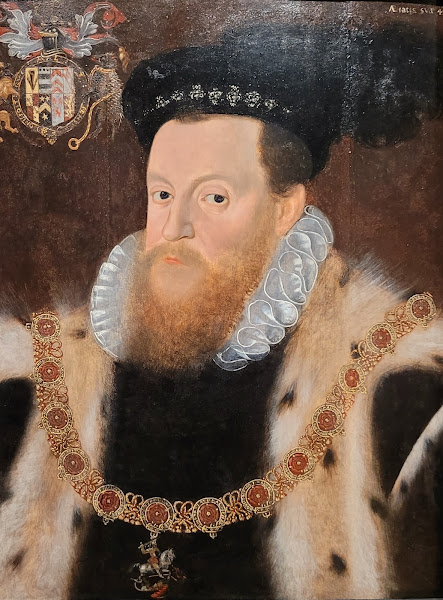
A similar dour note can be seen in the portrait of Sir Henry Sidney (1529 - 1586) by George Gower in 1585. As Lord Deputy of Ireland, he oversaw the implementation of English law on Irish soil. The rich fur-trimmed gown, heavy livery collar and intricately pleated ruff are offset by an oblique stare that could turn milk and a down-turned mouth, lips pursed in disapproval!
Sovereign rule over the oceans and foreign territories was essential to Elisabeth 1's reign and was reflected in visual references that serve as backcloth to late Tudor portraits. Above is the Elisabethan explorer and privateer, Sir Francis Drake (1540 - 1596), who circumnavigated the world in 1577-1580 and here places a firm hand on a globe, and stares at us a little defiantly.
In the so-called 'Ditchley' portrait of the Virgin Queen (1592)by Marcus Gheeraerts the Younger , Elisabeth is shown in all her finery, standing on the top of a globe, a map of her kingdom beneath her feet, as she turns her back on the thunderclouds gathered in the background, facing us and the brighter skies ahead. Again, the portrait's odd anatomical representation of the queen's body, with its strangely elongated arms, curious little hands and feet sticking out from the voluminous gown makes this work appear world's apart from the mastery of Holbein. Yet the little eyes are there, beadily watching out at us... Later, miniature portraits would become highly popular in courtly rituals and in this field of artistry, Nicholas Hilliard excelled, creating tiny paintings of perfection such as this one of Elisabeth...

Friday, March 4, 2022

Beastly Goings-on in the Victoria and Albert Museum - The Dacre Beasts...

Whilst in the Victoria and Albert Museum, I came across the following four imposing figures, guarding the steps leading to one of the exhibit rooms of the British Galleries. The Dacre Beasts, as they are known, are the last remaining specimens of Tudor heraldic carving dating back to the reign of Henry VIII. Standing tall and proud at around 6ft in height, the red bull, black gryphon, white ram and crested dolphin tower over the visitors, much as they must have done in their former setting in Naworth castle in Cumbria from the early 16th century. There, the beasts loyally stood below a ceiling decorated with paintings of the sovereigns of England in a sign of the allegiance of the Dacre family to the king, and thus highlighting the Dacre motto: « Fort en Loialte » (Strong in Loyalty). The name Dacre, is said to originate from an ancestor, Acre, who served in the siege of Palestine at the end of the 12th century…
Unfortunately, due to the tightening of financial circumstances in the 21st century Dacre family, the beasts were taken from their noble ancestral home that had been their ‘turf’, so to speak, for almost 500 years. In order to finance the upkeep of the Dacre castle, the descendant, Hon Philip Howard, felt obliged to generate funds through the sale of these historic pieces. Put up for auction at Sotheby’s in 2000, they were bought up by the V and A at a bargain price and are now visible to the public. The image of cattle to market did come to my mind at this point as I learnt of their history but at least they have been preserved, unlike the majority of similar works that have not survived to the present day. But if only they could talk ; what would they say of their change in identity, as one man’s insignia has become a rather anonymous, albeit impressive prize for a museum in the new millennium ? Although we visitors have gained in this exchange – I had certainly never heard of the Fab Four prior to my visit – they are perhaps a little lost in their present setting and may even be experiencing an existential blur.
Not so in the past, when the beasts set in their rightful domain were said to have inspired the illustrations of John Tenniel (1820-1914) for Lewis Carroll’s Alice in Wonderland during the artist’s stay at Naworth. Even those unable to see the actual beasts in flesh and fur within their castle setting would have seen printed works, driven by the Victorian thirst for Medieval imagery, heraldry and that Gothic touch. At one moment in their history, such illustrations were nearly all that was left of these magnificent carved forms when a devastating fire swept through Naworth in 1844, and yet the beasts escaped being reduced to charcoal. Nevertheless, whilst they may have thankfully lived to tell the tale, their current location renders them somewhat speechless and the small museum notice next to them does not tell us a great deal of their story. And what glorious beasts these are !
Carved from a single oak tree trunk by unknown craftsmen at the very end of the 15th century or first part of the 16th, these figures were made for Thomas Dacre (1467-1525), the 2nd Baron Dacre of Gilsland to reflect the dynastic alliance of two powerful families in Northern England through marriage. Indeed, each beast is a ‘supporter’ ; the creature that is shown on either side of the shield of arms. The exact function of the beasts is not known, for although they were apparently used in Dacre’s funeral, it is believed that they were intended to be displayed during tournaments to mark his considerable military skill and valour. Dacre had been a soldier in the last episode in the English Wars of the Roses during which King Richard III was defeated and killed by Henry Tudor in the Battle of Bosworth in 1485. He then went on to fight in the Battle of Flodden against the Scots in 1513, thus earning his reputation of staunch defender of the English crown, with the battle cry "A read bull, a read bull, a Dacre, a Dacre".
Thomas Dacre appears to have been a decisive man of action off the battlefield too, for in 1488 he eloped with Elizabeth Greystoke (1471-1516), a landed heiress. The Dolphin therefore represents the Greystoke family, as it carries the banner which displays Elizabeth’s arms – three cushions of argent – clasped between its decidedly fishy fins. Indeed, I must admit to having great difficulty in believing this was actually the portrayal of a dolphin – it looks more like a sizeable salmon, even given artistic licence ! The ram meanwhile, is the supporter of the De Multon family – from Ranulph de Dacre’s wife – and it bears a banner with a lion ‘passant’(walking with right fore paw raised) with three bars gules (heraldic tincture of red) upon argent (silver). The rather closely-shorn fleece and lack of horns make the ram look somewhat sheepish - not to say lacking in virility - but his very ostentatious male appendage would appear to define and display his ancestral power and position, presumably in a manner similar to (the rather more discreet) portrayals of Henry VIII in the royal portraits of Hans Holbein the Younger.
This same feature is shared by the two other beasts - the bull and the gryphon – whilst the Dolphin must content himself with a crown; fair is fair! The red bull of Dacre bears gilded horns, hooves and tongue in honour of his ancestry and wears a chained crown collar around his neck. He clasps the banner between his cloven hooves, displaying the arms of the Dacres – three white scallps on a red field. The black gryphon is the supporter of the Dacres of Gilsland and bears three rose chaplets (garlands of leaves with flowers) that are the 19th century arms of the Greystoke family. After the fire in 1844, the four beasts were repainted using Victorian colours that sought to recreate the initial tinctures, and the coats of arms were added at this stage. The architect in charge of restoration also saw fit to to gild the bull’s 'pizzle', an act that shocked the Victorian sensitivities of certain visitors to the castle at that time. I fear that the photos here may be banned due to ‘inappropriate content,’ which would be the ultimate dishonour to these fine beasts. Since they were on full public display in the Victoria and Albert, in all their finery, I trust they are ‘safe’ on this post too. How else can we learn about historic heraldry, with or without the infamous pizzle?