Showing posts with label Creeping Modernity. Show all posts

Monday, March 30, 2026

Kelmscott House...

Kelmscott House
An armoury of weapons against the weariness of life; such was the metaphor used by William Morris to describe the ideal book. How weary would he feel today, if he could merely glimpse our present society? He who fought for ‘beauty accessible for all’ in a world where art, design, form and content would together embellish and enhance the life of all social classes, what would he say? 


This great man, born into Victorian England (1834-1896), battled for reform against the social hardship, material poverty and cultural and spiritual impoverishment that arose as dehumanizing externalities from the great industrial and technological advances that marked Queen Victoria’s reign. For him, these wrongs could be largely redressed by the arts in their purest form, created and crafted by human hands to serve the people, far from the enslavement of industrial-scale manufacturing and consumption. 

I love the man standing proud up on the roof to watch the race!

It seems to me that the only thing clutched in a human hand today is some smart device that saps away our attention span and real-life exchanges so that we depend on it for every conceivable form of social validation, stimulation and even self-identity. Any kind of creative process is now readily handed over to some labour and time-saving AI app, freeing us to indulge ourselves in something supposedly more meaningful and worthwhile. But with our curiosity, focus and general interest in the world in front of us in real-time shot to pieces, what is there left that has genuine enduring meaning and actual worth in our lives? 
The Morris & Burne-Jones families - 1874

As for the social aspect of social media, do we truly have better relations today than in the past? Is communication better, even if the means to communicate have undeniably been facilitated beyond expectation? For all that we have gained, I think we have given up far more, imperceptible aspects of normal life that have been lost, and that loss will only become apparent once the ugliness and emptiness have taken a firm grip on so many areas of life these days. 

Edward Burne-Jones & William Morris
Visiting Kelmscott House, Morris’s final home, set by the Thames in the Hammersmith district, is an antidote to all that ugliness around us in the present. Although probably best known for his aesthetic vision and Art & Crafts decorative art – especially the Strawberry Thief motif – Morris was also a writer, poet, printer and socialist and, for his last 18 years, this house was where he pursued and developed this amalgam of interests. 


For Morris, art was the expression of Man’s joy in labour, a devotion of which the worker had been robbed due to the industrial capitalism that drove Victorian England. As the artists of the Pre-Raphaelite Brotherhood before him, Morris was driven by a quasi-religious vision of artistic creation in Medieval times – prior to 16th century Renaissance art. Just how ‘joyful’ the creative process actually was for the average Medieval craftsman is questionable, but it can probably be safely assumed to differ with Morris’s notion!

Nevertheless, the purity of Medievel art with its breathtaking realism and stunning detail rendered in vibrant, bright colours inspired Morris just as it had his Pre-Raphaelite brothers. For Morris, however, this inspiration was more than purely aesthetic, it was social too and it is interesting - and perhaps not entirely surprising - to learn that he had initially wished to join the clergy before devoting himself to art and design and specifically the Arts & Crafts Movement. By the time Morris and his family – wife Jane and their two daughters, Jenny and May – had settled in Kelmscott House, the decorative arts firm Morris & Co was fully established, having taken over from the initial business Morris, Marshall, Faulkner & Co had set up in 1861 with artists including Edward Burne-Jones and Dante Gabriel Rossetti. 

Before moving into the Thames-side house, Morris expressed the intention to ‘make it beautiful with a touch of my art’, giving it the name Kelmscott House in honour of Kelmscott Manor House, his idyllic Cotswold retreat which had inspired a number of his famous designs, notably the Strawberry Thief! The interiors were duly transformed in line with Morris’s aesthetic vision, but it was clear that the home was to be more than a mere family residence, decorated to his personal taste.


 Indeed, Kelmscott House would become the place where designs and projects were brought to life through experimentation in craftsmanship and social thought carried out by Morris, his daughters and visitors; artists and social activists alike. The house became the physical expression and catalyst for Morris’s philosophy, to create a world of beauty and fairness ‘By people, for people’. 


His daughter May stated ‘Our home was a workshop of love; where art and life were inseparable’, having grown up in a unique universe, which was both rich and yet strangely pure, compared to stifling Victoriana homes with their predilection for clutter. Jane Morris, former muse and model to the Pre-Raphaelite artists, taught her daughters embroidery following traditional techniques and May proved to be so gifted that she was appointed head of the embroidery department at Morris & Co in 1885, at the age of 23, and herself designed the wallpaper design ‘Honeysuckle’. 

'Honeysuckle'
Prior to his Kelmscott years, Morris attempted to master the technique of hand-knitted carpets inspired by Persian rugs and large-scale tapestries following Medieval tradition and work practices – he even set up a loom in his bedroom! He experimented with natural pigments for the dyeing process with his daughter, May, believing that modern chemicals could not match the quality and beauty that emanated from the integrity of ‘honest’ materials and ancestral methods. 

The production facilities of the William Morris company moved to Merton Abbey in 1881 in order to follow through this practice of time-trusted techniques that had fallen by the wayside in the pursuit of speed efficiency and cost-effectiveness. In the former monastic grounds, the water flowing from the River Wandle was used to carry out hand block-printing and weaving in the same manner as in previous centuries, contrary to the modern practices employed by the fellow textile printing company, Liberty.

Steps up to the back garden at Kelmscott
With the same intense devotion, Morris turned to his other great interest during his Kelmscott House years; book-printing. With a reverence for books that were ‘a well of life’ and a ‘mirror of the soul’, Morris stated that a library was a creative well-spring, and he hoped to live in a society ‘with a public library on each street corner’. 
Drawers of movable type sorts

Certainly the library in the Morris household was a revered place of beauty and reflection, a sanctuary that held his precious collection of works that embodied his creative vision; Medieval manuscripts, historical tomes, a 15th century illuminated Book of Hours, Chaucer’s Canterbury Tales

In 1891, Morris set up his own private press in the family home with three Albion machines – the Kelmscott Press – in order to create the ‘ideal book’ that would reject the contemporary industrial process and produce, in favour of the beauty of medieval-inspired design, poetic and historical content partly influenced by Icelandic sagas and mythology, original typefaces and wood-block illustrations. I loved the fact that the very press itself had large squat paws on the base of its strong legs, showing again that there could be beauty in design and utility. 

What would Morris make of the extensive closure of public libraries across the UK, that has been taking place over the last decades due to financial pressure and budget prioritization? The creation and funding of free libraries for all, established by the successive Public Libraries Acts from the mid-19th century is slowly being over-turned and these grand civic buildings are now turned over to other activities or sold on for lucrative property development. Meanwhile, the book itself has suffered an insidious decline as the physical text is often perceived as too time-consuming, cumbersome and slow-to-deliver in a world that demands stimulation and rewards at a click, a swipe and a like. 

A wearisome world indeed…. And while we often feel enslaved to our jobs, surely we have already become slaves to our screens and apps, becoming dumber as they become ever smarter? What would Morris have to say to Elon Musk, I wonder?  


Wednesday, February 28, 2024

Simplicity and Authenticity...

This time last year, I had no notion of how artificial intelligence could be relevent to the everyday life of the average being. However, over the months it has become clear that these developments in AI represent less a breakthrough, albeit unprecedented, than an actual seachange in our existence, as sci-fi becomes reality. With a pace rapidly gaining momentum, we learn of some new skill acquired by this force to be reckoned with. And yet for the moment, no one seems to be wondering about the exact nature of this force and what ultimately our relationship will be with it. Nor do many appear to be alarmed by the speed of change as everything is shifting beyond our understanding and we have no time to consider what this may actually result in or when the day of reckoning will arise. Right now, we seem to be heading down a path that I do not want to take. In fact, I want to run in the other direction entirely...
Looking at simple blossom on the blackthorn, I felt a rush of gladness to have such unadulterated natural beauty in front of me; nature in all its complex simplicity. I fear we are becoming increasingly irrelevent and redundant in an environment that will be pure artifice, far from the authenticity of the natural world that we have plundered as a mere commodity. Now we seem to be treating the essence of mankind with a similar lack of regard and respect, using human intelligence and emotion as further commodities - data - to be replicated artificially until we no longer know what is authentic and what is not.

Monday, May 29, 2023

Brave New World... Foolhardy Future?

While societies in the Western world seem to be tearing themselves apart over identities, labels, rights and wrongs of all kinds in a great endeavour to be more inclusive and fair to all, something even more important and frighteningly insidious is taking place and I wonder if we will actually open our eyes and react to this in time, before it is too late. From January this year, Chat GPT suddenly seemed to burst onto the scene - in academic circles at least - and became a name to be reckoned with. Heralded as a game-changer in accessing and assimulating data, and therefore opening up opportunities on many levels in virtually every domain, this latest AI baby has been welcomed with open arms. But not by the Luddite in me... A feeling of redundancy is already bearing down along with a growing sense of dismay. Although this incredible tool could or should give rise to marvellous outcomes in learning, communication and creation, I feel that this smart chatbot may ultimately cost us dearly and will ruin us players as it rewrites the rules of the game; any game for that matter. Diderot's encyclopedia fed the Enlightenment and fostered social advancement in 18th century France but that has not been paralleled in the digital world so far and I am not convinced this will ever be the case. As AI becomes increasingly powerful and effective, we humans appear to be dumbing down and growing utterly dependant on some screen or another for basic cognitive tasks. Our brains are no longer stretched and challenged, thus risking decline just as the underexerted muscular system in the human body without sufficient physical effort. Screen life linked to social media takes up so much time in the average individual's daily life that there is far less to devote to other activities and fewer means and little will to do so in any case. A glut of artificial stimulation - largely thanks to videos - seems to have led to complacency and boredom rather than fully inciting our curiosity in the world around us and the people that inhabit it in tangible form. Excessive social sharing is making us ever more image-conscious and self-centred yet ignorant of who we really are and even less aware of who the others are. How can we be so jaded when so much is offered to us through this vast, magical Pandora's box; internet? Endless, mindless chat has taken the place of meaningful conversation, and concrete discussion and full-blown debate have been thrown out for fear of saying something inappropriate. But now we do not even necessarily need to reflect on any particular subject in any great depth because Chat GPT will readily do it for us, so it seems. Who needs to learn or think something over in any academic sense? Why bother? And who can teach students who have understood this state of affairs? Yet for me, ingrained Luddite, the latest, most potentially devasting AI creation to enter the arena has a physical form and its own name; Ameca. This short, modest name belies the vast capacity of this fully interactive humanoid robot, which is without rival in the field of robotics technology. Chat GPT3 has enabled Ameca to reproduce human facial expressions, move its body and engage freely and intelligently on any given topic; the stuff of Sci-fi dreams. However, are we mere humans really ready for this when even the engineers do not know the full implications of this new venture into an unfathomable brave new world? Ameca did not appear by stealth; we were probably too busy entertaining ourselves on TikTok or whatever to even notice its arrival and yet it will change our lives and human existence itself. What fools we are, for indeed one day soon we will not be fussing and squabbling about 'content' and arguing about social labels but asking ourselves serious questions about the integrity of the human species and how to define a human being. PS Excuse the lack of paragraphs....

Sunday, December 26, 2021

Doors to the Past... And their Future.

I can no longer recall if I learnt of Spitalfields through Dennis Sever’s House - 18 Folgate Street - or vice versa, but in fact that is irrelevant since the two are now so intertwined in my mind’s eye. The aspects of the district which I hold onto are a little like the essence that I retained of the museum itself in Folgate Street.
Both the old streets and No :18 present a "still-life drama" (Dennis Severs), being played out in an historical stage set that can be peered into and perused at great length and wonder. Having entered the reality of Dennis Sever’s make-believe world, with its evocative play on all the senses in this beautiful Georgian townhouse, I wanted to go out looking for the traces of other lives over the centuries.
How many other Huguenot silk-weaver families and their descendants, like the Jervis family, are bound up in the fabric of the surrounding Spitalfields ? Behind the façades of similar townhouses, there must be a wealth of stories to be read or narrated, all far richer than our modern-day diet of easily-accessed screen-fodder - swipe-friendly, bite-sized fact and fiction. The addictive facility of streamed TV series that spoon-feed our starved imaginations make the tale of the Jervis family, spun by Dennis Sever, and the story of the actual house itself all the more remarkable.
A visit to No :18 is to walk into an experience that demands total submission. Should you miss or dismiss the sensorial cues of sight, smell and sound, you will not sense the full presence of the family members who have just left the room. These are evasive yet all pervasive individuals with lives that are acted out on the various floors of the house, spanning the 18th and 19th centuries. But this discreet world is only open to those ready to see this imagined reality in the present instant – for here believing is seeing.
No point in trying to relive this at a later moment via video or photograph; no cameras allowed... Without the modern-day props of incessant chatter, bright lights and gaudy visuals, to ‘guide’ and dictate, the visitor must rely on heightened senses and imagination to give belief and body to illusion and suggestion.
Although at best you are merely a voyeur to the lives within No: 18, ultimately you leave its confines with the freedom to feel the potential stories behind and beyond the reality of the world outside… or not. Regardless, Dennis Sever’s ’living museum’ continues to weave its stories of the lives of its inhabitants, and the house itself continues to live on, as living history.
The same is true of the old Spitalfields townhouses, which perdure regardless of present ownership which forms part of a continuum of change. The properties themselves are the main protagonist in this play. Whether purchased or created, as in the house of Dennis Sever, each one is key player and its essence is set by the weight of its own past lives, interwoven with the lives of all its past residents. For over time, each leaves his mark, as a patina on this rich historic mantel which provides life, continuity and community.
The preservation of such townhouses and other civic buildings that make up the urban landscape is essential to maintain the spirit of the place. Whilst the nature of a community may change with the influx of inhabitants – significantly so in the history of Spitalfields – its spirit should not. Integral to maintaining the heart of a community is the survival of the historic buildings and grounds that are central to a collective identity, albeit adapted to changing needs.
Such buildings must still act as backclothes to our lives as living entities in their own right ; we are not their definitive owners but passing custodians. The demands of all-intrusive modernity should not dictate the destruction of all trace of the past, to make room for changing lives and lifestyles that will likewise be replaced by others in the future. Surely redevelopment should not be synonymous with brutal demolition or its hypocritical partner in crime ; facadism.
The area that was to become Spitalfields - one of the city’s oldest industrial suburbs - was initially fielded land belonging to the priory of The New Hospital of St Mary, founded in 1197. It occupied the corner formed by two Roman roads – today Bishopsgate and Aldgate High Street. St Mary Spital, as it later became known, was one of the largest Medieval hospitals in England. It was however, largely demolished in 1539,victim to Henry VIII’s dissolution of the monasteries.
Subsequently the land was built upon in order to provide residential areas on the very outskirts of the overcrowded City of London and to accommodate the industries that were settling in ‘Spitalfields’. From the Middle Ages onwards, brewing and the clothes trade dominated there. Situated beyond the walls and laws of the comparatively affluent City, Spitalfields had its own vibrancy, becoming home to a steady influx of individuals who converged there by choice or necessity. The industrious shared the area with the impoverished who likewise rubbed shoulders with social outcasts of all kinds, alongside beings of a criminal leaning.
As foreigners were not allowed to live or work in the City, new communities set up in Spitalfields and the surrounding districts, each leaving its mark there, but none so much as the Huguenots. The Dutch Protestants took refuge there from the late 1500s as a consequence of the wars of independance from Spain in the 1580s and Spitalfields silk-weaving started to grow as a cottage industry. It was yet to become the dominant source of employment and revenue in the East End.
In 1685, following the revocation of the Edict of Nantes by Louis XIV in 1685, over 50 thousand Huguenot Protestants fled persecution in Catholic France and many came to London, bringing their own skills, knowledge and customs. Many had already been tied to the textile industries on native French soil, while others had already been directly involved in silk-weaving in Lyon or Tours, but most were now central to the growth of the English specialised silk trade in all its aspects. At one point, a quarter of the inhabitants of the area were said to have French as their mother tongue. Suddenly, the most lavish, sophisticed silks were being manufactured in Spitalfields itself and even their names convey the rich, luxurious nature ; watered silks, paduasoys, lustrings, brocades, coloured mantuas…
The English supply and demand for silk grew exponentially with the establishment of the Huguenot silk-weavers in Spitalfields, to the point that the 18th century was refered to as the ‘Age of Silk’. Despite its availability, silk was not accessible to all and remained firmly a luxury commodity that reinforced social differences. Indeed, according to one proverb of the time, ‘We are all Adam’s children but silk makes the difference’. This use of such fabric to reflect and uphold social standing and hierarchy was not of course new. Already in the Medieval period, sumptuary laws had been introduced to prevent the inappropriate wearing of such fabrics by socially inferior classes of society.
I couldn’t help but think of how today’s most coveted items of clothing and footware – of rich and poor alike worldwide - are made of ubiquitous plastic and synthetic tat. Has this modern tsunami of trainers and sportswear swept away the desire for delicate items made in noble materials that cater for individual aesthetic tastes? Ironically, the fur that was once the preserve of the affluent and the aspiring members of society, worn to mark special occasions and show social status is now used for the cheapest garments and accessories for daily use, without any real value for anybody who wears them but that’s another story…
In order to accommodate Spitalfields’ growing population, streets emerged of terraced houses that reflected the general move away from the Medieval narrow alleys with their densely-packed wooden buildings that had proved to be a veritable tinderbox in the Great Fire of London of 1666. In line with the 1667 Rebuilding Act under King Charles II, stone or brick had to replace highly inflammable wood as the primary building material.
So it was that Spitalfields would grow with the mass construction of brick townhouses, providing tall, elegant yet largely functional homes. From the early 18th century many silktraders and weavers of Huguenot descent occupied these houses, many of which still stand today, spreading across the parish of Hawksmoor’s Christ Church. Weavers were frequently employed from these very homes by silk masters, working on looms that were set up not just for the key artisan, but also his wife and children too.
The upper floors of the townhouses were constructed with this usage in mind, as the high, wide windows running along the length of the facade afforded the luminosity required in these workspaces… Needless to say, the frequent fluctuations in the silk trade would send ripples of unease across Spitalfields, rendering the local economy unstable. The 17th and 18th centuries were punctuated by on-going struggles in the fight against poor working conditions and even poorer wages, and an ever-increasing threat of the mechanisation of the silk-weaving process.
The spectre of the engine loom with its multiple shuttles hovered over the industry, ready to herald the demise of the handloom and make its workers redundant in the process. In later years, the arrival of cheaper woven silk following the repeal of the ban on imported French silk took its toll. It is hardly surprising to learn that many of the criminals executed or deported came from Spitalfields and often from the silk trade itself….
One famous, yet rather elusive figure in the history of Spitalfields silk industry, is the designer Anna Maria Garthwaite (1690–1763). Her prolific output responded to a constant demand for new textile designs and patterns. Born into a good family settled in Lincolnshire, there was however nothing significant in her youth that would point to her artistic prowess as an adult. On the death of her father, she went to live with her married sister near York, where it is presumed that she may have learnt of the textile industry. Both women moved to Spitalfields Princes Street some ten years later in 1729, when Garthwaite’s sister was widowed.
Suddenly, it would seem, Anna Maria started to produce watercolour floral designs to be sold on to silk weavers. The reason for her decision to do so or indeed the origin of her great skill remain unknown to us and are of course open to much conjecture. What is certain, however, is that this individual went on to produce many of the finest designs to be found in Georgian England, in a trade monopolized by men. All this occurred at a time when almost no ‘respectable’ woman earned her own living !
Fortunately, she met with great acclaim during her lifetime as her silks – specializing in brocades - were highly desirable to the wealthy and powerful in both England and America. Her botanically-astute designs earned her recognition in the Universal Dictionary of Trade and Commerce of 1751 for having ‘introduced the principles of painting into the loom’. Whilst much of her work is conserved in the Victoria and Albert Museum, a trip to England won’t be on the cards for the moment but I do hope to get hold of a copy of Portrait of a Woman in Silk: Hidden Histories of the British Atlantic World, by the American historian Zara Anishanslin…
Although the silk trade did eventually decline in Spitalfields, the link to textiles and the garment industry remained as subsequent migrant communities took over and likewise occupied the old townhouses from the end of the 18th century and well into the 19th and 20th. The fate of the latter was far from assured however as these ‘merchant palaces’ slowly slid into disrepair over the long decades.
By the post WW2 years, the area was deemed to offer little but unsalubrious slum housing and by the 1960s demolition thought to be the only viable option. Numerous Georgian townhouses were destroyed in Spital Square and Hawksmoor’s Christ Church was even considered for the same destiny . Fortunately, the public outcry was heard and ultimately gained shape and form with the foundation of the Spitalfields Historic Buildings Trust in 1976. Even if the activists’ means were rudimentary – squatting certain derelict houses under threat of demolition – they were effective since properties were restored and safeguarded.
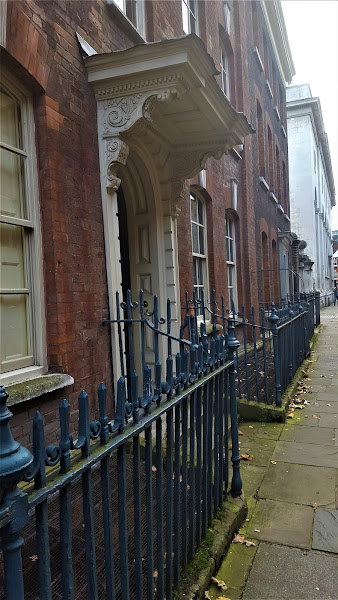
Today, large parts of the old silk-weavers’ neighbourhood have been gentrified, a trend whose merits are certainly debatable. The prices for property must surely be phenomenaI, ensuring that the possession of a home is truly the preserve of the lucky (fortuned) few. Nevertheless, I enjoyed walking around the streets, looking at the beautifully maintained doorways and trying to (discreetly) peer beyond the intriguing windows to see what domesticity looks like in such rich historical settings.
Fortunately the Town House in Fournier Street allows you to get a glimpse of this. And so I for one, am just glad that these last remaining streets have been preserved, whatever the means, even if that does involve seeing that tiresome Chanel logo, and others brandished over a store in the ‘Old Spitalfields Market’…But all things considered, what’s a small price to pay..

Sunday, October 31, 2021

Blurred Reality.....

A flying trip to Spitalfields London at the beginning of the month felt like an enchanting illusion, especially when returning to work, business as usual, on the Monday morning. But each moment of that brief weekend seemed somewhat unreal, starting with an early evening visit to Dennis Sever's house, 18 Folgate Street.
As you weave your way through the atmospheric rooms of the old 18th century townhouse, you become a spectator and two-bit actor in Sever's 'still-life drama' which leads you back through time in this 'historical imagination'.
Back on the street, however, you are quickly snatched from the state of dream-like reality of no:18 as its unique calm and beauty evaporate into the surge and clamour of 21st century life that looms all around.
If only the towering buildings that encircle the last remnants of old Spitalfields contented themselves with staring with conceit at the centuries-old architecture at their feet. But no, these playground bullies have already struck at their weaker prey, sweeping them off the board in this vicious game of redevelopment.
In this losers' game, the Water Poet pub (above) was drowned out by developers' ambition.
Punters' last orders were called in 2019, when the establishment finally closed its doors for good... or should I say bad... or worse? It still hangs onto its East End pitch, as a corner stone to a way of life that is being stealthily strangled and then slowly submerged by a sea of sleek concrete, steel and glass, hidden under shrouds of scaffolding.
Don't be fooled by the false veneer smile of façadism, as developers pay lip service to the preservation of the past by keeping a thin layer of centuries-old architecture on the front of some modern-day monolith. The rot has already set in...
Here's the gaping hole next to the Water Poet (photo from 2019), following a brutal extraction but 'compensated' by the maintenance of a slither of heritage. It is better than nothing, I suppose, but seriously, who are they kidding?
Other islands of the past cling on too, of course, resilient when the odds do not always appear to be stacked in their favour in the long term...
Meanwhile the dragon of the City boundary markers proudly guards over his ground, brandishing his shield of arms to hold off the enemy.
He still growls his Latin motto to the City - Domine dirige nos - Lord, direct us but at a time when money talks louder than anything else, his words are perhaps lost to the wind.
Of course, as in any time, business must largely prevail over other concerns, especially in the City - historic and present-day heart of finance, but at what price to the landscape around it?
In some respects, this vast contrast between past and present is so spectacular that it becomes grandiose, as skyscrappers dwarf the delicate brickwork forms of buildings that date back to centuries before. But the solemnity of these towers seems somewhat false to me.
Size belies the fact that this is construction with little to say, beyond the very real shock of the new and the stunning visual impact of such sheer, unapologetic volume. This may be statement architecture but what trace will it leave in the following decades or centuries. What will it write in the collective history of this part of London city? And more importantly, what was and will be erased to make room for it?
As night falls, the old cobbled streets are veiled in darkness and mystery whilst the modern roads are lit up by the vivid glare of traffic and the towering edifices from all round.
But in the early morning mist, as the (New) Old Spitalfields Market awakens, the boundaries between old and new, real and illusionary are blurred...
The blackcloth of modernity and that of the past are interchangeable...
Spires and facades of past and present cut into the horizon in dizzying variations.
Whilst migrants flow in as they always have over centuries of Spitalfields life, riding on the waves of change and time...