Showing posts with label Facades. Show all posts

Wednesday, July 23, 2025

A Fine Beast on a Facade...

As I come back home on the same old route, stuck in the traffic going in the opposite direction to the morning trip, I likewise look out at the now-familiar sights in the city landscape. Nevertheless, a few little gems appear to have escaped my attention and the architectural feature above is a perfect case in point!
This beautiful sculpted ram adorns one of the buildings that apparently survived the wartime hostilities in the Great War (1914-1918). I think it probably dates back to the last decades of the 19th century. And what a magnificent beast this is and what a precious specimen of discreet facade decoration! For all its finery, this feature is below a balcony and therefore not immediately visible. The ram therefore gazes down on all passersby, surrounded by oak leaves - presumably signifying stability and endurance and acorns for renewal and new beginnings - perhaps a reference to the years following the Franco-Prussian war of 1870- 71. Like the lion (and the Lion of Belfort), the ram symbolises strength and bravery... The past meaning is largely lost on us today, for those who even notice the very existence of the fine sculpted creature above, and I do feel sadness that today's buildings are devoid of any will to decorate their bland facades in any interesting manner or to send out any kind of message, except that of modernity. But today's modern is soon a has-been for tomorrow...

Tuesday, April 30, 2024

Exotic Facade Beasts...

Invariably, visiting any city with older buildings and/or a historic centre involves gazing up in order to catch sight of any quirky detail... Lions often adorn buildings of all types, but it is not often that elephants are used as a key feature in the decoration of a facade, but here you have it! How dull and dreary modern buildings are in comparision to those of almost any other century!

Tuesday, August 23, 2022

Changing Seasons...

Almost in blatant defiance of the relentless heat and glaring sunshine that have defined these summer months, the first signs of a change in season are making themselves visible. The bright green horsechestnuts that have grown imperceptibly over this period now boldly demand to be acknowledged, with their sizeable spiny hides soon ready to burst open on impact with city pavements or the head of a hapless passer-by...
Tree leaves that have been prematurely scorched and wizened by the summer heat, stand out against the intense blue skies and summer foliage with their brittle, brown forms.
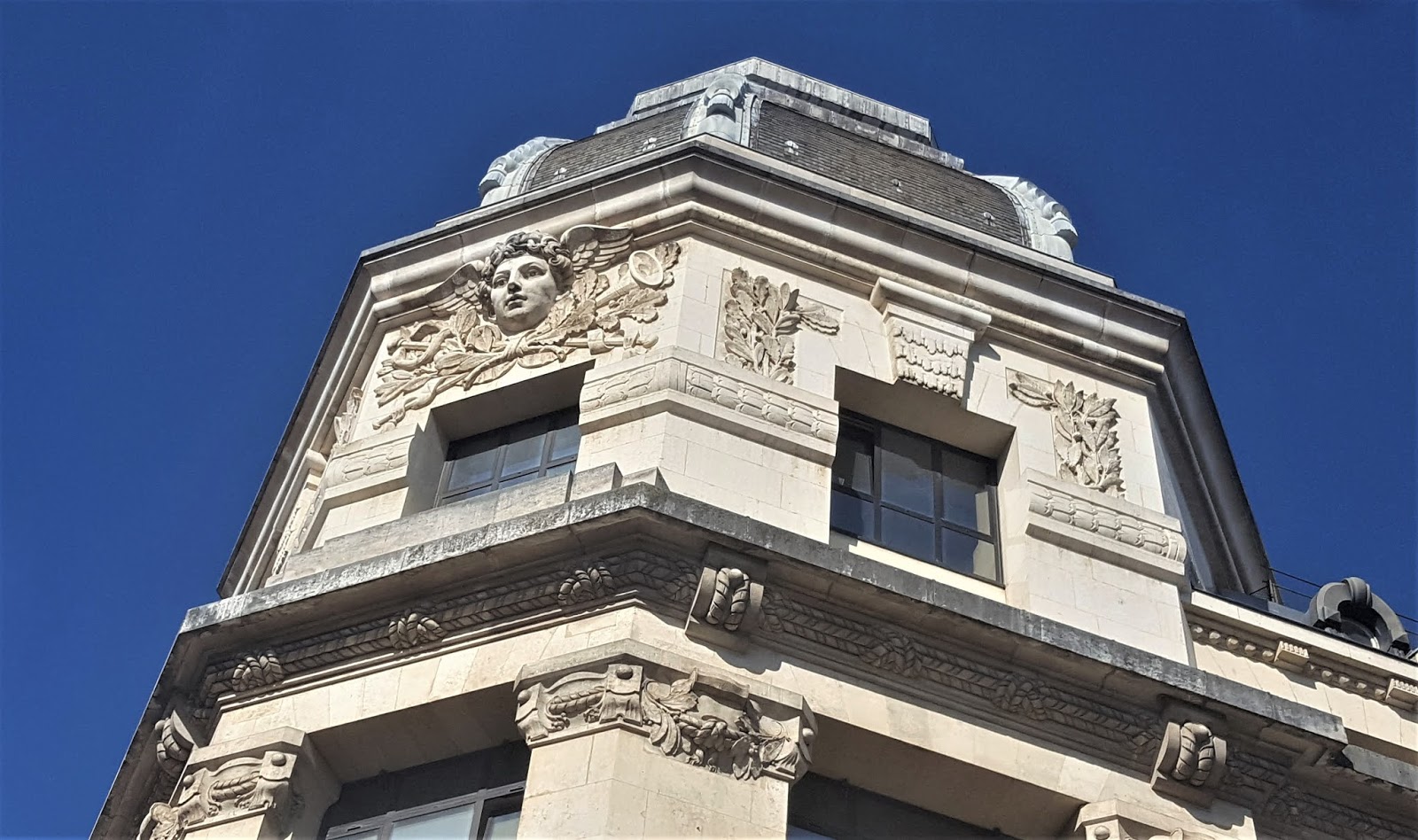
And for those of us who care to look far above when wandering the city streets, these distinct forms are also to be found, beautifully replicated, in the often quirky mouldings and sculptures that grace the façades of many of the old art nouveau and art deco buildings.
Within flourishes of sculpted leaves, seeds, berries and fruit are concealed nesting birds, hoarding squirrels and strange greenmen which almost go unnoticed by our untrained modern-day eye that hardly expects to find such treasures residing in window alcoves and doorways. And yet here they are - a little touch of beauty, humour and hope dating back one hundred years to the interwar years, seasoned by time and the ever-changing seasons themselves...

Monday, June 27, 2022

Doorways to the Imagination...

At the beginning of the month I went to Le Train Bleu in the Gare de Lyon, to immerse myself in golden light and elegance just before catching my train for La Provence - for a break in Aix-en-Provence, passing via Marseille. This illustrious station is indeed "comme un port sur la Méditerranée dans Paris, et les trains sur les quais d’embarquement sont comme des navires en partance vers des stations rêvées." (Jean-Marie Duthilleul, Architect)
After the beautiful Belle Epoque bas-reliefs that frame and highlight the vast frescos and chandeliers in the restaurant, I came across some of their Southern counterparts on the façades of the grand buildings around le vieux port district of Marseilles.
The dazzling sun illuminating old architecture was offset by the intense blue skies overhead in the most stunning fashion, whilst the shade and shadows lent an enigmatic air to the figures of the façades.
Many of these are in reference to the city's nautical role and its religious beliefs... yet the average 21st century passer-by (myself included) is no longer able to read the full meaning of these, of course, assuming that they manage to lift their eyes up from a screen long enough to actually notice them!
The nobility of the 19th century Neo-Classicist busts, gazing out across the elegant boulevards with a mysterious air is then countered by the sculpture of other periods, styles and moods.
Yet the same elegance permeates the grandiose buildings that tower over the streets, punctuated by their ornate balconies with intricate wrought-iron features.
Each set of tall windows, style fenêtre Haussmanniene, is flanked by shutters, essential in a region where the degree of heat and luminosity soars in the extended summer months.
In Aix-en-Provence, elegance and a charm provençal are apparent everywhere, and majestic doorways lead you to imagine what lies behind and beyond in the present day, and more interestingly, in the past.
Who inhabited these incredible buildings and what kind of life did they live?
The sculpted forms that decorate the doorways, along with the Caryatids and Atlantes that bear imposing architectural features, all create an effect that finds no equivalent in any modern building that I know of.
I wonder what the strange, often grotesque, mascarons could tell us of their history, as they look down from their vantage point, warding off evil for those passing the doorway they guard over, just as they surely have for centuries.
And what or who looks out for us today, who can tell us our stories in an age when we invest ourselves wholly in a digital world?
This seems to be a barely chartered universe that draws us into a complex game of mirrors, offering tantalizing images of self, which we are encouraged to then present to a vast virtual public in order to continue the process of image, illusion, delusion.
The unique quality that these beautiful architectural features possess, allows us to see ourselves as just another piece in ongoing history - our own history in the making - in a strangely reassuring manner.
And I would far rather gaze on these, and open the door to my imagination than mindlessly stare at staged selfies, which would surely slam that shut!

Sunday, April 17, 2022

A Quiet Morning in a Medieval Town... Troyes!

A few weeks ago, I returned to the beautiful Medieval town of Troyes, having kept such pleasant memories of this incredible site.
Unlike my last visit, on a Summer's day a number of years ago, this one took place on an early Spring day...
There was one common element however; both trips being made in order to admire the art of painter Jean Marrel. More about that in another post...
Whereas my first visit had led me through the relatively busy streets and alleyways of the town, this time I found myself wandering through the virtually deserted roads and walkways that meander along and around the old town.
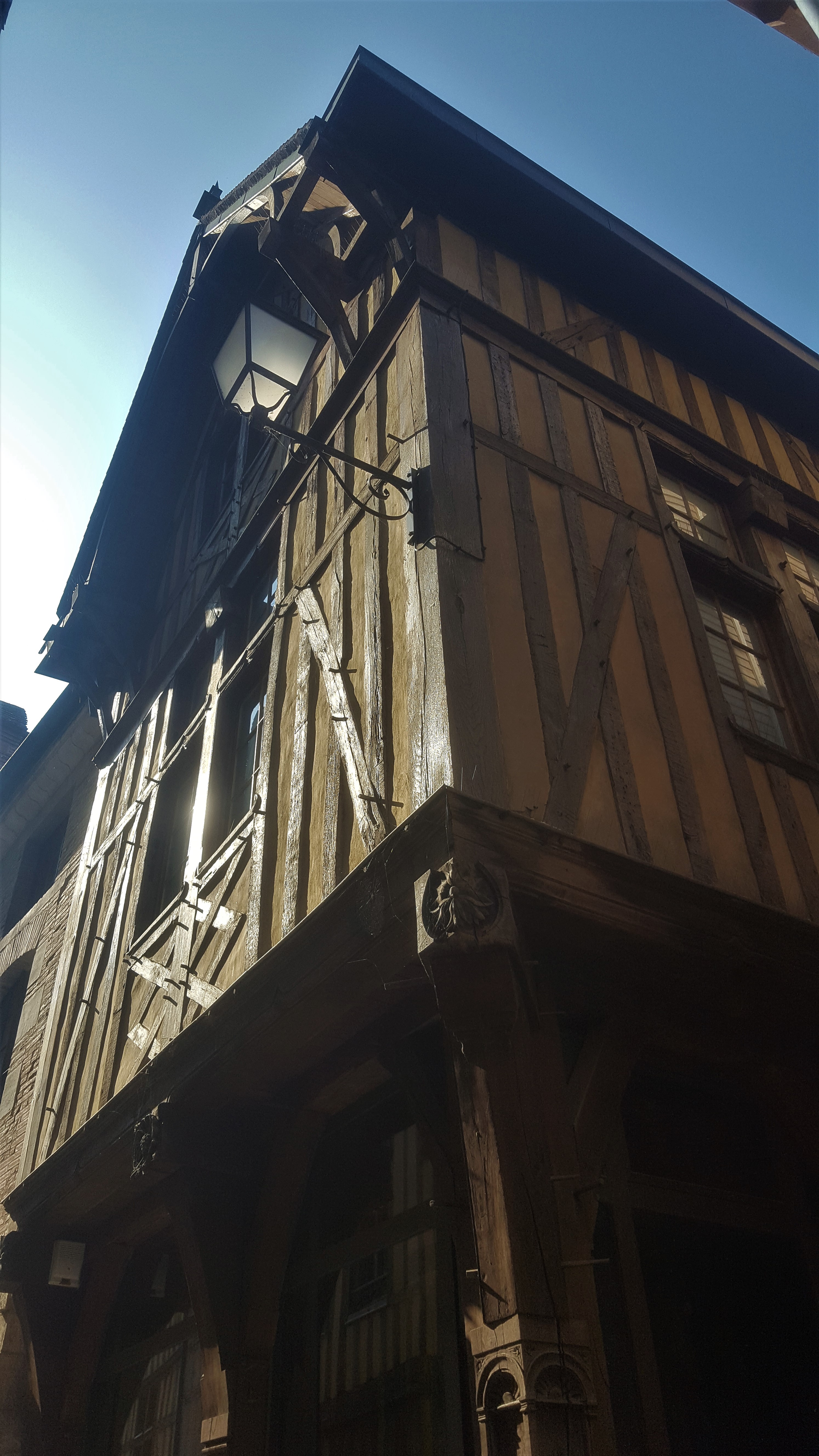
The vibrant blue skies brought out all the timber details on the architecture that seemed to tower above.
Despite a radiant light, the Sunday-morning air was bracing ! Hardly surprising then that I initially encountered so few people...
In fact, that suited me perfectly as I wanted to imagine life as it may have been in centuries past, and in the historical heart of the town this is almost possible to achieve.
Over the last few decades, the town municipality has taken measures to protect and preserve the historic buildings and monuments that reflect the former importance of Troyes.
The cash dispenser in the bank above is fairly discreet, and generally speaking the shops and services likewise tend to respect the cultural heritage of the sites that they occupy.
However little indicates the degree of commercial exchange in the town during the foires de Champagne of the Middle Ages or the size and significance of its textile industry of Troyes over the centuries.
The wealth of Troyes today is largely dependant on tourism, accommodating and catering for those drawn to the town. Restaurants and cafés flourish, of course, and some serve the incomparable local meat dish - andouillette de Troyes.
Many visitors come to purchase big brand clothes and other goods at the factory outlet stores outside town, but others converge on the historical centre and wonder at the architecture and negotiate those impossibly narrow alleys.
The Medieval half-timbered buildings - à colombage - with their variety of colours contrast against the striking blue sky and the 19th century architecture that cohabits this space ...
I couldn't help but wonder who lived in all these buildings, what stories lie behind any one of these amazing façades or within the many courtyards beyond. Not to mention the lives of those who commissioned or carried out the building of such archicture and its decoration...
The merman below has to be one of my favourite carved figures. What was his exact meaning?
Forms of man, beast and flower adorn beams, cornices and corners, peering out at us in our 21st century ignorance !
Many, of course, are symbols of the Christian faith and appear on private buildings in addition to the numerous churches of Troyes. I suspect that for the most part, their meaning is lost on us too as we are no longer able to 'read' them.
On this latest trip to Troyes, I soon realized that the town is deceptively big. It may appear light and accessible on first impression yet is as dense and complex as the wooden structures that hold up its 16th century architecture.
I will surely have to return to visit the other magical places of this town - one of these to be found behind this impressive wall - Le Musée de Vauluisant .

Wednesday, July 29, 2020

Watched From Above... Friend, Foe or Freak on the Façades?


As I am currently plant-sitting, in order to set about my daily watering duties I have to wander along the same city-centre streets each day. On pavement level, these are not necessarily the most interesting to stroll along - no cafés or restaurants, few shop windows, a number of closed shutters.


Pedestrians tend to shuffle along, eyes bolted on their phone, minimal attention paid to the other individuals around, just enough not to run into them. Here is social distancing, but not quite as meant by the health authorities in response to Covid 19...


It is not entirely surprising that no one seems to notice the swallows that nest in the stonework of the buildings all around, shrieking and swooping along the streets, in search of insects in hot summer air. Of course the architecture that acts as the backcloth to all these daily activities - pedestrian or airborne - likewise goes unnoticed.


And yet, above the doorways and on the façades of the older buildings there is invariably a world - or bestiary - of human and animal forms. Sculpted beings gaze down
on us lesser mortals in the same manner as they have for almost a hundred years. For indeed, most of the architecure  - including its sculpture -  was built during the reconstruction of Reims, following the First World War.


These sculpted figures could tell a tale of two but their expressions are often enigmatic - as if they were amused by our behaviour, or in turn bemused by it! I think they are taking things quite well, considering the events that they have witnessed first-hand over the years, or the injustices they have been subjected to. The Belle Epoque beauties still smile sweetly and strike their poses, despite the layer of city grime that now coats them and the general indifference shown them, with or without the dust and soot. Similarly, these braves belles brush off the fact that they now rub their delicate shoulders with a fine example of mid-20th concrete ungainliness. 


Truth be told, my favourites in this façade parade are far less the fawning, female figures than the faces of freaks and weirdos who gurn and gawp at the ignorant passers-by below! I did not include any of the putti carvings here, I am afraid to say. Give me a scrawny, malevolent gargoyle any day over some plump, winsome cherub...


There is often more social exchange between this mischievous bunch than there is between any of the pedestrian screen zombies that trudge along, oblivious to all and everything other than their phone.


Naturally, the combination of screen addict, eyes riveted downwards, and façade aficionado, head lifted up (and camera too, it should be said....) sets all parties on a collision course - quite literally - as nobody is actually navigating the pavement ahead.


I do wonder for whom these marvellous, monstrous creatures were intended - solely for the pleasure of the eyes, but whose? If it was then considered to be of civic importance to commission and carry out art work -  aesthetically and socially-speaking - when did this no longer apply?


Tastes change, that's normal but if it is mostly down to financial issues, it's enough to make you scream.