Showing posts with label Art Nouveau. Show all posts

Sunday, June 29, 2025

A Bouillon in Bordeaux... St Jean.

Eager to escape the blazing sun and scorching temperatures during a recent trip to Bordeaux, but above all curious to see what the bordelais version of the Parisian Bouillon restaurants was like, I went into Bouillon Saint-Jean by the train station.
Like the more familiar Paris restaurants, the Saint Jean site is decorated in the art nouveau style with the fluid arabesque forms of the furniture and elegant decor, all of which was brought to life with the gentle lighting that was in contrast with the raging sunlight outside.
Although the restaurant could seat a large amount of people, on my visit everything was very calm. An expanse of immaculately laid tables stretched out, with their spotless white table cloths, gleaming glasses and, of course, the timeless Bouillon menu that offers the signature dishes at incredibly reasonable prices.
Unlike the Parisian Bouillon from last year, this one did not appear to have an upper-floor seating arrangement, but the staircase was enticing nevertheless and I felt compelled to explore!
Most of the tables extend out from below a vast verrière and the impressive globe chandelier......
The symmetrical rows of tables and chairs set out under the warm glow of the lights gave an impression of cool crispness and order alongwith a certain intimate coziness.
The Saint Jean is decorated with a collection of blue-and-white crockery - with plates on the walls and a vast array of dishes and tureens in the glass cabinets.
The effect was striking yet not starchy, as was continued by the displays of framed herbiers (specimens of dried plants)...
As always, I kept wondering about where all these different artifacts had originally come from and tried to imagine the lives of those who had once used them...
What would they think of the family dinner set now being used to welcome visitors from far and wide?
Outside the establishment is the vast mosaic Art Déco facade that in fact indicates the origins of this particular Bouillon restaurant. Interestingly, the Café du Levant was founded at virtually the same time as the Parisian Bouillons; the end of the 19th century. It took on the Bouillon name in 2023 but retained much of its initial identity.

Saturday, June 29, 2024

Art Nouveau Beauty... Bouillon Racine.

In a relatively unassuming side street of the Latin quarter, not far from the Ecole des Mines by the Jardin du Luxembourg, I caught a glimpse of this enticingly impressive façade and having peered in through the beautiful window, decided that I just had to reserve a table to experience a meal there! Although I did not realise it at that moment, the establishment in question was one of a handful of remaining 'bouillon' restaurants in Paris.
With its unique concept, distinct from the typical offerings of a brasserie, bistrot or banal restaurant, the 'bouillon' has always occupied a singular position, even if the profile of today's clientele is surely very different from that of the past.
The term bouillon, meaning 'meat stock', refers to the key item proposed by the founder of the first bouillon etablishment in 1854, a certain Adolphe-Baptiste Duval (1811-1870). This butcher catered to the food porters and general workers in and around the vast parisian market - Les Halles - which Zola depicted as Le Ventre de Paris.
While stock was not a new culinary invention, Duval understood how to present his own signature version to les forts des Halles in an appealing manner, at affordable prices so that demand would grow. Thus he was able to boil down and thus use up the pieces of meat generally overlooked or dismissed by the public (offal and the like...) while vastly improving his takings.
The offering was soon widened to include basic meat dishes of good quality, served in clean settings with quick, efficient service delivered by smartly dressed waitresses - 'les petites bonnes' - and hence the bouillon restaurant was born.
The popularity of this concept was such that hundreds of other restaurants were set up on the same model and so countless bouillons were scattered across the city over the following decades, acting as a 19th century precursor of our present-day fastfood outlets.
Towards the end of the century, the two Chartier brothers, Camille and Edouard, decided to try their hand at a new bouillon restaurant; one that would provide the same renowned and respected menus and service, but in an illustrious Art Nouveau setting in line with the aesthetics of la Belle Epoque that had been displayed in the Exposition Universelle de Paris 1900.
Le Bouillon Chartier Grands Boulevards was opened in 1896, and must have stunned the public with its vast dining area and lavish Art Nouveau decor, with swirling forms and sculpted wood, brightly-lit chandeliers and numerous mirrored surfaces that reflect the facets of the great expanse.
The Bouillon Edouard Chartier Montparnasse saw the day in 1903, followed by the Bouillon Camille Chartier - known as the Bouillon Racine in 1906. It was the latter that I visited and the former that I next intend to experience! And what a lovely experience Bouillon Racine was...

Sunday, May 26, 2024

Umbels, Florets and Flowers in an Art Nouveau Jewel... La Villa Demoiselle.

Villa Demoiselle is one of the most perfect examples of art and architecture being brought back to life in full glory in a present-day that is often sorely lacking in aesthetic elegance. A visit to this enchanted domaine that lay in ruins following a gradual, steady decline from the interwar period onwards, can only lift your spirits and heightens your sense - even more so, should you take a glass of the Demoiselle champagne afterwards!
Indeed, for decades, Villa Cochet, as it had once been called, had been left in a shocking state of disrepair and must - or should have been - a source of shame and sadness for the Domaine Pommery that is situated across the road. When Vranken bought the domaine from LVMH in 2002, the couple Nathalie and Paul-François Vranken set about restoring the delapidated villa, thus combining their passion for art, culture and the champagne heritage. The result is nothing short of spectacular...
From its 'rebirth' in 2008, almost a century after its initial commission and construction under the orders of Henry Vasnier, Director of the Pommery Champagne Maison, Villa Demoiselle has regularly housed art exhibitions. However, for me, just a tour of the grand house and grounds is sufficient, enabling me to discover new elements each time, just as the sunlight pouring in through the stained-glass windows reveals some other detail of colour or shape in the architectural structure or the furnishings within...
The imposing Art Nouveau fireplace in the main entrance is incredibly majestic as a whole - it was initially exposed at the Exposition Universelle at the turn of the century - however it is the intricate features that draw you closer to admire their skill and beauty. This piece, designed by a pupil of Louis Majorelle from the Ecole de Nancy, is but one of many items of decor and furniture that were gathered by the Vrankens to refurbish the villa that had lost all its original works to theft and acts of vandalism when it stood empty from the 1970s onwards.
The restoration work has been so thorough and thoughtful in its realisation, that one could easily assume that this is how the villa always was, but in fact the Vrankens had little on which to base their plans since rather meagre information remained, barring a few old photos that offered some guidance. As such, the Villa Demoiselle is truly a credit to the Vrankens' determination to see this site relive, literally snatching it away from land developpers who had planned its total destruction.
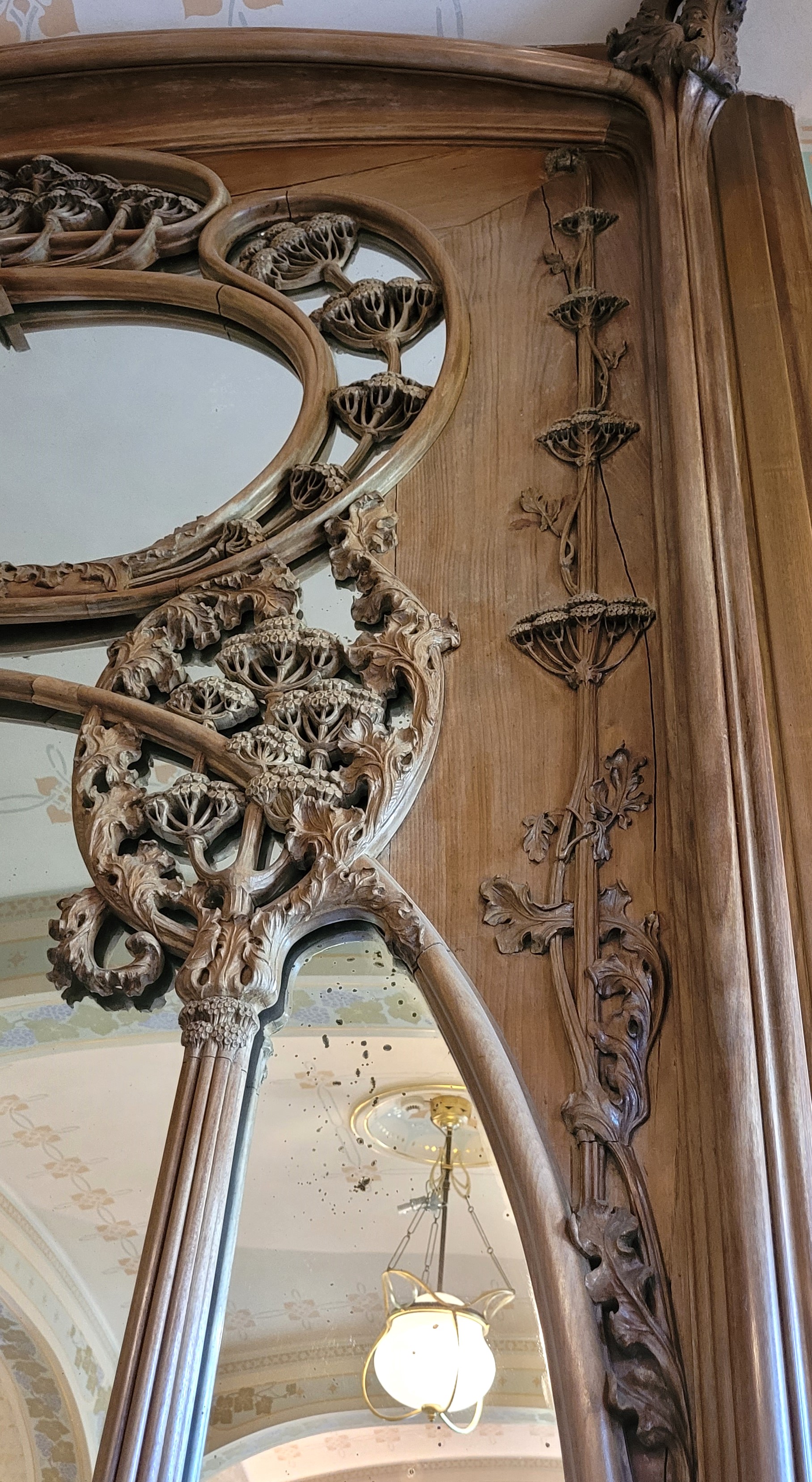
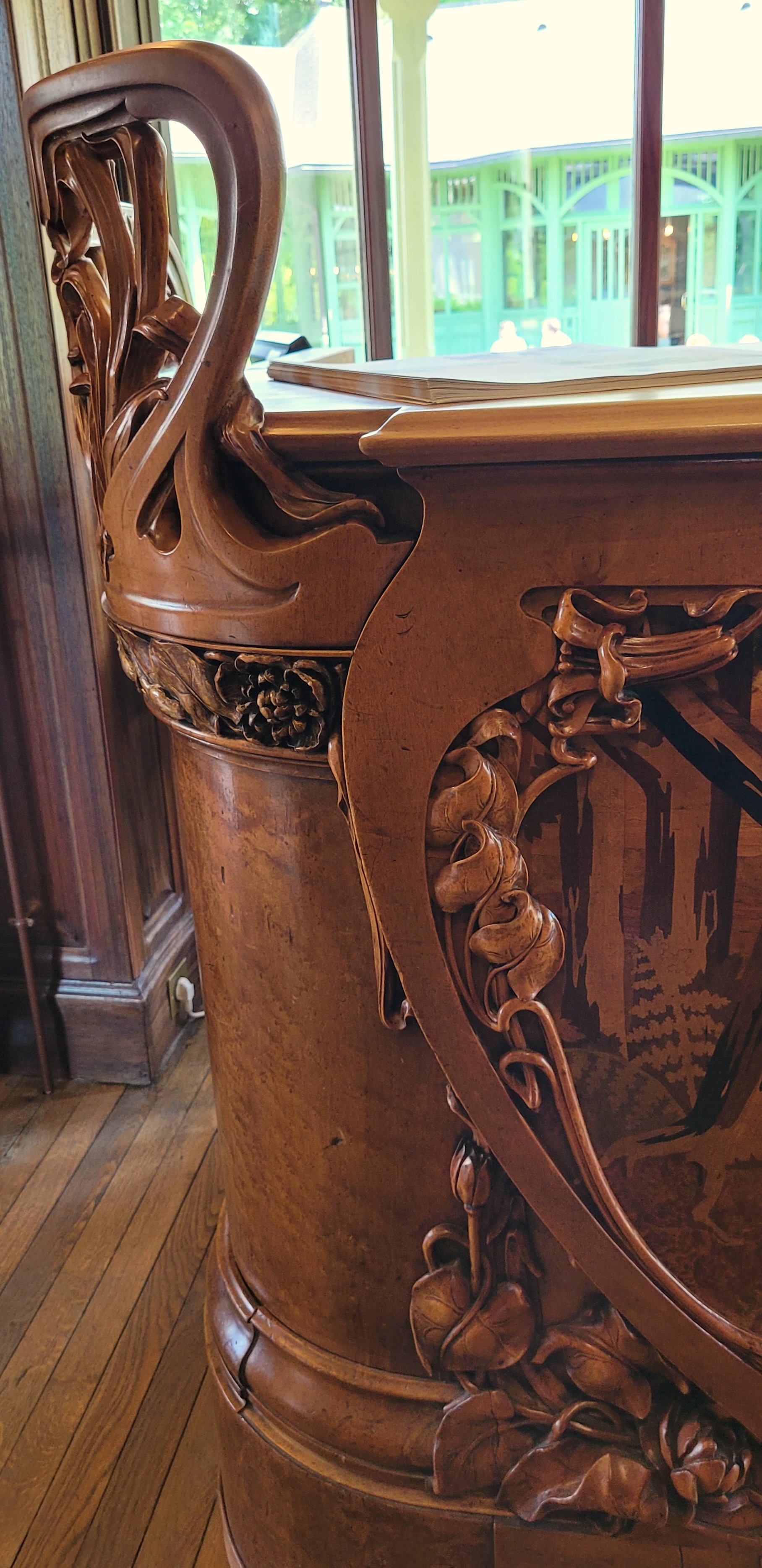
As in most Art Nouveau manifestations, particular importance is attached to the swirling, sweeping forms of a heightened, natural world, with plants, flowers, foliage, insects, snakes and birds twisting, sliding and slithering across sculpted surfaces, paintings, mouldings or furniture itself. Here at Villa Demoiselle it is magical to pick up on these details in all their beauty...
Of course umbellifer plant occupy a central position, with their delicate crown of ribs that radiate out from the flat-topped inflorescence in such a fascinating manner...
These curved and clustered forms were repeated throughout the villa on fireplaces, buffet-bars, cabinets and so on...
Meanwhile contorted, spindly stalks and branches intertwined...
Or lily leaves seemed to melt and flow down the solid forms of furniture in a liquid, vital fashion...
Whilst other objects concealed snails that glide silently on gnarled vines, set alongside smooth marquetry...
Or lizards that are frozen in a furtive, darting movement as they dash across scaly branches...
And in the main hallwall, the stairwell is dominated by the incredible chandelier, with its strange bulbous lights, which emphasises the great vertical drop from the ceiling of the top floor to the ground...
And the vast wrought-iron glass door with its stark, black tendrils that furl out like a spider's web, looking out onto the garden beyond...
Whilst one demoiselle peers on joyfully from a flurry of petals and light!

Saturday, December 30, 2023

Art Nouveau Hair Adornment...

This little sprig of Art Nouveau mistletoe that is beautifully intertwined around the carved horn of the hair comb above is not, as I had assumed, by the hand of René Lalique (1860-1945) but is in fact one of the creations of the Vever brothers; Paul and Henri. Having taken over the family business in 1881, they went on to experiment in new materials for their creations, exploring the possibilities afforded by horn, ivory, pâte de verre, enamel and semi-precious stones as opposed to the more standard approach offered by noble gold, silver and fine gems .
As many Art Nouveau artists, the Vever brothers were inspired by the Japanese themes and techniques that were visible in France in the latter part of the 19th century. The influence of Japonisme is clear in the delicate studies of the three 'F's which were key to their work; la Femme, la Flore and La Faune. The furled petals of the Cyclamen hair comb above (1900) are offset by the fine opal facettes that catch the light with their bright colours in a way that is stunning, yet not gaudy or vulgar.
Similarly, the Owl comb (1900)is bright and bold yet the intricate cloisonné feather features create another level of delicateness, whilst the curved forms, piercing emerald-green eyes and prominent beak provide an edginess to the whole. The Vevers met with success in the Expositions Universelles of 1889 and 1900 and their clients included emperesses, tsars and actresses...
The troubling beauty of natural forms that swirl, curl and engulf us in the process in a rather hypnotic manner are characteristic of Art Nouveau. Similar features are to be found in this Sycamore comb (1906) by Lucien Gaillard (1861-1942), where the papery, feather-like samaras are in contrast to the slightly menacing wood-like spines of the structure.
The same qualities can be found in Gaillard's Honesty pod hairpin and the Bee comb below. Gaillard was a contemporary of Lalique and was likewise linked to Japonisme and the experimentation of new materials, technical approaches and later, different objects acting as supports for his art, with walking stick handles and perfume bottles, for example. He too was lauded at the Exposition Universelle of 1900...
Many of the Art Nouveau artists, whatever their medium, would rely on similar subject material. Birds, insects, beetles, flowers and foliage emerge in varying beautiful forms, with a slightly different slant but with a common essence of disquiet, animated by a strange energy.
Henri Hamm's Butterfly pin (1906), offers a rather menacing representation in all its simplicity with an almost palpable tension in the wings, leading to spiked tips. Even Lalique's Lily-of-the-valley comb possesses the same unnerving qualities...
René Lalique is of course the best known of the Art Nouveau artists - principally for his pendants, brooches and necklaces. Emile Gallé – the French glassmaker, ceramist and cabinetmaker - referred to him as “the inventor of modern jewellery”. The same approach was employed in his hair combs and pins but it was interesting to see his work set alongside that of the others; Gaillard and the Vever brothers being just a few of the names.
Naturally, the peacock (here by René Lalique) is closely associated with Art Nouveau, but another typical symbol of the style is the dragonfly, as seen below in the comb by Paul Frédéric Follot (1877-1942).
And of course, the moth, here below by Gaillard... The combs were all on display alongside many items of jewellery, timepieces and equipages (chatelaines) from different periods of history up to relatively recent times in the Musée des Arts Décoratifs in Paris. Looking at the great beauty of these hair adornments dating back to over a hundred years ago, and glancing at what is coveted by many people today in terms of attire, accessories, jewellery etc, I cannot help but lament what has gone.

Sunday, February 23, 2020

Porte de Sèvres...


Along the impressive Boulevard Saint-Germain in the 6th arrondissement, stands an almost imperceptible vestige from the Parisian Belle Epoque. Indeed, as throngs of tourists and Parisiens alike stroll or scuttle in the Haussmannian landscape of the Rive Gauche, few may notice the beautiful ceramic plaque on the flank of a building that closes the discreet little Square Félix Desruelles, just next to the Eglise Saint-Germain.


St-Germain-des-Prés is not only thought to represent quintessential Parisian chic, with its luxury boutiques and restaurants but also to reflect the traditional literary and intellectual core of the city. Indeed, the famous cafés of Les Deux Magots, Brasserie Lipp, Café de Flore and Café Bonaparte are renowned as the former gathering points for great intellects, writers and artists such as Jean-Paul Sartre, Simone de Beauvoir, Man Ray, Picasso, Léo Ferré or Georges Brassens from the 1920s. However the monumental Porte de Sèvres dates back to a moment in history when the whole world turned to the City of Light to observe its shining examples of modernity and audacity, promising an bright, illustrious future. Held in 1900, the Exposition Universelle de Paris was the fifth and last of its kind in the capital, following those of 1855, 1867, 1878 and 1889. It drew visitors in their droves over the months between its opening in April and closure in November. The first World Fair – the 1851 Great Exhibition of Crystal Palace, London – enticed a meagre 6 million visitors whilst the Exposition Universelle of 1900 announced over 50 million.


It is difficult to imagine how this vast, dazzling display must have appeared to a public, little accustomed to such sights. Immense pavillions and palaces were constructed in the very heart of the city, representing different nations, inventions and technologies. The sheer scale of the exposition and the scope of the other worlds and realities exhibited must have been incomprehensible to the average visitor. I wonder what they could have thought of the Palais de l’Electricité, with its spectacular arrays of sparks or the incredible moving pavement – ‘La rue de l’avenir’ ?


In our digitally-enhanced, device-enabled, over-stimulated universe, we would find it hard not to be underwhelmed, assuming that we had been able to lift our eyes from the 'precious' smartphones we clutch, Gollum-style, in the first place...


And yet in the Belle Epoque, the exposition would have been a breath-taking experience – an incredible assault to the senses and imagination.‘Projected motion pictures’ had been developed by the Lumière brothers in the very last years of the 19th century and were simply light years away from the cinema films that would later stun audiences with their images of the future.


Most of the immense edifices constructed for the Exposition were not built to last, yet that made them no less impressive and it should be remembered that the Eiffel Tower, erected for the 1889 Exposition, was in fact only intended as a ‘temporary’ feature ! Many buildings were largely stuccoed façades, of which nothing or little remains today. Nevertheless, the towering Porte Monumentale that welcomed the visitors and the huge globe-shaped planetarium – the Globe Céleste were no less incredible to behold. Other constructions, however, are still very much part of the Parisian landscape and skyline today – the Grand Palais and the Petit Palais for example, along with the Alexandre III bridge. Below ground, the first Metro lines were inaugurated with great pride to coincide with the Olympic Games – transporting visitors from the Porte de Vincennes to the Porte Maillot. The prowess of France’s production and arts were likewise showcased in the Pavillon des Manufactures Françaises on the Esplanade des Invalides. 


The merging of industry and craftsmanship with new materials and innovative usage was particularly exciting and the ceramic work of the Manufacture de Sèvres met much acclaim. Indeed, its organic, plant-like forms and unusual colours were very much  in l’air du temps and adorned buildings and monuments alike. The date 1753 figures on the porte ceramique in the Square Félix Desruelles – referring to the year that the porcelain production had become Manufacture Royale, shortly before the site was transferred from Vincennes to Sèvres in 1756. Indeed, from 1740 the porcelain had received support from Louis XV and Madame de Pompadour and the emblematic Sèvres coulours became synonymous with crown and court ; rose Pompadour, vert Vincennes, bleu de Sèvres, jaune de Naples, bleu Céleste.


By 1900, the work of the Manufacture de Sèvres was far more accessible and targeted a diverse clientele - Le jeu de l'écharpe by Agathon Léonard, for example met great success at the exposition. The porte monumentale de Sèvres originally decorated the entrance to the Pavillon des Manufactures Françaises and is its last remaining trace, having become the property of the city of Paris in 1901 and transferred to its present position in 1905. It was designed in enamelled stoneware by the architect Charles Risler and sculpted by Jules Coutan, and bears a large arch-shaped panel supported by columns, decorated with flowing Art Nouveau forms of plants, fruit and flowers. In the centre part is a woman representing the art of pottery-making, and again at the top a haut-relief depicts the art of ceramics. Towards the bottom is an owl – enigmatic figure of wisdom or learning.


This aesthetic movement became the symbolic expression of the Belle Epoque. In Paris, Hector Guimard’s strange, curving, fluid forms are integral to the Metro entrances, yet similar flowing lines would proliferate in architecture and its decoration elsewhere; wrought iron, mosaics, frescos, stained-glass windows and, of course, ceramics. Shortly after the Exposition Universelle, the Ecole de Nancy was officially founded and French Art Nouveau was expressed to its fullest form under Emile Gallé, the Daum, Louis Majorelle in art, furniture, pottery, glassware, jewellery…