Showing posts with label William Morris. Show all posts

Monday, March 30, 2026

Kelmscott House...

Kelmscott House
An armoury of weapons against the weariness of life; such was the metaphor used by William Morris to describe the ideal book. How weary would he feel today, if he could merely glimpse our present society? He who fought for ‘beauty accessible for all’ in a world where art, design, form and content would together embellish and enhance the life of all social classes, what would he say? 


This great man, born into Victorian England (1834-1896), battled for reform against the social hardship, material poverty and cultural and spiritual impoverishment that arose as dehumanizing externalities from the great industrial and technological advances that marked Queen Victoria’s reign. For him, these wrongs could be largely redressed by the arts in their purest form, created and crafted by human hands to serve the people, far from the enslavement of industrial-scale manufacturing and consumption. 

I love the man standing proud up on the roof to watch the race!

It seems to me that the only thing clutched in a human hand today is some smart device that saps away our attention span and real-life exchanges so that we depend on it for every conceivable form of social validation, stimulation and even self-identity. Any kind of creative process is now readily handed over to some labour and time-saving AI app, freeing us to indulge ourselves in something supposedly more meaningful and worthwhile. But with our curiosity, focus and general interest in the world in front of us in real-time shot to pieces, what is there left that has genuine enduring meaning and actual worth in our lives? 
The Morris & Burne-Jones families - 1874

As for the social aspect of social media, do we truly have better relations today than in the past? Is communication better, even if the means to communicate have undeniably been facilitated beyond expectation? For all that we have gained, I think we have given up far more, imperceptible aspects of normal life that have been lost, and that loss will only become apparent once the ugliness and emptiness have taken a firm grip on so many areas of life these days. 

Edward Burne-Jones & William Morris
Visiting Kelmscott House, Morris’s final home, set by the Thames in the Hammersmith district, is an antidote to all that ugliness around us in the present. Although probably best known for his aesthetic vision and Art & Crafts decorative art – especially the Strawberry Thief motif – Morris was also a writer, poet, printer and socialist and, for his last 18 years, this house was where he pursued and developed this amalgam of interests. 


For Morris, art was the expression of Man’s joy in labour, a devotion of which the worker had been robbed due to the industrial capitalism that drove Victorian England. As the artists of the Pre-Raphaelite Brotherhood before him, Morris was driven by a quasi-religious vision of artistic creation in Medieval times – prior to 16th century Renaissance art. Just how ‘joyful’ the creative process actually was for the average Medieval craftsman is questionable, but it can probably be safely assumed to differ with Morris’s notion!

Nevertheless, the purity of Medievel art with its breathtaking realism and stunning detail rendered in vibrant, bright colours inspired Morris just as it had his Pre-Raphaelite brothers. For Morris, however, this inspiration was more than purely aesthetic, it was social too and it is interesting - and perhaps not entirely surprising - to learn that he had initially wished to join the clergy before devoting himself to art and design and specifically the Arts & Crafts Movement. By the time Morris and his family – wife Jane and their two daughters, Jenny and May – had settled in Kelmscott House, the decorative arts firm Morris & Co was fully established, having taken over from the initial business Morris, Marshall, Faulkner & Co had set up in 1861 with artists including Edward Burne-Jones and Dante Gabriel Rossetti. 

Before moving into the Thames-side house, Morris expressed the intention to ‘make it beautiful with a touch of my art’, giving it the name Kelmscott House in honour of Kelmscott Manor House, his idyllic Cotswold retreat which had inspired a number of his famous designs, notably the Strawberry Thief! The interiors were duly transformed in line with Morris’s aesthetic vision, but it was clear that the home was to be more than a mere family residence, decorated to his personal taste.


 Indeed, Kelmscott House would become the place where designs and projects were brought to life through experimentation in craftsmanship and social thought carried out by Morris, his daughters and visitors; artists and social activists alike. The house became the physical expression and catalyst for Morris’s philosophy, to create a world of beauty and fairness ‘By people, for people’. 


His daughter May stated ‘Our home was a workshop of love; where art and life were inseparable’, having grown up in a unique universe, which was both rich and yet strangely pure, compared to stifling Victoriana homes with their predilection for clutter. Jane Morris, former muse and model to the Pre-Raphaelite artists, taught her daughters embroidery following traditional techniques and May proved to be so gifted that she was appointed head of the embroidery department at Morris & Co in 1885, at the age of 23, and herself designed the wallpaper design ‘Honeysuckle’. 

'Honeysuckle'
Prior to his Kelmscott years, Morris attempted to master the technique of hand-knitted carpets inspired by Persian rugs and large-scale tapestries following Medieval tradition and work practices – he even set up a loom in his bedroom! He experimented with natural pigments for the dyeing process with his daughter, May, believing that modern chemicals could not match the quality and beauty that emanated from the integrity of ‘honest’ materials and ancestral methods. 

The production facilities of the William Morris company moved to Merton Abbey in 1881 in order to follow through this practice of time-trusted techniques that had fallen by the wayside in the pursuit of speed efficiency and cost-effectiveness. In the former monastic grounds, the water flowing from the River Wandle was used to carry out hand block-printing and weaving in the same manner as in previous centuries, contrary to the modern practices employed by the fellow textile printing company, Liberty.

Steps up to the back garden at Kelmscott
With the same intense devotion, Morris turned to his other great interest during his Kelmscott House years; book-printing. With a reverence for books that were ‘a well of life’ and a ‘mirror of the soul’, Morris stated that a library was a creative well-spring, and he hoped to live in a society ‘with a public library on each street corner’. 
Drawers of movable type sorts

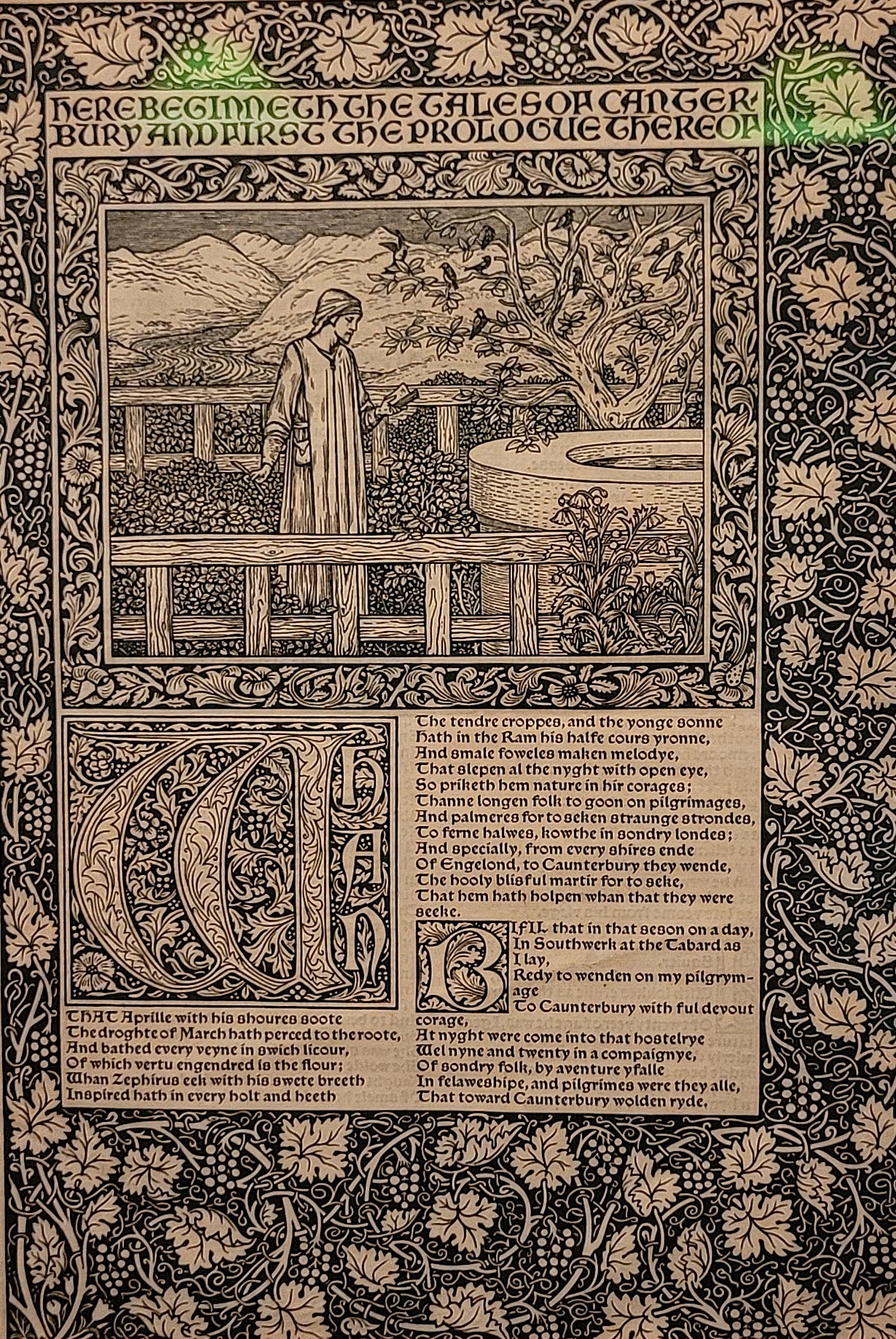
Certainly the library in the Morris household was a revered place of beauty and reflection, a sanctuary that held his precious collection of works that embodied his creative vision; Medieval manuscripts, historical tomes, a 15th century illuminated Book of Hours, Chaucer’s Canterbury Tales…

In 1891, Morris set up his own private press in the family home with three Albion machines – the Kelmscott Press – in order to create the ‘ideal book’ that would reject the contemporary industrial process and produce, in favour of the beauty of medieval-inspired design, poetic and historical content partly influenced by Icelandic sagas and mythology, original typefaces and wood-block illustrations. I loved the fact that the very press itself had large squat paws on the base of its strong legs, showing again that there could be beauty in design and utility. 

What would Morris make of the extensive closure of public libraries across the UK, that has been taking place over the last decades due to financial pressure and budget prioritization? The creation and funding of free libraries for all, established by the successive Public Libraries Acts from the mid-19th century is slowly being over-turned and these grand civic buildings are now turned over to other activities or sold on for lucrative property development. Meanwhile, the book itself has suffered an insidious decline as the physical text is often perceived as too time-consuming, cumbersome and slow-to-deliver in a world that demands stimulation and rewards at a click, a swipe and a like. 

A wearisome world indeed…. And while we often feel enslaved to our jobs, surely we have already become slaves to our screens and apps, becoming dumber as they become ever smarter? What would Morris have to say to Elon Musk, I wonder?  


Wednesday, February 26, 2025

Water House... William Morris Gallery...

In Walthamstow, north-east London, is the William Morris Gallery set in a grand Georgian house, that was briefly the Morris family home from 1848 to 1856. I decided to visit as I did not have the time to visit Red House - the stunning architectural work commissioned by William Morris in 1859 to reflect the aesthetic principles that would form the basis of the Arts and Crafts movement. Rossetti said of the home to which he was a frequent visitor - along with the other Pre-Raphaelites – that is was “more of a poem than a house”.
Water House (now the William Morris Gallery) in Walthamstow, situated at the entrance to Lloyd Park, is large and looming but I could not really imagine any type of family life there, probably because of the exhibition rooms and displays throughout. However, it is said that Morris spent time sitting in the tall window, on the main staircase... I hope it was this one!
William Morris, born in 1834, would have developed some of his ideas during the brief years there, since these coincided with his university studies at Oxford. As a student, he formed friendships and made acquaintances that exposed him to social, historical and artistic theories that would shape his vision and values in a radical manner. I wonder what Morris would think of the exhibition - Morris Mania? Or rather, how his work has been used by companies – past and especially present - whose values could not be further from his own?
Despite his mother’s yearning to see her son a bishop,Morris abandoned his theological pursuits and thus his initial goal to be ordained, just like Edward Burne-Jones, his closest friend and aesthetic ally. Yet turning towards architecture instead, he discovered that he possessed a greater drive still for interior decoration in its many aspects… and of course, poetry. Through Burne-Jones, Morris met Rossetti and, above all, read the writings of John Ruskin. These encounters led him to a quasi-religious life-long quest for social reform through design, rejecting the dehumanizing force of Victorian industrialized manufacturing and its dire effect on art and society on every level.
This virtually moral mission led him to revolutionize the design and production of wallpapers, textiles, ceramics, furniture, metalwork, and glass throughout his life, taking inspiration from Medieval art but also early Islamic work. Through Ruskin, Burne-Jones and Morris discovered the Pre-Raphaelite devotion to the purer age of Medieval art and workmanship and applied the tenets of this movement as a guiding principle, no more so than in Red House. In 1862, Morris and six partners founded an interior decoration business which was referred to as The Firm (Morris, Marshall, Faulkner & Co) and led a crusade against ‘Victoriana’ with its clutter and irrelevance. Commissions for church decoration and refurbishment brought in a wider clientele, as did work carried out for rooms in St James’ Palace and South Kensington Museum (the future V & A). Ironically, the production methods of The Firm – with handcraftsmanship and natural materials where possible - meant that only the wealthier members of the population could afford its offerings. Lower prices relied on mass volume production, which would bring in the very ills – aesthetic, social and environmental – that Morris was trying to combat. I cannot imagine how Morris would have welcomed the commercial deal between H&M and the modern-day Morris & Co in 2018. Fast fashion linked to the name of the father of socialist design methods; didn’t anybody see the irony? And then to quote William Morris himself to justify mass-manufacturing is quite something! "I do not want art for a few, any more than education for a few, or freedom for a few".
In his time, Morris remained true to his vision and never knowingly sold his soul for financial returns, despite expanding the business through grand retail shops and seeking international recognition for the company. He was a prodigious writer – and ironically, was actually more famous in Victorian times for his writings rather than his art. This seems incredible today, when indeed Morris Mania has led his designs to be seen everywhere; anywhere and on anything… Kelmscott Press enabled him to design his own type and print beautiful work, as ever in line with his fascination for a pure brethren – the ideal community of traditional craftsmen and story-tellers. This did remind me of J.R.R Tolkien – and I was interested to learn that Morris’ poems and writing on myths and legends were indeed a significant influence on the younger writer.
In the same spirit, his rural atelier in Surrey, favoured a move away from the grime and grind of London in the 1880s for himself and his employees, and as such Merton Abbey provided a purer working environment, allowing Morris to study traditional textile production and dyeing techniques. Not sure that Morris could even have imagined today’s sweat shops that churn out the apparel that is readily ‘consumed’ and discarded… This could not be further from Morris’ optimistic vision of the future nor his faith in man’s progress. Indeed, aged 50, and already a successful businessman, Morris fully espoused Socialist values and for the rest of his life actively campaigned for social reform, expressing his beliefs widely. He condemned the exploitation of the underprivileged in an industrial age which brought about unprecedented pollution, poverty, disease and moral decay, stating that. "….there should be neither rich nor poor, neither master nor master's man, neither idle nor overworked, all men would be living in equality of condition, and would manage their affairs unwastefully…"
And what on earth would William Morris think of the use of Artificial Intelligence in art? When I see the AI'enhanced' Morris designs on offer, I could cry… Yes, artists may have used photography in the past/present to help them recreate a vision, yet that surely cannot be compared to AI, which does not simply reflect reality, but actively creates its own version of this, with or without the artist in question.

Wednesday, September 29, 2021

Winterbourne House and Gardens...

As time goes by, and I have a clearer idea of what I personally find aesthetically pleasing, I apply a form of selective vision to block out all that is visually unsettling – or just plain ugly. From there, I am free to play in my mind’s eye – imagining another version of reality around me, without the majority of the modern ‘improvements’ which are born of natural progress, pushed through by social and economic necessity. Sometimes, I get carried away in this game of mental photoshop and extend it to its very limits.
A liberal dose of artistic license includes a shameful glossing-over the harder aspects of life past and present and probably results in picture-postcard quaint, with a distinct whiff of gentrification, but there you have it... However, this readjusted reality it is an effective means of escaping dreary 21st century views. Landscapes with their urban development - all typically monopolized by concrete slabs, glass casing and plastic panels - are conveniently rearranged to the flights of fancy and fantasy. Some places, fortunately, require little visual tweaking and on my recent trip to Birmingham, I revisited one of these….
Winterbourne House and its extensive grounds is a perfect example of an Edwardian Arts and Crafts villa and botanic gardens. Often somewhat overshadowed by its better-known neighbour, the Birmingham Botanical Gardens and Glasshouses, Winterbourne is set in the leafy suburb of Edgbaston, yet is surprising close to the city centre . So close, indeed, that across the lake can be seen the latest high-rise constructions… Suffice it to say that these were hastily banished from my line of vision! I wonder what John Nettlefold would say of these new towers of modernity, as the industrialist who commissioned the building of this elegant country estate and himself a pioneer in housing reform in Birmingham? The principals that he held dear in the realisation of Winterbourne were also key to his philosophy in town planning, later visible in Harbourne’s Moor Pool Estate. Inspired by Bournville, he sought to provide decent homes for the working classes with housing that would enhance quality of life.
Coming from a wealthy family and working at Guest, Keen & Nettlefold (GKN) – the world’s largest screw, nut and bolt manufacturer - it is probably safe to assume that Nettlefold and his wife Margaret already had a fairly decent quality of life. They were, in fact, second cousins from the Chamberlain family and wished to live in a home that reflected their vision and was in harmony with its natural setting. They opted for a design in the Arts and Crafts style and the house was built to incorporate all the latest amenities that modern technology could offer at the turn of the century; running hot water, electric lighting and telephones.
Built by Birmingham architect Joseph Lancaster Ball, Winterbourne was based on the simple, spacious layouts of 17th century farmhouses making the home light, comfortable and unfussy. This was a far cry from the heavy, dark upholstered interiors of the Victorian era, as was the house’s relationship with the gardens that surrounded it. Light, airy rooms, largely south-east facing, look onto the gardens and are flooded by natural light whilst the French doors on the ground floor open directly onto a terrace that once served as an extended living room. I could almost imagine hearing the clink of china and the noise of croquet being played out at teatime on the lawns!
One of the tenets of the Arts and Crafts movement was the use of simple, natural materials and local craftsmanship and Winterbourne house and outbuildings were indeed built of characteristic Brummie redbrick with casement windows. The decorative wall panels of the interiors were the work of George Bankart, a craftsman who led a revival of 16th and 17th century plasterwork in the region. These are all based on natural forms - plants and animals - and are in line with the movement’s use of flora and fauna in ornamentation, textiles and wallcovering, all exemplified, of course by the work of William Morris.
Throughout the home, there was a harmony between utility and beauty – again a key principal in Arts and Crafts design and a calm still seems to reign there today. When Winterbourne was finally restored to its former Edwardian glory in 2010 - after years serving as halls of residence and classrooms and then left empty – Morris wallpaper and Edwardian furnishings were used throughout to recapture the unique mood of the period.
I did wonder if it was actually quite so beautifully decorated back in its early days but that certainly wasn’t a major preoccupation for me as I walked along the spacious corridors, from room to room, imagining the life that Winterbourne’s inhabitants once led there -without any inevitable hardship, of course. For indeed, as any family, whatever their financial situation, the Nettlefolds did experience pain and loss. Not only did two of their eight children die, but John Nettlefold suffered a mental breakdown that probably led to the sale of Winterbourne in 1919.
Although the name Winterbourne is closely associated with the Nettlefolds for whom it had been specifically designed in 1903, when they left just 16 years later, it went on to belong to two subsequent families. The final occupant of Winterbourne - John MacDonald Nicolson - was a keen gardener who added additional features such as the Japanese bridge and the scree garden to the original grounds. Nevertheless, he maintained the harmony created by Margaret Nettlefold’s designs which had been inspired by the gardening theory of Gertrude Jekyll, with emphasis on utility and beauty.
Today, Winterbourne encompasses both house and grounds – it is no longer considered as separate entities, as had been the case on the death of the last owner, Nicolson, in 1944. Indeed, he had bequeathed house and garden to the University of Birmingham with the botanic garden becoming the main focus of the acquisition for research by the School of Botany.
As with the house, the seven-acre grounds have been restored to their former splendour and the garden was Grade II listed by English Heritage in 2008. So it is that we can walk around Winterborne today, across lawns, beside sandstone rock gardens, along woodland walks, and into greenhouses. We can wander next to the geometric patterns of the walled garden and find ourselves surrounded by ‘traditional’ English plants but then discover exotic species from all across the world.
Winterbourne now offers public events, alongside a variety of courses, talks and workshops. A simple visit to house and gardens is made all the more enjoyable by a trip to the café, serving all the usual teatime treats on a daily basis – on William Morris trays, no less. The latter can also be purchased in the shop, incidentally… The second-hand bookshop in one of the former outhouses also has a great selection of books and even the outside toilet was pretty.
All in all, Winterbourne was the perfect experience on a grey day at the end of August; in my head I was enjoying its sunlight spaces at the turn of the 19th century! Below is one of a series of linocut works by the artist Sarah Moss in 2018 - They Called it Winterbourne, inspired by a William Morris woodcut.

Saturday, October 31, 2020

Beardsley Before Lockdown...

The long-awaited Aubrey Beardsley exhibition at the Musée d’Orsay was cancelled during the first lockdown, so I had no intention of missing it when it opened in mid-October, having been on show in the Tate Britain over the summer. I duly went to Paris the day before the second national lockdown with great expectations.
Whilst there had been no major Beardsley exhibition in England for over 50 years, this was apparently the first time his work has been presented to the French public. However the d’Orsay exhibition turned out to be a greatly scaled-down version of the Tate’s, so much so that I could not help but feel disappointed, and got back home wondering if might somehow have actually overlooked an exhibition room. Perhaps the decision to show this reduced collection was down to COVID restrictions, but ultimately I felt rather short-changed and I think the average uninitiated French visitor must have been left a little bemused, despite there being a number of beautiful pieces on show. To my knowledge, there was no in-depth coverage of the exhibition in any of the mainstream French art revues which meant that curiosity here was not piqued. All in all, without wishing to be ungrateful or belittling, this seems to have been a missed opportunity to bring Beardsley to French public – after all he died here just before the turn of the century (Menton 1898).
In the Musée d’Orsay there were nevertheless a number of the Beardsley pen-and-ink illustrations for which he was so famous, already during his own short life but especially far later in the 20th century. His distinctive aesthetic style and clever exploration of the themes of sexuality and death , and notions of beauty and the grotesque, all displayed in delicately executed images met with appreciation in the psychedelic Sixties. Beardsley images were often reproduced and replicated in the coolest posters, album covers etc of the time. Yet, the most famous pieces that featured in the ‘Boudoir’ section at the Tate this summer were missing here in the autumn. Furthermore, there seemed to be artist references that were left ‘floating’, without concrete explanation or example in the descriptions. For instance, I am not sure how familiar the average Continental visitor is with the work of the Pre-Raphaelite Edward Burne Jones, for instance. This Birmingham artist, whose paintings and stained-glass windows had such a formative influence on the young Aubrey Beardsley, is brushed over here and yet it would have been helpful to be able to compare styles and themes. The Brummie artist inspired in him an apparent interest in Greek mythology and indeed, the languid expressions and ethereal forms of his early characters can easily be traced back to Burne Jones. The latter had been so impressed by Beardsley’s work that he advised the young man to study at the evening classes in order to become a professional draughtsman.
I do not know what Burne Jones thought of the later Beardsley style, but the first moves away from the typical saccharine medieval/mythological themes soon became apparent in Beardsley’s first major work – pieces of which were on display here. It was interesting to be able to study up close the drawing and details one of these - How King Arthur Saw The Questing Beast – part of one of his first commissions. In his illustratation of Malory’s version of the legend of King Arthur, commissioned by the London publisher Joseph Dent, in 1893, Beardsley proceeded to incorporate his own, unique touches into the work. Indeed, in the Morte d’Arthur sequence of drawings, he soon grew tired of the chivalric themes with their virtuous ladies and daring knights, and therefore wove in small details that created another mood – edgy, ironic or just plain incongruous. In The Questing Beast, our eyes are lead from the beastly monster towards the strutting Pan along with the bizarre schoolboy-sketch spider and male genitalia that decorate the paper, like the doodles of a bored, precocious pupil. At this point I was very glad for the relatively small amount of visitors in the exhibition as I was not obliged to stand at a distance to look at these pieces. These all seem to reveal a certain defiant streak in Beardsley that ran through much of his life work, as he incorporated ‘inappropriate’ elements – generally of a lewd nature - into his images, knowing that these would obviously go against the grain of Victorian morality. It has been suggested that even Beardsley’s distinctively elegant emblem signature was in fact a reference to the phallic form. Apparently his earlier publishers would be duty-bound to scrutinize these pieces for offending, provocative detail, in order to render these more acceptable to public taste – asking Beardsley to water down the more shocking elements or even to resort to the use of a fig leaf ! John Lane, publisher of Oscar Wilde’s Salomé, for which Beardsley provided the illustrations, remarked that it was necessary to vet the work before publication « One had, so to speak, to place his drawings under a microscope, and look at them upside down ».
Alongside this use of quirky detail, Beardsley used highly sophisticated decorative motifs to frame the central images of the commissioned work, ultimately drawing attention from these Arthurian themes towards the mastery of artwork surrounding these. The visitors to the exhibition – me included – all peered at the intricate designs that come into their own in the Arthur series with their incredibly striking beauty. Prior to this exhibition, I had never noticed just how marvellous Beardsley’s decorative work was, but with the richly-illustrated chapter headings and tailpieces for Le Morte d’Arthur and another publication – Les Bons Mots and Grotesques – I was able to see how incredible these are. The intricacy and perfection of these pieces is made all the more incredible since virtually nothing is known of Beardsley’s work practices and exécution techniques… The Dent commissions enabled Beardsley to earn enough to live for two years, leave the office clerk position he so hated and devote himself to his art. He was still in his very early 20s at the time.
As much as Beardsley is unique, he was very much a product of this time. His art springs from the fin-de-siècle Decadent mood as the Victorian era drew to an end but still maintained a strangle hold on free expression of sentiments, sexuality and the ‘unsanitized self’. Key to this Decadent mood was the novel by French author Joris-Karl Huysmans – A Rebours (Against Nature) – with its references to the art of Gustave Moreau and its significant influence on Oscar Wilde, and by association Beardsley too. Beardsley turned to an aesthetic vision that prefered the artificial to the natural, or better still the natural that seemed to replicate art and artifice in a rather unsettling manner – hence the fascination with peacock feathers, exotic orchids and the like. Beardsley was quite the dandy- aesthete – a fleur du mal – and used staged beauty as a device to ward off fate ; Man’s condition at the mercy of Mother Nature. Elegance and extreme ornateness were sought and revered as a stand against Nature, whilst perversity and the grotesque were extensions of this.
Beardsley claimed « If I am not grotesque, I am nothing. » using it and caricature as the ultimate defiance of a wholesome, natural state. He was referred to, rather scathingly, by Oscar Wilde as « the most monstrous of orchids ». Having been diagnosed as having tuberculousis, at the age of seven, Beardsley certainly knew how cruel Nature could be and understood that his life would indeed be short. Driven to produce art at a prolific rate, he left a legacy of hundreds of works behind him and the 1890s in London was heavily influenced by what critic Max Beerbohm called the « Beardsley period ». Again, I wished that the exhibition room had been able to let the visitors get a sense of that fin-de-siècle mood and aesthetic style so that we could see Beardsley’s art in its context. Having seen the incredible collection of Art Nouveau furniture and ornamentation at the Musée d’Orsay, it seems a shame that some pieces were not used to create a rather more immersive experience of Beardsley.
Advances in the printing process and publishing itself towards the end of the century not only meant that Beardsley’s art became well-known in a short period of time but also influenced his style and production. Working exclusively in pen and ink, his illustrations could be reproduced using photomechanical line-block printing rather than William Morris’ more costly Kelmscott Press process. Beardsley promptly adapted his artistic approach to benefit from the effects this new reproduction technique offered, leading towards his distinctive bold, linear work. He himself declared that he took « no notice of shadows », and the resulting art often offers a striking, flattened plane, with detailed figures set against empty backgrounds reminiscent of the Japanese woodblock prints (Ukiyo-e) or patterned, abstract decorative designs, emphasising the floral, with the undulating lines and arabesque forms that were to be typical of the Art Nouveau movement. In 1893, Beardsley wrote about his « entirely new method of drawing and composition, something suggestive of Japan… » and he went on to adopt the tall, narrow form of « Japanesque » image, inspired by the traditional kakemono scrolls. Indeed the influence of Japanese aesthetics and artistic technique on Western art was visible everywhere in late 19th century England. Beardsley had already seen one of the finest examples of Anglo-Japanese art ; Whistler’s renowned Peacock Room. However, Beardsley took these sources of inspiration to a whole other level, as he used the stark black and white contrasts, dark Decadent themes and Art Nouveau forms of which his illustrations to Oscar Wilde’s work Salomé (1893) are probably the best known. However, his illustration to the medieval legend, Virgilius the Sorcerer is another fine example as the protagonist is curiously and anachronistically dressed in a voluminous kimono !
Furthermore, Beardsley lived at a pivotal moment in the perception and propagation of illustrated work. Having visited Paris in 1892, he had been struck by the use of large street posters for advertising purposes – les affiches – as an urban art form that was respected in its own right. He had also seen Toulouse-Lautrec’s poster for the Divan Japonais, and when the first British exhibition of posters later took place in London, 1894, works by Beardsley were displayed next to those of the founders of this modern art form ; Toulouse-Lautrec and Jules Chéret. His poster to advertise the play, A Comedy of Sighs, was remarked upon in an edition of Punch « Ave a new poster ». Indeed, the poster suited Beardsley’s vision of illustration as a form of art that did not need to justify its existence or act as "handmaid of literature". He was heralded as « the new illustrator » by artist and author Joseph Pennell, who wrote the introduction to The Studio - an illustrated magazine of fine and applied art that sought to end the division between fine and applied art. Beardsley not only contributed to several issues of The Studio but also designed covers too.
Already in his illustrations, it had been remarked that the images did not always entirely correspond to the text, but for Beardsley his was no stylistic error ; on the contrary, it was desirable. This was perhaps also a necessity for him as he remarked « However much I may admire a piece of literary work, the moment I am about to illustrate it I am seized with an instinctive loathing to the cause of my woe. » The role and status of text and image were further explored in the literary periodical The Yellow Book, founded in 1894, for which Beardsley acted as editor. In this daring new publication – yellow as an allusion to illicit French text - notably Huysman’s Decadent novel A Rebours – words and images were to be of equal worth and could be independant of each other. With its shocking, ‘immoral’ themes and illustrations, it is perhaps not surprising that The Yellow Book did not meet with unanimous approval.
Therefore when the furore broke out following Wilde’s sentencing for gross indecency, Beardsley’s artistic association with the writer meant that his name and reputation were sullied too, given the rigid Victorian morality of the time. Beardsley was promptly dismissed as editor of The Yellow Book, and facing financial hardship, left for Dieppe in France. It was there that he met the publisher Leonard Smithers, and that he was to embark on the last stylistic phase of his artistic career and final stage of his short life. Smithers wished to found a new magazine that would rival The Yellow Book, with Beardsley acting as art editor. The subsequent magazine – The Savoy - was launched in 1896 and under Smithers’ control would « publish what all the others are afraid to touch ». Erotic prints of Japanese origin and licentious Ancient Greek vase painting were considered too indecent to be marketed in a traditional manner and could therefore only be acquired through private subscription to the magazine. Beardsley met this demand by producing explicit work that was inspired by classical texts. He illustrated the Ancient Greek erotic comedy, Lysistrata, by Aristophanes and Juvenal’s Sixth Satire. Sadly, the famous drawings from these collections were not present in the Paris exhibition ! I remember coming across these as a child and being most shocked, but surely the French public would have able to take these in their stride ? Apparently not… I would love to include one here, but probably not a good idea.
As Beardsley’s health deteriorated due to the ravages of consumption his themes became more extreme and controversial, yet their execution became increasingly detailed, with lavish depictions of clothing, hairpieces and drapery , largely inspired by the French Rococo and 18th century literature – his illustrations to Alexander Pope’s The Rape of the Lock being the most well-known. He refered to these intricate pieces as his « embroideries » and typical of this late style is L’Abbé, the drawing selected by the Musée d’Orsay for the exhibition poster. Beardsley continued to include the sexual allusions and satirical reflections on society for which he was renowned and which had earned him the title Aubrey Beardsley-Weirdsley from Punch magazine. The elegance of this late work, and sophistication of its style, interwoven with elements of the perverse and grotesque were to influence the art of the Irish stained-glass artist and book illustrator, Harry Clarke (1889-1931). In his final months of his life, Beardsley converted to the Catholic faith and the last image we see of the artist in the exhibition is a photograph taken in the hotel at Menton in 1898, surrounded by reproductions of Mantegna’s art. He seems small and distant, unlike the rather self-aware, dandified youth seen in the portrait photographs on display, as if he had already relinquished his defiant position in society and the art world. Apparently he had written to Smithers asking for the destruction of all his « obscene drawings », a request that the publisher chose to ignore – fortunately for us.
And so the exhibition ended, and whilst I was pleased to have seen Beardsley’s work at close quarters, I felt as if this particular show had not done the artist justice at all. Since Beardsley’s art was largely made for reproduction, surely prints of the missing originals could have been used to map out his aesthetic evolution and the influence he had on other illustrators ? All in all, I think it would have been preferable to hold out for a complete exhibition rather than this one. However, I will return for a second visit, once the second lockdown is over, just in case I did actually miss something the first time. But this experience did make me consider how exhibitions are set up and how they too could evolve over time. Imagine if Beardsley’s work could be set alongside that of the Irish artist Harry Clarke ? What an exhibition that would be…