Far from the beach, but still surrounded by treasure of all kinds just ready to be found, looked at, gloated over, gleaned and swiped or simply created! Here are my latest finds....
Showing posts with label Orchids. Show all posts
Sunday, January 30, 2022
Animal, Insect or.... Orchid?
Although it may only be the end of January, the daylight hours are already starting to extend, and the birds sing... A few plants are even beginning to send out tentative buds in response to what has been, so far, a remarkably mild winter. In the garden centre, of course, the outside temperature has little effect on what is on display.
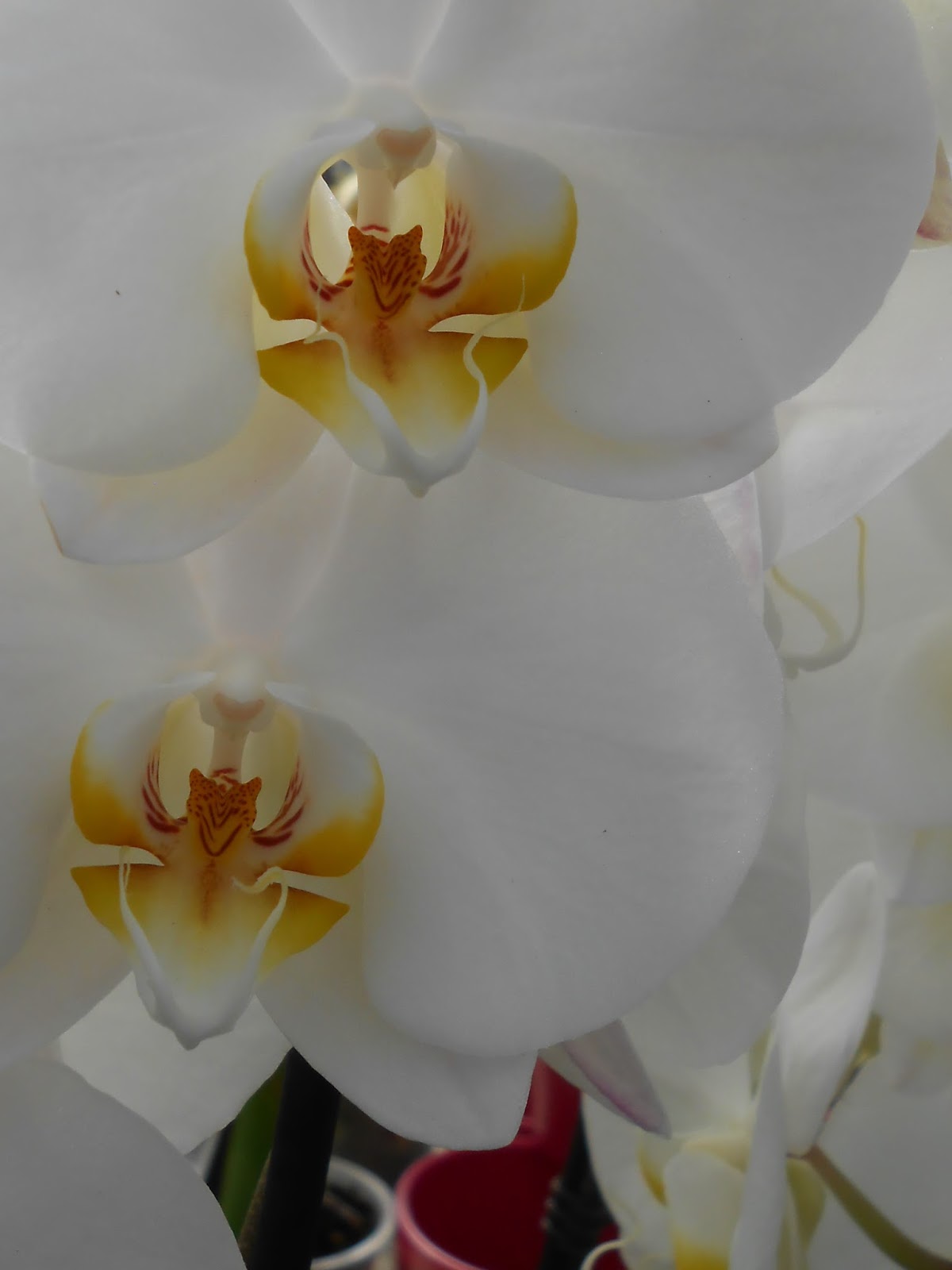
Today's visit plunged me into an exotic universe, at once both subtropical, equatorial and even aquatic, with the most beautiful collection of orchids that seemed to draw far more on the animal kingdom or the marine world than that of plants...
Some of the blooms seemed to have the flesh and form of sea creatures - perhaps anemones, coral or crustaceans - with plump, bulbous shapes and strange tentacle-like shoots and delicate hairs...
Others looked more like seaweed or algae, or perhaps part-fantasy fish with bizarre fins and gills...
And all were lit up with the first Spring-like light... Beautiful!
Thursday, January 23, 2020
Lady's Slippers - the Magic of Orchids...
Unfortunately, the voracious vine weavils have put paid to many a plant – regardless as to whether these were intended for indoor or outdoor life. All my favourite forms of foliage tend to be targeted by the evil weavils. Leaves of ivy, buddleia, passionflower and honeysuckle are chewed to tatters whilst the roots below the soil are gnawed to shreds.
This tactic has worked out quite well, and especially at the present time as the balcony has had to be stripped entirely due to renovation work. Last weekend I made my usual addict’s dash to the garden centre in order to get my regular ‘floral fix’ and was not left wanting.
The greenhouse was awash with a flood of pale purple and pink, elegantly borne on stems rising from rich green leaves. Once synonymous with the exotic and rare, we now find orchids on sale everywhere – from supermarkets at knock-down prices to petrol station forecourts as a last-minute gift. Indeed they often seem to have become a little too commonplace and vulgar even – sprayed in gaudy colours, glitter-coated and decorated with naff ribbons! The ones here, however, were breath-taking.
Whichever the genus, the petals of each orchid seemed artificial, made up from some kind of luxurious, waxy synthetic material, delicately painted in rich colours. The Phalaenopsis – from the Greek phalaina ‘a kind of moth’ with the suffix -opsis meaning ‘having the appearance of’ is probably the best-known commercial orchid. Flat flowers, with strangely formed parts, are arranged on long, arching stems, while long, ‘leggy’ roots trail below. Native to a number of Asian countries and Australia too, the Moth Orchid is now a staple in florist’s shops and garden nurseries in climates far less hot and humid.
Cypripedioideae is an orchid subfamily commonly referred to as Lady's Slipper. These are recognized by the flower’s slipper-shaped pouches (modified labella). Its intriguing beauty, wields the same power over passing insects that are irresistably drawn down into the pouch, thus fertilizing the flower.
Paphiopedilum, often named the Venus Slipper, is a genus of the Lady Slipper Orchid. The name is derived from Paphos in Cyprus (the mythical birthplace of the goddess Aphrodite) and the Greek word pedilon for ‘slipper’. It is native to a list of countries that sound as if they are drawn from a children’s book of adventure and exploration from a bygone era; Southeast Asia, the Indian Subcontinent, southern China, New Guinea and the Solomon and Bismarck Islands… This genus is largely cultivated by seed, as opposed to tissue culture, which means that each plant is unique.
Zygopetalum is a scented variety of the orchid family, with a name that refers to the yoke-like form of the flower’s lip (from the Greek ‘zygon’). The fragrance and petal marking attract the insects that will then act as pollinators. Unlike the other orchids on display, with origins scattered over the eastern hemisphere of the globe, the Zygopetalum is ‘merely’ a native of certain areas of South America. Of course, all orchids that are hybridized and cultivated for mass-market sales today will never have seen their natural habitat as production now is international in scope. So, maybe not so remote and other-worldly after all, but just as mesmerizing. And the best aspect about getting horticultural fixes for free? The variety of ‘drugs’ is never-ending – changing with the seasons and the latest hybrid breakthrough so that I rarely know what I will come across. That really is magical !
Saturday, March 31, 2018
Third and Final for the Month...
As there is no way I'll ever prepare a third post for this mad month of March, I'll just cheat and use my orchid shots - pink and purple this time.
Maybe these colours will bring some warmth to the temperature outside and the mood within!
There is a magical full moon tonight - perhaps the best way to usher in the month of April and say goodbye to March!
Plimsoll Lines....
According to dictionary definition, the term 'Plimsoll Line' refers to the marking on a vessel's side, showing the limit of legal submersion when loaded with cargo under various sea conditions. Right now, I feel like some old boat, sinking under the weight of my work obligations. So, while I had actually planned on writing a proper post, this one will have to do.... Still, I do think these are such beautiful flowers and of an appropriate colour - blue !
Monday, March 19, 2018
Last Day of Winter...
So what better than some bright warmth from orchids...
These are so exotic, yet as they are seemingly available everywhere, they seem strangely commonplace...
Tuesday, April 17, 2012
Exotic Easter...
Well, actually Easter was not at all exotic, but we did go out to the garden centre and some of the plants there were most exotic-looking. This made a change from a distinctive un-exotic lifestyle which seems to consist of preparing and marking exam papers in a very un-tropical climate (we're back into minus° figures in the morning here... Freezing!).
Some of the flowers that we came across seem to resemble strange reptiles, with their lizard-like speckled markings and bizarre colouration.

Others looked like strange seaweed, or maybe even straggly sea creatures, with odd tendrils that look like crustaceans' feelers or long, stalky legs. The one below reminded me of an elongated sea anemone...
Others again looked like exploding coral...
Some plants don't appear to be natural at all, but composed of some synthetic fabric instead...
Or perhaps made of just plain plastic, or rubber...
The aspects, textures and colours are so extreme that they are a shock to the system...
Others look quite daunting with their strange, alien pod formations that make you wonder what will finally burst out.
Some fascinate with their bizarre billowing forms...
And finally there are others that are just striking in the modest delicacy of their petals...
And then the feather-like petals, clustered around the hidden stamens...
And the tender pastel water-colour shades with flecks of pollen - unfortunate in the case of pansies as I seem to be allergic to this, but that's a small price to pay!
Some of the flowers that we came across seem to resemble strange reptiles, with their lizard-like speckled markings and bizarre colouration.
Others looked like strange seaweed, or maybe even straggly sea creatures, with odd tendrils that look like crustaceans' feelers or long, stalky legs. The one below reminded me of an elongated sea anemone...
Others again looked like exploding coral...
Some plants don't appear to be natural at all, but composed of some synthetic fabric instead...
Or perhaps made of just plain plastic, or rubber...
The aspects, textures and colours are so extreme that they are a shock to the system...
Others look quite daunting with their strange, alien pod formations that make you wonder what will finally burst out.
Some fascinate with their bizarre billowing forms...
And finally there are others that are just striking in the modest delicacy of their petals...
And then the feather-like petals, clustered around the hidden stamens...
And the tender pastel water-colour shades with flecks of pollen - unfortunate in the case of pansies as I seem to be allergic to this, but that's a small price to pay!
And finally some flute music to go with that - James Galway playing Pachelbel. I included this as my daughter likes it, and also because when we discovered the magic of the garden centre the background music almost killed off the atmosphere of the place. Only almost, luckily!
Saturday, March 3, 2012
Catleya....Cattleya... The Flower Duet.
I like looking around the very old ‘atmospheric’ parts of graveyards where the tombs are rarely carved from ageless, yet soulless marble, and you may come across the flights of spirituality and creativity displayed through the graves. However, what I particularly enjoy noting are the names of those long-since departed, ornately engraved into the headstones, even if now barely legible. With the erosion of time and the elements many of the inscriptions seem to have melted away like the icing on some intricate wedding cake.
But that’s not all – the very names themselves seem to have dissolved from our repertoire today so that however original we think we are when naming a child the result is somewhat bland in comparison. How can you compete with the resonance of Seraphina, Euphemia, Ophelia, Zillah, Cornelia, Araminta, Phineas, Clarence, Lucius or the beautiful name Zepherin that I discovered inscribed on a stone today… Some would seem more than a little heavy today, and would prove to be a great weight to carry, but I rejoice in seeing them nevertheless. Yet even if I mourn the passing of such unusual, yet dignified names I do occasionally encounter some odd specimens in the living world of today. Cattleya, as a girl’s name, must be the most noticeable one to date…..
Cattleya is the innocent-sounding name given to the highly-popular species of orchids that decorate interiors far and wide. Originating in Central and South America these were brought to England towards the 1820’s, apparently largely by fluke, as legend has it. Indeed the plants had been used to bulk up the containers of other botanical specimens to be shipped abroad. Finally arriving in England these ‘new’ plants were cultivated out of curiosity by a certain William Cattley. Producing unusual scented flowers of lavender, crimson and gold with distinctive frilly-edged labellum, this particular orchid was named Cattleya in 1824 in Cattley’s honour by a famous botanist. The term was to be applied to the other 113 species of the genus and the cattleya heralded the beginning of a craze for orchids amongst Victorians already avid for exotic ferns and foliage. Today the thirst for the ubiquitous orchid seems to be stronger than ever, to the point that I see them everywhere, but sadly never notice them anymore…
But that’s not all – the very names themselves seem to have dissolved from our repertoire today so that however original we think we are when naming a child the result is somewhat bland in comparison. How can you compete with the resonance of Seraphina, Euphemia, Ophelia, Zillah, Cornelia, Araminta, Phineas, Clarence, Lucius or the beautiful name Zepherin that I discovered inscribed on a stone today… Some would seem more than a little heavy today, and would prove to be a great weight to carry, but I rejoice in seeing them nevertheless. Yet even if I mourn the passing of such unusual, yet dignified names I do occasionally encounter some odd specimens in the living world of today. Cattleya, as a girl’s name, must be the most noticeable one to date…..
Cattleya is the innocent-sounding name given to the highly-popular species of orchids that decorate interiors far and wide. Originating in Central and South America these were brought to England towards the 1820’s, apparently largely by fluke, as legend has it. Indeed the plants had been used to bulk up the containers of other botanical specimens to be shipped abroad. Finally arriving in England these ‘new’ plants were cultivated out of curiosity by a certain William Cattley. Producing unusual scented flowers of lavender, crimson and gold with distinctive frilly-edged labellum, this particular orchid was named Cattleya in 1824 in Cattley’s honour by a famous botanist. The term was to be applied to the other 113 species of the genus and the cattleya heralded the beginning of a craze for orchids amongst Victorians already avid for exotic ferns and foliage. Today the thirst for the ubiquitous orchid seems to be stronger than ever, to the point that I see them everywhere, but sadly never notice them anymore…
Since everything seemed to be have been killed off by the cold weather last month I decided to go to a garden centre just to see something bright and blooming. Looking closely at the orchids I rediscovered just how incredibly exotic these plants truly are. The colour, shape, texture and the visual perfection of the petals are oddly artificial in their beauty. They truly seem to have a form that goes beyond mere physical function – the attraction of pollinators…
The 19th century French author Marcel Proust (1871-1922) presumably read more into the form of the Cattleya too and certainly gave the flower a whole new meaning. In his novel Un Amour de Swann, second part of Du côté de chez Swann from the vast A la recherche du temps perdu, the reader encounters the nascent infatuation of Swann for the demi-mondaine, Odette de Crécy, and witnesses his amourous overtures. In an attempt to gain a sentimental and physical proximity to the object of his ‘love’, Swann chooses to reposition the orchids that Odette pins onto the plunging neckline of her evening gowns. Seeing that this flower-arrangement ploy brings him what he most desires, Swann uses the expression “faire catleya” to signify the physicality he wishes to pursue.
I remember our (male) French teacher explaining all of this to us in class, telling us to look at the orchid itself in order to understand the expression better, and I certainly recall how we embarrassed we were when the saw the flower in question… I had forgotten that Proust had chosen to write his verb with a single ‘t’, and so on encountering the student of that name I couldn’t believe that parents would give such a heavily-weighted appellation their unsuspecting offspring. How raunchy – even if we are in France! I didn’t like to inquire in front of the class, but later realized that she was named in honour of the virginal orchid after all! I was a little disappointed…
I did see the film Un Amour de Swann when it came out in 1984. I don’t now remember what I thought of the film itself at the time, I was too busy trying to keep up with the French language and look at Jeremy Irons!
Un Amour de Swann
Watching extracts again today I just love the elegance of the clothes and interiors, with or without the Cattleya. I grew out of Jeremy Irons…
The orchids I saw recently reminded me of the Lakmé opera by Léo Delibes – the Flower Duet. This was a work based on the novel Rarahu by the French writer Pierre Loti, describing the ill-fated love between Lakmé, an Indian girl, and Gerald , a British colonial officer. The romantic exoticism of the piece contrasted with the social naturalism apparent in art and literature in the latter part of 19th France and fed an interest for all things Oriental.
Clicking on the computer I discovered an association of names that certainly hadn’t occurred to me… I had never fully appreciated the beauty of Charlotte Church’s voice. Her classical singing seems to defy all natural barriers or concepts – it goes into a realm that seems unnatural in its perfection.
Below is Lakmé’s part in the Flower Duet scene, singing with her servant Mallika as they gather jasmin and roses by the river. The opera was first performed in Paris in 1883; I don’t know if Proust would have seen a performance at a later date.
Proust’s tomb can be seen at the Père-Lachaise cemetery, Paris – in sober, black marble – again I was a bit disappointed...
Dôme épais le jasmin
A la rose s'assemble
Rive en fleurs frais matin
Nous appellent ensemble
Ah! glissons en suivant
Le courant fuyant
Dans l'on de frémissante
D'une main nonchalante
Gagnons le bord,
Où l'oiseau chante, l'oiseau, l'oiseau chante
Dôme épais, blanc jasmin
Nous appellent ensemble!
A la rose s'assemble
Rive en fleurs frais matin
Nous appellent ensemble
Ah! glissons en suivant
Le courant fuyant
Dans l'on de frémissante
D'une main nonchalante
Gagnons le bord,
Où l'oiseau chante, l'oiseau, l'oiseau chante
Dôme épais, blanc jasmin
Nous appellent ensemble!
| The humble cabbage - the only 'flower' to have survived winter in the town centre! |
Subscribe to:
Posts (Atom)