Far from the beach, but still surrounded by treasure of all kinds just ready to be found, looked at, gloated over, gleaned and swiped or simply created! Here are my latest finds....
Showing posts with label Cathedrals. Show all posts
Saturday, January 15, 2022
Palais du Tau and Notre-Dame de Reims... Jewels in the Crown in the Cité des Sacres.
As time goes on, I find myself turning to time long gone by, as all the traces of centuries past seem to offer far more beauty, interest and intrigue than the offerings of today. The peace and tranquility that many of the historic pieces of art and archictecture appear to exude in the present day does, of course, belie their tumultuous past. Nevertheless, simply being surrounded by the solidity of age and the fluidity of evolving aesthetics over the eras is far more calming and enriching than any of what our frenzied click-and-swipe screen culture provides.
We are being devoured by our dependancy on these high-tech mirrors that offer a distorted and distorting vision of ourselves and the world about us. Gazing down into these modern looking-glasses, we lock ourselves in a present moment which has to be fun and bite-size, or for fear of losing out on ‘likes’ from being too dour and fatiguing ‘friends’ by being too long-winded. I won’t bother about being wholly guilty of both !
Preening and posing for the camera in the reality of this largely visual virtual world, where words are used as mere captions to accompany some photo or other, we may soon lose sight of where we have come from and what we are and relinquish all curiosity to find out. And so on a bracing cold Sunday a visit to one of the city’s oldest architectural sites – le Palais du Tau – seemed to be a curative solution to my latest bout of 21st century screen-induced disenchantment.
This was certainly not the first time I had visited the building which has been listed as UNESCO World Heritage since 1991. Not only does the Palais du Tau house the musée de l’Oeuvre, acting thus as museum to the artwork and treasures associated with the ceremonial role of the site, along with a display of the original statuary and tapistries from over the centuries, it also hosts many contemporary cultural events.
Naturally its cour d’honneur is used during the Fêtes Johanniques, when the procession of Medieval characters – and mostly significantly Jeanne d’Arc and Charles VII – converge on the cathedral in the annual commemoration of the 1429 coronation.
In addition, the truly marvellous international marionnette festival, Orbis Pictus, has been held to great effect in the halls and chapels of this monument since 2010. Likewise, many exhibitions have been set out here over the years and the association Carnet de Bals has organised Second Empire-themed dances to tap into a spirit of living history.
Simply approaching the palais du Tau from the back of the cathedral with its apse still feels a little magical. The 800-year-old Notre-Dame de Reims stands proud against the afternoon skies with its intricate flying buttresses, pinacles and spires rising upwards. The palais du Tau is not itself a vast monument however, either in height or size, considering the symbolic and functional role it has played in the religious and monarchical history of France.
Set to the right, southern flank of the cathedral and its main doorways, separated by the cour d’honneur, the palais allowed access to Notre Dame during the grand ceremonies. Its chapel runs perpendicular to the cathedral but is far more sober in style.
Although the palais du Tau was initially the palace of the Archbishop of Reims, it went on to play a significant part in the coronation of the kings of France – some 33 in all – in the succession of sovereigns from 816 to 1825. Following the baptism of Clovis, the first king of all the Franks, by Saint Remi cerca 500, subsequent monarchs sought to be annointed with the Holy oil, thus uniting temporal and sacred power. The palais thus became the residence of future kings, prior to the elaborate crowning, and Reims became la cité des sacres.
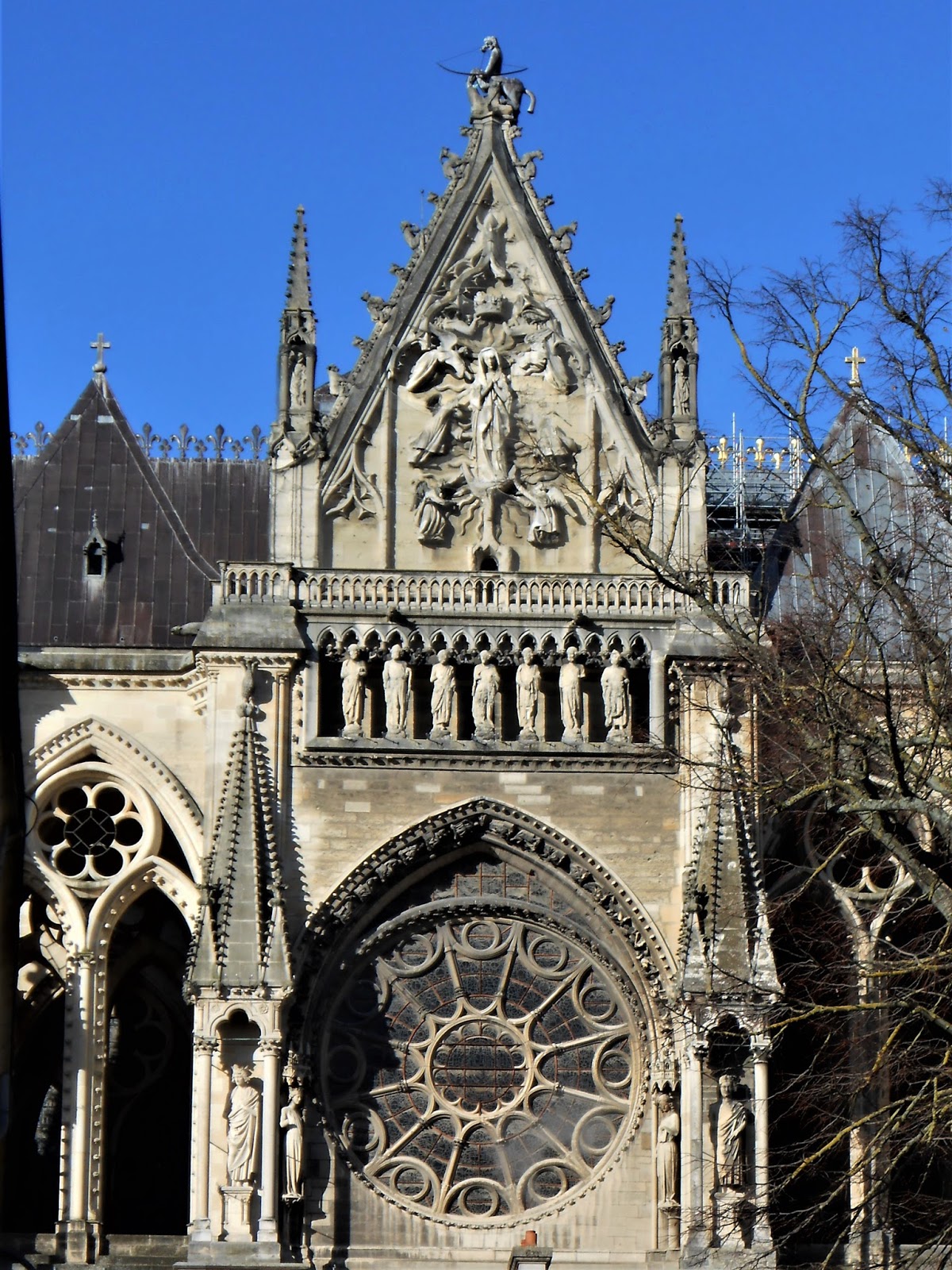
The sacred and sovereign significance of the cathedral and thus the palais du Tau too, is reflected in the gallery of Old Testament kings. These massive figures tower over us from their vantage point above the rose window on the western facade and set at the centre is the baptism of Clovis.
The incredible height of these sculpted forms (4.5 metres and 6 tons each) is apparent in the palais as many of the cathedral’s original works are now kept there for conservation. What we see on the monument, meanwhile, are reproductions, capable of withstanding the elements and that modern-day blight ; air pollution…
The city had nevertheless been of great importance even before its regal associations. Originally known as Durocortorum (‘round fortress), Reims was the second largest city in Roman Gaul and operated as a hub during the Roman Empire. The palais du Tau was in fact built on the site of a Gallo-Roman villa that was still in place in the 7th century but was finally replaced by a Carolingian palace and later given its Greek name (tau) in reference to the T shape of its ground plan.
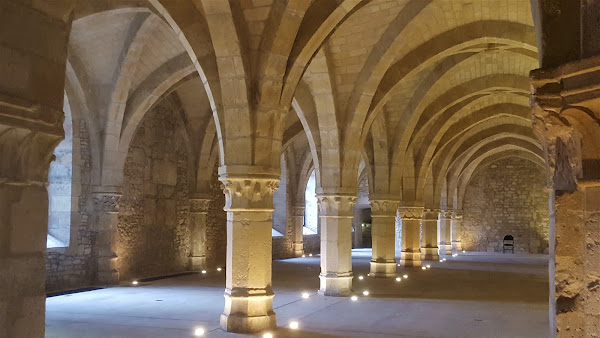
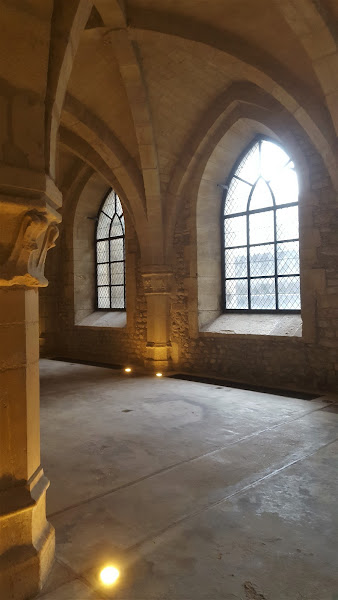
Although most of this early architecture was lost, the 13th century Palatine chapel remained and the rest of the building was rebuilt in the Gothic style in the late 15th–early 16th century. The grand Medieval banquet hall – initially known as the Salle Du Tau or the Salle des Festins – is intact today with its high wooden-vaulted ceiling in the form of a boat’s hull, although sadly only two of the original six vast wall tapestries are still present today.
Towards the end of the 17th century, a large part of the building was transformed by modification made in the Classical style, under the direction of Louis XIV’s first architect, Jules Hardouin-Mansart.
With the dramatic end of the Ancien Régime in 1789 the palais du Tau evidently fell into disgrace. Its close association to the union of sacred and sovereigny – with the altar and the throne - meant that it represented all that the French Revolution sought to overturn. In 1790 it was confiscated and became state property for use as a law court, prison and stock exchange.
Under the Restoration years, the bishop returned and the palais itself recovered some its former pomp and ceremony during the coronation of Charles X in 1825. Nevertheless, it suffered the indignity of being used as lodging by Kaiser William following France’s humiliating defeat in the Franco-Prussian war in 1871
The separation of Church and State in 1905 ended the occupation of the palais du Tau by the bishops of Reims and site was classed as a historical monument in 1907. Unfortunately that status in no way spared it from the ravages of World War so that by the end of the four-year hostilities, only the walls and the chapel were left standing.
The cathedral suffered catastrophic damage from the very onset of the war, and quickly became the symbol of ‘La France martyre’. Such was national outrage that reconstruction commenced in 1919, whilst the palais du Tau had to wait until 1950 for restoration work to be carried out. Not that you would notice any of this today, thankfully, as you wonder around the various atmospheric halls and the corridors adjoining them, especially at nightfall when you imagine the weight of the past.
The palais du Tau became a museum in 1972 and so now the Holy ampula, the royal chalice and even the talisman of Charlemagne that were once actively used in les sacres are set in glass cabinets as beautiful display pieces only. Nothing can dull the radiance of the cathedral though- the best jewel of all!
Sunday, September 26, 2021
Cathedral in Autumn Night Sky...
Walking home, I love looking at the cathedral. Whatever the time - day or night, whatever the weather or my mood, the cathedral always makes me feel contented. However, I think it looks even more beautiful when illuminated at night.
It never fails to amaze me that this same edifice has stood there for over 800 years, dominating the horizon from afar, and towering over the streets around it.
Monday, November 30, 2020
First Frost For The Last of The Month...
The bracing cold night air of the final days of the November caught everybody's breath, as did the sight of the beautiful cathedral standing majestically ahead, with the bright moon beyond it.
Sadly I have never been able to do any photographic justice to any of the eight phases of the moon, as it waxes and wanes each month but the magic of the original sight is there in my mind's eye at least...
The stonework looked like a backcloth of lace in the illuminations that have now brightened up the town, in preparation of Christmas, as the last autumn leaves cling onto the trees...
Then for the early morning of the very last day of the month, frost had decorated everything with its own lacy designs - my favourite of these being the beads of ice on spiders' webs.
The icy threads of silk hung down, in impressive proportions, magically draped from lamps and sign posts, thankfully distracting my gaze from the bland urban landscape beyond. If that is not magic, I don't know what is!
Wednesday, December 25, 2019
Christmas Regalia...
The beautiful cathedral at Christmas, with the market at its feet, and the Regalia light and sound show on its majestic façade, celebrating the regal history of this 800-year-old edifice that was the coronation site of the kings of France.
I decided to take photos at dusk and dawn to make a video to set the images of the light on the cathedral to the beautifully haunting music of Sir John Tavener - The Lamb. Tavener's Song for Athene was performed at the funeral of Princess Diana by the Choir of Westminster Abbey...
Reims Cathedral - 'The Lamb' by John Tavener - sung by The Tenebrae Choir
The Lamb has been sung several times by The Choir of King’s College, Cambridge for their Festival of Nine Lessons and Carols which takes place each year on Christmas Eve. The version here, however, is sung by The Tenebrae Choir. More impressive than my video-making attempts was the Regalia show, needless to say!
![]() |
| "The Lamb" in William Blake's Songs of Innocence and of Experience (1794), illustrated by Blake William Blake Digital Materials from the Lessing J. Rosenwald Collection, Library of Congress |
I decided to take photos at dusk and dawn to make a video to set the images of the light on the cathedral to the beautifully haunting music of Sir John Tavener - The Lamb. Tavener's Song for Athene was performed at the funeral of Princess Diana by the Choir of Westminster Abbey...
The Lamb has been sung several times by The Choir of King’s College, Cambridge for their Festival of Nine Lessons and Carols which takes place each year on Christmas Eve. The version here, however, is sung by The Tenebrae Choir. More impressive than my video-making attempts was the Regalia show, needless to say!
Thursday, August 15, 2019
Notre-Dame de Paris...
The year here has been one scorched by searing heat and tensions reaching boiling point. The full force of rage and frustration exploded on the street with the continued demonstrations of Les Gilets Jaunes. Initially sparked off by rising fuel prices, the flames of anger were soon fanned by all forms of social, economic and political injustice. This feverish atmosphere seemed to prime the country for the surge in climatic extremes which have surely been some of the clearest manifestations of global warming. However, the image that burnt itself in me is that of Notre-Dame cathedral, engulfed in flames in mid-April.
This was not a human tragedy, comparable to the inferno of London's Grenfell Tower, for example, where the cruel sequence of events led to a devastating loss of life, in unspeakably awful circumstances as the tower was rapidly transformed into a monstrous blazing torch, ensnaring its inhabitants. Notre-Dame de Paris was something else...
A similar sense of mourning for the loss of heritage seemed to make itself apparent with the unearthly vision of Notre-Dame ablaze. That night, it was not even sure that the last remaining structure of the cathedral – the twin bell towers - would withstand the flames to survive till dawn. Without these structural ‘bookends’, the vaults would surely have collapsed and the entire building lost. Had this happened, the whisperings of this 850-year old building would have been silenced and the vital human traces that have spanned the centuries like a thread or beam of light would have been cut. Although the edifice was first and foremost a place of spirituality – Catholicism – its significance goes far beyond this. Born from a desire to communicate Godliness, Gothic architecture emerged in Northern France, where a new dynasty of powerful French Kings, flanked by bishops, wished to prove their religious devotion and the extent of their unparalleled might and wealth. Through dazzling constructions that would literally reach to the heavens, all viewers were stunned to submission by the dizzying heights, blinding luminosity and vivid colours of these cathedrals and churches. From the emergence of the Gothic style, with the transformation of a large medieval abbey church into the Basilique Saint-Denis in a northern suburb of Paris around 1140, many edifices grew in an unprecedented manner. Each of these was a testimony to the ability, daring and dedication of the hundreds of craftsmen who toiled over the decades to create a vision of divine perfection; architects, engineers, masons, stone-carvers, sculptors, stained-glass artists.
The successful realisation of each work and its survival to the present day is heavy with past sacrifices. Each piece in any cathedral bears its weight in blood, sweat and suffering. Not only were the workers directly involved expected to give their all, but the commoners too, since they were required to pay taxes and tithes to finance these projects, despite their peasant status. From the beginning of its construction in the 12th century, throughout the centurIes up to the extensive restoration work in the mid-19th and beyond, Notre Dame’s history is a long litany of tales of toil and hardship but one also of the glory, beauty and the depth of human creativity and resiliance – both cultural and spiritual. We will never know anything of the lives of these thousands of individuals who contributed to the existence of the cathedral, but their common voice is carried through every detail of the building. In this way, a vital essence of all these beings has been caught and preserved – like an insect in amber - thus creating intransience that reassures us, yet points to our own mortality. Indeed, for the majority of us, our time on Earth will leave little lasting trace, mere footprints in the sand that are destined to be effaced. The cathedral, like the other great edifices of history still standing today offers a ‘whole that is more than the sum of its parts’, to borrow Aristotle’s words. It has created a bond of humanity and spirituality between past, present and future. To behold such an edifice is a humbling experience and therefore to see its destruction is tragic.
On the fateful night of the 15th April, Notre Dame was ravaged by the flames and the subsequent water that doused these; both posed an obvious direct and immediate threat to the entire structure. Without the weight of the roof, parts of the vaulting and the subsequent weakening of the stonework, the intricate equilibrium of the cathedral was fatally disrupted. The whole construction of any of the great Gothic cathedrals is strong through the mutual interactions of all its parts – wherein horizontal force is met and counterbalanced by vertical thrust. Once this play has been compromised, stress is redistributed and the entire structure is at risk of imploding. Notre Dame no longer has the weight of its spire and roofing to act as ballast to withstand the horizontal force of wind, whilst the flying buttresses now exert an unbalanced thrust inwards. This has meant that since April, all measures have been taken to avoid the collapse of Notre Dame rather than commencing concrete restoration work, especially given the extreme heat during this summer’s heatwave which has further stressed damaged masonry. Added to these key considerations, are the major concerns over the hazardous debris that has contiminated not only the area directly surrounding the cathedral, but also the streets around the Ile de la Cité. As tons of lead melted in the blaze, many toxic particles became airborne and were spread freely in the wind, contaminating buildings, soil and the water of the Seine. This exposure to high-levels of lead pollution naturally presents a risk to the on-site workers and local residents of the adjacent streets and will require extensive decontamination measures. In view of these titanesque obligations further compromising a cash-strapped government, spending millions of euros on returning Notre Dame to its fomer glory may seem delusional. It is argued that the cathedral should be secured structurally, but left as a symbolic ruin. But what would it symbolize exactly? Unlike Notre-Dame de Reims, which was devastated in the early stages of the First World War and then heralded as the emblem of the martyred city and country, the cathedral of Paris was the victim of fire. Notre-Dame de Paris did not fall victim to a force majeure or an act of God – but by a presumably preventable incident which was then dramatically compounded by a set of clumsy failures in communication. To say this was unfortunate would be an understatement, but the cause of the fire cannot be attributed to a ‘great’ event, merely a series of errors. So what now?
The weeks and months have now passed; the billowing smoke has long since subsided, the ashes have settled and now scaffolding envelopes the damaged structure like crazy webs, whilst the limbs of giant cranes lean across like predatory spiders. Deprived of its impressive roof and spire, the nave has now become a charred hulk.
From the exterior, the whole structure indeed ressembles an empty vessel - la nef (nave) being the old term for navire or ship, it is now apparent why. The distinctive form of the cathedral apse that stood majestically over the Seine, has been likewise truncated. The gutted interior of the cathedral is still too dangerous for workers to clear rubble, although robots have been able to carry out some work. Meanwhile, the parts of the masonry and sculptures that were intially lined up, like corpses on the parvis in front of the cathedral in the days after the fire, are now securely hidden from sight. Long lines of barriers encircle the grounds, obscuring the view of this crime scene without a criminal. High above, the row of kings gaze down from the main façade, as they always have done, yet now they seemed stunned and glassy-eyed… .
From the outset, money literally poured in overnight as the public mourned the devastation of one of the most important symbols of French history and culture, not to mention one of its greatest places of Catholic worship. Within days, millionaires and key figures in the corporate world were vying with each other to pledge the highest sums of money in order to raise up this 850-year- old edifice, in phoenix fashion. The readiness to give such vast financial backing to this cause soon drew indignation from many quarters. It was remarked that these bottomless coffers which had remained tightly-shut for social issues of a more contemporary nature, were spontaneously thrown open for an ancient monument that had perhaps done its time. Funding Notre Dame’s restoration is now almost perceived as some elitist gesture, for the benefit of the Happy Few. This saddens me since this restoration work should not be considered as being pitted against social causes, in an open competition for financial hand-outs. It is not a case or either/or, wherein the two are presented to the benefactors to select their ‘worthiest’ mission. How many of the wealthiest beings on Earth squander their money without donating anything to any cause whatsover, unless you cite the narcissistic endeavours of their conspicuous consumption?
Surely if these billionaires donated such vast sums, that should, in theory at least, have freed the government’s funds to concentrate on balancing social inequalities. To point out the fact that poverty exists in the streets just beyond Notre Dame seems facile since it always has done, ever since the very first stone was set, however unfortunate that may be. Further afield, the cathedral of Saint Denis is now surrounded by some of the poorest living conditions in the capital but that does not mean the monument is involved in the perpetuation of this sorry state of affairs. If necessary restoration work is refused these ancient monuments, what will remain of our cultural landscape and heritage? Fastfood outlets, bland franchises, discount stores and the like, standing next to banks, estate agents and so on?
Although financial backing is not an obstacle to the Notre Dame conservation project at present, the coming months and years will surely be scattered with doubts and practical stumbling blocks of great proportion. The most significant of these is perhaps finding a manner in which the building should be restored. There is no obvious, ready-made solution. Naturally, traditionalists would like to see Notre Dame resuscitated and brought back to its former pre-fire glory. However, this raises a few points. Many people consider that it would be an error to embark on a restoration project that would faithfully replicate the design of Notre Dame – even if extensive laser imaging from 2015 provides a highly-detailed digital template of the edifice. It is believed that a replica would not be true to the organic spirit of Notre Dame or the cultural history of the capital. A redesign would therefore be more fitting for a past revisited and paid due respect in a unique manner. After all, much of the structure lost was in fact designed by Eugène-Emmanuel Viollet-Le-Duc, in the latter half of the 19th century. The innovative 750-ton central spire covered in lead and the vaulted roof were thus ‘fake’ Gothic since they had themselves replaced the original 13th century work. Viollet-le-Duc himself had incorporated certain modern practices in this undertaking, and in so doing seemed to anticipate the ideas of composer Gustave Mahler - “Tradition is tending the flame, not worshipping the ashes”.
Meanwhile, in the tradition of former French presidents who have embarked on cultural projects, Emmanuel Macron appears to see Notre Dame as his opportunity to leave his political and personal mark on French history. He stated that at the end of an initial five-year deadline the world would discover a "creative reconstruction" of Notre Dame, representing "an alliance of tradition and modernity, a respectful audacity". That particular time slot, set to coincide with the hosting of the 2024 Summer Olympic Games, has been shown to be unrealistic, but ambitious plans are still held for restoration work under Macron. Prime Minister Edouard Philippe announced an international architects' competition for designs in order to replace the 19th century spire. Several highly-original proposals were put forward – most of which are indeed imaginative, audacious and highly inappropriate. I won’t even bother to include any images of the ‘whackiest’ of these, as most seem to be a bid to get world-wide attention and some kind of shock-value acclaim for the individual ‘designer’ prepared to make irreparable changes to this iconic edifice. Buildings such as these, as indeed most artifacts, have been bequeathed to us all collectively by History, and we are duty-bound to honour and pass them on to future generations.
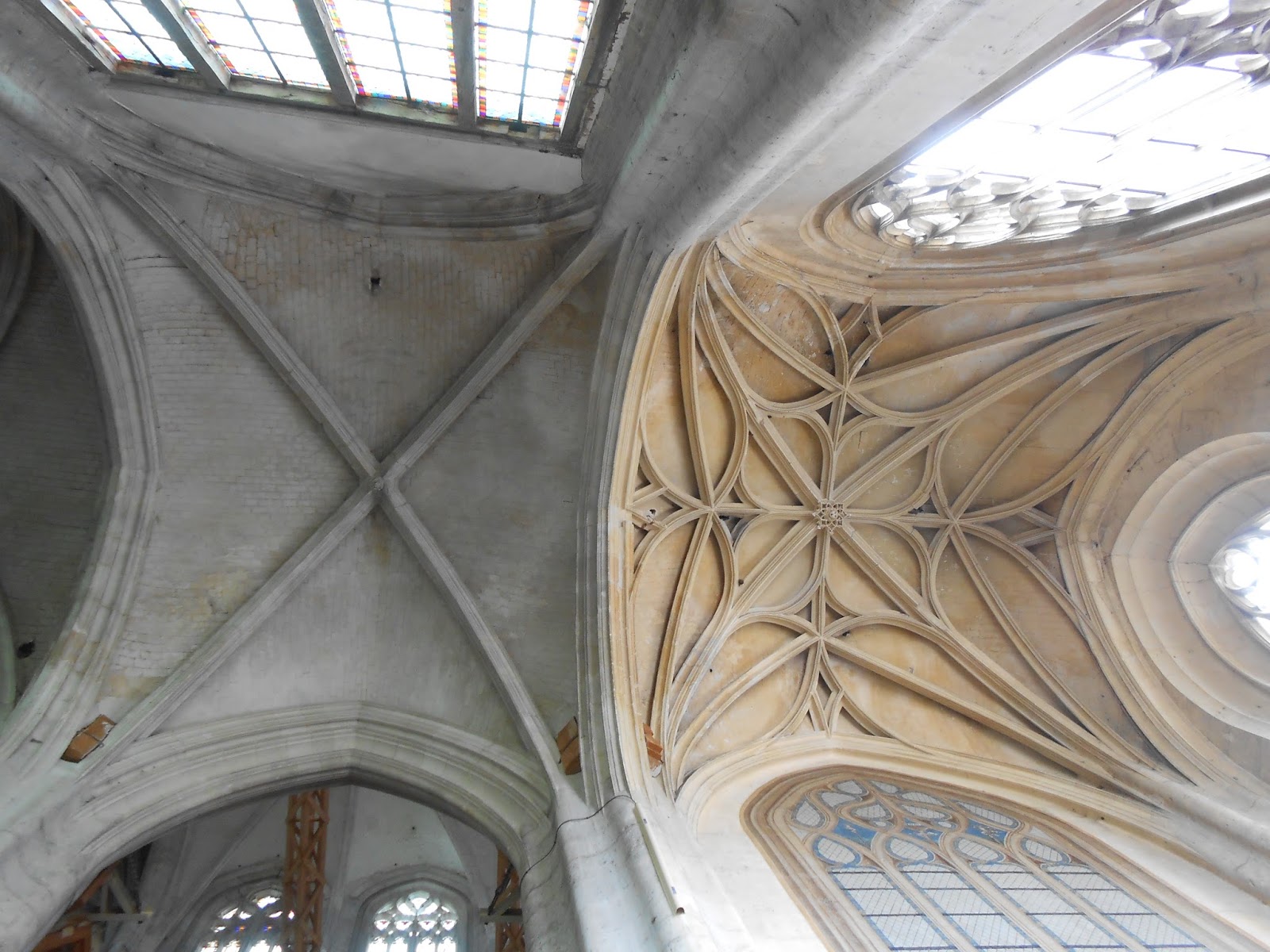
Why are we then talking about mediatized projects which appear to be acts of self-promotion, peddling the whims of personal tastes? Why bother with these ‘exciting’ present-day statements when we could be concentrating on state-of-the-art technology and modern materials to lift the cathedral up again, as in the case of Reims cathedral in the inter-war years? With the financial backing of billionaire American John D. Rockefeller, the whole roof of the Notre-Dame de Reims was replaced by a structure supported by an incredibly innovative concrete framework, invisible between the roof and the internal vault ceilings it supported. This is not so disimilar to the predicament of Notre-Dame de Paris which has lost the original frame that was built upon a complicated lactice structure of centuries-old oak beams - known as ‘the Forest’. Fortunately, Notre-Dame de Paris has the status as a Unesco World Heritage site and a law enacted by the French Senate, concerning the regulation of the restoration work, now has an addendum specifying that this should preserve the "last-known visual condition" of the monument, including the spire. The stained-glass windows will probably be restored and/or replaced too, since many have suffered thermal shock due to the extreme contrasts in temperature during the firefighting. This is indeed an opportunity for contemporary artists, just as it has been in Reims since the First World War. Over the years, generations of master glass artists from the Atelier Simon(Marq) have worked on the cathedral windows, and those of certain churches around the city of Reims. Other artists have contributed too - namely Marc Chagall, Maria Helena Vieira da Silva (Eglise St Jacques) and Imi Knoebel. I am still trying to be won over by the work of that latter maître verrier however...
I don’t know what will happen over the next few months or years. We must hope that this monumental work of restoration will be undertaken by the most capable panel of professionals who understand that they have been entrusted with the task of marking our collective respect for this great edifice for now and posterity. I am not sure what lesson we can draw from the fire in Notre Dame, except perhaps to appreciate what beauty we have, from the most sturdy-looking structures to the most delicate. Before seeing Notre Dame in May, I came across the poppies in Le Jardin des Plantes - the flower beds were aflame!
Thursday, January 31, 2019
Snow on the Spires...
Sunday, December 31, 2017
End of the Year 2017...
Almost the end of the year... This view of the southern part of the transept of the cathedral of Reims was taken just a few days ago - and those tranquil bright skies will soon be starkly contrasted by the grey, stormy weather that is forecast for the start of the new year. Mind you, such extremes seem to resume 2017, full of highs and lows. I just hope that the Sagittarius the Archer, taking aim at the courtyard of the Palais du Tau far below, will nevertheless be lit up by the new moon - the Wolf - that will usher in 2018.
Monday, October 31, 2016
St Peter's Cathedral at Beauvais - The Struggle of Architecture over Gravity...
After visiting some of the great early cathedrals – St Denis, Noyon, Laon – I was eager to see what makes the incredible edifice at Beauvais so unique. Well, remarkable it certainly is.
The price to pay for such an act of hubris would be high and the sum due has still not been fully paid off. Beauvais cathedral is proof that pride does indeed come before a fall This crazy desire to build a divine edifice on a foundation of almost sinful worldly ambition has affected every single aspect of its architecture and fate to this very day.
When approaching the cathedral today, you are obviously struck by its sheer size. The elaborate chevet on the eastern side of the edifice, housing the apse, choir and radiating chapels, has an imposing structure that looks like some weird sci-fi Gothic rocket launcher, if such a thing could exist!
Your eyes are drawn to the metal rods that criss-cross and span the buttresses , which themselves resemble strange blades of stone. The whole seems to release a strange tension, as these vertical spears rise into the skies straight above, yet seem to curl inward slightly towards the summit.
Walking on around the perimeter of the cathedral, the striking Gothic and Renaissance features catch your attention, with the beautiful carved wooden doors on the northern side and with the magnificent sculpture of main entrance on the southern facade.
It seems odd to see a 10th century Romanesque church attached to the western flank of the cathedral itself, but it is the architectural structure just beyond this, trussed up by vast wooden joists and partly covered in slate that gives the distinct impression that something is somehow amiss. You can say that again…
If we are still able to see the old Romanesque edifice today -the Notre-Dame de la Basse Œuvre - this is due to the fact that the Gothic cathedral of the Haute Œuvre was never fully completed. The nave of the later work was destined to occupy the site of this early edifice, but lack of sufficient funds meant that the cathedral of Saint Peter is lacking this significant element.
Without a nave, the building is strangely truncated, but the impact of this architectural omission does not just concern spatial aesthetics. Furthermore, the problems that stemmed from this missing link have never been fully resolved. This is an ongoing story and whilst your eye might get distracted from the bigger picture when admiring the architectural details on the exterior facades , a glimpse inside the cathedral soon sets the record straight…
When the Romanesque Basse-Œuvre church was virtually destroyed by fire in 1225, the decision was taken to replace this Carolingian architecture by an ambitious Gothic edifice that would surpass the others of Northern France. In this way, the cathedral would be an appropriate reflection of the prosperity and importance of Beauvais that had grown with flourishing trade and a prestigious diocese that had significant religious and political power.
Situated on a crossroads of commercial routes, this ‘ville drapante’ benefitted from the considerable revenue generated by its textile industry. Work commenced on this new edifice, Saint Peter, using the technological experience that had been gleaned from the building of the first generation of Gothic cathedrals. Construction of the building relied on massive blocks of local chalk stone. These were set onto foundations that went down more than 10 metres in order to rest on the solid rock formation below.
Not only was the Beauvais choir to be far taller than those of its great predecessors, the battresses were to be thinner too, enabling maximum luminosity from the dazzling heights above. This initial construction period was realised relatively smoothly and from 1260 services started to be held in the completed choir area.
During some 12 years, from the end of work in 1272 until one fateful day in 1284, the Beauvais edifice must have been the glory of the town. Due to its great height, the cathedral rose above the plateau of the surrounding landscape, leaving it exposed to the high winds that would be funnelled towards its massive form and through its structure.
A November storm over 700 years ago saw the collapse of the choir. The fine buttresses buckled under the pressure exerted by the gusts of wind, in turn causing the vaulted ceiling to crash down onto the bays below, shattering the stained-glass windows in the process. Serious structural conclusions were drawn and the whole was rebuilt, to the same dizzy height but this time with walls that were thickened, pillars that were doubled and the inclusion of far more columns and vaulted partitions in the choir and chevet.
Restoration was finally completed around 1347, but the plague and the One Hundred Years War interrupted any further undertakings. It was only in 1500 that work was started on a transept to complete the edifice, some 150 years after the edification of the choir that had proved to be so troublesome.
When it was decided that a lantern tower in the Flamboyant style would crown the transept crossing, it went without saying that this would indeed tower over any other similar structure in Christendom. Over 50 years, the spire rose up to reach its final height of 150 metres in 1569.
The fragility of the cathedral spire was soon apparent and in 1572 the iron cross that had been mounted on the top of the lantern tower was removed as it was considered to be too heavy. Despite this precaution, nothing could protect the cathedral from the elements. Yet again, the cathedral of Beauvais fell prey to the resonating winds. During Mass on Ascension Day, the whole spire collapsed just four years after completion, bringing down with it the tower, surrounding vaults and parts of the transept.
Reconstruction work followed over the next thirty years, but this time there was no spire; the money had run out. A simple wooden vault was put in the place of the tower. The nave itself was never completed and this western facade was later covered by the slates that we see today.
It was the southern facade that housed the main entrance to the cathedral for dignitaries and great processions. Despite the ravages of the Revolutionary years from 1789, this is still very beautiful today. Sadly the statues from the niches of the facade were destroyed and the furniture and artifacts within the cathedral were likewise removed.
Sans-culottes pillaged the building and for some time St Peter became a temple dedicated to Reason. The sculpted fleur-de-lys, symbol of the French monarchy, was effaced by the revolutionaries but several of the royal salamanders, with their tails coiled into a figure-of-eight, still hide on the facades, as emblems of François I.
Other parts of the cathedral facades seem to have escaped all damage during the Revolution. On the northern side, there is the richly-sculpted Tree of Life tympanum and just below are the wooden doors of the portal, built in 1530.
Whilst the style and mood of these are Gothic, the shells that feature below the saints hint to the influence of the Renaissance. Eugène Viollet-le-Duc greatly admired the cathedral for its beauty – especially that of its choir, calling it «The Parthenon of French Gothic». Later in the 19th century, an impressive astronomical clock was introduced, and insured a further influx of visitors.
All in all, the greatest threat to the cathedral of Beauvais never really came from the Revolution… In view of the structural weaknesses that have blighted its long existence, it is a sheer miracle that the cathedral of Beauvais is still standing.
Like the majority of old edifices today, the whole cathedral does look a little run-down, with leaking drains allowing water to stain the stonework and plants to grow from cracks and crevices.
I wish more money could be poured into the upkeep of these fantastic marks of civilisation, even those who have siphoned off so many funds during their lives. The cathedral of Saint Peter must be the ultimate example of a high-maintenance existence!
Subscribe to:
Posts (Atom)