Showing posts with label Jardin des Plantes. Show all posts

Sunday, September 29, 2019

Greenery and Gourds in Le Jardin de Plantes...


A few weeks ago I went back to Le Jardin des Plantes in Paris to check on the progression of the decorative gourds that are the main feature of a number of flower beds there. The most impressive of these herbaceous vines are to be found in a tunnel trellis arrangement along the main path leading to the Muséum National d'Histoire Naturelle.


From the outside, the tunnel appears rather ordinary - like a leafy bunker - but once you peer within and the sunlight pours in between the drapes of greenery, you catch sight of the strangest suspended forms, dangling down, heavily from stalks, defying the laws of gravity and logic too! 


The length and weight of these gourds was truly incredible, as was their shape and the surface of their rind-like skin. Smooth, serpentine fruit hang alongside gnarled, oblong varieties, and odd pendulous clubs. It was difficult to believe that these are the fruit of rather delicate, unassuming flowers.


Gourds come from the Cucurbitaceae family, which also includes squash, pumpkin, cucumber and melon. Whilst most of this group of tendril-bearing plants are grown for consumption, the gourd is generally cultivated for its decorative, ornamental qualities.


However, it also used for its practical usages - as vessel and utensil - and finally as the basis of an amazing array of musical instruments. Some of the names alone are food for thought, with self-explanatory animal references; the snake, hedgehog, buffalo, coyote. My favourite name is, however, the Turk's turban...
I'm not sure what use will be made of the gorgeous gourds at Le Jardin de Plantes, but here are a selection - along with pumpkins and squashes - in my local health food shop.

Wednesday, October 31, 2018

Highlighting the Wonders of the Animal World - Espèces en voie d'illumination - at the Ménagerie, Paris


Soon a light festival will open along the paths of the Jardin des Plantes - this prestigous botanical setting in Paris - tracing the incredible diversity of the planet through the mammals and other creatures that have populated the land, sea and air over the millenia. Large illuminated structures, created by the China Light Festival, will honour these beasts of past and present, from the dinosaurs of 65 million years ago, to their modern descendants.


Indeed the festival leads from the entrance of the gardens next to the Galerie de Paléontologie et d'Anatomie comparée, to the Ménagerie within the heart of the grounds. In this manner, these large animal lanterns will accompany the visitor, taking him past the species of prehistoric times, to the contemporary creatures which are themselves, in turn, threatened by extinction. Hence the play on words of the festival poster, highlighting the "Espèces en voie d'illumination" to recall those ‘en voie de disparition’.


Having recently seen the preparations around the Ménagerie, I am very tempted to go, although I know the pleasure of the visitors could never be matched by that of any of the animals there. If only.


The magnificent Jardin des Plantes has to be one of my favourite places in Paris and is conveniently placed near the coach station so merits a visit every time I go to the capital. As you walk alongside flowerbeds, blooms and bushes under the alleys of plane trees, you hear the distinctive squawk of the African green parakeets that now colonise the gardens. Their mocking calls and brazen freedom is in stark contrast to the other exotic creatures housed but a few metres beyond.


On display in the Ménagerie is a population of beasts of fur, feather or scale, living in the safety and sanitation afforded by these enclosed spaces. Naturally, all the charges are well-cared for and their physical well-being is carefully supervised and without such structures, many species would simply already have become extinct.


However, the fact that certain species have relatively little to occupy, let alone entertain them can surely only sour our entertainment. Unlike our predecessors who had little experience and certainly no real understanding of such exotic examples of the natural world, we have the benefit of learning and a certain knowledge.

We may well be utterly enthralled and enchanted by the sight of latest arrivals –no one could be blasé when catching sight of the Snow Leopard cubs – but we are also now aware of what such capitivity signifies. The presence in the heart of the city of captive wild creatures is not normal, but nor is the fact that these endangered species originated in a wilderness that is equally under threat. We know the cost that such confinement incurs on these animals, and we also know that without paying this price for protection and perservation, many more would die out. The beauty on show – that animal magic - has always operated an obvious magnetic force that draws us in. However, the overwhelming sense of the ‘senseless’ in this existence of containment and confinement for some of the species is almost unbearable.


The profound ennui of many of the mammals was recognized centuries ago and yet today they pace their enclosures with the same crazy clockwork movement as they did then. It is heart-breaking to see the vacant expressions in their dulled eyes, but almost impossible to break this mechanical existence that offers little more than survival in a prison sentence for life.


This autumn’s babies are a joyful sight to behold and surely represent one of the unique joys in their mothers’ lives here in captivity and yet you cannot help but wonder what this life will be when these offspring reach maturity and no longer content themselves playing as they do at present and no longer need caring for. Both young and old will learn the reality of life imprisonment or simply resume it. Next to these mischievous cubs that scale the branches and mercilessly tease their mother, other adults wander ceaselessly and aimlessly up and down the cage, showing the direction that the young leopards’ lives will duly take. It seems tragic.


Initially, the Jardin des Plantes was created in the early 17th century as a royal botanical garden, le Jardin du Roi, tended to cultivate herbal remedies known as 'les Simples'. Under the direction of le Comte de Buffon (1707-1788) this was extended to become one of the most important research centres in Europe. Shortly after the French Revolution, the national research and educational institute for science was founded in the grounds; the Muséum National d'Histoire Naturelle. In the same drive for public instruction in all affairs of the natural world, the Ménagerie was opened in 1794, under Bernardin de St Pierre, in order to enhance the museum collection with live specimens. Finally, the Galerie d'Anatomie Comparée was created just after the turn of the century.


The Ménagerie is thus one of the oldest zoos in the world and is very much a product of its time. As the French aristocracy literally lost their heads in the Revolution years, the numerous exotic animals from their private collections lost their homes. The nobility’s property and possessions were seized by the State, and likewise they were relieved of their noble beasts as these were taken off to the Ménagerie, soon joined there by other animals from the royal ménageries at Versailles and Raincy. As the public and fairground exhibits of animals were banned from the streets of the capital, the owners saw their charges confiscated and housed in the new structure in Le Jardin des Plantes.


From a relatively modest 58 beasts, the Ménagerie collection expanded as the armies of the Convention period and then Napoleonic years took possession of further animals, receiving others as gifts or simply brought them back from foreign expeditions. One can only imagine how Parisians felt when encountering elephants, buffalo, camels, lions and the like at such close proximity. New enclosures were constructed to house the animals and display them to the eager spectators. For almost two decades the Rotunda was inhabited by one of the most famous ménagerie beasts; Zarafa the girafe. This ‘graceful and kind beast’, as her Arab name suggests, was sent to Charles X in 1826 with the aim of improving diplomatic relations between Egypt and France. Following her capture in southern Sudan, she was transported across the Mediterranean before being marched to Paris to the great astonishment of the crowds en route, not to mention the 600,000 visitors that flocked to see this strange beast in the Ménagerie. 'Girafomania' was thus born in 1827, triggering a range of merchandise to honour Zarafa.


Under the instructions of the naturalist Saint-Hilaire, director of the Muséum, the Ménagerie was increased in size in the 1860s and the enclosures improved in order to observe animal behaviour. Few people could have foreseen the dark period that was about to beset the Ménagerie. Whilst certain animals were killed by the hostilities during the Prussian invasion of the city, others were eaten by besieged, starving Parisians of the Commune in 1871. So it was that the elephants Pollux and Castor were lost in the most unfortunate circumstances…


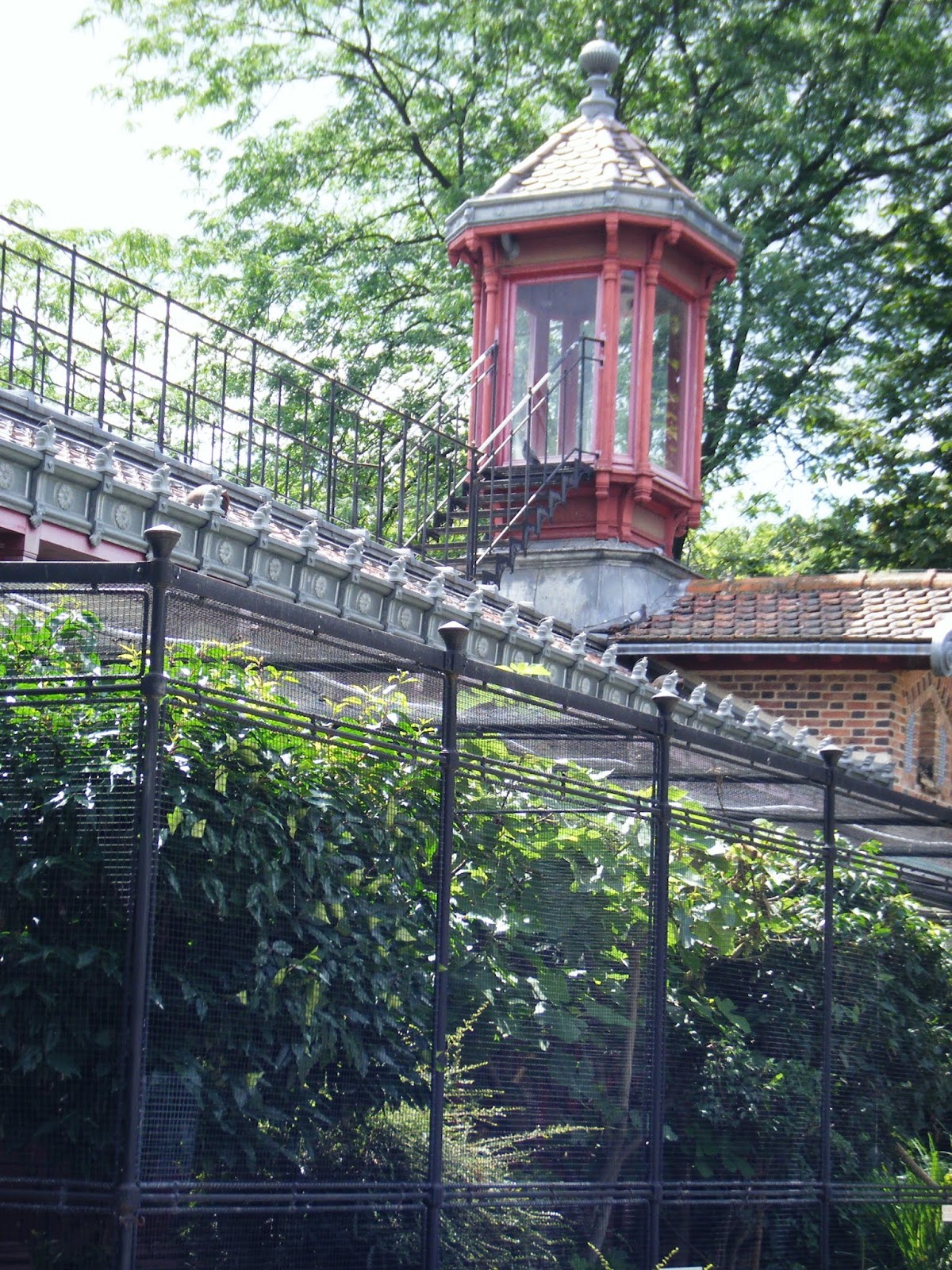
The history of the Ménagerie is traced in its very architecture. From the pitturesque straw-thatched huts that drew inspiration from Marie-Antoinette’s farm, the imposing Great Aviary of 1888, to the beautiful Art Déco buildings from the interwar years, the function and significance of the Ménagerie are reflected.


The striking forms of the Vivarium (1926), the Monkey House (1936), and the Big Cat Enclosure (1937) employed innovative metal, materials and design, to startling effect, replacing certain structures that dated back some hundred years. The Art Déco sculpture of Paul Jouve completed the tone, yet by 1834 the opening of the Parc Zoologique de Paris had already had an impact of visitor numbers.


Since 1993 the buildings of the Ménagerie have been listed as historical monuments so whilst the larger mammals are slowly being transferred to larger institutions, more appropriate to their needs, this ancient site still fascinates the public, precisely due to its own unique story and its position in the history of Paris.


The enclosures that once were home to the showcase beasts of bigger dimensions, now accommodate smaller, critically endangered species. The former bear pits are now populated with the highly-popular Red Panda. Meanwhile other less-familiar species find refuge here – the bizarre Binturong (‘bearcats’) and the curious Pallas Cat, for example. However, the big cats still remain, captive and captivating, just as they were when Rilke wrote his poem 'The Panther', over a hundred years ago. Tragic.


The Orangutans stay on too, but seem to fare far better due to the social dynamics of their community – a group which has just increased in size with the birth of 'Java'. The hope is for a future reintroduction of many of the species preserved here, once their natural habitats have been repossessed and restored, but the powers of the Ménagerie - or any similar zoological establishment for that matter – are limited.


When I see the beauty of the beasts on display here, I feel sad that we humans cannot comprend that we do not actually possess the land we inhabit or indeed the Earth itself and should not be able to dispose of the other creatures as we see fit. Let's just hope that the festival Espèces en voie d'illumination that opens in November will throw a little more light onto the plight of our planet. Human-beings and orangutans share 97% of their DNA and yet Man is knowingly endangering the existence of this, our closest relative.


Tuesday, September 26, 2017

Zillions of Zinnia at the Jardin des Plantes, Paris..


Be they insect, animal or human, all visitors to the Jardin des Plantes in Paris are offered the beautiful spectacle of extensive avenues of flower beds that run the length of the grounds. Mid-September was no exception.


The sun was amazingly bright on the afternoon that I walked through the gardens that were themselves aflame with colours from the vibrant Zinnia.


This resiliant little plant belongs to the daisy family - asteraceae and compositeae - yet manages to present itself in many forms, thanks to hybridization. Today, there are more than 100 cultivars and the Jardin des Plantes seemed to have endless varieties on display.


Although early varieties of the Zinnia have graced European gardens since the 18th century, the plant is in fact a native of Mexico. The Aztecs labelled the vibrant flowers mal de ojos ('pain to the eyes') due to their intense colours.


The plant is named after the German botanist, Johann Zinn (1727-1759), but benefits from a whole host of names, used to describe the variations in form and colouration,of the many different series...


Indeed, there is the Zahara series, the Peter Pan, Ruffles, Queen Lime, Dahlia, amongst many others... And Zinnia is known for the many ways in which the flower petals are laid out, with quill-leaf forms, spiders, stars and daisies, domes and buttons. Also, the body of the plant bears characteristically long, sturdy stems...


Given its natural resilience that enables the plant to cope with harsh weather extremes, it has, not surprisingly, been taken as a symbol of endurance. Last year, zinnia were even rumoured to have germinated and flowered in the International Space Station, yet this claim was soon dismissed. On a more down-to-earth front, in the Victorian language of flowers, Zinnia represented the lasting affection toward absent friends.


Well, I was unable to take a photo free of the very numerous visitors, who, like me were enjoying this magnificent setting on a radiant September day. Instead, here is another from another tiime; different flowers (poppies!) but same incredible views, facing the Muséum national d'histoire naturelle .


Wednesday, February 15, 2012

Galeries de Paléontologie et d'Anatomie Comparée....

Fixed flight.
Before temperatures plummeted (falling to minus 18° here the other weekend) I went to see one of my favourite museums in Paris which by the nature of its exhibits – principally skeletons and fossils – and the nature of the very building and exhibit presentation seems to be frozen in time. Welcome to the Galeries de Paléontologie et d’Anatomie Comparée – part of the Muséum National d’Histoire Naturelle (or MNHN as the French love giving initials to everything which complicates things for the uninitiated!)….
An alternative Noah's Ark...
 Apart from the odd interactive digital panel that appears to be a token gadget to satisfy a click-happy public, the glory of the museum is simply the unadulterated,  somewhat old-fashioned presentation of its exhibits. These need no justification or gimmickry to attract even, or rather especially, the youngest visitors. Should you wish to come during the school holidays, expect to queue for a considerable time as a glut of children gaze and gasp at the more dramatic forms of beast, breath-taking in terms of size, volume and age. 
Marine beasts
 As with all museums, however, one of its main roles, apart from simply conserving and improving the collection, encouraging research and teaching, is the diffusion of knowledge. The impressive lay-out of the displays, the vast glass mural cabinets and standing cases bear explanatory labels and descriptions, many hand-written and dating back to the inauguration of the museum, as the faded ink and ornate script attest. 
The canine family.
 While the museum has adapted the display of its collection to the taste and needs of the visitors over the years, it has mercifully not yet felt the need to pander to digital addictions by providing distracting tactile screens that never seem to truly inform. And yes, I do acknowledge that just saying that makes me a freak, frozen in time myself, but there you have it!...  Indeed, since its inauguration the museum has sought to vary the exhibitions, presenting some of its collection whilst storing others pieces in order to rotate the exhibits to enhance interest and improve conservation. This technique may appear logical to us today, but wasn’t common at that time and subsequently was adopted by other museums who admired this initiative.
Skulking Stegasaurus outside the museum.
 The museum grounds set the tone before you even enter the building. From the outside, it presents itself as an imposing edifice of red brick design – typical of many from the very end of the 19th century – and especially reminiscent of Victorian architecture.
Main entrance of the Galerie de Paléontologie et Anatomie Comparée.
 Andre-Joseph Allar undertook the decoration of the façade when the work requested by the natural history professors Albert Gaudry and George Pouchet for the inauguration of the Galeries in 1898. and even if the dramatic bas-reliefs animating the building have been worn down by the weight of years, climate and pollution the initial effect must have been striking. Situated just beyond the gated entrance of the Jardin des Plantes, opposite the Gare d’Austerlitz, the museum is surrounded by the impressive trees and shrubbery of the park. Amongst outsized ferns and other suitably ‘pre-historic’ foliage and trees such as the Monkey Puzzle (Araucaria Araucana) are imposing sculptures of beasts that seem to be grazing in these majestic grounds whilst guarding the museum.

The architect responsible for its realization was Ferdinand Charles-Louis Dutert (1845-1906), who was perhaps better known for the creation of the Galerie des Machines for the Exposition Universelle of 1889 (for which Gustave Eiffel created his infamous feat of engineering – the Eiffel Tower). The Galerie des Machines was indeed an impressive structure, composed of vast metal trusses and bridges spanning the great width of the building whilst large expanses of glass provided luminosity and a sense of lightness. 
Galerie des Machines: Dutert.
 This was sadly demolished in 1909, however these features of glass and metal appear in the Galeries de Paléontologie et d’Anatomie Comparée. Here the metallic skeleton is not only visible, but is fully emphasized. Delicate iron fretwork decorates the mezzanine level in an organic manner and flourishes of ferns and flora enhance the stairwell and handrails to intricate effect, in some ways acting as a precursor to Art Nouveau.
Ironwork on the balcony handrail.
 The stonework of the museum also bears references to the natural world, with sculpted creatures emerging from pillars and lurking on cornices if the visitor cares to lift his eyes to notice them… You cannot fail to miss the striking sculpture of Emmanuel Frémiet, one of the greatest artistes animaliers, which demonstrates the ever-powerful hold of the natural world on man. 
Orangutan: Frémiet. 1895
 Once you’ve paid your entrance fee however, and walked into the vast room on the ground floor, you soon feel that Man still strives to maintain his dominant position in the animal kingdom. At the head of a veritable troup of animal skeletons stands an écorché statue of a man, all muscles and veins visible, yet this vulnerability is belied by his determined stance and a strategically placed fig leaf!. With one arm raised, the statue, very much man-made, unlike the natural remains of his animal procession, seems to be ordering his bestial followers forward, heralding the way, like a surreal version of Noah preparing his ark.
The 'écorché' leading on his troup...
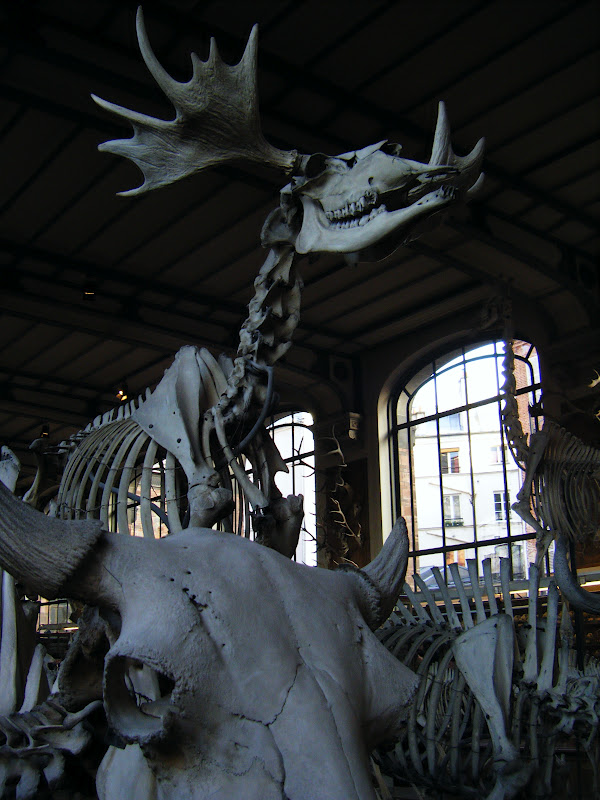
 Just as ‘Noah’ has been stripped of his protective layers, his animal herd seems to be an ironic parallel to the huge procession of naturalized (i.e. stuffed) beasts that can be seen in the Grande Galerie de l’Evolution of the Natural History museum on the other side of the Jardin des Plantes. In the section of comparative anatomy, over 1000 skeletons of mammals, birds, fish, reptiles overwhelm you in their diversity. Many of the specimens were brought to the collection from naturalists’ missions around the world in the18th and 19th century, or came from the animals once housed in the Ménagerie du Jardin des Plantes, or elsewhere (eg. The rhinoceros from the Ménagerie de Versailles). 
 On the day that I visited, the museum was full of art students, busy sketching various forms and subjects, school children and a number of foreign visitors just admiring the building and collection alike. The ground floor has to be my favourite of the three collections to be seen. The big procession of marine, air-borne and terrestrial beasts all highlight different aspects of comparative anatomy of species and groups that still exist today, or have just become extinct. Walking around the central display you encounter the animals in all their skeletal glory.
Elephant minus the characteristic trunk and ears...
 Comparative anatomy dictates the differentiation and classification of species and the first lateral display windows that you encounter on your right offer an ‘alphabet of the skeleton’ and study of locomotion. Most specimens surprise you by their sheer size, and the incredible intricacy of the bones and many others seem virtually unrecognizable without their furry/ fleshy coverings and characteristics. The elephant skull, minus a trunk and huge ear flaps, has a strangely truncated, block-shaped form, whilst other skulls, such as that of the duck-billed platypus prove just how accurate the species’ name actually is.
Duck-billed Platypus.
 The more delicate specimens are displayed in the mural glass cabinets, as are glass jars containing organs and body tissue, all of which serving to demonstrate similarities and differences in function, form and structure in the animal world. The majority of the jarred specimens date from long ago, and many of these appear to be like macabre displays from a travelling fair, destined to titillate and shock the general public. Ancient mutant forms floating in formalin attract us with a strange quaintness as Geoffrey Saint-Hilaire’s cabinet of Monstres demonstrates. Other forms simply fascinate us by their strange properties – just have a look at the giraffe’s tongue for a prime example of this!
A siamese skeleton.
 In this part of the museum we see that in terms of skeletal formation and function Homo Sapiens is not so very different from the primates apart from his notably upright position and the resulting proportion of bones. Perhaps as a security measure most of these skeletons are safely exposed behind glass - visitors do actually steal skulls and various other bones from the Catacombs in Paris, as I witnessed myself! As a consequence, the photos caught the light and reflections but I quite liked the effect, as Man seems to be floating in a timeless, unreal space, almost traced onto the squat remains of the primate family.
Homo Sapiens floating in the primate family.
 This effect was more marked, and poignant even, with the cabinet bearing the skeletons of foetuses. Here, groups of ‘unborn’ babies appear huddled together, with strangely expressive head positions, bowed down and puzzled by their fate, arms and hands hanging down, at a loss – all still-born yet destined to live together in this state of limbo, floating in time and space in a cradle of animal bones. 
The forlorn foetuses.
 The anthropological and pre-historical collections were largely transferred to the Musée de l’Homme in 1937, but copies of Lucy’s bones are displayed on the first floor of the Galerie de Paléontologie. 
Part of the stairwell.
 Heading up the the decorative stairs the visitor comes across a mural plaque depicting the Tree of Life, which enables us to situate Man in this vast, diverse classification. Arriving in the paleontological section of the museum we see the force of evolution in the succession of fossilized vertebrates that populated the earth from over 600million years ago. 
 Here is a long disappeared world, retraced through the lay-out of the large room. The visitor passes in front of ancient beasts only familiar to us through books and the screen – the big ‘stars’ being the dinosaurs of monstrous dimensions; Diplodocus, Tyrannosaurus, Triceratops and Ichthyosaurus. 
The terrifying Tyrannosaurus.
 We also encounter distant ancestors of species common to us today – the horse, giant deer, birds, primates, and of course, Lucy herself. All the creatures are imposing due to their size, and visible signs of their force and ferocity. 
A collection of fiendishly ferocious fangs
Huge tusks, horn formations, antlers, massive jaws, jagged feet and treacherous teeth and fangs leave no doubt to the brutality of the fight for the survival of the fittest. One imposing beast, related to the Armadillo is the Glyptodon Asper, with its own glass cage to protect it (or us!) has a particular ‘crazy-paving’ armoured shell . 
Glyptodon Asper with its intricate shell and hard-wearing feet.
 Leaving this floor we enter the mezzanine where the invertebrate specimens are to be found. The names roll of the tongue like an ancient school textbook – trilobites, ammonites, arachnids, nautiloids, gastropods, molluscs… What I really liked is that this part of the museum even looks like an ancient study room. 
Fossile display cabinets.
 A spiral staircase leads up to a library full of ancient volumes (sadly inaccessible to the public), long rows of old display cabinets stretch out and the whole atmosphere is of a distant world that I hope will long be preserved and revered here, at least. The museum was partially renovated in 1998, but escaped the ravages of excess modernization and the need to meet the extensive criteria of health and safety and has kept its spirit intact. The French poet, Paul Claudel, said that the museum was…"rien de moins que [le] plus beau musée de Paris [...]. À chacun de mes passages en France, je reviens visiter cette galerie sublime avec un sentiment de vénération religieuse, qui chaque fois, me donne envie d'enlever non seulement mon chapeau mais aussi mes chaussures." 
 The museum also attests to the quasi-religious veneration of the natural world and the sciences and reflects the continued thirst to understand these during the 19th century. From the previous century, scientists had been attempting to find, describe and name species of the natural world – largely basing their classification on the work of the Swedish zoologist, botanist and physicist Carolus Linnaeus (1707-1778). His studies and publications - especially his Systema Naturae - put forward his theories on the division and sub-division of the animal world with a system of taxonomy using binomial nomenclature.
 At the head of the huge parterre of the Jardin des Plantes is a large statue of Georges-Louis de Buffon (1707-1788) for it was he who transformed what was initially known as the Jardin du Roi, from its creation as the royal herbarium in 1633 into a centre of research and a museum when he was named intendant in 1739. Over the next fifty years Buffon increased the size of the grounds, replanted the Jardin with trees and plants from foreign lands and improved the zoological and botanical specimens for the Cabinet d’Histoire Naturelle du Roi to the point that it offered the most elaborate collection In Europe. Buffon was the first to evoke the birth of the universe and the Earth in terms that did not include religious theory, but instead advanced the idea that time itself was the “grand ouvrier de la Nature” (Nature’s workman), based on a theory of revolutions. He was recognized as not being “an evolutionist, yet he was the father of evolutionism” (Ernst Mayr). He enjoyed considerable success during his lifetime; elected member of the Académie Française, named Compte de Buffon, admired by the great novelist Balzac who emulated him in his La Comédie Humaine. «Si Buffon a fait un magnifique ouvrage en essayant de représenter dans un livre l'ensemble de la zoologie, n'y avait-il pas une œuvre de ce genre à faire pour la Société? »
Lamarck: Léon Fagel. 1908
 The same level of success and esteem were not meted out to another grand savant whose statue is to be found at the other end of the gardens, not far from the entrance to the Galerie de Paléontologie. And yet this was a great man of science who was instrumental in the initial development of the Muséum National d’Histoire Naturelle and the Jardin des Plantes in 1793, and the classification of the collections. Jean-Baptiste de Lamarck (1744-1829), botanist, zoologist and professor of Histoire naturelle des Insectes et des Vers au Jardin du Roi was to have a key role in the development of the theories of evolution in the 19th century. As Charles Darwin remarked in 1861, Lamarck “first did the eminent service of arousing attention to the probability of all changes in the organic, as well as in the inorganic world, being the result of law, and not of miraculous interposition.”

It was he who coined the term invertebrate and applied that of biology to refer to the study of living forms. Lamarck elaborated his notion of transmutation, based on his studies of invertebrate fossils, wherein he remarked that species were in a continual state of flux and progression. However his resultant theory of the inheritance of acquired characteristics was already widely refuted during his lifetime, and further rejected after his death, drawing particularly harsh criticism from his colleague Cuvier. Lamarck died in such a state of poverty that his body was finally disposed of in a paupers’ communal grave, his bones indistinguishable from those of all the others buried there; an ironic end for a man who had contributed so much to identification and classification. 
Cuvier: David d'Anger. 1833
 A bust of Georges Cuvier (1769-1832) stares out over the troop of animal skeletons on the ground floor of the museum, and rightly so since he was recognized as one of the founders of the disciplines of paleontology and comparative anatomy. Rejecting any notion of linear ancestry, Cuvier divided living creatures into four distinct categories – vertebrates/molluscs/arthropods and radiates. Any similarity between groups could simply be explained by common functions, but not put down to common ancestry. He was set against all the theories of transmutation privileged by Lamarck and Saint-Hilaire and enforced his own notion of the extinction of species, frequently due to catastrophic events. Cuvier himself proved to be a highly adaptable specimen since he managed to serve under three opposing governments (Revolution, Napoleonic and Monarchy) and met with great acclaim during and after his lifetime. 
Geoffrey Saint-Hilaire: Philosophie Anatomique. 1818
 At the far end of the comparative anatomy section of the museum we come across the afore-mentioned Cabinet de Monstres elaborated by Etienne Geoffrey Saint-Hilaire (1772-1844). In 1793 he was appointed as one of the twelve professors at the Muséum d’Histoire Naturelle and occupied the Chair of Zoology, also teaching this discipline at the faculty of science. Gradually he began to devote himself to the study of anatomy (he examined the Hottentot Venus in 1815) and in 1818 he published the first part of his Philosophie Anatomique. His studies gave rise to a theory of evolution which was based on the notion of the unity of composition, subject to a general plan, with all animals formed from the same elements. In this vision of analogues and connections any abnormality or malfunction in nature was born of imperfect evolution. With his theory of transformation Saint-Hilaire was closer to the ideas of Lamarck and therefore in opposition to Cuvier’s work based on invariability.
 Walking around the grounds today it is difficult to imagine the debate and controversy that many of these theories and counter-theories gave rise to. Many, if not most of these have been overshadowed by the work of a man they all served to inform and influence; Charles Darwin. My most recent visit to the museum has made me appreciate the grand naturalists even more and want to take up reading a book I bought a few years ago – an account of Darwin’s visit to South America. 
Make sure you visit the museum before it is renovated/modernized/sanitized as it surely will be – the façade of the building is undoubtedly in need of a vital facelift. I just hope that the skeleton and essence of the museum remains the same. Enjoy this trip back in time while you can – over the millennia and particularly back to the 19th century!