Showing posts with label Georgian Life & Art. Show all posts

Sunday, October 22, 2023

Genteel Pleasure; Observing the Tea-drinking Conversation Piece...

On this year’s trips to the V & A and the Tate London, amongst the vast collections of paintings I was drawn to the conversation pieces in their various forms, largely from the 18th century British collection. Characterized by the simple anecdotal quality of their domestic or landscape scenes, with sitters conversing together in small social groups as they share in common activities, these works have a certain intimacy. Whether the individuals portrayed are from the same family, or are friends or members of some group, we catch them in collective gatherings such as tea parties, meals, card games; musical events or hunting. Yet, just as much as we observe them and remark on the often-strange dynamics of the scene, they too look out on us, watching us quizzically or avoiding our gaze defiantly.
This unsettling eye contact, or lack of it, seems to bring another dimension to these works through this odd connection and silent exchange with these figures. Some family members have the same watchful expression, with similar, eerily beady eyes staring out, whatever the age of the individual! Even the horse studies of George Stubbs present magnificent beasts with solitary riders who stare out at us directly in an indefinable manner.
William Hogarth worked in the same genre, and even though his pieces largely pointed to the satire of the given situation and its hapless actors who fell prey to their own shortcomings, this particular eye contact is still present, as seen in his Strode family below. The conversation piece, as indeed the genre of the fictional novel itself, departed from the epic classical themes and forms to focus on the daily existence of the rising mercantile class. Although Joshua Reynolds worked in the Grand Manner, he would do conversation pieces, albeit with vast proportions featuring life-size figures. Meanwhile in France, Antoine Watteau in some ways perpetuated the conversation piece in his fêtes galantes but his characters are typically so engrossed in their amourous antics and caught up in the bucolic scenery that they have little time to waste engaging with us, the viewer! In England, the commissioned conversation piece enabled the rising moneyed classes to indulge in their self-satisfaction at their social position and impress society likewise; the ultimate ostentatious consumption! In the place of the aristocracy’s allegorical allusions to Classical antiquity and its values, was the reflection of genteel contemporary pleasures, focusing above all on those enjoying these activities.
Playing a key role in the conversation piece was the social etiquette that surrounded the ritual of tea drinking. As a genteel social activity, the consumption of tea en famille or preferably with guests was a means of demonstrating social manners, and of course displaying status in society and economic standing. Tea was first introduced to Europe in 1606, when the Dutch established their trade routes to Asia, and a shipment was sent to Amsterdam. In Britain, the rise of the East India Company led to greater imports of such exotic goods and the marriage of the tea-drinking Portuguese Catherine to Charles II in 1662 assured the success of this drink.
By the mid-17th century, tea was thus establishing itself as a genteel beverage in the upper classes. Indeed, Samuel Pepys mentioned it in his diary on Tuesday 25 September 1660, when he was offered a 'Cupp of Tee (a China drink) of which I never had drank before'. As an apparent avid coffee drinker, Pepys was not won over by this foreign import that proved to cost 10 times the price of coffee, although he did laud its reputed medicinal properties. When Thomas Twining, famous tea purveyor expanded his existing store to create the Golden Lyon Tea and Coffee House, he helped change conventions and the role of women. Whilst social taboos prevented the fair sex from entering the typically male domain of the coffee house, women were allowed to shop for the high- quality dry tea offered by Twining. Eager to purchase this fashionable, elitist drink, ladies not only led the craze for social tea-drinking but were at the heart of the tea ritual in the home, when receiving and thus entertaining guests with tea and pretty conversation.
Serving tea was the female prerogative and much importance was attached to the preparation, pouring and ceremony of tea-drinking for this was the perfect way to demonstrate the hostess’s impeccable savoir-faire and enviable social position. As she In turn reflected the power and influence of her husband, only the best would do. Tea was indeed a costly commodity to purchase, and one which also required considerable paraphernalia – tea 'equipage' – in order to serve and drink it in the most fitting manner. The indispensable teapot and tea service had to reflect the excellent taste and limitless means of the lady of the house and therefore, porcelain was de rigueur for elegant cups (bowls) and saucers whilst the teaspoons and sugar tongs would of course have been in silver, perhaps with original designs. Again, women were often given the right to select the family tea equipage and thus expressed their identity through their preferences. All this is apparent in Joseph van Aken’s 'An English Family at Tea' (1720).
To up the ante, a genuine Chinese redware teapot would be used in place of a silver one, alongside a blue-white porcelain tea service whilst the tea caddy, kept under lock and key by the mistress, was typically made of mahogany or leather-covered wood with silver inlay or details in mother-of-pearl or tortoiseshell. In many of the conversation pieces, the caddy has pride of place, in the foreground of the painting, near the hostess... A silver sugar bowl would complete the set and give a final cachet to the whole, all the more so as sugar was likewise an expensive good. The tea table itself was extremely expensive as it was a key statement piece to highlight wealth and taste; usually made of exotic hardwood with carefully crafted legs and inlays designed to impress the guests. Finally, what I found most fascinating in the tea-drinking conversation pieces is that they are almost a mise en abîme; the image of an image of self-glorification coupled with a certain need for validation, in which we play a role too, at a remove of around 300 years! Just take a look again at those enigmatic stares!

Friday, October 13, 2023

Elegant Arms and Engageantes...

In the Georgian exhibition in the Queen's Gallery at Buckingham Palace, I loved looking at the sumptious silks, satins and taffetas on display, either on the actual garments on show or portrayed in the paintings representing the period.
The silk industry was lead by the French city of Lyon, however the silk-weaving district of Spitalfields, London held its own too, producing increasingly rich, detailed fabrics that were coveted more than the finished items of clothing they were used for. The floral and botanic details on the gown worn by the duchess above were woven onto a background of silver threads and the lustre of the silk flowers is complemented by the metallic glint, all of which is captured in the painting.
Sometimes the mastery of the artist in portraying the unique sheen and silken aspects of the clothing seems to surpass the skill of lifelike portraiture, the exception to that being animal studies with their incredible rendition of fur not to mention those expressive eyes!
Lace, flounces, frills and here, ermine trimmings, all seem to have appealed to the artist as a means to demonstrate his great talent as much as to the largely affluent individuals - male and female - who sought to show off their vast wealth and status through such richly decorated garments. You almost want to touch the surface of the painting, so realistic are the textures - look at this gentleman's incredible velvet jacket!
Along with silk, lace was extremely costly since its production was unbelievably long and arduous, demanding great skill. You can sense the pride such lavish, frothy lace details must have inspired in the garment-wearer and their portraitist. And just look at the elegance of the hands with their delicate, expressive fingers, with or without jewellery to highlight their grace.
Beautifully poised fingers and gently intertwined hands are framed by folds and flounces of lace and the purity of skin, untainted by sunlight or indeed a day's work, is highlighted by pearls.
To emphasise the elegance of slender wrists and dainty hands - on both ladies and gentlemen it should be said - there was widespread use of engageantes throughout most of the 18th century. These generally took the form of extended decorative flounces of lace or (another fabric) that were worn underneath existing sleeves of either a dress or bodice if not a man's coat.
The word engageante derives from an old French adjective engageant, meaning 'attractive' or 'seductive'. Certainly, these delicate layers of ruffled lace or linen offset the beauty of the rich material of the main garment in a glorious manner.
These were not false sleeves as such, nor were they loose cuffs or indeed part of any lighter undergarment. They were independant articles used to enhance and embellish outfits already richly decorated with bows, ribbons and embroidery, from the reign of Louis XIV onwards.
Engageantes could be sewn or tied onto the underside of garment sleeves that generally reached elbow-level. They could be removed at will, in order to be cleaned or otherwise exchanged for other styles, in other materials, thus enabling the wearer greater possibilities to adapt clothing to circumstances.
In this manner, elaborate, highly decorative engageantes could give way to plainer, more practical versions for daily routines. Whilst the more ostentatious ones could have up to five layers of ornate lace, the simpler variety were far less voluminous.
Generally speaking, they were longer behind the elbow than in the crook of the arm and thus could hang in a fluid manner.
Gradually, engageantes assumed more modest proportions in accordance with changes in fashion and fell out of use towards the end of the century due to the rise in Neoclassicism with its purity of lines which made excessive detail and decoration redundant.

Saturday, September 30, 2023

Glorious Georgian Gowns...

In the summer, I eagerly queued up to visit the exhibition at The Queen's Gallery, Buckingham Palace; Style and Society: Dressing the Georgians. Looking at the exhibition poster (sadly not on sale), I thought how well the painting by the British School - St James's Park and the Mall - seemed to capture my perception of this period of history. In this work, an animated, joyous throng of individuals of all class and character goes about its social business in this grand setting, unperturbed by the presence of those from wildly different circles with whom they rub shoulders, almost literally. On the contrary, each being, however humble or illustrious their origin and demeanor, wishes to take part in this extraordinary living fresco, to exchange words, parade, preen, pose in public. Meantime, rather lacking in deference to the human counterparts they somehow seem to mirror are the dogs and cows that likewise occupy themselves and the centre stage with a certain insouciance. This strange combination of extremes, contrasts and likenesses is fascinating.
As I gazed at the exquisite clothing, jewellery and elegant footwear of the exhibition, I wondered how articles and artifacts of such intricate beauty and craftsmanship were made (and indeed worn) when the means to do so were limited, relatively speaking, and lives were hard, with or without affluence to ease hardship. Supply was naturally buoyed up on a regiment of ill-paid and poorly-treated workers with deft fingers and so I suppose that the real question that I actually asked myself is what happened to our demand or desire for goods of comparable elegance and originality today, means permitting? I am frequently left choking in dismay and disbelief at the sight of today's vulgar, limited vestimentary selections, all variations of the same trends, coveted by all, regardless of status or wealth. Most of these seem to me dull and unoriginal and I am sadly unable to unsee the very worst modern-day monstrosities, visually fatigued by the sight of all these logos that are branded onto each individual to form a globalized uniform mass. Anyway, an antidote to all that dross clothing and footware were above all these incredible gowns.
Having already seen samples of silk designed and woven in the silk-weavers’ district in Spitalfields, East London, it was marvelous to see more types of garment this was used for in the 18th century. Created at a time when precious fabrics were more valuable than finished gowns, sadly few of these gowns have survived to the present day in their initial state. Many were indeed taken apart, the silk recovered to create further dresses in line with changing fashions over the decades, whilst others with their brocade, taffeta, glossy lustring and damask were used in home furnishing and upholstering. Peering through the display cabinet, I had the impression that the decoration of the fabric was due to embroidered motifs but in fact it was simply down to the rich working of the silk. The delicate botanical patterns and floral details, so characteristic of Spitalfields work, were one of the specialities of Anna Maria Garthwaite, who was a pioneering female textile designer, producing silks from the 1720s. until her death in 1763.
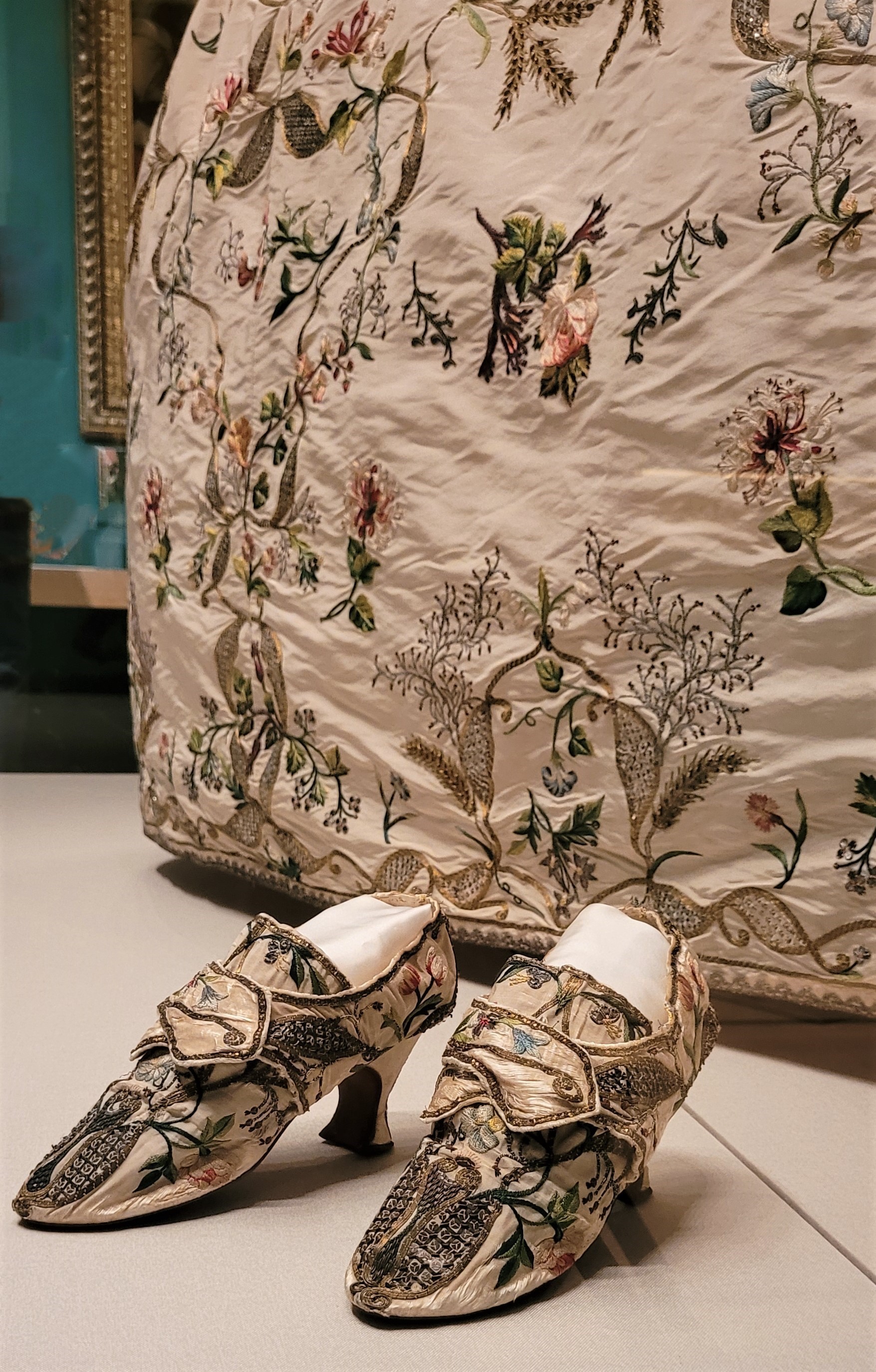
By their very composition and design, these grand ‘statement’ clothes were a powerful reflection of the wearer’s social status, affluence and aesthetic taste. They were worn to enable the privileged woman in question to set herself apart from the others, all likewise vying for the centre stage through the sheer size and splendour of their attire. The stunning piece in the Queen’s Gallery was the magnificent Mantua dress with its intricate floral details displayed across the vast dimensions of this dress unlike any other! With its incredible volume and the perfection of its details, down to the dainty silk slipper shoes that accompany it, this gown is simply spectacular. Possibly named after the Italian city of Mantova, renowned for its silk production, or in reference to the French manteau, the mantua gown represented a significant move away from the restrictive bodice that was a key element in the grands habits in court until around 1670. Indeed, this new form of dress towards the end of the 17th century was in fact more like a coat with its fabric draped and pleated to display the silk and numerous trimmings to their full advantage. Unlike typical formal garments that required careful structuring, the mantua, with its loose coat-like form was cut from one piece of fabric alone with a visible separate petticoat.
In many respects, the mantua was a variation of the banyan worn by men as a form of 'undress'; casual wear. Pleats hung from the shoulders and draped material was bundled up to form a bustle at the back of the gown. Initially, the informal nature of such garments met with disapproval; they could not be worn in the royal courts. Gradually, however, the mantua gown came to be accepted as its style evolved. Indeed, the pleated material at the front of the gown was decreased in size to form robings, and the bodice was opened to insert a stomacher – a richly decorated panel in an inverted triangular shape that gave a more elegant form to the whole. The stomacher was pinned onto the stays beneath the bodice and the robings on each side. The considerable size of the dresses and the fact that the stomacher was not sewn in but merely secured by pins meant that achieving unhampered, pain-free movement must have been quite a feat for the wearer! Not only was the unstructured mantua gown revolutionary for such women, it also radically changed the lot of many female seamstresses (known as mantua-makers) who were able to undertake the sewing of such garments, at a time when tailoring was the domain of men alone. It should perhaps be remembered that all sewing (and indeed tailoring) was performed by hand since no sewing machine would exist until the end of the 18th century..
With time, the mantua gave way to the sack-back gown that was imported from France. Although not as wide as the mantua, this robe à la française was initally voluminous with long box pleats on the back of the neck that led to a train which was obligatory in court. These were famously captured in the paintings of Watteau, hence the name commonly applied to refer to them; Watteau pleats. Gradually these pleats grew narrower and tighter whilst great importance was attached to the trimmings and embellishments of the robe.
Flounces, falbellas or furbelows and fly braiding– were sewn on the front of the dress, and likewise lace, bows and embroidery would decorate the robe or the visible petticoat below. To the long robings at the front of the robe were attached ornate quilles. Similarly, to the elbow-length sleeves would be sewn 3 tiers of scalloped ruffles and separate frills with separate lace cuff details – known as engageantes. Naturally, a pannier or hoops would be worn below the robe to provide characteristic form and volume. Of course, as with the mantua, the effect was stunning but as the Neo-classical movement began to take precedence in the latter part of the 18th century, the sack-back went out of fashion as waistlines grew higher, hoops and stays were discarded and therefore the full, highly decorated robes lost their popularity.

Monday, February 28, 2022

From the Spitalfields Silkweavers to the Silk Snippets of Beatrix Potter...

Returning to Spitalfields in the Spring break, I wanted to wander around the old streets again, in the district where the 18th century silk weavers worked from the grand townhouses that still stand, despite the encroaching ugliness of 21st century ‘development’ schemes. I noticed that some of these projects, whose progression I have observed with dismay over the last 3 years, were nearing completion having successfully wiped out yet another swathe of collective history and culture…
I particularly wanted to gaze up at the house from which Anna Maria Garthwaite (1688 – 1763) had worked. Although not of Huguenot extraction herself, she set up home within the community largely composed of French Protestant refugee silk weavers and merchants to practice a trade for which she in turn would be renowned as silk designer.
The house is situated in what is now known as Princelet Street (formerly Princes Street) and Anna Maria would have been able to see the steeple of Hawksmoor’s Christchurch from her attic workshop, as would many of the other silkworker households. She was buried in that same imposing church on her death in 1763. Today, the ominous sight of developer’s cranes spoil the skyline.
What I wouldn’t do to look around her home today ! As that isn’t possible, on a quiet, cold Sunday morning I was able to look around the streets that she had once inhabited.
Whilst there, I did speak to a home builder/decorator who has been doing restoration work on the townhouses for the last few decades, having initially just come to the area ‘for a week’ ; such is the magnetic pull in this incredible setting.
Creating intricate floral woven designs that combined a rich Roccoco style with a more typically English penchant for intricate flowered clusters, Anna Maria Garthwaite responded to the fashion for beautiful gowns, accessories and even furnishings in lavish silks, featuring damasks and brocade, often using silver thread for greater effect.
This time I made sure that I saw some of her work on display in the Victoria and Albert Museum and I was not disappointed. Lavish garments and dainty, decorative footwear that were assembled using the delicate silks from 18th century Spitalfields were shown in their own section of the museum as well as part of a clothing-over-the-centuries exhibition.
Several of the pieces were by Anna Maria – with swatches of silk and the final exquisite gowns and ‘sacks’ (loose, tent-like robes), all carefully sewn. Not only could you see what the 18th century lady wore on her feet – with elegant slippers that were worthy of a fairytale - you also got a naughty glimpse of what she wore beneath all that material ! More precisely, how the more extravagant dresses maintained their desired shape whilst worn…
Panniers or side-hooped undergarments of impressive width were exposed, revealing how robes such as the Mantua were carried, rather than worn. Gentlemen were no means less soigné in their dress code and beautiful waistcoats and jackets were equally as stunning as the ladies’ gowns.
The delicate embroidery and buttonwork put me in mind of The Tailor of Gloucestor by Beatrix Potter, with the missing cherry-coloured skein of silk for the Mayor’s garments of silk ‘embroidered with pansies and roses’. Having failed to get an online ticket to the Drawn to Nature exhibition, I was thrilled to get to visit all the same!
And so it was, to my great pleasure, that I saw similar garments that had inspired Beatrix Potter in the watercolour illustrations that I had loved so much as a child – with the mice discretely collecting the snippets of fabric under the watchful guard of Simpkin the cat, and finally completing the tailor’s order with skill.
After all these exquisite pieces from the past, I couldn’t help but wonder what happened to our desire to wear beautiful, carefully crafted garments and shoes, apart from the obvious and real limitations imposed by financial considerations. But why is it that a large majority of the population, regardless of age or situation, opt for the same kinds of clothing and foot attire that have become a virtual uniform ? How would Anna Maria Garthwaite regard today's staple ensemble of sneakers and jeans ?

Sunday, December 26, 2021

Doors to the Past... And their Future.

I can no longer recall if I learnt of Spitalfields through Dennis Sever’s House - 18 Folgate Street - or vice versa, but in fact that is irrelevant since the two are now so intertwined in my mind’s eye. The aspects of the district which I hold onto are a little like the essence that I retained of the museum itself in Folgate Street.
Both the old streets and No :18 present a "still-life drama" (Dennis Severs), being played out in an historical stage set that can be peered into and perused at great length and wonder. Having entered the reality of Dennis Sever’s make-believe world, with its evocative play on all the senses in this beautiful Georgian townhouse, I wanted to go out looking for the traces of other lives over the centuries.
How many other Huguenot silk-weaver families and their descendants, like the Jervis family, are bound up in the fabric of the surrounding Spitalfields ? Behind the façades of similar townhouses, there must be a wealth of stories to be read or narrated, all far richer than our modern-day diet of easily-accessed screen-fodder - swipe-friendly, bite-sized fact and fiction. The addictive facility of streamed TV series that spoon-feed our starved imaginations make the tale of the Jervis family, spun by Dennis Sever, and the story of the actual house itself all the more remarkable.
A visit to No :18 is to walk into an experience that demands total submission. Should you miss or dismiss the sensorial cues of sight, smell and sound, you will not sense the full presence of the family members who have just left the room. These are evasive yet all pervasive individuals with lives that are acted out on the various floors of the house, spanning the 18th and 19th centuries. But this discreet world is only open to those ready to see this imagined reality in the present instant – for here believing is seeing.
No point in trying to relive this at a later moment via video or photograph; no cameras allowed... Without the modern-day props of incessant chatter, bright lights and gaudy visuals, to ‘guide’ and dictate, the visitor must rely on heightened senses and imagination to give belief and body to illusion and suggestion.
Although at best you are merely a voyeur to the lives within No: 18, ultimately you leave its confines with the freedom to feel the potential stories behind and beyond the reality of the world outside… or not. Regardless, Dennis Sever’s ’living museum’ continues to weave its stories of the lives of its inhabitants, and the house itself continues to live on, as living history.
The same is true of the old Spitalfields townhouses, which perdure regardless of present ownership which forms part of a continuum of change. The properties themselves are the main protagonist in this play. Whether purchased or created, as in the house of Dennis Sever, each one is key player and its essence is set by the weight of its own past lives, interwoven with the lives of all its past residents. For over time, each leaves his mark, as a patina on this rich historic mantel which provides life, continuity and community.
The preservation of such townhouses and other civic buildings that make up the urban landscape is essential to maintain the spirit of the place. Whilst the nature of a community may change with the influx of inhabitants – significantly so in the history of Spitalfields – its spirit should not. Integral to maintaining the heart of a community is the survival of the historic buildings and grounds that are central to a collective identity, albeit adapted to changing needs.
Such buildings must still act as backclothes to our lives as living entities in their own right ; we are not their definitive owners but passing custodians. The demands of all-intrusive modernity should not dictate the destruction of all trace of the past, to make room for changing lives and lifestyles that will likewise be replaced by others in the future. Surely redevelopment should not be synonymous with brutal demolition or its hypocritical partner in crime ; facadism.
The area that was to become Spitalfields - one of the city’s oldest industrial suburbs - was initially fielded land belonging to the priory of The New Hospital of St Mary, founded in 1197. It occupied the corner formed by two Roman roads – today Bishopsgate and Aldgate High Street. St Mary Spital, as it later became known, was one of the largest Medieval hospitals in England. It was however, largely demolished in 1539,victim to Henry VIII’s dissolution of the monasteries.
Subsequently the land was built upon in order to provide residential areas on the very outskirts of the overcrowded City of London and to accommodate the industries that were settling in ‘Spitalfields’. From the Middle Ages onwards, brewing and the clothes trade dominated there. Situated beyond the walls and laws of the comparatively affluent City, Spitalfields had its own vibrancy, becoming home to a steady influx of individuals who converged there by choice or necessity. The industrious shared the area with the impoverished who likewise rubbed shoulders with social outcasts of all kinds, alongside beings of a criminal leaning.
As foreigners were not allowed to live or work in the City, new communities set up in Spitalfields and the surrounding districts, each leaving its mark there, but none so much as the Huguenots. The Dutch Protestants took refuge there from the late 1500s as a consequence of the wars of independance from Spain in the 1580s and Spitalfields silk-weaving started to grow as a cottage industry. It was yet to become the dominant source of employment and revenue in the East End.
In 1685, following the revocation of the Edict of Nantes by Louis XIV in 1685, over 50 thousand Huguenot Protestants fled persecution in Catholic France and many came to London, bringing their own skills, knowledge and customs. Many had already been tied to the textile industries on native French soil, while others had already been directly involved in silk-weaving in Lyon or Tours, but most were now central to the growth of the English specialised silk trade in all its aspects. At one point, a quarter of the inhabitants of the area were said to have French as their mother tongue. Suddenly, the most lavish, sophisticed silks were being manufactured in Spitalfields itself and even their names convey the rich, luxurious nature ; watered silks, paduasoys, lustrings, brocades, coloured mantuas…
The English supply and demand for silk grew exponentially with the establishment of the Huguenot silk-weavers in Spitalfields, to the point that the 18th century was refered to as the ‘Age of Silk’. Despite its availability, silk was not accessible to all and remained firmly a luxury commodity that reinforced social differences. Indeed, according to one proverb of the time, ‘We are all Adam’s children but silk makes the difference’. This use of such fabric to reflect and uphold social standing and hierarchy was not of course new. Already in the Medieval period, sumptuary laws had been introduced to prevent the inappropriate wearing of such fabrics by socially inferior classes of society.
I couldn’t help but think of how today’s most coveted items of clothing and footware – of rich and poor alike worldwide - are made of ubiquitous plastic and synthetic tat. Has this modern tsunami of trainers and sportswear swept away the desire for delicate items made in noble materials that cater for individual aesthetic tastes? Ironically, the fur that was once the preserve of the affluent and the aspiring members of society, worn to mark special occasions and show social status is now used for the cheapest garments and accessories for daily use, without any real value for anybody who wears them but that’s another story…
In order to accommodate Spitalfields’ growing population, streets emerged of terraced houses that reflected the general move away from the Medieval narrow alleys with their densely-packed wooden buildings that had proved to be a veritable tinderbox in the Great Fire of London of 1666. In line with the 1667 Rebuilding Act under King Charles II, stone or brick had to replace highly inflammable wood as the primary building material.
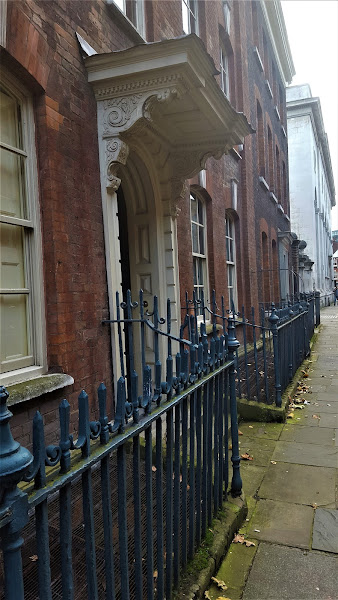
So it was that Spitalfields would grow with the mass construction of brick townhouses, providing tall, elegant yet largely functional homes. From the early 18th century many silktraders and weavers of Huguenot descent occupied these houses, many of which still stand today, spreading across the parish of Hawksmoor’s Christ Church. Weavers were frequently employed from these very homes by silk masters, working on looms that were set up not just for the key artisan, but also his wife and children too.
The upper floors of the townhouses were constructed with this usage in mind, as the high, wide windows running along the length of the facade afforded the luminosity required in these workspaces… Needless to say, the frequent fluctuations in the silk trade would send ripples of unease across Spitalfields, rendering the local economy unstable. The 17th and 18th centuries were punctuated by on-going struggles in the fight against poor working conditions and even poorer wages, and an ever-increasing threat of the mechanisation of the silk-weaving process.
The spectre of the engine loom with its multiple shuttles hovered over the industry, ready to herald the demise of the handloom and make its workers redundant in the process. In later years, the arrival of cheaper woven silk following the repeal of the ban on imported French silk took its toll. It is hardly surprising to learn that many of the criminals executed or deported came from Spitalfields and often from the silk trade itself….
One famous, yet rather elusive figure in the history of Spitalfields silk industry, is the designer Anna Maria Garthwaite (1690–1763). Her prolific output responded to a constant demand for new textile designs and patterns. Born into a good family settled in Lincolnshire, there was however nothing significant in her youth that would point to her artistic prowess as an adult. On the death of her father, she went to live with her married sister near York, where it is presumed that she may have learnt of the textile industry. Both women moved to Spitalfields Princes Street some ten years later in 1729, when Garthwaite’s sister was widowed.
Suddenly, it would seem, Anna Maria started to produce watercolour floral designs to be sold on to silk weavers. The reason for her decision to do so or indeed the origin of her great skill remain unknown to us and are of course open to much conjecture. What is certain, however, is that this individual went on to produce many of the finest designs to be found in Georgian England, in a trade monopolized by men. All this occurred at a time when almost no ‘respectable’ woman earned her own living !
Fortunately, she met with great acclaim during her lifetime as her silks – specializing in brocades - were highly desirable to the wealthy and powerful in both England and America. Her botanically-astute designs earned her recognition in the Universal Dictionary of Trade and Commerce of 1751 for having ‘introduced the principles of painting into the loom’. Whilst much of her work is conserved in the Victoria and Albert Museum, a trip to England won’t be on the cards for the moment but I do hope to get hold of a copy of Portrait of a Woman in Silk: Hidden Histories of the British Atlantic World, by the American historian Zara Anishanslin…
Although the silk trade did eventually decline in Spitalfields, the link to textiles and the garment industry remained as subsequent migrant communities took over and likewise occupied the old townhouses from the end of the 18th century and well into the 19th and 20th. The fate of the latter was far from assured however as these ‘merchant palaces’ slowly slid into disrepair over the long decades.
By the post WW2 years, the area was deemed to offer little but unsalubrious slum housing and by the 1960s demolition thought to be the only viable option. Numerous Georgian townhouses were destroyed in Spital Square and Hawksmoor’s Christ Church was even considered for the same destiny . Fortunately, the public outcry was heard and ultimately gained shape and form with the foundation of the Spitalfields Historic Buildings Trust in 1976. Even if the activists’ means were rudimentary – squatting certain derelict houses under threat of demolition – they were effective since properties were restored and safeguarded.
Today, large parts of the old silk-weavers’ neighbourhood have been gentrified, a trend whose merits are certainly debatable. The prices for property must surely be phenomenaI, ensuring that the possession of a home is truly the preserve of the lucky (fortuned) few. Nevertheless, I enjoyed walking around the streets, looking at the beautifully maintained doorways and trying to (discreetly) peer beyond the intriguing windows to see what domesticity looks like in such rich historical settings.
Fortunately the Town House in Fournier Street allows you to get a glimpse of this. And so I for one, am just glad that these last remaining streets have been preserved, whatever the means, even if that does involve seeing that tiresome Chanel logo, and others brandished over a store in the ‘Old Spitalfields Market’…But all things considered, what’s a small price to pay..