Far from the beach, but still surrounded by treasure of all kinds just ready to be found, looked at, gloated over, gleaned and swiped or simply created! Here are my latest finds....
Showing posts with label Chapels & Churches. Show all posts
Tuesday, October 29, 2024
St Julien in Courville...
From a distance, almost from any direction, l’église St Julien in Courville seems to rise out from its surroundings in a most uncanny manner. As if in defiance of any modern indifference or ignorance towards its past, this church stands out, refusing to be overlooked or brushed aside. And indeed, the whole supposedly modest village - with its proud church - hides far more than we could possibly imagine as mere visitors passing through this picturesque hamlet, typical of hundreds of others in north-eastern France.
Set in a curve in the Ardres valley, on the Route des Sacres in the Marne département, the domain of Courville was once one of eight châtellenies of the archbishops of Reims. The latter played a vital role in the history of the French monarchy - la Cité des Sacres - where all the kings of France were crowned from the 9th century to the 19th. Incidentally, much of the stone used in the masonry of the cathedral would, in fact, come from the quarries around Courville, some 27 kilometres to the west of this major city.
The château of Courville became one of the exclusive residences for the archbishops from the end of the 12th century and it was one of a series of châteaux intended to protect the episcopal territory. Its exact date of construction remains unclear, yet is likely to have succeeded a Carolingian villa which was mentioned by the 10th century historian, Flodoard of Reims. The structure of the chateau was based around the four keeps (les donjons), and despite the modifications made over the centuries by its successive owners, not forgetting its confiscation under the French Revolution as a state asset in 1792 - it survived until the early 20th century. Sadly, as countless other edifices, it fell victim to the ravages of the Great War 1914-1918, although in this case the château des archevêques was all but obliterated from a deliberate act of destruction as opposed to collateral damage.
It is almost impossible today to imagine this peaceful countryside bearing the full brunt of the hostilities in the First World War, but these lands were strategic vantage points over which thousands of lives were lost on both sides. The natural plateau overlooking the nearby village of Unchair was used as a military airbase to send squadrons daily to the nearby Chemin des Dames, site of some of the most brutal fighting, despite its genteel name. The village of Courville was occupied by German forces until May 1918, most of the villagers having fled prior to their arrival, and the château then became the quarters of the military staff.
Although the village was bombed regularly by French and American troops, the château remained intact, but on their departure, the occupying forces ensured that the whole edifice was blown up, in accordance with the order given to destroy all grand buildings, monuments and beautiful homes and apply a scorched earth strategy to all else left in their wake.
Situated in the park of the château, the church miraculously survived the destruction of the residence, despite suffering considerable damage to its exterior structural parts and roof from shellfire. It had served as sleeping quarters for German troops, who, on their departure either destroyed or removed sacred objects, furniture, bells and stained-glass windows. The church was listed as a Monument Historique in 1920, and looking at the edifice today in its calm setting, little gives any indication to its history, be that relatively recent or far distant past.
For indeed, St Julien has stood its ground for hundreds of years, dating back to its construction at the end of the 11th century. Initially constructed to a simple plan with a nave and a high Roman tower built over the narthex, this design was carried out by artisans from Reims then modified considerably from the 12th century onwards. The bell tower was repositioned to stand at the other end of the edifice whilst octagonal apses and side aisles were added too. The archbishops had a double-level gallery incorporated in the nave, with large arcades in Roman style and high window set above in the second level built in the Gothic style. The upper level served as the independent chapel of the archbishops of Reims in the 15th century and was dedicated to Saint Michel.
This was accessible from the grounds of the château via a wooden footbridge that remained in place until 1730. At the end of the 18th century, the years of the French Revolution took their toll on the church as it was defaced and plundered as were so many other religious sites across the country but fortunately it remained standing and suffered no further assaults until the Great War 1914-1918, apart from the relatively recent theft (and recovery) of a sculpted wood statue of Saint Sébastien in 2011.
As a precaution against the deeds of ill-intentioned visitors, the church doors are locked, and therefore I have not yet had the opportunity to explore the interior. Although the entrance is a very sober archway, with minimal decoration apart from simple indented stonework, the exterior of the church bears some interesting sculpted forms that offer a tantalizing idea of what to expect within the building.
Indeed, the capitals that adorn the top of the columns and archways are said to bear highly decorative forms with human heads, animals, flowers and foliage -even a scene of Jonas and the whale! While there is a sculpted altarpiece in the flamboyant Gothic style, the stained-glass windows ‘merely’ date back to the 19th century, only one of a pair to survive the bombing of the château in 1918.
These were a donation from one of the last inhabitants of the domain, the Bracquemont family, and were made by the Atelier Simon-Marq specializing in stained-glass since 1640…. and still running today! The wooden ceiling of the nave was vaulted in ogival brickwork in 1895 but that and all the other architectural features of the church I will discover when I visit. In the meantime, I can’t help but wonder what this region would have been like today, if it had not been subjected to such war-time devastation that willfully destroyed so much of its heritage.
Sunday, June 30, 2024
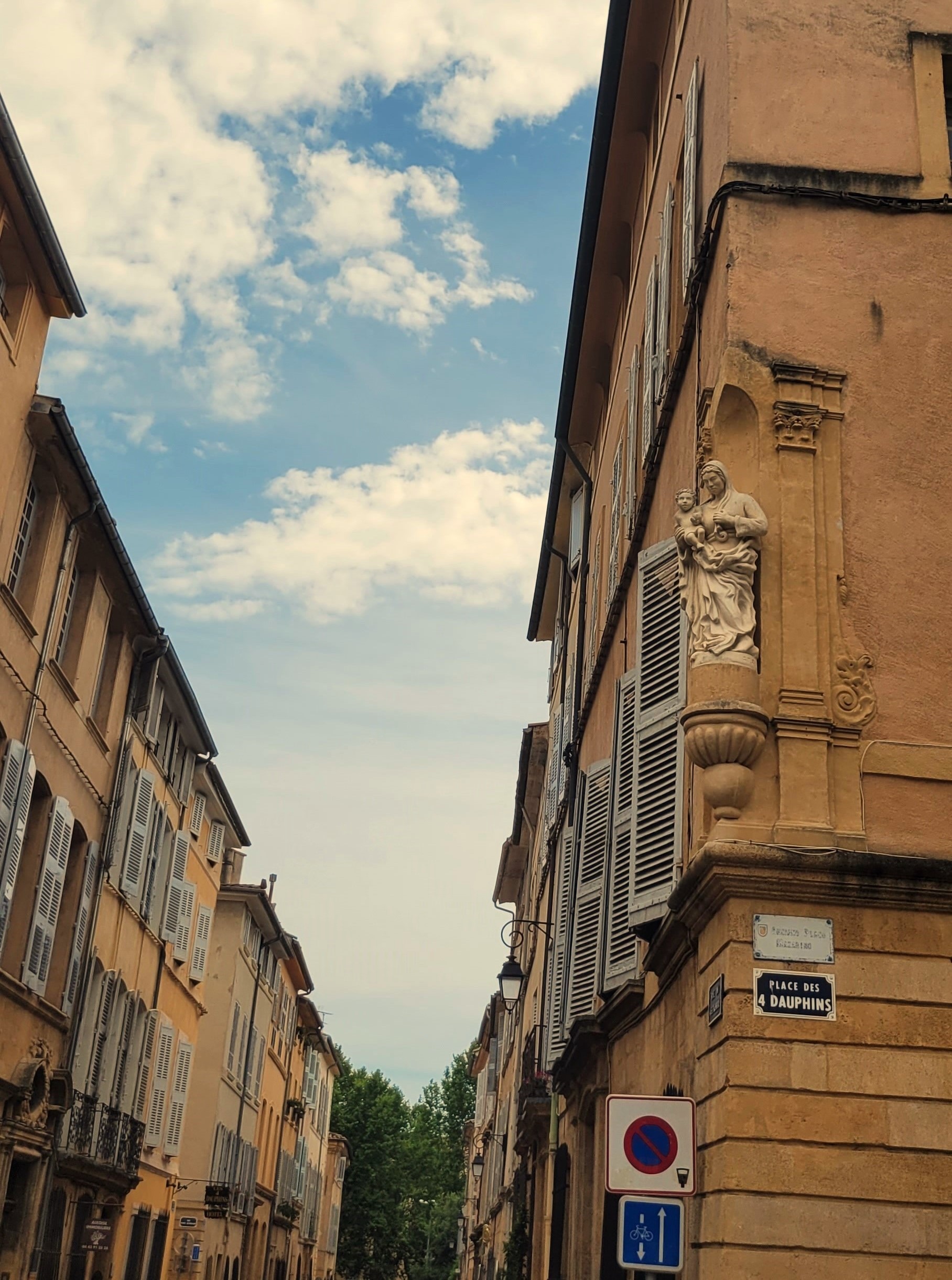
Alcove Oratories... in Aix-en-Provence.
With its majestic Cours Mirabeau, and the countless streets and alleys that criss-cross a beautiful historic centre punctuated with centuries-old fountains, Aix-en-Provence offers so much to see that you literally do not know what to gaze at first when strolling around. The grand carved doors, set in equally imposing doorways with their massive sculpted forms that peer down at passers-by draw my attention whenever I visit the city and this time was no exception.
However, I decided to focus a little more on those other figures that likewise stare down at the throngs of aixois and visitors going about their business on the busy pavements below, unaware of being observed...
Indeed, once you notice one of these small oratory statues poised high above, set on the corner of a building at the end of a street, you become conscious of the others... of which there are many!
Although a serene Virgin Mary - often holding the infant Jesus - appears to be the most common figures, in fact she shares the skyline with various Saints, hands raised in prayer from their alcove pedestals above...
These other oratory forms were somehow rather more intriguing and I did wonder what they were supposed to represent or refer to...
While many of the statues were plain and sober, others were colourful...
Some were standing in decorative alcoves...
That are almost like shells, bearing their figures protectively...
Or like miniature shrines, guarded by wire mesh...
Some of very modest proportions...
Sometimes in the shade of the surroundeding plane trees...
Or in the searing heat and bright sunshine...
But many of them having to tolerate the invasive presence of modern-day urban paraphernalia such as lighting, street signs,drainpipes and cables...
Such intrusion does not seem to alter their calm, however...
Mary and the Child seem unperturbed by all this modernity...
And some versions of Mary appear to be the very image of serenity itself...
Or that of joy and peace...
All of this caused me to wonder why Aix should have so many of these beautiful oratories, in addition to numerous churches across the city....
The answer was simple; over the centuries, the people of Aix sought Salvation from the earthly challenges that decimated their population; plague, drought, wild fires and the usual lot of common mortals.
Unable to attend religious services in times of contagion and confinement, the aixois would worship from the street or from their windows, using the alcove oratories on the buildings, praying for deliverance from their plight.
Those who lived to survive, and whose prayers had been answered would gather to offer praise...
Wednesday, July 19, 2023
A Place of Peace... Madron Church.
Set against one of the walls in picturesque Madron Church, itself set in spectacular Cornish countryside with sweeping views over Mount's Bay, is this beautiful tombstone, dating back to the early 17th century.
Gazing at the quaint couple who kneel in devotion, you cannot help but feel a sense of peace and calm, along with the notion that their God-fearing existence in this breathtaking setting must surely have been one of tranquil simplicity, without the frenzied tech-led lifestyles we have opted for in the 21st century.
I wonder what kind of life this gentleman led until his demise in 1621, some 400 years ago? His fine Cornish surname - Maddern - has crossed the centuries, as have indeed many of the other names on the tombstones here, just as in other cemeteries around Cornwall.
Tonkin, Eddy, Rowe, Trembath, Hoskin, Penrose, Nichols, Trelawny, Cargeeg, Nankervis... So familiar are such family names that they remind me of the daily roll call from my schooldays, down the road from Madron, in Penzance!
The graveyard around the church here is well maintained yet naturally inhabited and sometimes invaded by the usual wild plants, bushes and lichen typical of the rather mild climate of Cornwall to preserve a timeless, organic essence...
Some of the greenery seems vibrant and exotic, while other forms appear old, wizened and commonplace...
Many of the gravestones, lean and lilt, as if huddling together to brave the frequent winds that sculpt trees and hedgerows alike into odd, hunched silhouettes on the skyline...
Others appear partially obscured from view, hidden under bows, bushes and shadows...
Celtic forms are visible, carved into the granite in stark designs...
Some of which assume an almost pagan aspect, leading back to the ancient Celtic origins of the land itself and those who inhabited it...
The lands of Landithy - with lan signifying 'sacred enclosure' and dithy referring to a 'celtic holy man' - were given to the Knights Hospitallers in the 12th century. The estate bore an early church which finally lead to what is now known as the Church of Saint Maddern, consecrated in 1336.
The stout tower and squat, sturdy walls of the building before us today date back to the 15th century and are a world away from the soaring heights and architectural feats that were characteristic of the Gothic churches some two hundred years earlier.
Despite the drastic changes in architectural styles over time, the number of relatively early deaths commemorated here make it clear that lives were still brutish and short for a significant proportion of the population and it is hardly surprising that religion provided support when there was precious little else.
The idyllic Cornish landscapes and promoted picture-perfect lifestyles to go with these today lead most of us to assume that lives in centuries past must somehow have been healthy and hearty in these rural settings, far-removed from the hardships associated with the dark, satanic mills of industrial England. And yet the mining and fishing industries offered little but a dangerous, dirty and dismal existence, whilst farming was hardly better.
Coastal existence bore its own challenges, with the treachery of the seas bringing in tow shipwrecks, drowning and flooding - most dramatically perhaps in the latter case with a tsunami recorded in Penzance in 1855 in the wake of the Lisbon earthquake. The sea also enabled marauding of all sorts, with pirates, smugglars and even Spanish invaders at the end of the 16th century. I wonder if our Gentleman John Maddern, as mentioned above, experienced that invasion?
Several artifacts in the church predate our gentleman - notably some of the carved wooden benchends. Did he ever sit on these very benches in prayer?
If so, what did he think as he sat there? Was he accompanied by his wife?
The vaulted barrel ceiling above the nave is decorated with ribs and purloins which creates a spectacular view leading towards the altar, behind the wooden rood screen.
The original rood screen was taken down in the 18th century but was restored in 1880 to dramatic effect - so intricate and yet not overbearing.
Around the church are Tudor roses to demonstrate allegiance to Henry VII following a revolt that led the vicar of the church to feel a certain eagerness to express his loyalty.
Alabaster angels are grouped together in one sculpted work...
Whilst solitary wood-carved greenmen stand guard at the end of benches in the chapel...
Large plaques with their Latin inscriptions look down on the nave passage below, making me regret I can't read their message...
Also on display are the plaques devoted to Lord Nelson whose death in 1808 was heralded by the bells at Madron church, making Penzance the first town in England to learn of his demise. I was more interested in finding traces of the Branwell family (of the Brontës) but more about that another day... In the meantime, here's the view from my walk back home to Penzance!
Subscribe to:
Posts (Atom)