Showing posts with label Reims Heritage. Show all posts

Wednesday, July 23, 2025

A Fine Beast on a Facade...

As I come back home on the same old route, stuck in the traffic going in the opposite direction to the morning trip, I likewise look out at the now-familiar sights in the city landscape. Nevertheless, a few little gems appear to have escaped my attention and the architectural feature above is a perfect case in point!
This beautiful sculpted ram adorns one of the buildings that apparently survived the wartime hostilities in the Great War (1914-1918). I think it probably dates back to the last decades of the 19th century. And what a magnificent beast this is and what a precious specimen of discreet facade decoration! For all its finery, this feature is below a balcony and therefore not immediately visible. The ram therefore gazes down on all passersby, surrounded by oak leaves - presumably signifying stability and endurance and acorns for renewal and new beginnings - perhaps a reference to the years following the Franco-Prussian war of 1870- 71. Like the lion (and the Lion of Belfort), the ram symbolises strength and bravery... The past meaning is largely lost on us today, for those who even notice the very existence of the fine sculpted creature above, and I do feel sadness that today's buildings are devoid of any will to decorate their bland facades in any interesting manner or to send out any kind of message, except that of modernity. But today's modern is soon a has-been for tomorrow...

The Past behind Une Place in Reims...

Typically getting held up at the same traffic lights most days, as my mind dwells on the usually niggling tasks to carry out, I also end up looking out at the same city architecture too. The old building by the tram stop usually catches my attention, albeit not for any actual beauty in design, but simply for the fact it has survived the passage of time and the various plans to get it demolished! Over the last two decades the surrounding area has been redeveloped to incorporate extensive modern housing projects and pedestrian areas to the point that the old house with its vast walled garden hidden behind stands fully alone in every sense. Although not a particularly old building – built in 1910 - it is the only remnant of the city’s distant past that few are even aware of today. However, this link back in time is less through its architectural design than the street name attached to its facade; Place Colin. Squinting across at the plaque the other day, I made out the reference associated with this location – the rémois Nicolas Colin (1621-1668). During the reign of Louis XIV, when Jean de La Fontaine was writing his fables in nearby Château-Thierry, and Molière’s plays were being performed, Colin was head surgeon to the king’s armies. More significantly in this context, the year 1668 marked the devastating outbreak of plague in Reims to which Colin would finally succumb along with his daughter Simonne, having valiantly returned to his hometown to help fight the epidemic.
Of course, waves of contagious disease were not uncommon across Europe in centuries past and Reims itself had already fallen victim in 1635 and 1650. The case of the Great Plague of London 1665 was, of course, one of the most renowned epidemics, known largely through the writings of Samuel Pepys (1633-1703) and those of Daniel Defoe (1660-1731) whose Journal of the Plague Year was published in 1722. London lost up to 20% of its population to the bubonic plague and the banishment of the disease was aided by the Great Fire of London that swept the city the following year, 1666. Understanding of the causes of plague was sketchy with most people believing, like Pepys, that contagion was a ‘divine visitation’ brought upon mankind in punishment for earthly sins. Prevention, protection and possible cure were all based on practices that were gruesome and generally inefficient, in line with beliefs that seem nonsensical, if not comic, to us today!
Nevertheless, rudimentary sanitary measures were developed and applied over time so that the plague of Marseille in 1720 was far better contained than previous outbreaks. In late 17th century France, the government laid down a cordon sanitaire, to limit uncontrolled propagation of the disease across the territory. Jean-Baptiste Colbert (1619-1683), oversaw the application of strict rules that initially saved the north of the country but little by little cases were declared and Reims -incidentally Colbert’s birthplace - fell just as other cities had weeks before. To prevent further deaths, pesthouses would isolate plague-stricken individuals from the healthy citizens and quarantaine sites des lazarets would often be set up in ports and docks. In Reims a former washhouse serving the Hôtel-Dieu (on the site of today’s palais de justice) was set up to this effect along the marshland by the banks of the Vesle. It was in this buanderie or buerie that Nicolas Colin worked and subsequently died alongside the patients, most of whom subsequently buried in a cemetery placed near the pesthouse. The buerie was later destined to become a hospital for cancer patients under Canon Godinot (1661-1749) – and Hôpital Saint-Louis was the first of its kind in the world. Godinot also ensured that Reims was supplied with fresh water from the Vesle thanks to a series of fountains that helped maintain a basic level of sanitation and thus prevent contagion from infectious diseases across the city. In order to honour Colin’s sacrifice and to commemorate the lives of those lost, a plaque mounted by a Croix aux Pestiférés was placed on this site which would finally be named Place Colin in 1903. With the construction of the tramway in 2011, the cross was moved to its present location – hidden by the trees near the bridge over the Vesle. Had I not tumbled across it one day, I would never have known about it. It seems to me that in the present day the city of Reims does not commit sufficiently to honour the past sacrifices of its medics…

Friday, November 29, 2024

Forgotten Memorials...

One of the main traffic roundabouts in Reims isolates a grassy central island on which is set a monument that is rather hard to see in any great detail, due to the steady flow of vehicles that winds around it, largely indifferent to the sculpted forms it bears or the inscriptions in the rush to get some destination or other. It is in fact virtually impossible to know what the impressive column monument commemorates and for this reason, it tends to be overlooked.
It did however attract attention at the turn of the millenium when a hurricane bore down on the city, destroying the trees that encircled it, as well as wreaking havoc on the architecture of the city as a whole. Today it is difficult to believe that the large trees we see now are 'only' a quarter of a century old, planted in 2000 to replace those uprooted in the days after Christmas in 1999. The monument itself escaped the event seemingly intact, miraculously, albeit strangely exposed, without the trees' branches and leaves to shroud it.
The monument in question - dedicated to the allied nurses of the world - was set in place 100 years ago, almost to the day, on the 11th November 1924. Indeed, whilst each village, town and city in France possesses a commemorative edifice to honour its sacrificed soldiers and civilians, there are but three monuments erected to the memory of the nurses who died caring for others. It was Juliette Lambert who decided to lead a committee to gather funds to assure the building of a monument « à la gloire des infirmières françaises et alliées victimes de leur dévouement » for the nurses who fell in the World War I. Reims was selected as the obvious site for this purpose as the 'ville martyre' had suffered horrendously during the hostilites, from the very outset in September 1914 until the end of the war, with its cathedral being the very emblem of French loss and sacrifice.
On the day of the monument's inauguration several years after the war, Juliette Lambert was present, but her speech was read out for her as she was already 88 years old by this stage. The sculpted relief on the monument shows two nurses giving care with great tenderness to an injured soldier from the Front, whilst on the other side of the cylindrical column stands an angel strewing roses, in a gesture representing renewal. The top of the column is decorated with a sculpted laurel leaf frise with a funerary urn decorated with pine cones - symbols of eternity - while the octagonal base bears the sculpted forms of scallop shells to symbolise hands opened out to other people, emblematic of the gesture of doctors and nurses towards their patients.
The architect Charles Girault, famous for his construction of Le Grand and Le Petit Palais in Paris and the sculptor Denys Puech were responsible for this work. The inscriptions along the column pay tribute to the devotion of the nurses; "On land and sea they shared the dangers of the soldier. They braved in hospitals, bombed and torpedoed the fire of the enemy contagion, exhaustion.By consoling pain, they helped victory. Honour to them. They will live forever in the memory of their homelands proud and grateful."
When I finally managed to dodge the traffic to make my way onto the island and look at the monument in detail, I noticed the commemorative plaque just below the symbolic Red Cross relief. This had been added following the Second World War (1939-1945), in reference to tragic losses due to bombing on the 30th May 1944. Although I was aware that Reims had suffered from Nazi occupation, deportations to the death camps and shellfire, I had not heard of any major bombing campaigns. Intrigued, I tried to find out the circumstances and fatal consequences of this incident and what I did discover surprised and shocked me in equal measure.
In order to rid the city of its Nazi occupants and above all cut enemy access and supplies, the American Airforce (USAF) sent over Flying Fortresses to strategically bomb specific sites, namely the Maistre barracks (previously Caserne Neufchâtel), the railroad marshalling yards, locomotive workshops and the central train station itself. Three bombing waves were carried out in May 1944. However, it was the third of these, on 30th May, that resulted in significant civilian losses.
As the first bombs went off, the nurses and young students (14-19 years old) of the Centre de formation Professionnelle in Rue Belin went to offer their help as the area around the station and railway had been hit in the air raid. Most of the streets, literally minutes from my home, were affected but it was Place Luton where the greatest tragedy took place. In order to protect themselves, the group took shelter in a house cellar but as bomb ripped through the building, exploding in the cellar vault, the blast and the thick, asphyxiating dust that followed killed 20 out of the 21 youngsters. Nurses from a nearby dispensary also died, as did ordinary civilians, thus taking the number of fatalities to 55, with far more injured aside. On visiting Rue Belin and Place Luton, I expected to see some mention of this tragedy but there is - apparently - absolutely no trace although a plaque is to be found in a local secondary school Lycée Gustave Eiffel. I actually find that quite sad that a quiet city square should have been the site of such brutal devastation and yet today there is nothing to mark this or indeed to check the actual facts since all is rather vague. As there are plans to revitalise Place Luton and make it greener and leafier, I sincerely hope the local council will take steps to honour these long-departed individuals of whom the city is supposed to be forever 'proud and grateful'. I did try to locate the fateful site on Place Luton, and since the very plain house below was the only relatively 'recent' building in the square - the rest dating to the 19th century or the reconstruction of Reims after WWI - I can only assume this was it...
It was, of course, in Reims that the surrender of the Third Reich was agreed upon and signed, on the 7th May 1945, as General Eisenhower, the supreme commander of the Allied Expeditionary Force in Europe, had previously transfered its headquarters from Versailles to Reims. This may be long-distant history today, but how can we know where we are, or what we have now if the traces of the past are wiped away or overlooked?

Sunday, May 26, 2024

Umbels, Florets and Flowers in an Art Nouveau Jewel... La Villa Demoiselle.

Villa Demoiselle is one of the most perfect examples of art and architecture being brought back to life in full glory in a present-day that is often sorely lacking in aesthetic elegance. A visit to this enchanted domaine that lay in ruins following a gradual, steady decline from the interwar period onwards, can only lift your spirits and heightens your sense - even more so, should you take a glass of the Demoiselle champagne afterwards!
Indeed, for decades, Villa Cochet, as it had once been called, had been left in a shocking state of disrepair and must - or should have been - a source of shame and sadness for the Domaine Pommery that is situated across the road. When Vranken bought the domaine from LVMH in 2002, the couple Nathalie and Paul-François Vranken set about restoring the delapidated villa, thus combining their passion for art, culture and the champagne heritage. The result is nothing short of spectacular...
From its 'rebirth' in 2008, almost a century after its initial commission and construction under the orders of Henry Vasnier, Director of the Pommery Champagne Maison, Villa Demoiselle has regularly housed art exhibitions. However, for me, just a tour of the grand house and grounds is sufficient, enabling me to discover new elements each time, just as the sunlight pouring in through the stained-glass windows reveals some other detail of colour or shape in the architectural structure or the furnishings within...
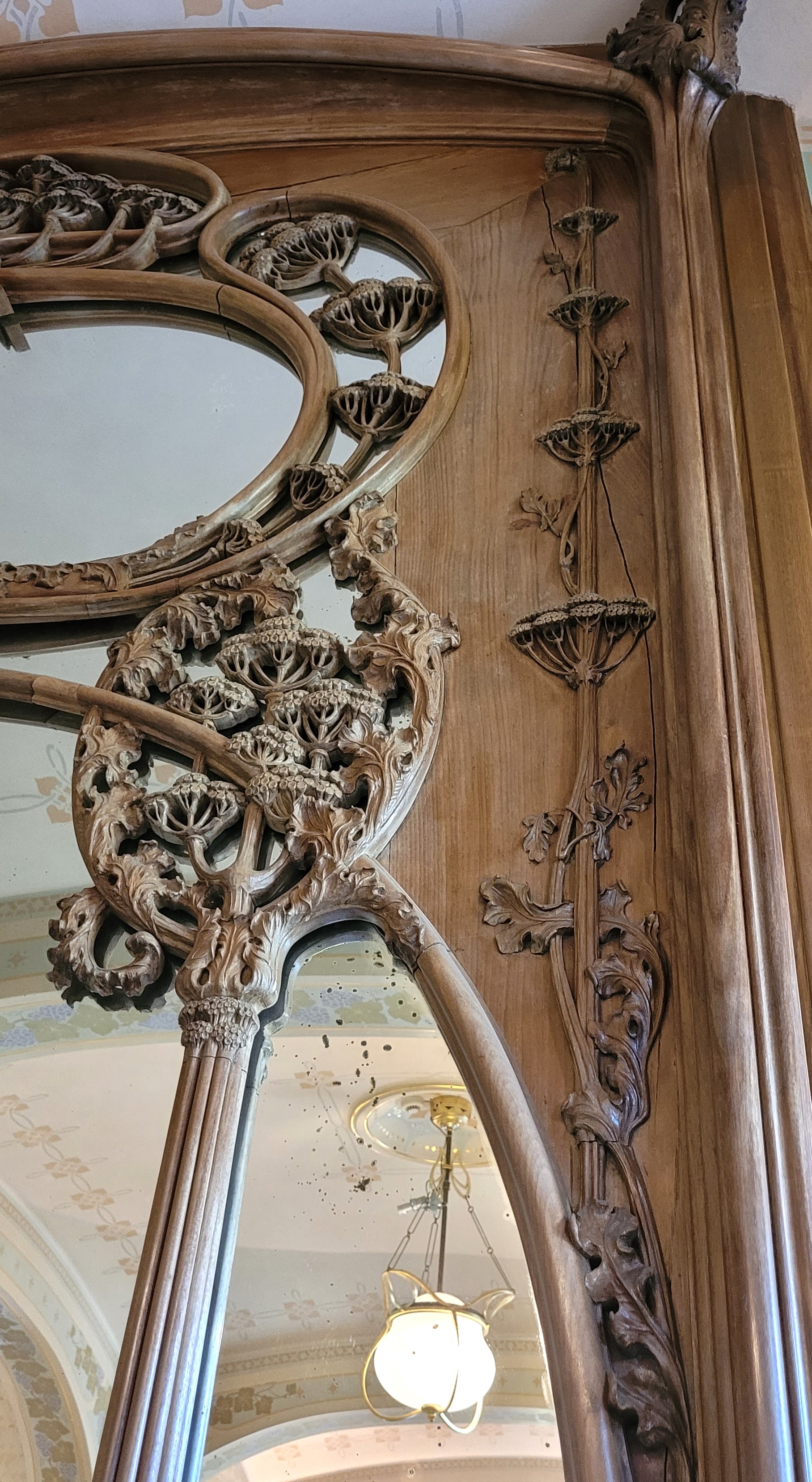
The imposing Art Nouveau fireplace in the main entrance is incredibly majestic as a whole - it was initially exposed at the Exposition Universelle at the turn of the century - however it is the intricate features that draw you closer to admire their skill and beauty. This piece, designed by a pupil of Louis Majorelle from the Ecole de Nancy, is but one of many items of decor and furniture that were gathered by the Vrankens to refurbish the villa that had lost all its original works to theft and acts of vandalism when it stood empty from the 1970s onwards.
The restoration work has been so thorough and thoughtful in its realisation, that one could easily assume that this is how the villa always was, but in fact the Vrankens had little on which to base their plans since rather meagre information remained, barring a few old photos that offered some guidance. As such, the Villa Demoiselle is truly a credit to the Vrankens' determination to see this site relive, literally snatching it away from land developpers who had planned its total destruction.
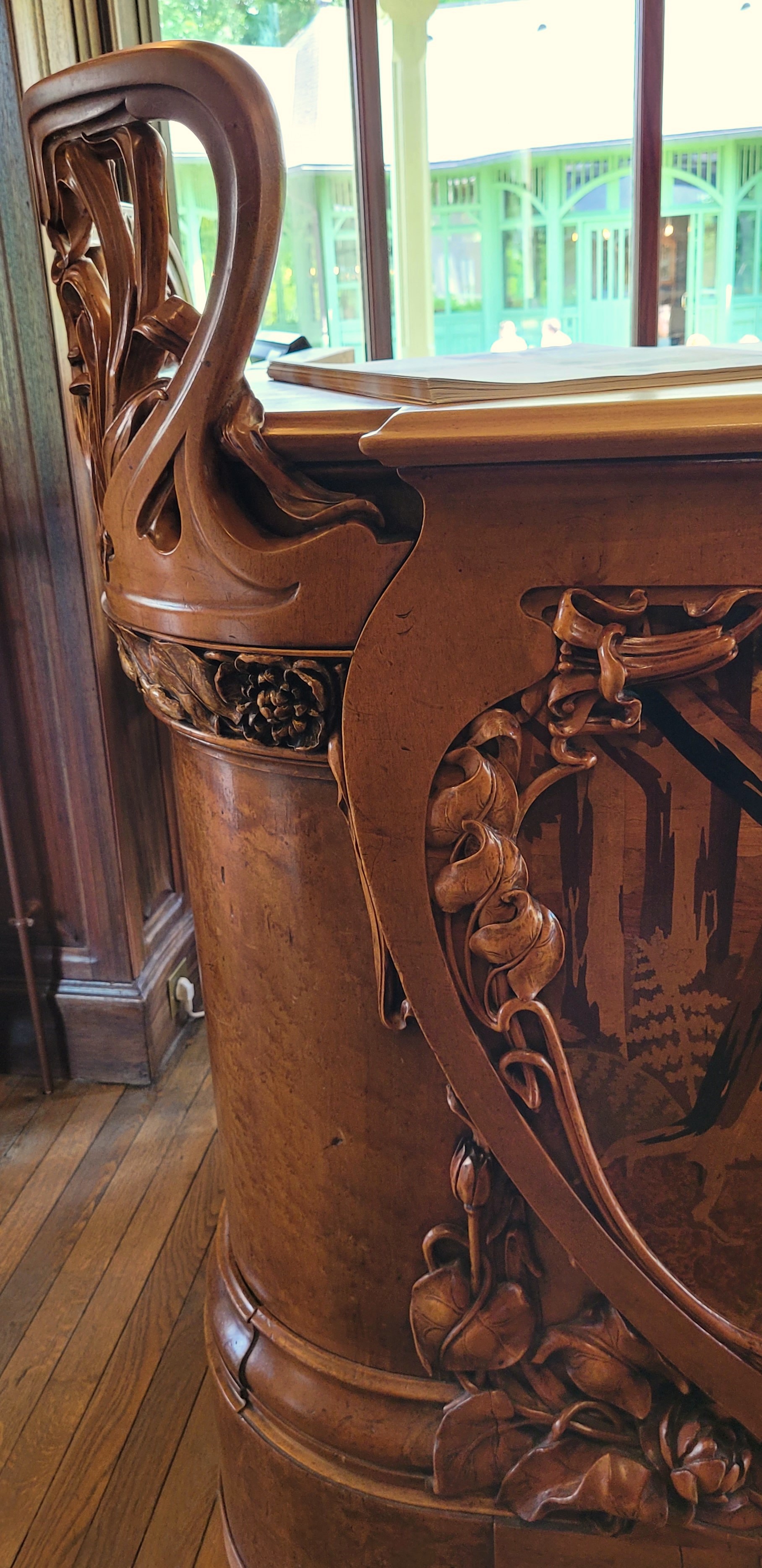
As in most Art Nouveau manifestations, particular importance is attached to the swirling, sweeping forms of a heightened, natural world, with plants, flowers, foliage, insects, snakes and birds twisting, sliding and slithering across sculpted surfaces, paintings, mouldings or furniture itself. Here at Villa Demoiselle it is magical to pick up on these details in all their beauty...
Of course umbellifer plant occupy a central position, with their delicate crown of ribs that radiate out from the flat-topped inflorescence in such a fascinating manner...
These curved and clustered forms were repeated throughout the villa on fireplaces, buffet-bars, cabinets and so on...
Meanwhile contorted, spindly stalks and branches intertwined...
Or lily leaves seemed to melt and flow down the solid forms of furniture in a liquid, vital fashion...
Whilst other objects concealed snails that glide silently on gnarled vines, set alongside smooth marquetry...
Or lizards that are frozen in a furtive, darting movement as they dash across scaly branches...
And in the main hallwall, the stairwell is dominated by the incredible chandelier, with its strange bulbous lights, which emphasises the great vertical drop from the ceiling of the top floor to the ground...
And the vast wrought-iron glass door with its stark, black tendrils that furl out like a spider's web, looking out onto the garden beyond...
Whilst one demoiselle peers on joyfully from a flurry of petals and light!

Wednesday, January 24, 2024

Stamps of Time... Robert Nanteuil.

While I was looking at the limited edition stamps at the post office, this leaflet and indeed the postage stamp itself caught my eye. As the name of the artist commemorated was in no way familiar to me, I read the brief description in the display cabinet below. As it turned out, Robert Nanteuil (1623-1678) was in fact born here in Reims yet was to go on to become one of the leading portraitists of the Grand Siècle, renowned for his skills in etching, drawing and pastel. How strange that the name of Nanteuil appears, for the most part, to have fallen so far into the shadows of time. As I was reading over his life history, it seemed fascinating to me to realise that I must have traced some of the same steps as Nanteuil here in his birth city, at a remove of some 400 years, for what is now Sciences Po was once the Collège des Jésuites de Reims where he initially pursued classic studies.
Proving to be unable and unwilling to repress his artistic drive, Nanteuil felt himself 'persecuted' by the Jésuit teachers who disapproved of the incessant sketching which finally led to his dismissal from the establishment. Fortunately, the young Humanities student was received in a more comprehensive manner by the Bénédictines at the Abbaie de Saint-Rémi (today Musée Saint-Remi). By 1645, Nanteuil had already entered the atelier of the remois engraver Nicolas Regnesson, whose sister he went on marry, but he did not stay in Reims as the opportunities in engraving in la Cité des Sacres at that time were limited. Moving to Paris, he developed ties with engravers, publishers and print dealers and artistically was greatly influenced by the Flemish portrait painter, Philippe de Champaigne. From then on, his career took off, to the extent that his ascension was such that by 1658 he was appointed draughtsman and engraver to Louis XIV, thus establishig a position for himself in the royal court, executing numerous portraits of the greatest dignitaries of the kingdom such as Mazarin and Colbert, along with the Roi-Soleil himself, in engraved and pastel work. With an unparalled skill in engraving that somehow managed to represent less attractive features in a flattering manner, Nanteuil was in great demand. Famous writer Madeleine de Scudéry was so impressed by her portrait that she paid hommage to Nanteuil's 'divine art', with its ability to render her detested facial traits pleasing. Beyond his art, Nanteuil was a man of letters, greatly appreciated for the words and knowledge that enabled him to frequent the literary milieux with ease and yet neither his work nor his wit secured him a place of due recognition in the 21st century...
Portrait de Madeleine de Scudéry - Public domain, via Wikimedia Commons.

Tuesday, October 25, 2022

Timeless Forms...

For a number of years now, Reims city centre has been occupied by rather spectral figures that tower above the hurried citizens that rush about their daily activities, too busy in their present thoughts perhaps to think of the past. Are these dark, massive forms with their passive yet forceful, brooding presence doing this for us? It is difficult to tell if they are our guardians as they peer out, keeping a benevolent, vigilant gaze on their urban surroundings and our existence therein or if they are rather guards, surveiling our every move, ready to take action if we overstep some mark, known only to them. Placed in different sites around Reims, these sculpted forms with their block-like, feature-less faces appear to follow us from every possible angle, from their chosen vantage points. With their plain silhouettes, without limbs or even actual faces, let alone facial expression, we nevertheless feel their human force. Carved from old trees, each with their own past, their rough, rugged blackened wood creates an impression of something timeless, tied to the land and mankind alike. And yet they are weighted down in history; our collective history, one that is universal. These are the work of a regional artist, Christian Lapie (1955- ), for whom the wounds of the war years are almost tangible, pulsating below the surface of the modern-day city of Reims and its region, some hundred years after the Great War. Charred and scarred, these figures evoke the soldiers and civilians alike who so suffered in the "war to end all wars". Likewise, they seem to underline the fact that war still rumbles on, further afield, continuing its grotesque work regardless, with its dehumanizing hold on humanity that is now part of the human condition. Although I am not generally attracted to modern art, these pieces fascinate me. Each time I catch sight of the huge sculptural forms of these enigmatic sentinels grouped together, I somehow sense a reassuring force that is tinged with with a strange evocation of past mistakes and the lessons that have not been learnt from these but could still.

Friday, August 26, 2022

From Hôtel des Sacqs de la Hérissandière, Hôtel de la Cloche Perce... to... Hôtel de La Salle.

One of the older historic buildings here in Reims - the Hôtel de La Salle - dates back to the 16th century. Listed as monument historique one hundred years ago, it is in fact miraculous that it actually made it through the hostilities of 1914-1918 which led to the destruction of most of the rest of the city. Today the Renaissance façade, inset with the benevolent figure of Jean-Baptiste de La Salle tending to one of his charges, stands elegant and proud, with little to indicate the past perils in almost 500 years of existence.
Its survival is not unlike that of the nearby Musée-hôtel Le Vergeur - set on Place du Forum in the heart of the city and in view of the cathdral, itself symbol of Reims ‘ville martyre’ during WWI. Indeed, both hôtels were saved from total obliteration in the aftermath of the war thanks to the intervention of individuals committed to the preservation of the cultural and historical heritage of Reims.
Hugues Krafft, co-founder of the Société des Amis du Vieux Reims in 1909, undertook the restoration of Hôtel Le Vergeur that he had purchased in 1910. Likewise, the biscuit manufacturers, Maison Fossier, of ‘biscuit rose’ fame, owners and occupants of the premises of what we now call Hôtel de La Salle, successfully brought the building up from the ashes during this same post-war period.
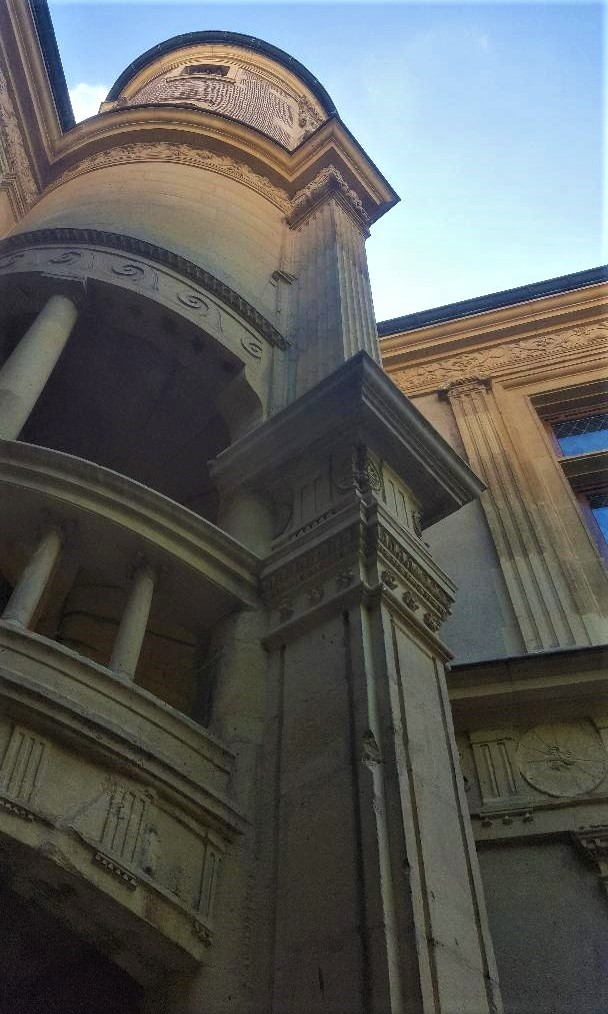
Again, both sites had once housed elements of significant architectural value and beauty and as such their preservation was deemed important to le patrimoine rémois. The hôtel de La Salle still possesses its ornately decorated escalier à vis, an external winding staircase in stone that turns clockwise on ascent, overlooking the court yard with an elegant architectural style reminiscent of the Château de Blois in the Loire Valley.
Constructed on the orders of affluent nobles and merchants of the city, both hôtels attest to the wealth and status of those who had originally commissioned them centuries ago. Although Jean-Baptiste de La Salle was born into an illustrious household in Reims to a father who was a king’s counselor and a mother from the Moët champagne family, the hôtel was not built on their behest nor on their behalf.
Initially known as Hôtel des Sacqs de la Hérissandière, it was in fact constructed in 1545 for an affluent cloth trader, Henri Choilly. And although the statue of Jean-Baptiste de La Salle looks down on us today from the façade of his birthplace - as if it had always been there - this is a relatively recent addition from the 1950s, taking position in an empty niche presumably once occupied by the figure of the Virgin Mary (but not the one below).
The hôtel only entered into the possession of the de La Salle family from 1609. Jean-Baptiste was born there in 1651, the eldest of eleven children. Despite being educated for a life in the legal profession, Jean-Baptiste followed a religious vocation and went on to become the patron of Christian teachers.
Lasallian schools are to be found on the five continents today and indeed a community of Brothers now occupy the Hôtel de La Salle, bought by the lnstitut des Frères des Écoles Chrétiennes in 1956. One of the Brothers kindly showed me around on a ferociously hot afternoon !
Although few of the original artifacts have survived to the present day, the rooms have been set out to reflect aspects of its past and displays show Jean-Baptiste de La Salle's life, work and legacy.
The façade of the building is decorated in the Renaissance style, with pillars, ionic capitals and a frieze running along its length, all bearing symbols of the cloth trade. The oddly-slanted carriage doorway is flanked by two allegorical caryatids, referred to as Adam and Eve. The male figure seems to be somewhat cramped in this tight corner with the wall of the adjacent building encroaching on his space at a rather strange angle.
This can be explained by the fact that the street that we see today only came into existence during the restoration period of Reims in 1921 when the Hôtel de la Cloche Perce, as it was then known, was still in such a sorry state that it might even have needed propping up. And so, as always, I wonder what this city – and others past and present - would be like today without such war devastation and have to be grateful for what remains to us now.

Thursday, July 28, 2022

Metamorphosis or Loss?

Walking home yesterday as the day drew to a close, I saw a sight that actually made me gasp in shock and brought tears to my eyes. The old conciergerie that has stood at the entrance of the Cimetière du Nord in Reims since 1839 had been partially demolished as part of the metamorphosis of the City of the Consecration of Kings.
Although this lodge had been no spectacular piece of architecture in itself, it formed an integral part of the view of the approach to the cemetery. Indeed, it somehow offset the massive wrought-iron gate that now looks strangely vulnerable and not without reason, for this will no doubt be over-shadowed by some towering sample of soulless concrete 'modernity' in months to come. The three odd arched windows and quirky little steps leading up to its front door that were so familiar to me on my walk home are now quite literally rubble.
Today I actually saw some of this mutation taking place, with a huge digger sprawling over the ruins like some grotesque carrion-eating beast, jaws greedily gnawing and grinding up the remains of the city architecture, pulverizing another part of the collective past so that no trace is left, even in individual memory.
Is nothing sacred? The new housing scheme will flank the tranquil plots of this 'Père-Lachaise rémois', built in 1786 with the evocative, Romantic beauty of tombs and monuments set amongst a tranquil landscape-garden setting. What will happen in the future when such sites - this and others - are deemed socially irrelevant and culturally inappropriate in a modern-day society that has little time or inclination for peaceful reflection on a past with all its flaws and imperfections?
The cemetery is, of course, just behind the vast Monument aux Morts built on Place de la République to commemorate those who lost so much in the Great War. Reims was largely decimated during the hostilities (1914-18), making this ville martyre a symbol of French suffering and resilience. Le Cimetière du Nord did not escape unscathed, as much of the grounds and masonry were likewise damaged during the war years yet it was restored again. How ironic that it should now witness new scenes of destruction just some hundred years later, at the very behest of the city authorities...
The war monument bears the inscription; 'For the new generations so that they may know and remember'. How are they going to do that when, little by little, the slate has been wiped clean? The old bell hung by the cemetery entrance has been torn off and that in itself seems to be a sign of ill-omen...