Far from the beach, but still surrounded by treasure of all kinds just ready to be found, looked at, gloated over, gleaned and swiped or simply created! Here are my latest finds....
Tuesday, March 29, 2022
Early Evening (and almost Night !) in.... Cimetière du Nord...
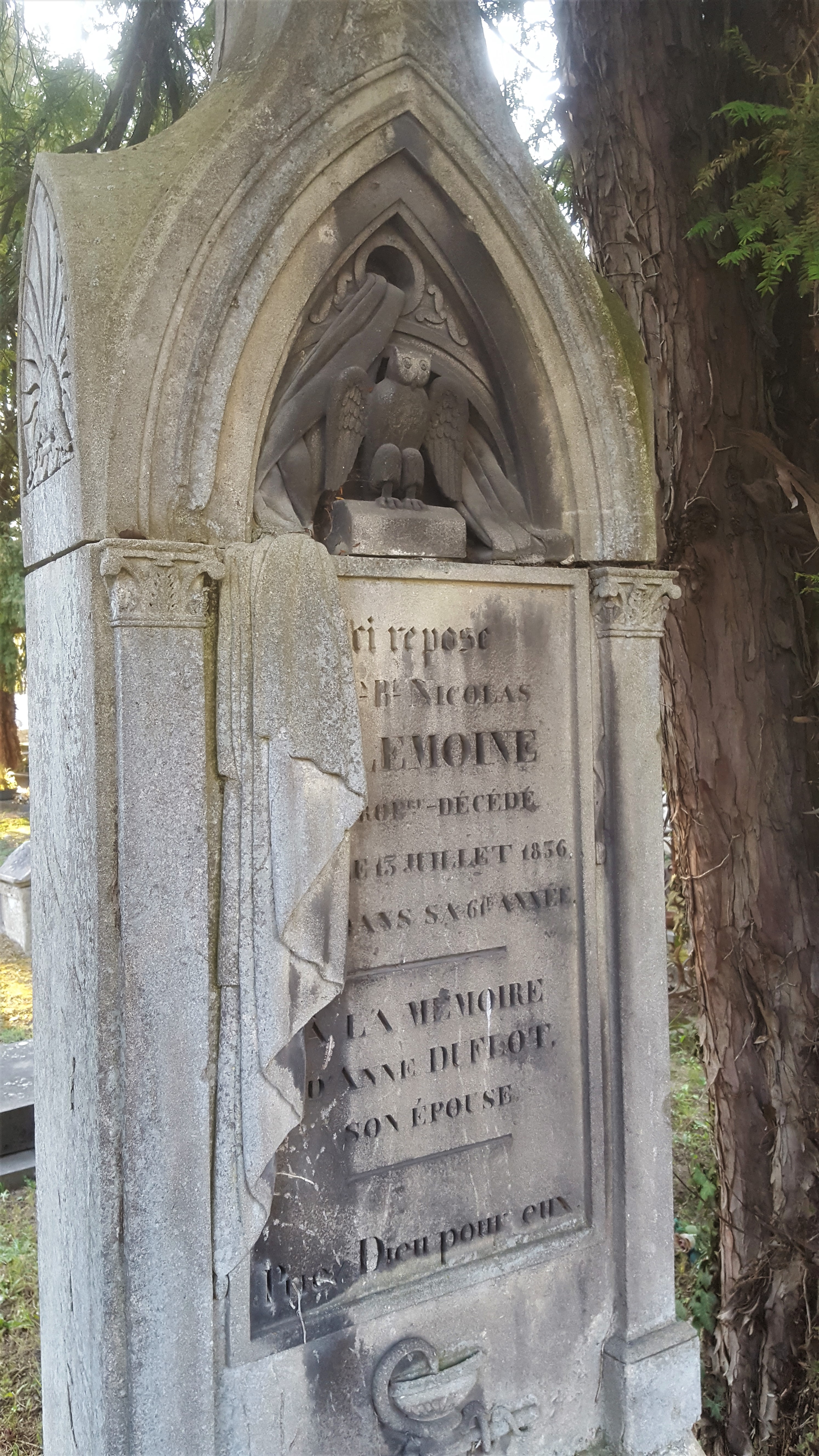
With the changing seasons, a beautiful site that I often return to is that of the « Père-Lachaise rémois », otherwise known today as the Cimetière du Nord de Reims. The oldest parts of this cemetery, which dates back to the late 18th century, still house many of the graves and individual chapels whose plots were set in place in the decades following its inauguration.
Built in 1787, just before the French Revolution, this garden à l'anglaise setting was conceived in response to the same dilemma that confronted most towns and cities; how to bury their dead in a dignified, safe manner. Communal graves set intra muros could no longer offer any kind of satisfactory solution and were to be banned definitively. Hence, some 17 years before the grand Parisian necropolis, the provincial Cimetière de la Porte Mars was opened, just outside the city walls, and later to be renamed Cimetière du Nord; the oldest cemetery of Reims.
Although many of the original monuments such as the Chapelle Sainte-Croix survived the ravages of the French Revolution years from 1789, like much of the city, the cemetery suffered considerable damage during the Great War of 1914-18. Indeed, the chapel itself was virtually destroyed and was under threat of demolition until classified as a Monument Historique in 1927.
Nevertheless, in the post-war years, both city and cemetery were rebuilt and it is difficult now to imagine the loss and devastation of that period. The earliest sections of the site - divided into cantons (as opposed to more familiar term - divisions) - make up a place of great beauty and tranquility, with the paths winding between trees and what could be called a 'respectable' amount of greenery.
Only when I visited Brompton cemetery in London last month, did I realise just how well its little French equivalent here in Reims stands up to a comparison with the vast and renowned necropoles of the 'Magnificent Seven'. The atmosphere is just as powerful yet peaceful, the monuments equally ornate, moving and somewhat mysterious in their age and gentle decay as their English counterparts and the wildlife likewise magical, in Spring, Summer or Winter. Last week, overwintering butterflies were dancing around the gravestones, flickering in the sunlight, birds cheerily chirping away, indifferent to any sombre mood the tombs may exude, and to the cats prowling around in the undergrowth, snaking their way between gravestones.
Each time I come here, new details seem to emerge from the old, catching my eye for the first time or retaining my gaze yet again. And so it is with the tomb below, which not only catches my attention on every visit, but also causes me to catch my breath. From an inscription that is gradually being lost to time, there is an expression of emotion has in no way diminished with the years. Indeed, such is the extent of the sadness that emanates from this grave that I can only stop to read it again and again. Whilst all graves hold infinite stories of loss - with love and life itself fully experienced and enjoyed, or denied, thwarted, cut short - rarely have I seen this expressed so clearly.
The pain of the parents of the first Joséphine, who suffered the loss of their beloved daughter at the age of 14 years, was to be relived and heightened by death of a second Joséphine in early infancy. Their sorrow seeps through the stonework still... reaching out to us.
To make this sadder still is the enigmatic blank first panel on the family tombstone, indicating that perhaps no relative of the famille Clément-Cochon was able to complete the inscription to show that parents and daughters had finally been reunited in this resting place as had been their own wish and expressed promise to their first-born.
On every visit, I try to shrug off this tale as a heavy shroud since I do not want to dwell on such sadness, but am inevitably drawn back, like a moth to a flame. So this time, I thought I would inscribe it in this virtual expanse and pay my respects as a stranger, over time and space, to a family of the long-distant past whose sentiments we can still sense in the present but pray will never experience ourselves.
Death is part of Life and vice versa, and it is therefore enheartening and wholly appropriate that all cemeteries are focal points for wildlife in all shapes and forms; even the lichen and moss that forms on the stonework underlines the movement of Life! Naturally the violets and primroses flowering on the grassy patches between plots add a jollity that you cannot escape, and reflect some of the ornate floral carvings of the gravestones themselves.
Whilst the 19th century symbolic staples are here; broken urns, upturned torches, hour-glasses, the odd weaping angel, Egyptian faces and a collection of owls, I particularly love the clasped hands. On my latest visit I noticed a hand detail that actually made me laugh, as two hands each clasp a wreath at the extremities of a sarcophagus yet both appear to be attached to one very long extended arm that runs along the entire length of the crest!
Well, for all that the last laugh was very definitely on me, for as I walked around the cemetery at the end of the afternoon, I failed to notice the time and so when I went to leave... the very tall, imposing iron gates were firmly shut and held in place by an equally impressive padlock! Having minimal battery on my phone, I quickly made a desperate call to my daughter with strict instructions to inform the fire brigade or police to get me out before nightfall! About an hour later, I was set free but have to admit it was a special moment to have the cemetery to myself... and yet again, my visit underlined the wise words used by Hugues Krafft as the motto for the Société des Amis du Vieux Reims;...... Urbium sacra senectus » : all that is ancient in a town is sacred.
Friday, March 4, 2022
Beastly Goings-on in the Victoria and Albert Museum - The Dacre Beasts...
Whilst in the Victoria and Albert Museum, I came across the following four imposing figures, guarding the steps leading to one of the exhibit rooms of the British Galleries. The Dacre Beasts, as they are known, are the last remaining specimens of Tudor heraldic carving dating back to the reign of Henry VIII. Standing tall and proud at around 6ft in height, the red bull, black gryphon, white ram and crested dolphin tower over the visitors, much as they must have done in their former setting in Naworth castle in Cumbria from the early 16th century. There, the beasts loyally stood below a ceiling decorated with paintings of the sovereigns of England in a sign of the allegiance of the Dacre family to the king, and thus highlighting the Dacre motto: « Fort en Loialte » (Strong in Loyalty). The name Dacre, is said to originate from an ancestor, Acre, who served in the siege of Palestine at the end of the 12th century…
Unfortunately, due to the tightening of financial circumstances in the 21st century Dacre family, the beasts were taken from their noble ancestral home that had been their ‘turf’, so to speak, for almost 500 years. In order to finance the upkeep of the Dacre castle, the descendant, Hon Philip Howard, felt obliged to generate funds through the sale of these historic pieces. Put up for auction at Sotheby’s in 2000, they were bought up by the V and A at a bargain price and are now visible to the public. The image of cattle to market did come to my mind at this point as I learnt of their history but at least they have been preserved, unlike the majority of similar works that have not survived to the present day. But if only they could talk ; what would they say of their change in identity, as one man’s insignia has become a rather anonymous, albeit impressive prize for a museum in the new millennium ? Although we visitors have gained in this exchange – I had certainly never heard of the Fab Four prior to my visit – they are perhaps a little lost in their present setting and may even be experiencing an existential blur.
Not so in the past, when the beasts set in their rightful domain were said to have inspired the illustrations of John Tenniel (1820-1914) for Lewis Carroll’s Alice in Wonderland during the artist’s stay at Naworth. Even those unable to see the actual beasts in flesh and fur within their castle setting would have seen printed works, driven by the Victorian thirst for Medieval imagery, heraldry and that Gothic touch. At one moment in their history, such illustrations were nearly all that was left of these magnificent carved forms when a devastating fire swept through Naworth in 1844, and yet the beasts escaped being reduced to charcoal. Nevertheless, whilst they may have thankfully lived to tell the tale, their current location renders them somewhat speechless and the small museum notice next to them does not tell us a great deal of their story. And what glorious beasts these are !
Carved from a single oak tree trunk by unknown craftsmen at the very end of the 15th century or first part of the 16th, these figures were made for Thomas Dacre (1467-1525), the 2nd Baron Dacre of Gilsland to reflect the dynastic alliance of two powerful families in Northern England through marriage. Indeed, each beast is a ‘supporter’ ; the creature that is shown on either side of the shield of arms. The exact function of the beasts is not known, for although they were apparently used in Dacre’s funeral, it is believed that they were intended to be displayed during tournaments to mark his considerable military skill and valour. Dacre had been a soldier in the last episode in the English Wars of the Roses during which King Richard III was defeated and killed by Henry Tudor in the Battle of Bosworth in 1485. He then went on to fight in the Battle of Flodden against the Scots in 1513, thus earning his reputation of staunch defender of the English crown, with the battle cry "A read bull, a read bull, a Dacre, a Dacre".
Thomas Dacre appears to have been a decisive man of action off the battlefield too, for in 1488 he eloped with Elizabeth Greystoke (1471-1516), a landed heiress. The Dolphin therefore represents the Greystoke family, as it carries the banner which displays Elizabeth’s arms – three cushions of argent – clasped between its decidedly fishy fins. Indeed, I must admit to having great difficulty in believing this was actually the portrayal of a dolphin – it looks more like a sizeable salmon, even given artistic licence ! The ram meanwhile, is the supporter of the De Multon family – from Ranulph de Dacre’s wife – and it bears a banner with a lion ‘passant’(walking with right fore paw raised) with three bars gules (heraldic tincture of red) upon argent (silver). The rather closely-shorn fleece and lack of horns make the ram look somewhat sheepish - not to say lacking in virility - but his very ostentatious male appendage would appear to define and display his ancestral power and position, presumably in a manner similar to (the rather more discreet) portrayals of Henry VIII in the royal portraits of Hans Holbein the Younger.
This same feature is shared by the two other beasts - the bull and the gryphon – whilst the Dolphin must content himself with a crown; fair is fair! The red bull of Dacre bears gilded horns, hooves and tongue in honour of his ancestry and wears a chained crown collar around his neck. He clasps the banner between his cloven hooves, displaying the arms of the Dacres – three white scallps on a red field. The black gryphon is the supporter of the Dacres of Gilsland and bears three rose chaplets (garlands of leaves with flowers) that are the 19th century arms of the Greystoke family. After the fire in 1844, the four beasts were repainted using Victorian colours that sought to recreate the initial tinctures, and the coats of arms were added at this stage. The architect in charge of restoration also saw fit to to gild the bull’s 'pizzle', an act that shocked the Victorian sensitivities of certain visitors to the castle at that time. I fear that the photos here may be banned due to ‘inappropriate content,’ which would be the ultimate dishonour to these fine beasts. Since they were on full public display in the Victoria and Albert, in all their finery, I trust they are ‘safe’ on this post too. How else can we learn about historic heraldry, with or without the infamous pizzle?
Monday, February 28, 2022
From the Spitalfields Silkweavers to the Silk Snippets of Beatrix Potter...
Returning to Spitalfields in the Spring break, I wanted to wander around the old streets again, in the district where the 18th century silk weavers worked from the grand townhouses that still stand, despite the encroaching ugliness of 21st century ‘development’ schemes. I noticed that some of these projects, whose progression I have observed with dismay over the last 3 years, were nearing completion having successfully wiped out yet another swathe of collective history and culture…
I particularly wanted to gaze up at the house from which Anna Maria Garthwaite (1688 – 1763) had worked. Although not of Huguenot extraction herself, she set up home within the community largely composed of French Protestant refugee silk weavers and merchants to practice a trade for which she in turn would be renowned as silk designer.
The house is situated in what is now known as Princelet Street (formerly Princes Street) and Anna Maria would have been able to see the steeple of Hawksmoor’s Christchurch from her attic workshop, as would many of the other silkworker households. She was buried in that same imposing church on her death in 1763. Today, the ominous sight of developer’s cranes spoil the skyline.
What I wouldn’t do to look around her home today ! As that isn’t possible, on a quiet, cold Sunday morning I was able to look around the streets that she had once inhabited.
Whilst there, I did speak to a home builder/decorator who has been doing restoration work on the townhouses for the last few decades, having initially just come to the area ‘for a week’ ; such is the magnetic pull in this incredible setting.
Creating intricate floral woven designs that combined a rich Roccoco style with a more typically English penchant for intricate flowered clusters, Anna Maria Garthwaite responded to the fashion for beautiful gowns, accessories and even furnishings in lavish silks, featuring damasks and brocade, often using silver thread for greater effect.
This time I made sure that I saw some of her work on display in the Victoria and Albert Museum and I was not disappointed. Lavish garments and dainty, decorative footwear that were assembled using the delicate silks from 18th century Spitalfields were shown in their own section of the museum as well as part of a clothing-over-the-centuries exhibition.
Several of the pieces were by Anna Maria – with swatches of silk and the final exquisite gowns and ‘sacks’ (loose, tent-like robes), all carefully sewn. Not only could you see what the 18th century lady wore on her feet – with elegant slippers that were worthy of a fairytale - you also got a naughty glimpse of what she wore beneath all that material ! More precisely, how the more extravagant dresses maintained their desired shape whilst worn…
Panniers or side-hooped undergarments of impressive width were exposed, revealing how robes such as the Mantua were carried, rather than worn. Gentlemen were no means less soigné in their dress code and beautiful waistcoats and jackets were equally as stunning as the ladies’ gowns.
The delicate embroidery and buttonwork put me in mind of The Tailor of Gloucestor by Beatrix Potter, with the missing cherry-coloured skein of silk for the Mayor’s garments of silk ‘embroidered with pansies and roses’. Having failed to get an online ticket to the Drawn to Nature exhibition, I was thrilled to get to visit all the same!
And so it was, to my great pleasure, that I saw similar garments that had inspired Beatrix Potter in the watercolour illustrations that I had loved so much as a child – with the mice discretely collecting the snippets of fabric under the watchful guard of Simpkin the cat, and finally completing the tailor’s order with skill.
After all these exquisite pieces from the past, I couldn’t help but wonder what happened to our desire to wear beautiful, carefully crafted garments and shoes, apart from the obvious and real limitations imposed by financial considerations. But why is it that a large majority of the population, regardless of age or situation, opt for the same kinds of clothing and foot attire that have become a virtual uniform ? How would Anna Maria Garthwaite regard today's staple ensemble of sneakers and jeans ?
Sunday, February 27, 2022
Angels in the Metropolis... Brompton Cemetery.
Tired of letting myself be drawn down the retail route – shops - I decided to explore one of the Magnificent Seven satellite cemeteries set around the capital in the first half of the 19th century. In fact, this was to be a commiseration prize to offset my disappointment at not being able to visit the Beatrix Potter exhibition at the Victoria and Albert Museum on on my recent trip to London...
Following my visit to Highgate cemetery a few years ago, I was eager to see how Brompton would hold up against its incredibly atmospheric, slightly older sister. Indeed, opened in 1840, Brompton closely followed Highgate (1839) but was some years behind the first great cemetery, Kensal Green (1833).
Greatly appreciated for its impressive architecture, imposing monuments and stonemasonry, I was particularly drawn to Brompton for its tombstones and the ‘contained and maintained’ wilderness that reigns throughout the site. Not surprisingly, the cemetery has featured as a backcloth in televised works and of course, the cinema, as has Highgate.
The peaceful, tranquil air of these sacred grounds devoted to past lives is magnified by the vibrant yet calming effect of the greenery of trees and plants which quiver with the life of the present. Early Spring sees the buds and flowers bursting out in defiance of the cold winds and rain of the winter months, as Life takes over from Death once more, in the eternal cycle.
Bold snowdrops and daffodils rise up again, bringing out the colour of the surroundings. Add to this the resident wildlife, and the magic is complete, with the plainly-visible robins, crows and squirrels of the daylight hours replaced, come nightfall, by a host of more elusive nocturnal creatures, when imaginations and spirits are free to wander. Whilst all share this sprawling territory with human populations, here is a haven for nature as much as a place of eternal rest for the Dead.
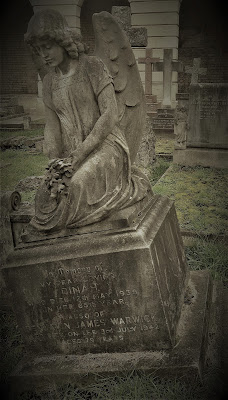
Whilst my thoughts and impressions ran free as I explored the alleys and somewhat overgrown plots, the phone (camera) simply ran out of battery. Infuriated, I had to resort to desperate measures and as the final photos did no justice to the unique mood and beauty of Brompton. I decided to use a special filter to mask the imperfections and try to make the best of a very unfortunate lot as my photos were so disappointing! Even if the result is rather eerie, not to say downright ominous, that was not necessarily intentional, and nor is it strictly representative of the atmosphere on a bright and blustery Spring day. Far from it, indeed!
Although a cemetery is burial site, and therefore intrinsically linked to loss and mourning, I find the older graveyards to be restful places that commemorate life past, enabling us to come to terms with life and existence itself and to understand social history more clearly. The atmosphere surrounding these old graves devoted to the long-departed is unique. The ageing stonework fittingly reflects lives ended centuries before ours were commenced. Names and dates that are barely visible today are often all that remain of lives forgotten, buried in time and blurred by anonymity. And yet they should remind us of the human condition, with regard to life and death.
We somehow forget that these beings were all individuals whose lives may mean little or nothing to us today, yet each had a life that was meaningful to them, however paltry it may have been. Each one experienced emotions, hopes and ambitions as we do today but we assume that these were somehow vastly different to ours today due to the different social and historical context. Shockingly high mortality rates in Victorian Britain meant that life for all was fragile and often short, whilst abject work and living conditions for the masses imposed a hopeless existence. Despite this, all individuals still clung onto life itself and were generally mourned when they left it.
Old cemeteries have always attracted me like a moth to candle-light, yet I had never known that there was actually a term for this – taphophilia – a ‘fascination and fondness for death rituals, funeral rites and cemeteries’. My attraction limits itself to the latter and only when the graves date back at least a century, preferably more. Any more recent, and the pain of loss pervades the atmosphere and seems to wind itself through the surroundings whereas the long-departed have long since been joined by their grieving loved ones. Furthermore, while I love to observe the inscriptions and symbolic decoration of graves and monuments, those from the 20th century generally do not have the same effect on me, possibly because timeless, flawless marble does not age or invite the growth of ivy, moss or lichen.
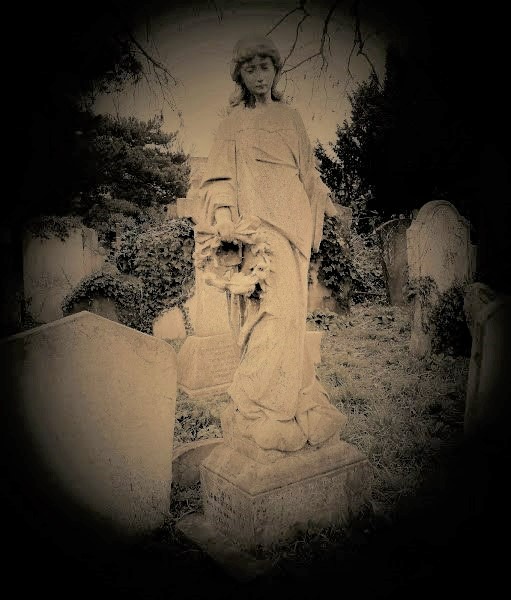
In Brompton, full Victorian symbolism is employed to reflect life, love, purity, death, loss, the soul and resurrection. Elements from the natural world, rich in meaning in previous centuries flourish in sculpted form with daffodils, lilies, birds, butterflies and snakes,to name but a few, all carved onto stone. Broken columns, inverted torches, draped urns and joining hands symbolize our earthly demise, the cycle of life and death and the journey to the afterlife. The traditional religious symbols abound, of course, with the Christian cross and the stepped cross, frequently inscribed with IHS but there are also many references to Ancient Egypt with obelisks, hieroglyphs and pyramidal forms. Unashamedly, I admit that one of my favourite symbols is the angel and I hoped that the ones here would be as evocative as those I saw in Birmingham, or indeed Highgate.
Behind the peace and beauty that we enjoy today in London’s garden cemeteries lies a less tranquil history. Indeed, these sites designed to honour the dead and soothe the living were born from a far less attractive need. The unprecedented population surge in early 19th century London meant that just as the city-dwellers were cramped together in dire, insalubrious conditions, so too were the deceased - piled together in vile, pestilential funeral grounds. Land, water and air were contaminated by putrid bodily fluids and infested by vermin which plagued the living and defiled the deceased.
Inspired by the impressive Parisian cemetery Père Lachaise of 1804, the seven large-scale funeral metropolis were designed to house London’s dead in a respectful, religious manner. Thus the construction of the Magnificent Seven was authorized by government, and commercial companies set about the task, eager to profit from a public prepared to pay the price for suitable burial plots to reflect social standing. Incidentally, I find it quite interesting that Paris should have been a source of inspiration in the solution to burying London’s dead, while London would later serve as a model for Baron Haussmann’s vision of a modernized Paris to accommodate the living!
Unlike Highgate, with its steep paths, slopes and meandering tracks that all add to its mystery, we still sense that Brompton cemetery was indeed constructed on flat land that had once been used for market gardens. Despite the numerous trees and undergrowth that conceal the skyline, the regular layout of the grounds makes itself apparent, underlined by the central tree-lined avenue that leads from the entrance on Old Brompton Road. In order to attract investors and customers, the design of the cemetery sought to impress, using features that recall St Peter’s Basilica in the Vatican. The neoclassical Great Circle, with central symmetrical colonnade, catacombs and chapel follows on from the avenue that acts as a nave. The eight-sided, domed chapel in yellow stone is at the heart of the cemetery’s design but was initially designed to be accompanied by two other chapels on both sides of the Great Circle.
Lack of sufficient funds skuppered these ambitious architectural plans and in fact the cemetery was forced to open in 1840 before the completion of the main chapel. Further financial difficulties arose when the catacombs failed to attract potential customers and shareholders were dismayed to have no return on their investment. Finally the Metropolitan Interments Act 1850 designed to enforce better provision for the internment of the dead enabled the government to buy Brompton, the first London cemetery to be nationalized. It is now managed by The Royal Parks and as such is the property of the Crown.
I was very pleased with my visit, especially as it made me appreciate just how much each cemetery has its own unique character and atmosphere and although the mood and magic of Brompton won me over, nothing for me so far could match Highgate and no angels have been as moving as the ones that mourn those departed in Yardley, Birmingham. Just as I left the cemetery, my digital camera suddenly gave up the ghost, and it started to pour with rain so I felt that my trip to Brompton had somehow been blessed. Perhaps there was an angel on my shoulder, though I would have settled for the jaunty little robin below! My good fortune did not end there either; I was able to go to the Beatrix Potter exhibition after all… It always pays to ask!
Monday, February 21, 2022
Glorious Gold, Stashes and Caches of Treasure...
I had forgotten just how beautiful the humble daffodil is, with its glorious gold set in seemingly simple, unassuming forms - yet with its bold 'trumpet' heralding the arrival of Spring. How these blooms manage to emerge from their tight, spear-like buds seems a most improbable feat, and yet emerge they do, in defiance of the winds and rain of the early months of the year, with their unique scent that defies description.
Returning home, I was suddenly reminded of the beauty of the daffodil and the fact that Spring is indeed on its way - accompanied by snowdrops and primroses. Nothing can be comparable to seeing these all growing wild, especially in the magical settings that I had taken for granted for so many years and now can only treasure from a distance... Glorious gold indeed!
Also in bloom were the 'Cornish roses' - Aeonium - the very hardy succulents that send out their ambitious stalky stems, outwards and upwards as a challenge to gravity and gusts of wind, bearing their golden clusters...
Likewise facing the elements, off I went in search of my own hidden treasures - seaglass! Although becoming increasing rare, I did find a few nubs and nuggets of weathered, frosted glass. This has become pure gold in itself, given the proliferation of plastic for packaging and bottling and the growing number of like-minded beachcombers, intent on seeking out these magically polished 'pebbles'. While I do have a specific, 'secret' beach for this - discovered through trial, error and elimination - the location appears to be common knowledge amongst fellow magpies who converge here from near and far. All are drawn by that irrepressible urge to find this unique treasure, one that has been etched by time and tide and eventually washed up on the shore. Each being is driven, to greater or lesser degree, by their private need to quench this quirky thirst, an almost primal covetousness. For this is a little object of desire with a strange hybrid beauty, created when Nature takes over what is Man-made, hiding the past under rounded forms and smoothened surfaces.
There is a certain camaraderie to be found nevertheless, amongst all these coastal scavengers and chancers, and the overall atmosphere is one of tranquility, punctuated by that keen determination to pick out the perfect piece from amongst the sand, seaweed, flotsam and jetsam swept by the tides. I have to admit that there is precedence in my 'Gollum-like' glee when procuring coastal treasures and the gloating, greedy satisfaction when running my finds through my fingers, in a jumble of colour and shapes. All is closely tied to one of my guilty childhood pleasures....
Having illicit access to enveloped packages of semi-precious gemstones in my early years, thanks to the family trade, I would happily let the jewels trickle down over my hands, in a magical flow that gleamed and glistened in the light. However, that could not satisy any hunger and merely stoked the fire to possess a secret, sinful stash to keep all to myself. Inevitably caught red-handed, I was promptly banished from the jewellery workshop and was rarely given the opportunity to play with the cracked, chipped stones that were of no commercial use but were tantalizing left to one side; worthless but priceless to my craving eyes. It was therefore with pleasure that I was finally able to get my greedy fingers on those caches of gemstones, after decades of coveting... Amethyst, peridot, citrine, garnet, moonstone and opal poured over my palms once more, but so did a few tears for the acquisition of this treasure heralded a greater loss and the rich, bright, sparkling hoard was weighed down by a certain sadness. But just look at how they glint and glow...
Subscribe to:
Posts (Atom)