Monday, January 28, 2013

Verdun via the Voie Sacrée...


On the site of the village of Fleury-devant-Douaumont which 'died for France'.
Fed up with all the stifling, petty problems of my (city-based) life I wanted to put these into perspective by getting out into the country in order to breathe another air.
As most of the regions in this part of France were the scene to extensive offensives during the First World War, it is almost impossible not to come across military cemeteries. 
Fleury-devant-Douaumont


Although these graveyards once rose from barren land that had witnessed the worst war atrocities Mankind had ever inflicted on itself, today a strange tranquility reigns in these now wooded areas. 


The surrounding landscape still bears the scars of the battles, but the effect is strangely beautiful as nature cloths and accommodates forms that can only be artificial. 


Probably the largest of these areas is the battlefield of Verdun, which strikes you with its woodland beauty and shocks you with its stretch of military crosses that unfolds before you, into the distance.

Verdun - In front of the Ossuary of Douaumont
In order to reach Verdun, you may follow the RD1916. This seemingly unassuming road nevertheless has a remarkable history and played a vital role in the Battle of Verdun of 1916.

Pocked-marked battle terrain in the mist.
 Named in reference to the Via Sacra -the ancient Roman road leading to the Coliseum - the Voie Sacrée of North-Eastern France led thousands of men towards gladiatorial combats of mythological proportions in the 20th century. During the First Word War century it was not slaves or beasts that were forced to enter the battle arena for the entertainment of the public, but young men who had often willingly enslaved themselves in order to honour their home land. 

Le train (convoy) on the Voie Sacrée.
 
The Voie Sacrée, thus named at the end of the war by Maurice Barrès, was to act as a vital artery to the French army in the Battle of Verdun. A never-ending stream of men and arms circulated to and from the Front, thus feeding the war machine, keeping it alive and literally supplying it with lifeblood in this giant clash of the Titans. The gods at war here were the Teutons and Gauls in a deadly racial feud that Lloyd George rightly termed "one of the most gigantic, tenacious, grim, futile and bloody fights ever waged".

Large road-side sign on the Voie Sacrée.

Erich von Falkenhayn, the mastermind behind the German offensive called it Operation Gericht - meaning 'judgment' or the 'administration of justice'. He hoped that this battle of attrition would "bleed the French army white" and that such a strategic strike would deal a fatal blow to the morale of the whole of France. 

Convoy on the Voie Sacrée
Ultimately it was hoped that France, as "England's best sword, would be knocked out of her hand". This, along with the widespread use of submarine warfare, would literally starve Britain to submission and would serve to crush the Entente whilst protecting the Habsburg Empire. 

In the whole deadly Verdun experience there could be no victor or vanquished. There was no justice to be dealt, no judgment to be made. Mankind lost in this battle since the only victory possible for civilisation would have been peace. Yet war requires the cold process of dehumanisation which leads men to simply act out its faceless battle tactics and moves, even when a battle has lost all sense or logic. These gestures took on unprecedented proportions of brutality, inhumanity and futility at Verdun in 1916.

Monument to French Minister of War - whose name honours the Maginot Line
 The town of Verdun had always been of great historical, strategic and symbolic importance to the French nation. The name itself comes from the Latin 'verodunam' meaning 'strong fort'; even Attila the Hun had been unable to penetrate this citadel in the fifth century. Ironically perhaps, until 1648 Verdun was not even French as it had been part of the Holy Roman Empire following the division of the Charlemagne empire in 843. What never faltered over the centuries was Verdun's interest as a strategic point marking the frontier between Gallic and Teutonic empires and acting as barrier, or potential gateway, to Paris. To withstand attack, Verdun's antiquated medieval defenses were updated during the Thirty Years' War (1618-1648) to resist enemy artillery. From 1670 the military engineer Vauban improved this defense further by a sophisticated fortification programme. Unfortunately these were not sufficient to safeguard the city in the first Battle of Verdun in 1792 which pitted the French Revolutionary forces against the Prussian army. Captured by the enemy and released again, Verdun suffered a similar fate in the Franco-Prussian war of 1870. As a result of this humiliation, and in an endeavour to protect the eastern border, a strong line of fortifications was built between Verdun and Toul, and between Epinal and Belfort. 

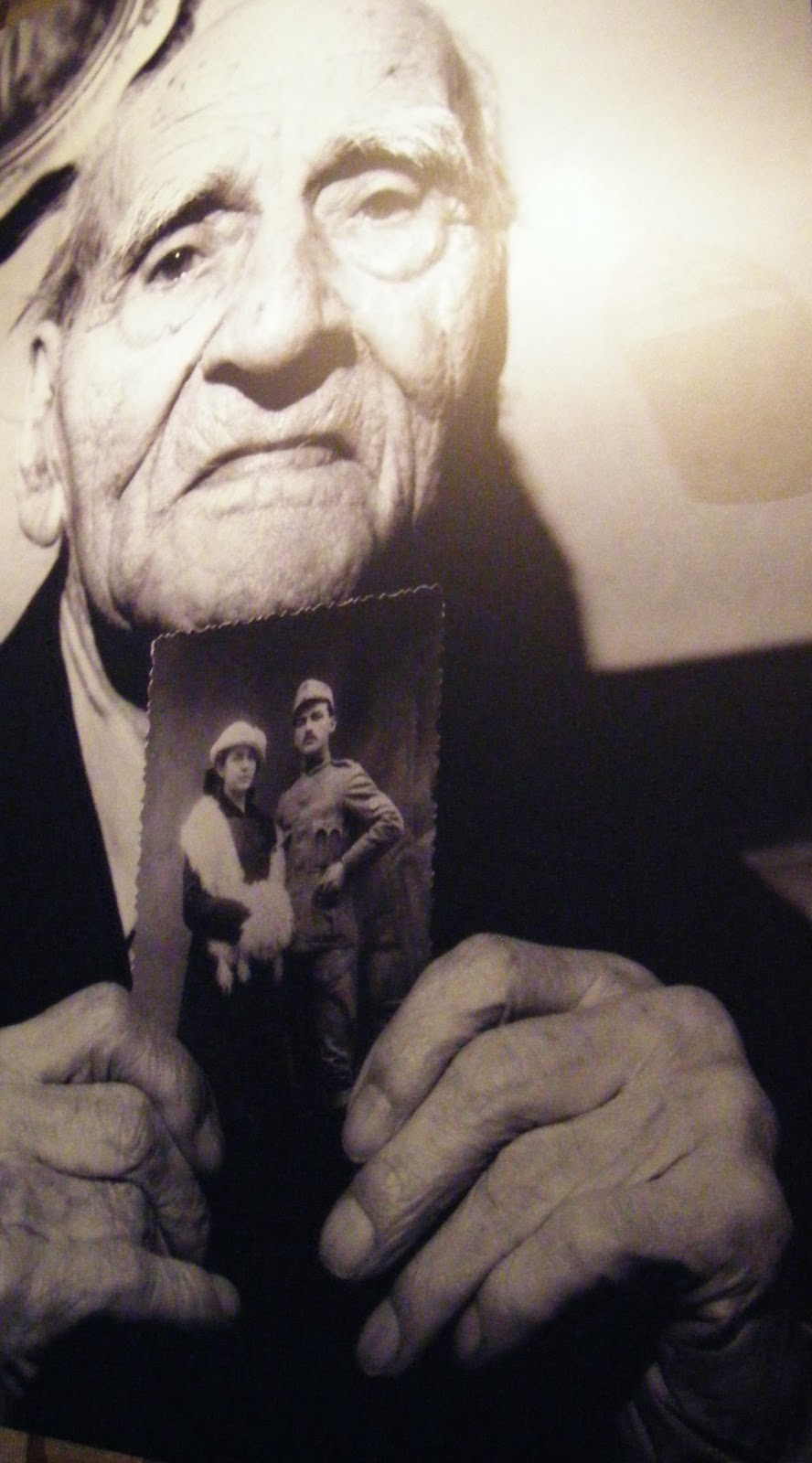
Ex-Poilu soldier with a photo of his former self.
 As a salient, protruding into German territory, Verdun was the tantalising northern gateway to the Champagne region, with Paris just 260km beyond. Its defense was vital. A ring of 19 forts was constructed several kilometres from the town shortly before the turn of the century, and further reinforcement work was later carried out on the sites to the north and east of Verdun, namely Fort Douaumont and Fort Vaux. 
Ossuary of Douaumont
 Despite its initial reputation for impenetrability, Verdun was to have notable weak points for which it would pay dearly. Exposed as it was on three sides, in theory Verdun needed all the fortifications it could muster, especially if exposed to heavy German artillery. However the capture of several Belgian defense forts had shown how ineffective such sites could be when faced with such powerful munitions and it was felt that their supplies could be put to better use. Indeed, by mid-1915, arms and equipment were required elsewhere. The enemy attack had been countered on the Western Front yet stalemate had ensued. As Verdun was ironically considered to occupy a 'quiet zone' at that period, it was thus decided that many of its forts would be downsized or dismantled (or even designated for destruction). Fort Douaumont was the most notable example. In addition, Verdun's single-track rail system had been weakened by German forces since 1914, and where it was exposed to enemy fire could not be relied on for the transportation of significant supplies. Little did the French realise, but as such, Verdun represented a deadly bottle-neck trap set up to ensnare them, and was a strategic trophy for the Germans, ready to be taken. 

 French intelligence knew that an attack was imminent at the very beginning of 1916. The die had been cast. Reinforcements in men and munitions were therefore hurried into the area, aided in their convoy by a delay in the German offensive due to bad weather. Instead of the 12th February, the attack was held back until the 21st February. Despite this delay the sheer disparity in power on every level left little hope for the French. The Battle of Verdun started in earnest with an apocalyptic 10-hour bombardment of the front line. This "trommelfeuer" (drum fire) attack churned up the land and pulverised its occupants. The deafening drum call, felt as a rumble even 160km away, sounded the emergence of a living hell. Indeed, this baptism of fire and blood was followed by advancing flamethrowers and storm troopers who cleared the trenches of any remaining defenders.

Veteran 'Poilu' soldier.
 The defeat of the French seemed to be merely a question of days. In this extreme state of urgency the French Second Army, under General Pétain, was summoned to the Front to reinforce the Verdun sector. The fort of Douaumont, not surprisingly perhaps, fell to the triumphant Brandenburg regiment on the 25th of February. Its capture highlighted the errors in strategic decisions on the part of the French war masterminds, notably under General Joffre, and dealt a hard blow to French morale. Crueler still were the physical blows which rained down on the actors in this very real theatre of war through weapons and warfare devices which had barely been used before or rarely to such an extent. 
 
Even before the staging of this apocalyptic scene took place in late February 1916, another frenetic activity had been triggered off well behind the front line, several days earlier. It lead to a previously unseen feat of logistics and would provide the French battleground with a vital lifeline in the form of a serpentine convoy of men and material to and from the Front. Following an emergency meeting on the 19th February the Automobile Regulatory Commission was formed in order to respond to the army's transportation requirements. It was decided that the modest road leading from Bar-le-Duc to Verdun would be the centre of this mission, and immediately all concerned ensured that the objective was achieved.

Monument to the Voie Sacrée
From the 21st February all horse-drawn traffic and infantry were prevented from using the road, which was then devoted solely to motorized vehicles. The narrow route itself was widened to accommodate the two lines of movement, wholly focused on Verdun, there and back. This continual flow never slowed over the following months; on the contrary, the movement over the 75km distance built up in momentum and capacity. A slowdown in the advance of Germans troops due to adverse weather conditions was used to great advantage by the French. Just in the first two weeks of hostilities 132 battalions were transported along the route, in addition to 20,700 tons of munitions and 1,300 tons of general supplies. In March 6,000 trucks passed each day - roughly signifying one every 14 seconds, day and night. The drivers of such vehicles were expected to work for up to 18 hours a day, for up to 10 days in a row in order to maintain the rhythm. Any vehicle that broke down would be hauled to the side of the road so as not to hinder the flow of traffic. To counter the problems resulting from the poor road surface and the dire weather quarries were opened up to supply stone chippings. When these proved inadequate to maintain the most basic of standards for the convoy , stones were placed on the route itself, to be crushed by the passing trucks themselves. Patrol planes were flown overhead to avert or crush German attack.

The same soldier with a bicycle, many decades later...
  'The Road', as it was simply called during the battle, reflected the ingenuity and sheer determination of all involved. In this manner, the Voie Sacrée led to the logistic legend of 'French trucks over German rail systems'. However, this legend is somewhat skewed since it does not give due recognition to the narrow-gauged rail track that ran virtually parallel to the Voie Sacrée. Although the Road did indeed bear the vast majority of traffic (approximately 78%), the remainder was carried by the Chemin de Fer Meusien. This modest line which transported supplies in food, horses and munitions to the Front and brought the wounded back, was seconded by the Nettancourt-Dugny line. In a prescient move, Pétain had ordered the construction of this standard-gauge track in early March 1916 and it is was duly completed and functional in a mere four months. Running beyond the reach of enemy fire, it eased the pressure on the Road which had already reached full capacity by the end of March. In this manner the Road gained in efficiency as it was able to concentrate further on the flow of lighter freight and vehicles. Together road and rail led to the rotation of some 2 million soldiers over the following months and the heavy rumble of transport was ever-present.
From the Monument au Morts at Meaux.

Likewise, the deafening war machine of Verdun continued relentlessly. The Germans appeared to have the upper hand, with French soldiers outnumbered by almost two to one and armed with weapons that could not match the heavy enemy artillery. Nevertheless the French put up a brave defense and hindered the attack on the village of Douaumont on the 29th of February, making the most of bad weather to further accelerate the advance of convoys. When the village finally fell to the enemy on the 2nd March, German losses were considerable and revealed shortcomings in their strategy. Perhaps too sure of victory, the Germans had advanced fast in the initial stages of the offensive and had made themselves vulnerable. The front line had been transformed into a quagmire which resisted the movement of heavy German artillery, especially in hilly areas. Equally bogged down in mud, the German infantry exposed itself to French artillery on the opposite side of the river Meuse. Unable to progress frontally, the Germans decided to attack via the flanks of the hills of Le Mort-Homme and Côte 304. These offered a vantage point over the battlefield and also housed many French munitions and were the focus of a huge enemy attack followed by a counter-attack on the part of the French. The site was ravaged by the hostilities and the hills scalped to become volcanoes in a lunar landscape that swallowed up any human community or indeed any form of life.

Although now taken by the enemy, Fort Douaumont remained a focal point of French concern on a both strategic and symbolic level. The Germans managed to hold onto the fort, but at considerable human cost. Despite the affectionate name bestowed on the fort - the "Old Uncle Douaumont" - its capture certainly did not necessarily bring them much shelter or luck as it turned out. It became a German safe haven for troops and operational base in spite of the French Second Army's valiant attempts to recapture it in late May 1916. However, the danger for the Germans came from within as a relatively banal accident over a cooking fire set off grenades and set alight to flame thrower fuel to then cause all the munition supplies to explode in the fort. The catastrophic consequences were instantaneous and resulted in the death of nearly 700 men. Although morale must have been crushed, this did not deter the Germans in the mission to advance on Verdun. Their offensive turned from Mort-Homme and Côte 304 and focused on Fort Vaux.

 In spite of the vast numbers of German shock troops( almost 10,000 men), and their successful occupation of the top of the fort at the very beginning of June, the bottom levels of the defense system were still courageously defended by the French. Over the next five days, the ensuing hostilities in the labyrinthine underground tunnels must have been worthy of an ancient tale from Greek mythology, combined with the cruel weaponry of modern times. The French defense was finally obliged to surrender when the soldiers simply ran out of water. 

The symbolic wounded Souville Lion.

The German victors of this stage of the Battle of Verdun could hardly be considered to be winners as the losses suffered by both sides were horrendous. Since May, General Pétain had tried to avoid the unnecessary loss of French troops by remaining on the defensive. In addition, he rotated soldiers  in a 'turnstile system' over several weeks so that the men gained in experience or used that which they already had, yet maintained their morale. His address to the troops in April 1916, "Courage ! On les aura !" was intended to congratulate and above all encourage the continued war effort in a period marked by devastating loss. Due to this system of rotation, 70% of the French army passed through the "wringer of Verdun", whereas only a quarter of the German forces did so. Needless to say, such trauma meant that the majority of these war veterans, "les Poilus", were old before their time - worn by the physical and psychological hardships.

Lion de Belfort - Bartholdi (Statue of Liberty) - Paris
 It was soon decided that an offensive approach was required to assure French success through a series of counter-attacks under a new commander. In the early summer the replacement of Pétain by General Nivelle, a man of artillery training, further added to this battle fatigue. Over the summer a feeling of discontent spread across the Verdun battlefield and resulted in sporadic bouts of indiscipline within the French ranks, the consequences of which did little to boost morale. Indeed, shortly after General Nivelle's appointment two lieutenants were executed without an official court martial at Fleury-devant-Douaumont. Nevertheless, the army obeyed General Nivelle's call to crush the Germans' intentions on the last bastion in the Verdun stronghold:"You will not let them through, my friends" ("Vous ne les laisserez pas passer, mes camarades!").

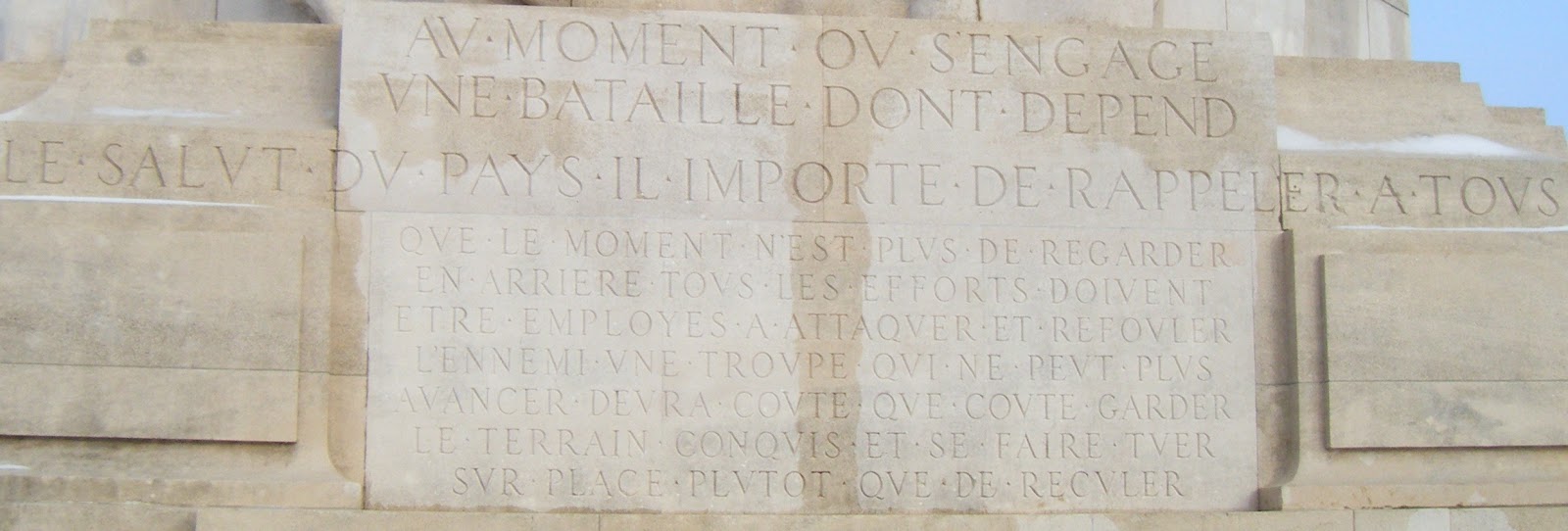
Blood-chilling inscription of the Monument aux Morts at Meaux - see below...

"Au moment où s'engage une bataille dont dépend le salut du pays, il importe de rappeler à tous que le moment est venu de ne plus regarder en arrière; tous les efforts doivent être employés à attaquer et à refouler l'ennemi. 

Une troupe qui ne pourra plus avancer devra, coûte que coûte, garder le terrain conquis et se faire tuer sur place plutôt que de reculer. Dans les circonstances actuelles, aucune défaillance

ne peut être tolérée." Maréchal Joffre

German morale could hardly have been much higher than that of the French, yet they continued their southerly advance on the city of Verdun believing that their extensive use of diphosgene gas would enable them to overpower their last major obstacle, Fort Souville. This strong point had already been destroyed on the upper level, so on the 22nd June 1916 it was simply a question of taking the underground tunnels. However, the attack did not go to plan. The gas had dispersed with little effect on the French defenders who themselves were then able to annihilate the large concentration of German infantry heading to the fort by the use of heavy artillery. An additional aborted attempt on the part of the Germans to capture Fort Souville on the 5th August appeared to mark a new phase in the battle.


The failure to capture Fort Souville saw a shift in positions and strategy as the French took up the offensive whilst the Germans were forced to adopt a defensive approach. The German army was further disadvantaged by the need to respond to the Allied offensive on the Western Front by extra sending men and munitions. This was a strategic diversionary coup set up by General Joffre. By obliging the British war general Haig to bring forward the intended offensive in the Somme Joffre hoped to ease the pressure on the Second French Army at Verdun. The conflict commenced on the 1st of July rather than the initial date one month later. From this diversionary point of view the opening of the Battle of Somme may have achieved its objective, although it must be remembered that on the first day of hostilities alone one third of the British Army soldiers lost their lives. German resources at Verdun were further drained when troops were withdrawn in order to fight a Russian offensive on the Eastern Front. The Souville sector was yet again the target of another German assault on the 12th July, but the mission failed to take Fort Souville from the French. It was easily apparent that none of Falkenhayn's objectives had been achieved and his German troops were exhausted, having never left the hell-hole of Verdun. In August of 1916 Falkenhayn was replaced by von Hindenburg. Nevertheless this change of commander did nothing to alter the German position.

Tombstone from a Muslim soldier - Douaumont

Following Nivelle's commands, General Mangin led the offensive that was directed at Fort Douaumont in order to prise it out of the enemy's hands on the 24th October. The Germans had already started to evacuate the fort, and the attack carried out by the Regiment of Colonial Infantry of Morocco was a success. On the 2nd November Fort Vaux was also evacuated and General Mangin continued his offensive to reclaim territory that had been captured by the Germans from the outset of their attack on Verdun. At the closing stage of the Battle of Verdun over 10, 000 German prisoners were captured and Hindenburg saw further retaliation as futile. 


In the mist - headstones of the Muslim soldiers at Douaumont - all facing Mecca.
The hostilities at Verdun ended on the 15th December 1916, 10 months after its dramatic commencement. The outcome; 700,000 deaths, which is to say approximately 70,000 men slaughtered for each month of battle. The German losses were only slightly inferior to the French. No strategic advantage was gained on either side. A commemorative statue of a wounded lion is situated on the site which marks the furthest point the Germans reached on their advance on Verdun. Dedicated to the French soldiers from Fort Souville garrison, this tragic lion is a painful reminder of all that was lost in terms of human life in order to defend or gain several kilometres of terrain. The Souville lion also recalls its defiant compatriot in Belfort. The famous Lion de Belfort monument commemorates the valiant defense against enemy attack in the Franco-Prussian war of 1870-1. Nevertheless, the sculptor Bartholdi said of his work that "It is neither a victory or a defeat that it should recall". The tragic Souville lion can only represent the defeat of all those involved in the Battle of Verdun. Pétain remarked of his soldiers;"Their expressions seemed frozen by a wisdom of terror; they sagged beneath the weight of horrifying memories". The same could have be said of the German soldiers too.


The very land of the Verdun region itself was twisted, torn and tortured beyond recognition. Villages were captured, recovered and captured again, all traces of community and civilisation were choked, churned up or simply obliterated in the process. This scarred landscape became known as the Zone Rouge where whole villages and swathes of farmland had been swallowed up and spat out again by the war machine. Contaminated with corpses of beast and man alike, rendered toxic by chemical weapons and made potentially lethal due to unexploded ordnance, the land was uninhabitable and unworkable. A string of villages disappeared in this manner having "died for France" in a series of tragic death throes. Fleury-devant-Douaumont exchanged hands 16 times before it fell silent, and the calm and peace that reigns there today belies the clamour and frenzy of the past.


A decision to plant trees on an extensive scale in the 1930's means that much of the battleground is tranquil woodland today. The craters and trenches that were scorched or scratched into the bare land during the hostilities now appear to be a curious undulations amongst the green foliage. Occasionally the land returns the remains of unknown soldiers to the present so that they may leave their burial ground in the wilderness to lay at rest in the necropolis at Douaumont. The strange form of the ossuary recalls that of a rounded bunker, or the curves on a combat helmet, with the central tower rising up like a vertical chrysalis. From the outside, the whole has a Germanic Art Deco feel which seems sober yet a little menacing in the absence of all colour except the overpowering grey of the stonework. 
Art Deco form of the Ossuary - even more oppressive in the mist...
Through the small windows looking inside the building are alcoves bearing the skeletal remains of around 130,000 unidentified soldiers. The interior of the building appears more like a classic spiritual place of peace and reflection, again in an Art Deco style. Plaques on the walls and ceiling of the cloister commemorate the fallen, whilst large black-and-white photos show veterans of Verdun, holding photos of their younger selves during the war period. 

Bell tower - Douaumont
The bell tower can be visited and offers panoramic views over the former battlefields. The bell itself is the 'Bourdon de la Victoire' ringing out over this eerie burial ground at official ceremonies but also seeming to call to the dead, just as the rotating red-and-white rotating 'lantern of the dead' seems to lead the lost to a final resting place. 
Cloister of the Ossuary at Douaumont


In front of the ossuary, leading down and away to the distance is the largest French WW1 military cemetery. The Ossuary of Douaumont was created in response to the public need of an official commemorative site to house the remains of the fallen soldiers in dignity shortly after the Armistice. The first stone was laid in place by Pétain in August 1920.


A monument to the Voie Sacrée was inaugurated in 1967 to mark the arrival point of troops coming from the rear to reach the plateau of Moulin-Brûlé, some 8 kilometres from the battlefields.

Monument to the Voie Sacrée.
This final distance had to be carried out on foot and saw thousands of men trace the same path to the same hellish destination. The monument was erected by the Fédération Nationale du Train and depicts the intertwined logistics of road and rail. Indeed, contrarily to what one might suppose, the term 'train' means 'convoy', not simply a railway network. The work was that of a Commercy sculptor, François Barrois, and the architect Gaston Schmit from Toul.


A curved wall bearing a sculpted frieze represents the transportation of man, beast, machine and munitions heading to the Front at Verdun along La Voie Sacrée. This form is intersected mid-arc by a large vertical obelisk representing the route itself which seems to rise up both independently and yet intertwined with the horizontal frieze.

La Voie Sacrée
 While the obelisk is massive and rather rugged in its stonework, it is in harmony with the wall's smoother surface and seems to draw attention back to the human activity of the frieze. Near its summit the vertical form bears the 'indented winged wheel' (roue dentée ailée), which is the insignia of the Arme du Train. 

In the central part of the curved wall, behind the obelisk form is an inscription addressed to the veterans of the convoys - road and rail - "Le train à ses anciens, à tous ceux de la Voie Sacrée". From this central point two convoys set off in opposing directions, representing the movement to and from the Front.

The train feeding the Front...
 Both are led by a small group of Poilu soldiers bearing either munitions on their way out to battle or returning, loaded down with haversacks and leaning on walking canes. Trucks, a horse-drawn cart and a locomotive feature on the frieze and all bear the valiant soldiers who had fought, or were going to fight at Verdun. 
Returning from the Front on the Voie Sacrée...
 There is no other life form represented here - no trees or plant adorn the frieze of the Voie Sacrée or detract our attention from the human activity. 

Apart from a distracting hum of traffic on the road today, the calm of the tree-lined setting seems to make the memorial of the Voie Sacrée even more sober, and the site more serene. The Voie Sacrée was made a national route in 1923 and symbolic milestones decorated with sculpted helmets of Poilu soldiers mark out the kilometres from Bar-le-Duc to Verdun. In 2006 the route was renamed the RD1916, in memory of its past.

Above the entrance to the Ossuary of Douaumont
Each year the Sacred Flame from the Tomb of the Unknown Soldier is taken by relay-runners from below the Arc de Triomphe in Paris to the Monument aux Morts in Verdun to mark the memorial ceremony of the 11th of November; Remembrance Day.

Lest we forget...

             Ode of Remembrance from Laurence Binyon's 1914 poem; For the Fallen.
They shall grow not old, as we that are left grow old:
Age shall not weary them, nor the years condemn.
At the going down of the sun and in the morning,
We will remember them.


Next year will be the centenary of the beginning of the Great War. I hope that after all of these years it will be remembered as a tragic event brought about by the folly of Mankind, irrespective of nationality. The film that best brings this aspect home, for me, is All Quiet on the Western Front. Everyone lost, on every side, in every way...


Thursday, January 17, 2013

Testament of Youth - Vera Brittain - through the mist of time...

In the mist...The First World War Military Cemetery - Douaumont (Verdun)


Over the Christmas holidays I rediscovered the 1979 BBC dramatisation of Vera's Britain's autobiographical work, Testament of Youth. I saw this series, as a teenager, all those years ago and found it highly moving at the time. Over thirty years on, the adaptation has stood up well to time and has lost none of its power. Although the sets appear to lend themselves more to a stage play, the excellent performances and skillful management of the original lengthy text managed to bring the book to life in a new media, re-awakening public interest in a work of such importance. The use of war poems of Wilfred Owen, Siegfried Sassoon and Vera's Brittain's fiancé, Roland Leighton, throughout made the rendition even more poignant.

Image © The Vera Brittain Literary Estate, 1970/The Vera Brittain Fonds, McMaster University Library

Written in 1933 Testament of Youth gave an account of the ravages of the First War War, from which nobody or nothing escaped unscathed. While the book exposes the truly horrific extent of the slaughter of the whole 'lost generation' , almost a century ago, it is lived out on a brutally painful personal level as Vera loses her brother, fiancé and male friends to the indiscriminate inhumanity of war, fought out in France and on the Italian front. 

Douaumont - Verdun
Hedauville Nov 1915 Roland Leighton - prophetically written shortly before his death...
 
The sunshine on the long white road
That ribboned down the hill,

The velvet clematis that clung

Around your window-sill

Are waiting for you still.
Again the shadowed pool shall break

In dimples at your feet,

And when the thrush sings in your wood,

Unknowing you may meet

Another stranger, sweet.
And if he is not quite so old

As the boy you used to know,

And less proud, too, and worthier,

You may not let him go –
(And daisies are truer than passion-flowers)
It will be better so.


Like thousands of other men, on both sides of this war "to end all wars" (H.G Wells), Edward Brittain and his brothers-in-arms appeared to have died needlessly and senselessly; Roland Leighton died a day before his Christmas leave. All men fought for the shared cause of defending their own civilisation, King and Country on opposing sides, yet did so in a war that itself destroyed the very concept of civilisation. Vera Brittain herself said of her work "It is not by accident that what I have written constitutes, in effect, the indictment of a civilisation." All these years on, it is not a question of particular civilisation, but the ever-present process which still leads men to the battlefield, and still sees them fall, to leave grieving loved ones behind.

One of thousands of crosses for Unknown Soldiers...
 Anthem For Doomed Youth - Wilfred Owen 1917
What passing-bells for these who die as cattle?
Only the monstrous anger of the guns.
Only the stuttering rifles' rapid rattle
Can patter out their hasty orisons.
No mockeries now for them; no prayers nor bells;
Nor any voice of mourning save the choirs,
The shrill, demented choirs of wailing shells;
And bugles calling for them from sad shires.
What candles may be held to speed them all?
Not in the hands of boys, but in their eyes
Shall shine the holy glimmers of good-byes.
The pallor of girls' brows shall be their pall;
Their flowers the tenderness of patient minds,
And each slow dusk a drawing-down of blinds.  
     
The series made me feel very reflective as a fourteen-year old, but when I finally read the book several years later I simply cried as I read it. I never forgot the book, but have never been able to read it again - it was just too heart-wrenching...


As Vera Brittain said, her autobiographical work served to "challenge that too easy, too comfortable relapse into forgetfulness which is responsible for history's most grievous repetitions". She herself would never forget. 


She had experienced the horror of the Front first-hand as she abandoned her studies at Somerville college, Oxford, to become a nurse in the Voluntary Aid Detachment (VAD), working in hospital units in London , Malta and particularly in Etaples, France. She saw clearly the ironies of war, the humanity still to be found in the inhumanity of blind conflict in the ward in Etaples where she tended fatally wounded German soldiers "...And I learnt that human mercy turns alike to friend or foe when the darkest hour of all is creeping nigh" (The German Ward, written in 1918).


Although she resumed studies at Oxford following the war, she changed disciplines in order to study history. This, along with her harrowing experiences led to her life-long interest in pacifism, speaking for the League of Nations Union and appearing in many peace rallies. She also wrote numerous other books, along with poetry.

My battered copy:Testament of Youth - Virago 1986

At the end of her life, Vera Brittain feared that she herself had been forgotten as a writer, voicing pacifist and feminist causes. As her daughter, Shirley Williams, put it, Vera Brittain felt that she had become "the fading voice of a dying generation". Until recently, Testament of Youth had seemed to be left behind in the last century, mislaid in the blur of passing years, but with a film produced in 2012, starring the actress Saoirse Ronan, Vera Brittain's memoir will be brought back to the fore. From the mists of time, Testament of Youth will re-emerge, in all its force, itself proof of the resilience of Man's need to understand, his eternal faith in Humanity which survives the harshest winter, like the "green of the spring". Proof of our need to remember and to learn.


Aftermath - Siegfried Sassoon 1919
Have you forgotten yet?...
For the world's events have rumbled on since those gagged days,
Like traffic checked while at the crossing of city-ways:
And the haunted gap in your mind has filled with thoughts that flow
Like clouds in the lit heaven of life; and you're a man reprieved to go,
Taking your peaceful share of Time, with joy to spare.
But the past is just the same - and War's a bloody game...
Have you forgotten yet?...
Look down, and swear by the slain of the War that you'll never forget.

Do you remember the dark months you held the sector at Mametz--
The nights you watched and wired and dug and piled sandbags on parapets?
Do you remember the rats; and the stench
Of corpses rotting in front of the front-line trench-
And dawn coming, dirty-white, and chill with a hopeless rain?
Do you ever stop and ask, 'Is it all going to happen again?'

Do you remember that hour of din before the attack-
And the anger, the blind compassion that seized and shook you then
As you peered at the doomed and haggard faces of your men?
Do you remember the stretcher-cases lurching back
With dying eyes and lolling heads - those ashen-grey
Masks of the lads who once were keen and kind and gay?

Have you forgotten yet?...
Look up, and swear by the green of the spring that you'll never forget. 


Tuesday, January 1, 2013

Serenity for the New Year...

Virgin from a local French museum
New Year arrived, but I wasn't there to greet it... I had ended up in bed with mild flu symptoms late in the afternoon! However, this did enable me to travel through the centuries on an overdose on period drama, costume drama and kitchen-sink drama, all from my bed, courtesy of YouTube - it was great!

I did have time to ponder over the last, now past, year and wonder what 2013 might bring.. Actually, there would be a large number of things that I would like to 'order' for the New Year, as an alternative Christmas wish list, but I suppose the best things to have would be serenity and time.
If you have serenity, you can face adversity with relative calm and better appreciate the fine moments of life too. Time to do other things than the obligatory would lead to greater serenity, which in turn would mean less time spent fussing and fretting over the adverse and obligatory in life...

Here is Schubert's Serenade, which certainly helps you approach a state of serenity.


                                                       Happy New Year 2013!

Monday, December 31, 2012

Syrinx by Debussy - Pan's Pipes... Le Flûte de Pan....

Syrinx - Arthur Hacker - 1892
A haunting piece of music was used in a 70's television dramatisation and from the minute I heard it all those years ago it absolutely captivated me. Shortly after that I came across a version of it performed by the flutist James Last, but with time I lost the cassette, and worse still could not even remember the title of the piece in question, despite all my attempts to follow its elusive trail ever since. I did get sidetracked by the fact that the television drama had been set in India, so I thought there was some vital Asian link.
In fact, Syrinx, written by Claude Debussy in 1913, elaborates the ancient Greek myth of Syrinx and Pan and the musicality born from their unfortunate encounter...


Debussy's ethereal music creates a plaintive, soulful sound that is literally enchanting and joyful too in all its magical beauty. It still makes my skin prickle just as it did when I was a child! It is a relatively short piece, of around three minutes in length, which seems to make it all the more haunting because it does not get diluted in any way. Syrinx was unusual for its time (just before the First World War) since it was an avant-garde solo flute performance. Originally called Flûte de Pan, it was intended to provide atmospheric background music to the uncompleted play, Psyche, by Gabriel Mourey.
Faeries -Brian Froud and Alan Lee 1978 Pan Editions
Syrinx relates the tragic end of Pan's pursuit of the nymph Syrinx and the melodious creation that results from this. Son of Hermes and a wood nymph, the bearded, horned Pan was a deity of woods and mountains, symbolizing shepherds, pastures, spring and fertility. Half-man, half-goat, Pan was one of the companions of Dionysus, the god of wine, and wished to pursue his love/lust interests. Despite being a well-endowed satyr, Pan's physique did not meet with much success and he was frequently ridiculed and his amourous advances spurned. He left Mount Olympus in order to try his luck in the rustic beauty of Arcadia, free to roam the woods with his unbridled sexuality. Still repeatedly rejected, the over-sexed goat was prone to fits of frustrated anger which would inspire panic (panikon deima) all around him. Stamping his cloven feet, he would stomp off, ready to vent his frustration in yet another amourous mission only to find his bestial love unrequited and his love interests literally slip between his fingers. Although Pan did manage to seduce the moon goddess, Selene, by concealing his hairy back, this was a solitary conquest. Spurned by the nymph Echo, who scorned the love of any male, Pan had her torn to pieces and scattered all over the world, forever repeating the words of others. As for Pitys, she was turned into a sacred mountain fir tree by the piqued Pan. Turning his attentions to Syrinx, the lecherous goat was to witness another metamorphosis when yet another potential lover fled his carnal advances. As Syrinx was a follower of Artemis, the goddess of chastity, she was little drawn to Pan the phallic god!
Not Pan, but a Scottish Urisk (Faeries - Brian Froud and Alan Lee 1978 Pan Editions)

There are variations to the sequence of events, but Pan chased the fleeing nymph who successfully escaped him until she reached the river Ladon. Finding herself in front of an unsurmountable obstacle, she begged the water nymphs to turn her into water reeds so that she could hide in the marshes.

Unable to locate his prey, Pan was only able to lay his greedy hands on the reeds. Noticing the plaintive notes produced by these through his sighs of desperation Pan cut the reeds down, using nine pieces to fashion himself a pipe to play, only then realizing that he had just killed Syrinx.

From Faeries - Brian Froud and Alan Lee 1978 Pan Editions

Although it was Ovid who first wrote about Syrinx and Pan in his Metamorphoses, but the English poet John Keats (1795-1825) also gave an account.. 
     
... fair trembling Syrinx fled  Arcadian Pan, with such a fearful dread. 
Poor nymph- poor Pan - how he did weep to find 
Nought but a lovely sighing of the wind
Along the reedy stream; a half-heard strain, 
Full of sweet desolation, balmy pain.


So with a haunting melody I'll say goodbye to 2012 - not a great year - and will look forward to 2013!

Friday, December 28, 2012

Dusty, unworn yet treasured... My kinky boots!

My kinky boots and dress!
I dedicate this post to my beautiful kinky boots that I bought late this summer, with great delight and without any hesistation whatsoever except over the choice of colour (teal blue or ruby red...Hmm!), despite the cost and any other practical consideration, for that matter. In fact, they were the perfect match for the dress that I bought from the same shop almost a year before, with the same impulsivity and no misgivings except one - that now concerns both dress and boots... I can't wear them!

The one and only time that I wore the dress early this summer, it (well, me wearing it, to be more precise) met with such a resounding wall of silence that I felt quite shocked! I don't wear clothes, jewellery or accessories 'for' anyone in particular except myself, but to have such a bright dress tactfully ignored was weirdly unnerving! I didn't want to let that deter me from wearing the whole ensemble - dress and boots - but it did and has still and so now my boots have become an alternative form of interior decoration. They have pride of place where they can be seen and admired by myself every day, whilst the dress is draped over a piece of furniture with the same aim!


At least they are also a great excuse to listen to the cult song - Kinky Boots - starring Patrick Macnee and Honor Blackman from The Avengers. This was released in 1964, the year that I was born - maybe that provides an explanation for the deafening silence inspired by my dress and I... Mutton glaringly dressed as lamb! Well, that won't stop me liking the dress or the boots, my lovely kinky boots!

 And I'm going to listen to the song again and again...

Thursday, December 27, 2012

Les Grands Boulevards of Paris... and Animal Magic!

Au Printemps - Haussmann - Paris
This year saw us spending the dusky part of Christmas Eve visiting the Grands Boulevards of Paris to look at the prestigious window displays of the famous grands magasins. These displays were all elaborated to highlight the magnificence of these shops and the world-famous French luxury brands they sell...

Well, I'm not really a fan of big names, labels and their corresponding price tags, but in magpie style my beady, greedy eyes are drawn to anything shiny and sparkly... and if it should feature animals, all the better!


So this really was the Noël du Siècle, as the adverting slogan for Galeries Lafayette stated.


While the Bal du siècle was being played out by a menagerie in the windows overlooking Boulevard Haussmann,  the Au Printemps department store next door saw mannequins, sashaying and strutting around in sequined attire.


It should have come as no great surprise to find that the window displays, pavements and streets surrounding these grands magasins had drawn in huge crowds, despite my theory that everyone else would be preoccupied preparing themselves and the Réveillon meal.


 This just proved that the grandes vitrines perform their duty just as efficently as their creators had intended in the 19th century; to make dreams accessible to the general public and to give them inspiration... to buy.


 With the names of Dior, Chanel and Louis Vuitton emblazoned on the window displays, the inspiration of le luxe français is certainly operating its magic on a global scale, with the greatest sales coming from the Asian clientèle.


Despite their great renown, Galeries Lafayette and Au Printemps were not the first grands magasins in Paris, nor were they the first to inaugurate the institution of the grandes vitrines.

Deyrolle - Rue du Bac - My FAVOURITE 'cabinet de curiosités'!
Some forty years before their arrival, there was Au Bon Marché, near Rue du Bac. This department store had a radical effect on the concept of shopping, fashion and flâneries, and consequently on the consumer habits and material aspirations of Parisian middle-class society.
Christmas bear chez Deyrolle in all his natural festive finery...
 Such was the social impact of Au Bon Marché as the "Cathedral of modern commerce" that Emile Zola used it as the basis of his novel Au Bonheur des Dames. To accommodate the large visiting clientèle during their shopping sprees, the Hôtel Lutetia was built nearby...
 Christmas polar bear at Galeries Lafayette, complete with Louis Vuitton accessories...

Although Au Bon Marché introduced an innovative form of commerce, not least with the structure of the building itself, with architectural contributions from Gustave Eiffel, it was with the later grands magasins that shopping took on a whole new meaning and opened out to an even larger public.
Louis Vuitton luggage-bearing frogs (well, what else!)
 In the 19th century, just as hoards of provincials flooded into the capital to arrive at Gare Saint-Lazare, near the grands magasins, others went much further afield...


 The company Louis Vuitton, founded in 1854, was to build its name on the need for solid, stylish luggage to withstand such travel requirements.


This year's window display at Galeries Lafayette is devoted to LV, which in turn pays hommage to the grand magasin itself through its aesthetic references to the store.

Snooty LV Afghan hound with pompom girls...
 The displays all present vintage and modern LV luggage and accessories, featuring the respective animal stars from the four corners of the world, yet all are set against a backdrop mirroring the luminous facets of Galeries Lafayette's famous glass dome, which celebrates its centenary this year.


Of Byzantine style, this magnificent stained-glass coupole dominates the store inside and out. At 33 metres in height, the structure is breath-taking today, but must have been even more so when first constructed at the beginning of the last century.

The Coupole - Galeries Lafayette - 100 years old.
For the centenary the coloured geometric forms of the Art Nouveau design were shown in all their glory by the changing lights that transform the colour schemes in a magical show. This was further enhanced by an enormous Swarovski Christmas tree of 22 metres!


 Unfortunately, from ground level in the store, the conditions were more like those on a rugby pitch - everyone was elbowing their way forward to take photos...

 Wow! A Croydon facelift à la française...
It was even worse outside - a veritable scrum - though you'd never imagine it from the photos... All the animals looked cool and collected! Not a ruffled feather in sight!


As much as she likes glitter and dazzle my daughter was not impressed by the experience at all! I assured her that she'd regret if she did not 'do' the Parisian windows!


The search for calm and a certain sophisticated order were what drove the grand urban planner of 19th century Paris, Baron Haussmann, whose name was given to the grand boulevard that houses Galeries Lafayette and Au Printemps near the Opéra Garnier.


Haussmann was responsible for the huge transformation of the capital, largely obliterating 60% of the narrow, sprawling streets and alleys dating from Medieval times in order to create a city centred around a series of great axis. The most famous of these arteries must be the Champs-Elysées which radiates from the Place de l'Etoile.

  While today certain aspects of Paris may appear to be the height of luxury and chic, this wasn't always the case... Inspired by the urbanism and hygiene of London, Haussmann wished to surpass this in his native Paris under Napoleon III, during the Second Empire.


His objective was to create a Paris that would be "beautified, sanitized and greatly increased in size" and he was most determined (ruthless even) in his will to accomplish this. Whilst many people praised his endeavours, others condemned his 'Haussmannization' as the destruction of the social heart of Paris.


Criticized for his obsession with straight lines and a strict application of norms for height and style of the typical Haussmannian architecture, he nevertheless created the Paris of vast tree-lined avenues and grands hôtels particuliers that we know today.


Haussmann sought to encourage ever-greater economic growth for the capital. He did so by rendering the circulation of traffic and pedestrians more fluid through a network of clear-cut routes - be that actual roads or pavements that facilitated the bourgeois flâneries.

Always a magpie lurking somewhere amongst the jewels...
 In so doing, he also hoped to crush any possible manifestation of political uprising in the civilians as large avenues would allow access to cavalry and direct canon fire.
Two pickpockets who 'cleared me out' over Christmas!
Well, I thought the grands boulevards were an absolute riot on Christmas Eve! Mind you, this was just preparation for the following day with the Main Street at Disney!


 Here's another grand marque - again more sparkle and animal magic...

Monday, December 24, 2012

Purrfect Christmas...

Contemplative calm before the storm...


Here's Christmas again, and it has to be said that Oggie has become more sensible with all things Christmassy - well, maybe just the Christmas tree. He did manage to start digging in the bowl of icing sugar yesterday, but kindly did refrain from sneezing in it this time...


The tree itself has not yet been plundered for 'interesting' decorations (from a cat's point of view) so that apart from one white dove that had its head elegantly nimbled off, and a few baubles that were used to play festive feline football, everything is intact! This is quite an exploit and was not always the case... Perhaps he lost a little of his Russian spirit of adventure when we changed his name from Krasnogorsk (Noggin) to Oggie...


The previous two years the tree spent much of the time twitching, trembling and tumbling as Oggie went climbing through and up the very artificial branches in search of goodies. Anything and everything deemed vaguely appealing to a cat was placed higher and higher up the tree until the whole structure became so top-heavy that the slightest feline marauding would have the same result...Timber! The fairy with her glittery feathered wings was obliged to take leave since the very beginning of this failed co-habitation, but that didn't deter Oggie from intrepidly climbing up the tree, King Kong style, in search of the absent fairy Fay Wray.


 Little does Oggie know it, but for part of Christmas Day this year the cat (him) is staying and the mice (us) might be going off to play with an even bigger mouse - at Disney! While our backs are turned Oggie may get up to his own adventures or maybe dream his own stories and fairy tales...He might even be thinking up a plan of action right now...


Maybe he's going to come up with a new swash-buckling mission, Puss-in-Boots style, or maybe he'll just take inspiration from the paper cats and just sit around, decoratively, or maybe not...


Hmm... I wonder what Oggie has in mind...