Tuesday, July 17, 2012

The Festival of Joan of Arc in Reims - Les Fêtes Johanniques de Reims...


Jeanne d'Arc - Place des Pyramides - Paris - E. Frémiet - 1889
The annual Festival of Joan of Arc - les Fêtes Johanniques - takes place in Reims in mid-June, in order to commemorate the triumphant arrival in the city of the 'Virgin of Orléans' and Charles VII in 1429 and the latter's subsequent coronation as rightful King of France...
This scene looks like something from a Brueghel painting...


Place Royale - Reims (with a magpie!)


For the space of a weekend, Reims, the bourgeois heart of the Champagne-producing region is taken over by a Medieval encampment.


A bawdy Middle-Age crowd invades the streets with their animations, stands and shows.


 The key moment of the event is however, the final procession of Joan and her King from the Basilique Saint Remi to the Cathedral of Notre Dame. 
The Medieval jam stand with the testing/tasting pots...
A spice girl...
This is traditionally followed by an incredible motley crew of royalty, ruffians, beasts and beggars, exotic animals and animation of all kinds. 
A hearty welcome from a Knight Templar...
A noble camel

 The city centre is freed of modern traffic, but the pavements and streets are suddenly occupied by stranger forms of transport and pedestrians...
A gaggle of geese and a troup of tourists behind...


This year promised to be even more spectacular as it commemorated the 600th year of the birth of Joan of Arc, and, as always, similar celebrations took place in Orléans and Rouen.


Place Royale
No Morris Dancers, but there was a Maypole that seemed to leave the younger dancers baffled!
The timing of the festivities posed a small problem this year, however, as not only was the Sunday ceremonial procession threatened by the looming rain clouds, but we also had another regal procession to watch; Queen Elizabeth's River Pageant.... 
Some of the many street musicians...


 Although my loyalty was tested, the choice was made quickly! Sorry Joan…


We ended up watching the washed-out London celebrations on television, instead of those taking place here. In terms of weather, the Grand Cortège des Sacres didn’t seem to fare any better as it poured with rain and seems to have done little else since. 
Place Royale - Reims
Now when I look at the photos of the Fête de Jeanne d’Arc the sunny weather of that Saturday afternoon seems to be a very dim and distant memory. 
A Medieval Spike Milligan...
 The relaxing summer days I had been hoping for didn’t materialize either so today being the 17th July, the date of Charles’ VII coronation, I hope to finish this post once and for all, with or without the sun! 
One of the poor greygrounds there to show how their treatment probably still hasn't improved since the Middle Ages..
Last year the town commemorated the 800 years of Reims cathedral and over the months we have seen beautiful evening Sight and Sound displays – Rêve de Couleurs –as lights illuminate and play over the façade of this famous Gothic edifice in the same vivid colours as the stained glass windows themselves.
 For centuries the cathedral played the same role in the Sacre, the coronation of French kings and queens, as Westminster Abbey in England. 
View of the cathedral from the Palais du Tau - Reims
The huge spiritual and sovereign importance of the cathedral and the adjoining Palais du Tau was recognized in the grandeur of the edifices and also the regalia with which the monarchs were presented during the ceremonial rituals of the consecration. The anointing, or unction, of the monarch in Reims, refers back to the baptism of King Clovis in the city in 496-499. From the year 816 the ceremony of Le Sacre took place principally in Reims and it was the Holy Ampulla, containing the balm to be mixed with ‘chrism’ and allegedly transported by the dove of the Holy Spirit, that conferred the divine right to power on the French monarchy. 
Tea break on Place Royale...
The numerous maraudings, meanderings, twisted intrigues and open hostilities between France and England that had started with the William the Conqueror’s victory in 1066 continued to grow in frequency and force to give rise to the Hundred Years’ War. These hostilities were further complicated by the civil wars between the Armagnacs and the Burgundians that ravaged the French realm from 1407-1435. The Burgundian factions sought alliance and protected their interests with the English, whilst the Armagnacs sided with the French. England, ever-avid to see an English king reign over France, exploited the animosity between the two factions to their own profit. 
Probably not much chance of the blacksmith getting into that coat of armour...
The end of the Anglo-French war was the backcloth to the Dauphin’s rightful accession to the French throne in the first part of the 15th century when Joan of Arc finally led Charles VII to Reims. However, this passage was far from smooth… The crushing defeat of the French at the Battle of Azincourt (1415) by Henry V had led to the marriage between this English king and Catherine of Valois, the daughter of the French King, Charles VI. In addition, the Treaty of Troyes (1420) recognized Henry V as regent of France and decreed that his successors would occupy the French throne. Charles V disinherited his own son, the Dauphin Charles VII, to the succession. 
 When Henry V died before Charles VI in 1422, Henry VI of England was acknowledged future king of France by the English and the Burgundians. He was to be crowned in Paris 1431, aged just 10. On his father’s death in 1422, the Dauphin, Charles VII, wished to claim this title for himself but being unable to overthrow the English, he left Paris for an area near the Loire Valley and was disparagingly referred to as the ‘King of Bourges’ (the small town he inhabited). The sudden arrival of the young peasant girl from North-East France, Joan of Arc, would put an end to this stalemate.
Equestrian show - Place du Forum
 In 1429, Joan freed the besieged city of Orléans from the clutches of the English forces and declared that she had a divine mission to take the Dauphin from Chinon, to Reims for his consecration. “Tu es vray héritier du trône de France”. Herself guided by angels’ voices, Joan succeeded in leading Charles Le Victorieux to the ville des Sacres, where he received the keys to the city, and Dauphin was duly crowned king on the 17th of July of that year. 
Joan was later captured by the Burgundians near Compiègne and was sold to the English so that they could do as they wished with this ‘heretic’. Her fate was sealed and she died at the stake in Rouen in 1431, aged only 19, yet was to become a folk heroine and a Catholic saint, and the Fête Jeanne d’Arc reflects the continued interest in this cult figure of French history.
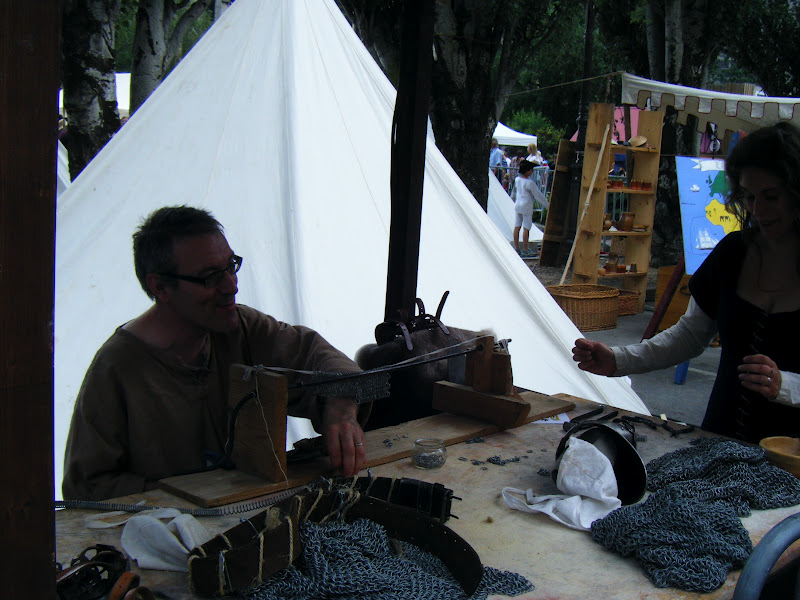
Making chain mail...
Over the centuries the symbolic image of Joan of Arc has given rise to numerous works of art and most French towns have large statues, sculptures and paintings in her honour. One the works that I have seen, I prefer that of the Place des Pyramides, near the Louvre, in Paris. 
Herding up the straying locals...
Commissioned by the government on France’s defeat in the Franco-Prussian war in 1870, the statue reigns over the traffic today, but initially commemorated Joan’s brave attempt to take Paris. I always think of this work as typically Parisian but in fact other versions of Frémiet’s statue can be seen in Nancy (France), Philadelphia, Portland and Melbourne – the latter being the less resplendent simply because it isn’t golden!
Of course, Reims has its own statue of Joan of Arc, situated just in front of the cathedral, but whilst she brandishes her sword bravely, her face does not seem to reflect the same bravura and determination as Frémiet’s Jeanne. Not only that, but her sword has fallen victim to acts of vandalism on several occasions, this year included…
Jeanne d'Arc - Parvis de la Cathédrale - Reims (sword still intact, but not for long..)
Well the sun has finally come out, and I hope it will do so next year when I fully intend to see the Grand Cortège des Sacres on the Sunday, camera in hand, surrounded by all kinds of Medieval and modern-day magic.
Display of hunting birds - Place du Forum - Reims
 It’s not everyday that you can see vultures, eagles and owls flying around the square in front of your local baker’s shop! Or be overtaken by a procession of camels and yaks on your way home after a busy day of festivities!

The yaks lead the way home...
 And no one could possibly forget the haughty expression of those camels!
A snooty beast 'parked' behind the cathedral - I just love that regal sneer!

Saturday, June 9, 2012

Silver Clouds... and an Appalachian Spring


I used to like looking out at the sea with its vast expanse of water, only broken by the waves crashing onto the rocks or rushing up the shore. Whatever the event passing over my life, like currents of water that bowl you over, these temporary waves in my existence always seemed very insignificant in comparison to the power and volume of the sea itself. The magic of this enormous force makes me think of the following music by Aaron Copland - Appalachian Spring...


Now very far from any coastline, I realised the other day that the sky with its billowing cloud formations and luminosity can have the same effect. The huge expanse of silver grey can be just breathtaking - and yet so neglected!
I taught my daughter the expression "Every cloud has a silver lining" this week - I didn't realise the saying was so literal!

Wednesday, May 23, 2012

Seraphine of Senlis at the Maillol...

Sculpture by Maillol, Musée Maillol Paris.


Several years ago, in 2008, there was an exhibition at the Musée Maillol Paris of the Primitive art works of Seraphine of Senlis. This coincided with the 2008  film Seraphine which traced her discovery as an artist by art collector, Wilhelm Uhde.


I missed both of these at the time, although I have since seen the film and went to see the collection of Seraphine's paintings at the Maillol this weekend.


I covered much of what I have understood of her life and art in my post Seraphine of Senlis. This time I just wanted to get a closer look at the paintings exhibited in order to see the brushstrokes and details of her work.
Most of the work on display is from the period 1920-1930, a time just after the First World War during which Seraphine had not yet been re-united with Uhde.

Pommes aux feuilles 1928-30
These apples actually do look more like ripe tomatoes, especially with the crackled effect that perhaps came as a result of ageing due to the composition of the paint materials used. Seraphine used her own 'secret' ingredients to create concoctions that are still not fully understood today.

These look so ripe you can almost sense the skin splitting...


The richness and density of paint application in some parts is contrasted by that in other areas where the canvas is visible below a thin layer of colour.


The vivid colours are set in contrast with pitch black, in turn offset by bright white paint strokes.


Many of the flower paintings (flowers and plants made up the vast majority of her work) seem to burst from a base in the lower part of her art work. This pattern seems to repeat itself even when trees, bushes and other hybrid plants are portrayed. A whirling mass of foliage rises upwards from a darker zone on the canvas, leading our eyes up towards the bright colours at the top of each work. These two areas are often delineated by a horizontal band that divides the painting.


Here a flurry of leaves lead up to a bright blue 'sky', and while the main tone of the mass of foliage appears in tones of autumnal brown, in detail each leaf bears jewel-like marks.


Other paintings seem to be wholly based on this bejewelled aspect.

Feuilles diaprées sur fond bleu  - 1929.
With their intricate beading and dashes these remind me of Aboriginal art...


Even the paintings which seem to be more traditional in their floral composition have exotic leaves and foliage that bear little resemblance with reality.

Bouquet de fleurs sur fond rouge - 1925-30     

These daisy-like flowers dazzle on the canvas.


Other flowers look feathery and billow across the canvas....leading me to wonder which way the painting should be hanging!

Marguerites - 1925


I prefer the wilder flowers in the later works because of their exuberance and force. Here strange forms are emphasized by tendrils that seem to furrow out from amongst the leaves and crawl like caterpillars.


The grapes here sprout out from bizarre vines. Thick leaves, like those of cabbage plants break out from a structure that looks like a palm trunk.


The paint composition seems to be less dense on this painting so that we can see the overlapping effect as leaves and stems cover each other.


The tendrils at the end of branches and buds add extra vitality to this painting.


The following painting, with its bright, irridescent colours and density looks like a stained-glass window. The blue set off against the orange creates such a vivid effect which the white buds seem to accentuate even further.


 The tiny touches of yellow and blue sparkle from these flowers, whilst the differing angles of the flowers give the painting a strange movement or animation.


As ever, on the right-hand side of her works is Seraphine's signature - S. Louis -that of the artist who rightly described herself as "Sans rivale".

All these paintings are at the Musée Maillol in Paris, waiting to be seen in the flesh which has to better than looking at the photos.

Musée Maillol:
  • 59-61 rue de Grenelle
    75007 Paris
    Tel : 01.42.22.59.58
  • Métro :
    Rue du Bac
  • Opening hours :From 11h to 18h,everyday except Tuesday.

 My favourite Seraphine work is however at the museum at Senlis - The Tree of Life.


Thursday, May 17, 2012

Fire and Rain... Unleashing my inner witch.


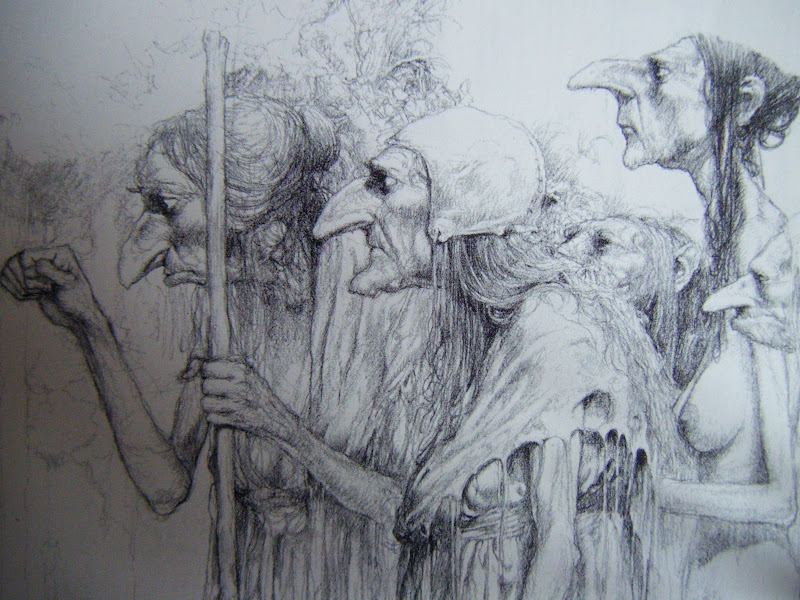
Transported thoughts... (From FAERIES by Brian Froud and Alan Lee- Pan Books - 1978)
 A wedding will take place tomorrow. Not surprisingly, I’m not included on the guest list but my thoughts will be wending their way to the veritable castle that will act as backdrop to this age-old fairy tale set-up. 

Spying... (From FAERIES...)
Part of me would like to be a voyeuristic fly on the wall, but I shall just content myself by playing the time-honoured role of the uninvited witch, in my head. However, the wish I would make for the couple in question is actually being realized – that they should live together forever after.

Third time lucky, after all...

The Three Witches... Ex-wives PAST, PRESENT AND FUTURE .(FAERIES...)
 Whenever I hear the below record, Fire and Rain by James Taylor, I just feel its beauty and no longer take it as a litany to “see me through another day”. People may change so much that you never see them again; they are beyond recognition, out of reach and have simply gone – out of your life but also away from all that had seemed to make up theirs. 


Worse still, the change is so radical that you don’t even want to acknowledge or see the person they have become, and in their eyes you are just a dead weight from the past. Then the one 'left behind' finally has to change in turn, passing through all the related emotional states and getting bogged down and stuck fast in certain ones! You oughta know.... However, this long drawn-out baptism of fire leads you onward towards the things that really do count in the present so it must be beneficial ultimately. You learn.

                  Just yesterday morning they let me know you were gone,
                  Susanne the plans they made put an end to you.
                  I walked out this morning and I wrote down this song,
                  I just can't remember who to send it to.

                 I've seen fire and I've seen rain,
                 I've seen sunny days that I thought would never end.
                 I've seen lonely times when I could not find a friend,
                 But I always thought that I'd see you again.

                 Won't you look down upon me, Jesus,
                 You've got to help me make a stand.
                 You've just got to see me through another day.
                 My body's aching and my time is at hand,
                 And I won't make it any other way.

                 Oh, I've seen fire and I've seen rain,
                 I've seen sunny days that I thought would never end.
                 I've seen lonely times when I could not find a friend,
                 But I always thought that I'd see you again.

                 Been walking my mind to an easy time my back turned towards the sun,
                 Lord knows when the cold wind blows it'll turn your head around.
                 Well, there's hours of time on the telephone line to talk about things to come,
                 Sweet dreams and flying machines in pieces on the ground.

                 Oh, I've seen fire and I've seen rain,
                 I've seen sunny days that I thought would never end.
                 I've seen lonely times when I could not find a friend,
                 But I always thought that I'd see you, baby, one more time again, now.

                 Thought I'd see you one more time again,
                 There's just a few things coming my way this time around, now.
                 Thought I'd see you, thought I'd see you fire and rain, now.

As for fairy-tales endings; no one remains spellbound for eternity. 
And now I shall return my inner witch to its rightful place....

FAERIES - Published by Pan 1978

Wednesday, May 16, 2012

Time in a Bottle - Blog Birthday....


I started writing this blog two years ago today. I wanted to track and leave a trace of all the things that had caught my eye or imagination in the past and present so that they would remain even after everything else had moved on. It felt like a means of keeping things preserved in a bottle, one floating in space and time, buffeted around and weathered by the elements but still the same in content. It was meant to be personal because I intended it to reflect the things that had caught my attention, but not an account of my personal life – with all its dull meanderings and often very pedestrian preoccupations that seem to take me away from what gives my life extra meaning and substance. So I suppose it has become a form of scrapbook, but it has itself led me along different paths of interests which I have enjoyed, as one path seems to open out onto other paths. I can’t imagine ever having nothing whatsoever to look at and wonder over! Having a blog finally gave me a concrete reason to work out how to use a digital camera on a basic level and to want to take photos!

Writing a post seems to be like sending out a cyber soap bubble, or feathery dandelion seed that parachutes off into the unknown, carried off in the currents around the planet. However, although they fly off they’re still present on my computer screen in this strange process – they remain personal and yet totally impersonal in their dispersal. I do wish that mine had met with some reaction; they all seem to meet a great resounding silence. Well, I suppose that means I can just carry on as ever, in my own private soap bubble, blowing on dandelion clocks! 

So, from a personal level it’s been enriching and quite indulgent too – just focusing on the things that I like, and excluding the rest which monopolize normal life. In addition, that’s without mentioning all the beautiful blogs that I’ve come across along the way, giving inspiration and ideas and opening up my eyes and changing my view of the world around me, beyond my daily routines and concerns! 

So, this is another dandelion seed to add to the collection. Apparently if you succeed in blowing away all the seeds at once from a dandelion head, any wish you make will be granted. A few remaining seeds means that you will have to wait before fulfillment – so I’d recommend just getting another dandelion clock until you get satisfaction! 


 Below is a clip of Jim Croce’s song Time in a Bottle (1972). He wrote it for his son, the little boy who features in the video. Shortly after the video was filmed, aged only thirty, Croce died in a tragic plane crash and so never actually saw his child grow up to become a singer too.
 The music is already moving, but put in that context, it is all the more so… 

Tuesday, May 8, 2012

Les Lilas et Les Roses...


Darker lilac
 O mois des floraisons mois des métamorphoses
Mai qui fut sans nuage et Juin poignardé
Je n’oublierai jamais les lilas ni les roses
Ni ceux que le printemps dans les plis a gardés

Je n’oublierai jamais l’illusion tragique
Le cortège les cris la foule et le soleil
Les chars chargés d’amour les dons de la Belgique
L’air qui tremble et la route à ce bourdon d’abeilles
Le triomphe imprudent qui prime la querelle
Le sang que préfigure en carmin le baiser
Et ceux qui vont mourir debout dans les tourelles
Entourés de lilas par un peuple grisé

Je n’oublierai jamais les jardins de la France
Semblables aux missels des siècles disparus
Ni le trouble des soirs l’énigme du silence
Les roses tout le long du chemin parcouru
Le démenti des fleurs au vent de la panique
Aux soldats qui passaient sur l’aile de la peur
Aux vélos délirants aux canons ironiques
Au pitoyable accoutrement des faux campeurs

Mais je ne sais pourquoi ce tourbillon d’images
Me ramène toujours au même point d’arrêt
A Sainte-Marthe Un général De noirs ramages
Une villa normande au bord de la forêt
Tout se tait L’ennemi dans l’ombre se repose
On nous a dit ce soir que Paris s’est rendu
Je n’oublierai jamais les lilas ni les roses
Et ni les deux amours que nous avons perdus

Bouquets du premier jour lilas lilas des Flandres
Douceur de l’ombre dont la mort farde les joues
Et vous bouquets de la retraite roses tendres
Couleur de l’incendie au loin roses d’Anjou


Louis Aragon, Le Crève-coeur, 1941


Les Lilas et Les Roses was written by Louis Aragon (1897-1982) to recount the trauma of war that France experienced following the Blitzkrieg advance of the German army in May and June 1940.

 Having crossed the neutral zones of Holland, Belgium and Luxemburg with lightening speed and brute force, within five weeks the Wehrmacht arrived on France soil via Flanders and Sedan.
Charles de Gaulle who organised the Free French Forces from England.
Thousands of citizens were desperate to flee the advancing German army and the Exode was set in motion, as panic-striken inhabitants of towns and cities took to the road to find safer territory. One quarter of the French population fled, giving rise to chaotic, horrific scenes as hordes of people tried to escape yet were blocked in by the sheer volume of human traffic and fell easy prey to the brutal aerial attacks of the Stuka bombers. In the space of a week Paris was largely emptied, by mid-June the French flag had been confiscated as France fell to the Occupying forces. 

In Aragon’s poem the imagery of flowers, and the gardens of eternal France are quickly torn apart by ironic references to the brutality of this hellish spring, this lightning war. 

Pale lilac
 I hadn’t really been thinking of this war poem this morning, the 8th of May, which marks the end of the Second World War, but when my daughter pointed out the lilac growing in the park I remembered it again.

It was actually in Reims that the first Instrument of Surrender was signed on the 7th of the month in 1945, although this was not announced until another had been signed the following day in Berlin.


 As a result we ended up watching the film that I always associate with this period and the poem; Les Jeux Interdits. I still can’t watch this without crying, as even the music sets it off, and this time there wasn’t a dry eye in the house!