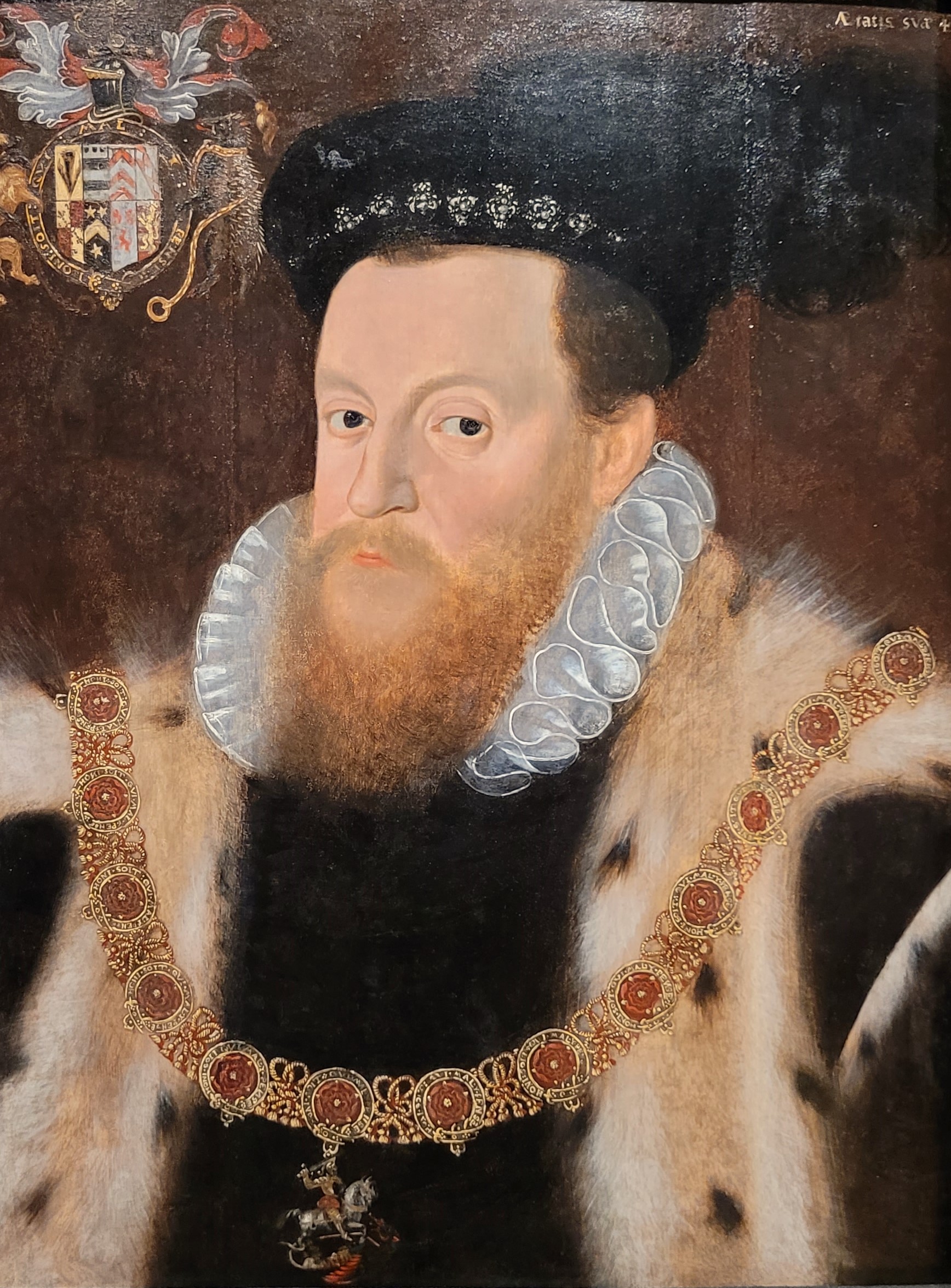
There is something absolutely mesmerising about the portraits from the extensive
Tudor period (1485 - 1603) which of course includes the Elisabethan era, with such magnificent works as the one above (detail of 1575 painting of Queen Elisabeth I by unknown artist). Many of these can, of course, be seen at the
National Portrait Gallery in London and during a recent visit, I tried to identify their unique appeal. However it is rather difficult to define a common trait in such varied works that extended over a hundred years in English history, and evolved accordingly but I would say it is their peculiar proximity to us which intrigues us as these individuals stare out from a set period in time yet reach out to us in a more universal, timeless way.

Certainly, the intricate rendering of their lavish attire catches the viewer's attention, leading us to peer at the work, picking out and pouring over all the breathtaking details, like crazed magpies. Above is Queen Elisabeth's last 'favourite'courtier, Robert Devereux (1565-1601) who was said to have a nature 'not to be ruled'. Looking at his portrait executed by an unknown artist in the style of Marcus Gheerhaerts in the early 17th century, his placid, frank expression, soft boyish features and elegant appearance belie the fact that he paid for this defiant attitude dearly, with his own life. He looks right at us in rather an unsettling way due to his frank gaze, likewise Philip Sidney (1554 - 1586) - another of Elisabeth's courtiers - as he stares out at us unquestioningly, appearing to wipe out the odd 430 years since his death.

And although this portraiture was very much a product of its time and historical context, in its essence it has a unique ability to connect with us, across a span of several hundred years, perhaps in the same way that we can identify with certain universal human traits explored in Shakespeare's writings.

Above is Henry VII, the Lancastrian king (1457-1509) who united the two rival Houses of Lancaster and York of the Plantagenet dynasty through his marriage to Elisabeth of York in 1486, having himself defeated Richard III in the Battle of Bosworth in 1485. There is some debate into the accuracy of the legend of Henry acquiring his rival's crown on the battlefield but either way, as a result the Tudor dynasty was born. This is one of the earliest paintings on display, but is highly effective. Looking at the 1505 portrait, we can literally feel the determination of the first Tudor monarch to hold onto his newly-established position - his hands emerge from the portrait as he grips the symbolic flower that represents the end of the Wars of the Roses. No jewelled rings distract our attention, as the king stares at us directly, seemingly to defy anyone who should question his right to the throne. Compare to that the following portrait of the maligned Richard III, painted some time after his death in 1485... Here he is seen fiddling with his ringed finger, his brow furrowed in an expression of concern whilst his eyes avoid contact with the public, creating a rather shifty impression that seems to prove Henry VII's greater suitability and apparent superiority as monarch.

Although the artist of Henry's portrait is unknown, its approach is in keeping with a the style and role of the genre which had already started to flourish in the latter half of the 15th century. Indeed, Henry's image was destined to be sent to Margaret of Austria in 1505, when diplomatic negotiations were to take place to find the widowed king a new wife. For the Royal portrait served a serious role, beyond mere decorative purposes, it was a tool for portraying the individual as the personification of power and integrity, thus managing and maintaining regal status. In a similar manner, portable portraits could be exchanged between sovereigns in the process of sealing a treaty or forming an alliance. Below is Queen Mary (1516-1568) by Hans Eworth (cerca 1554) in a portrait thought to be used in marriage negotiations with Philip II of Spain. She appears curiously girl-like here for a 37-year-old and holds a rather modern-day position with her back slightly arched back as she stares at us with an enigmatic expression. Either way, the portrait seems to have served its purpose and it certainly did the trick, for Mary and Philip married in 1554!

Many of the Tudor paintings were commissioned from foreign artists, for the most part from Germany or the Netherlands. The direct representation of the static individual executed with highly realistic detail - as opposed to a narrative work with acts and gestures to be 'read' - suited the function of the portrait. The focus is essentially on the figure in all his/her finery, often set against a dark, relatively simple background that does not detract from the key element; the subject as a person and not as an actor, playing out some theme. Below is William Cecil (1520-98), Queen Elisabeth's advisor as Secretary of State, an oil painting again by an unknown artist in 1570. Here is a fine figure of authority indeed - just on appearances alone - and there is no avoiding that intimidating stare!

Although Tudor portraiture bears many symbolic references through the strategic use of material objects - clothes, headwear, jewels etc - its approach is relatively simple and can literally be taken at face value. This could perhaps account for it being so greatly appreciated today; we do not need to fully understand the symbols to enjoy the work on a more basic level.
How could we not be stunned by the exquisite renditions of fine clothing made of damask, brocade, silk, satin and embellished with fur, feathers, lace and jewels as in the portrait of Queen Elisabeth (1575) above by Nicholas Hilliard? How could we not be amazed by the intricate, yet surely cumbersome and uncomfortable ruffs and cuffs that adorned necks and sleeves of the most powerful beings in society?

Above is a representation of Elisabeth on her coronation day in 1559 at the age of 25. She appears somewhat doll-like, with her frozen expression, a young almost naive face staring ahead, whilst wooden arms and hands clasp the orb and spectre. Yet her piercing eyes defy us to question her; she forces us to acknowledge her in an uncanny manner. The use of a stark figure depicted as if on centre stage, with minimal props and no cast members to draw attention away, is rather reminiscent of icon painting, with a 'flattened aspect'. Certainly the Northern European portraiture which largely led the genre had its roots in Gothic traditions of painting and manuscript illumination, using the oil paint medium to great effect with realism and illusionism in jewel-like colours. However, until the influence of the Italian Renaissance, with its use of perspective and anatomical study, such portraits tend to lack accuracy, giving the sitter a certain unwieldiness.

If we look at the representation above of Lady Jane Grey (1537 - 1554) painted at the end of the 16th century by an unknown artist with that of Mary, Queen of Scots (1452-1487) below, by an unknown artist after a piece by the great English portraitist, Nicholas Hilliard (1547-1619), in the same time frame, the difference is manifest...
The detailed altarpieces and church panel paintings created in the Burgundian and Habsburg Netherlands from the early 15th century were the keystone of the Northern Renaissance. The influence of artists such as Jan van Eyck (cf
Arnolfini Portrait 1434) was incredibly significant, long-lasting and far-reaching. Unlike the Italian Renaissance that drew inspiration from the classical aesthetics of ancient Greece and Rome to create harmonious and idealized forms from mythology painted in the tempera medium, the Northern countries represented the divine in realistic images of daily life in versatile oil paint. Below is Robert Dudley (unknown artist - 1575), one of Queen Elisabeth's favourite courtiers, who himself went on to commission several portraits; his self-confidence and pride are evident here!

When the Reformation swept across Europe at the beginning of the 16th century, the theological divide that emerged between Roman Catholics and Protestants lead to a North-South split in Europe. As the Northern countries followed Protestant theology, they shied away from religious painting for fear of being accused of sinful devotion of idols. Thus they then moved towards a secular approach with historical paintings, landscapes, still life and more importantly, portraiture.

In the portrait above, from 1568, of a leading courtier to Elisabeth, realised by Anthonis Mor - court artist to Philip II in Spain - there are symbolic references to bonds of loyalty with his ring and patterns on his shirt yet no references to biblical themes. Yet the Tudor period was dominated by religious rift as Renaissance humanism and above all the Protestant movement spurned the excesses of Catholic religious practices and the extremes of Papal authority in Rome. When Henry VIII's wish for the annulment of his marriage to Catherine of Aragon was denied, his fury and frustration at his inability to marry Anne Boleyn led to the English Reformation and the establishment of the Church of England, free of Papal authority, with Henry as Supreme Head.
Henry enjoyed unprecedented authority and occupied an unparalleled position, and this power and majesty is fully reflected in Hans Holbein's preparatory drawings for a work from around 1537, showing the king in a dominant pose, legs astride.

To portray his supremacy, Henry required a painter worthy of the task and indeed, the German artist Hans Holbein the Younger (1497 - 1543) was appointed the official King's Painter. Having trained under his artist father, and studied the work of the Italian Renaissance painters Leonardo da Vinci and Andrea Mantegna in Italy, by the time he came to England in 1526, he possessed unmatched skills and sophistication in technique and artistic approach. No English artist could compare, and his art would influence the entire Tudor era and well beyond. Just a glance at any of his work shows how far advanced he was in comparison to his contemporaries... Here is a copy of his 1527 portrait of William Warham (1450 - 1532) - Archbishop of Canterbury - painted by an unknown artist. Warham was one of Holbein's first patrons and by the 1530's, the artist was the most sought-after portraitist amongst English nobility.

Unfortunately, it was Holbein's beautifully executed portrait of Anne of Cleves (1539), that played a key role in Henry VIII's decision to marry the apparently eligible young German woman. Desperate to secure the Tudor dynasty by siring a heir, Henry wished to take on a fourth wife following the death of the queen, Jane Seymour. Judging Anne's suitability on the portrait presented to him, Henry agreed to go ahead with the marriage yet to his great dismay, reality did not meet the expectations the portrait had led him to nurture; after six months the marriage was declared unconsummated...
Despite being supposedly Protestant, under the Divine Right of Kings, the Church of England and Henry's kingdom followed certain Catholic doctrines when it suited his political and personal interests. Religion was synonymous with politics and the power struggles therein and the rest of the Tudor years would see the kingdom torn between the different faiths.

The striking figure above is Mary I, the first queen to rule England - born from Henry VIII's marriage to Catherine of Aragon. Known as Bloody Mary, she instigated a reign of terror, calling for the persecution of all heretics - Protestants - in an attempt to bring back Roman Catholicism to England, following the reign of her Protestant half-brother, Edward VI. Although the portrait dates from the end of the 16th century, its style is relatively stark - simplistic even - and devoid of excess detail, if compared to Holbein's work of some 50 years earlier. A certain severity is clearly visible in Mary's expression, and with her eyes averted and her jawline clenched, she appears disciplined and determined...
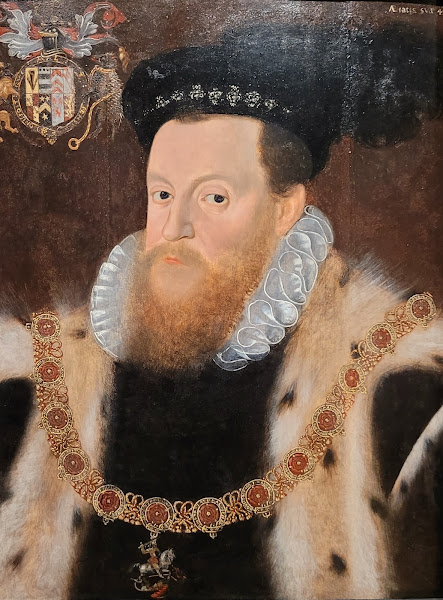
A similar dour note can be seen in the portrait of Sir Henry Sidney (1529 - 1586) by George Gower in 1585. As Lord Deputy of Ireland, he oversaw the implementation of English law on Irish soil. The rich fur-trimmed gown, heavy livery collar and intricately pleated ruff are offset by an oblique stare that could turn milk and a down-turned mouth, lips pursed in disapproval!
Sovereign rule over the oceans and foreign territories was essential to Elisabeth 1's reign and was reflected in visual references that serve as backcloth to late Tudor portraits. Above is the Elisabethan explorer and privateer, Sir Francis Drake (1540 - 1596), who circumnavigated the world in 1577-1580 and here places a firm hand on a globe, and stares at us a little defiantly.

In the so-called 'Ditchley' portrait of the Virgin Queen (1592)by Marcus Gheeraerts the Younger , Elisabeth is shown in all her finery, standing on the top of a globe, a map of her kingdom beneath her feet, as she turns her back on the thunderclouds gathered in the background, facing us and the brighter skies ahead. Again, the portrait's odd anatomical representation of the queen's body, with its strangely elongated arms, curious little hands and feet sticking out from the voluminous gown makes this work appear world's apart from the mastery of Holbein. Yet the little eyes are there, beadily watching out at us... Later, miniature portraits would become highly popular in courtly rituals and in this field of artistry, Nicholas Hilliard excelled, creating tiny paintings of perfection such as this one of Elisabeth...