Far from the beach, but still surrounded by treasure of all kinds just ready to be found, looked at, gloated over, gleaned and swiped or simply created! Here are my latest finds....
Saturday, September 30, 2023
Glorious Georgian Gowns...
In the summer, I eagerly queued up to visit the exhibition at The Queen's Gallery, Buckingham Palace; Style and Society: Dressing the Georgians. Looking at the exhibition poster (sadly not on sale), I thought how well the painting by the British School - St James's Park and the Mall - seemed to capture my perception of this period of history. In this work, an animated, joyous throng of individuals of all class and character goes about its social business in this grand setting, unperturbed by the presence of those from wildly different circles with whom they rub shoulders, almost literally. On the contrary, each being, however humble or illustrious their origin and demeanor, wishes to take part in this extraordinary living fresco, to exchange words, parade, preen, pose in public. Meantime, rather lacking in deference to the human counterparts they somehow seem to mirror are the dogs and cows that likewise occupy themselves and the centre stage with a certain insouciance. This strange combination of extremes, contrasts and likenesses is fascinating.
As I gazed at the exquisite clothing, jewellery and elegant footwear of the exhibition, I wondered how articles and artifacts of such intricate beauty and craftsmanship were made (and indeed worn) when the means to do so were limited, relatively speaking, and lives were hard, with or without affluence to ease hardship. Supply was naturally buoyed up on a regiment of ill-paid and poorly-treated workers with deft fingers and so I suppose that the real question that I actually asked myself is what happened to our demand or desire for goods of comparable elegance and originality today, means permitting? I am frequently left choking in dismay and disbelief at the sight of today's vulgar, limited vestimentary selections, all variations of the same trends, coveted by all, regardless of status or wealth. Most of these seem to me dull and unoriginal and I am sadly unable to unsee the very worst modern-day monstrosities, visually fatigued by the sight of all these logos that are branded onto each individual to form a globalized uniform mass. Anyway, an antidote to all that dross clothing and footware were above all these incredible gowns.
Having already seen samples of silk designed and woven in the silk-weavers’ district in Spitalfields, East London, it was marvelous to see more types of garment this was used for in the 18th century. Created at a time when precious fabrics were more valuable than finished gowns, sadly few of these gowns have survived to the present day in their initial state. Many were indeed taken apart, the silk recovered to create further dresses in line with changing fashions over the decades, whilst others with their brocade, taffeta, glossy lustring and damask were used in home furnishing and upholstering. Peering through the display cabinet, I had the impression that the decoration of the fabric was due to embroidered motifs but in fact it was simply down to the rich working of the silk. The delicate botanical patterns and floral details, so characteristic of Spitalfields work, were one of the specialities of Anna Maria Garthwaite, who was a pioneering female textile designer, producing silks from the 1720s. until her death in 1763.
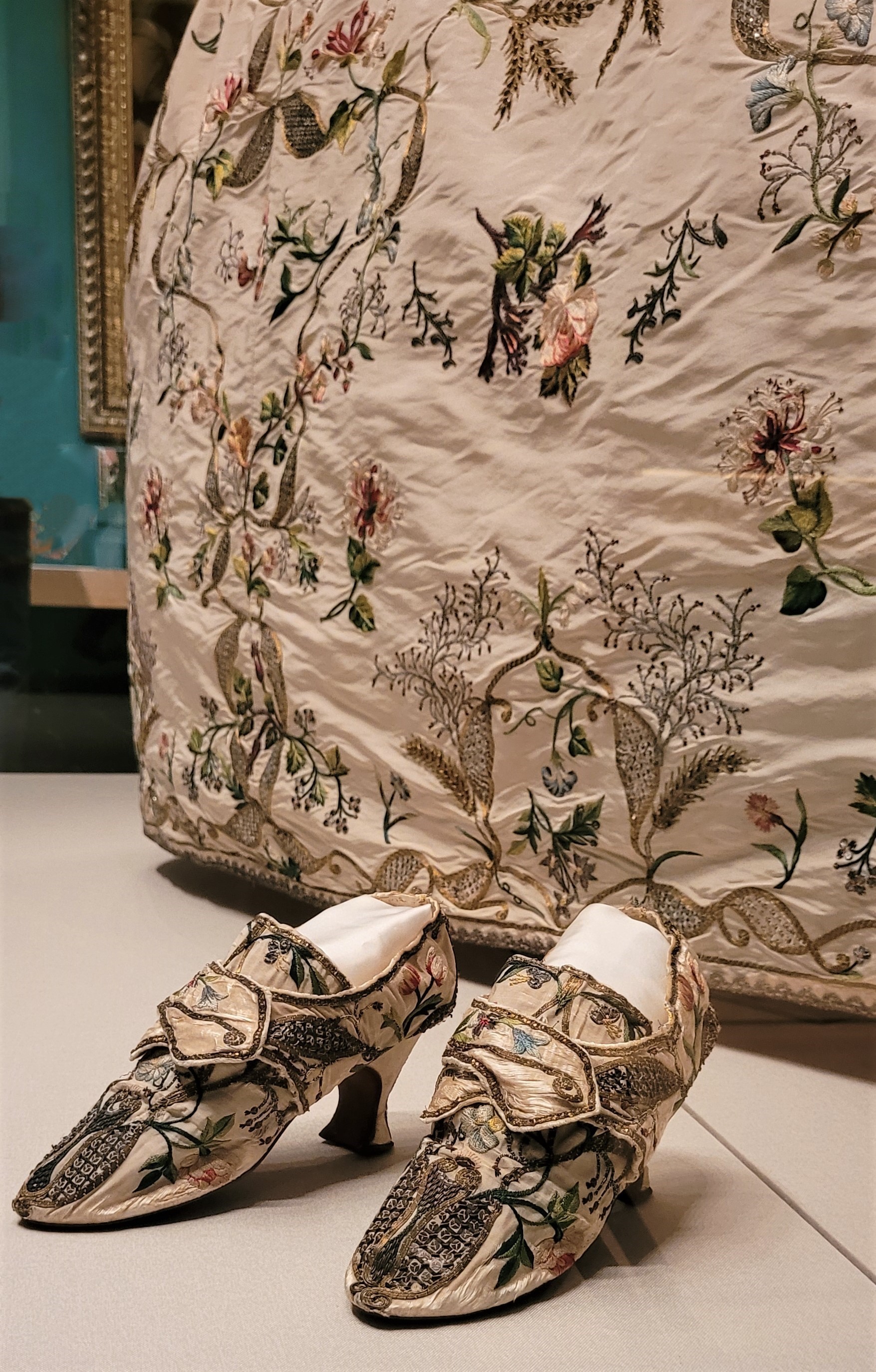
By their very composition and design, these grand ‘statement’ clothes were a powerful reflection of the wearer’s social status, affluence and aesthetic taste. They were worn to enable the privileged woman in question to set herself apart from the others, all likewise vying for the centre stage through the sheer size and splendour of their attire. The stunning piece in the Queen’s Gallery was the magnificent Mantua dress with its intricate floral details displayed across the vast dimensions of this dress unlike any other! With its incredible volume and the perfection of its details, down to the dainty silk slipper shoes that accompany it, this gown is simply spectacular. Possibly named after the Italian city of Mantova, renowned for its silk production, or in reference to the French manteau, the mantua gown represented a significant move away from the restrictive bodice that was a key element in the grands habits in court until around 1670. Indeed, this new form of dress towards the end of the 17th century was in fact more like a coat with its fabric draped and pleated to display the silk and numerous trimmings to their full advantage. Unlike typical formal garments that required careful structuring, the mantua, with its loose coat-like form was cut from one piece of fabric alone with a visible separate petticoat.
In many respects, the mantua was a variation of the banyan worn by men as a form of 'undress'; casual wear. Pleats hung from the shoulders and draped material was bundled up to form a bustle at the back of the gown. Initially, the informal nature of such garments met with disapproval; they could not be worn in the royal courts. Gradually, however, the mantua gown came to be accepted as its style evolved. Indeed, the pleated material at the front of the gown was decreased in size to form robings, and the bodice was opened to insert a stomacher – a richly decorated panel in an inverted triangular shape that gave a more elegant form to the whole. The stomacher was pinned onto the stays beneath the bodice and the robings on each side. The considerable size of the dresses and the fact that the stomacher was not sewn in but merely secured by pins meant that achieving unhampered, pain-free movement must have been quite a feat for the wearer! Not only was the unstructured mantua gown revolutionary for such women, it also radically changed the lot of many female seamstresses (known as mantua-makers) who were able to undertake the sewing of such garments, at a time when tailoring was the domain of men alone. It should perhaps be remembered that all sewing (and indeed tailoring) was performed by hand since no sewing machine would exist until the end of the 18th century..
With time, the mantua gave way to the sack-back gown that was imported from France. Although not as wide as the mantua, this robe à la française was initally voluminous with long box pleats on the back of the neck that led to a train which was obligatory in court. These were famously captured in the paintings of Watteau, hence the name commonly applied to refer to them; Watteau pleats. Gradually these pleats grew narrower and tighter whilst great importance was attached to the trimmings and embellishments of the robe.
Flounces, falbellas or furbelows and fly braiding– were sewn on the front of the dress, and likewise lace, bows and embroidery would decorate the robe or the visible petticoat below. To the long robings at the front of the robe were attached ornate quilles. Similarly, to the elbow-length sleeves would be sewn 3 tiers of scalloped ruffles and separate frills with separate lace cuff details – known as engageantes. Naturally, a pannier or hoops would be worn below the robe to provide characteristic form and volume. Of course, as with the mantua, the effect was stunning but as the Neo-classical movement began to take precedence in the latter part of the 18th century, the sack-back went out of fashion as waistlines grew higher, hoops and stays were discarded and therefore the full, highly decorated robes lost their popularity.
Strange Fruit and Faces...
Autumn again, not that you would truly notice that the seasons had changed if you based your impressions solely on the astoundingly high temperatures that are actually quite alarming. Nevertheless, the leaves are slowly starting to turn and will surely begin to fall in the days to come.
Meanwhile, with a more predictable and reassuring regularity, the ornamental gourds have made their appearance. Known as coloquintes here, these are striking for their vivid, contrasting colours but above all their curiously textured forms and extraordinary shapes. Almost as if Nature were amusing itself, strange horned growths, speckled ridges and weirdly irregular blisters emerge from otherwise smooth surfaces.
Wondering if these could be described as beautiful or somewhat ugly, or rather a mixture of the two, I remembered the unsettling, unparalleled portraits of Italian artist, Guiseppe Arcimboldo (1526 – 1593).
Known for his symbolical paintings of heads, composed largely of flora, flauna and of course vegetables, he created work that specialized in the grotesque presented with great beauty and detail; the inversion of aesthetic norms.
It seems odd that he should have been court portraitist under the Habsburgs but his ability to link nature and mankind, whilst highlighting the emperor’s power over all, surely gained him respect and a unique reputation. Naturally, this same obsessive fascination with the human form composed of elements from the natural world has also led to questions over his sanity ever since, but ultimately that makes his art even more enigmatic.
Sunday, September 17, 2023
Pansies, Pensées; A Penny for Your Thoughts...
The jaunty pansies are out for the harvest season and their strangely cheerful faces never fail to brighten up any mood, chasing away shadows and troublesome thoughts with their delicate simplicity...
The warm, sugary colours here look like something from a pâtisserie window, gently guiding us away from the overbearing (and unbearable) heat and blazing sunshine over the last weeks towards a more autumnal period.
The rounded flowers, gently ruffled, offer up their petals with veins leading to the mysterious depth of the head, or perhaps on the contrary these etched lines burst out from the golden centre, like ink bleeding across wet paper...
Peering up close, a white fringed border is visible just above the heart of each head - the stamen - like a whiskery moustache... Although the pansy does not strike us as a highly-scented flower, its perfume is discrete yet evident when the plants are grouped together and the scent of violet can clearly be picked up.
In French, the pansy is la pensée, and so what are my thoughts on this Sunday evening? My penny's worth; if only the weekend could stretch itself out longer and the working week postponed, but that's life, I suppose!
And finally, one of my favourite pansy paintings; part of one of Louis Wain's cat portraits...
Monday, August 21, 2023
Open Door to the Past...
As I was walking along my street, I peered into the doorway of one of the impressive late 19th century buildings that has long been carved up into student lets. Just by chance, the door had been left open, offering a glimpse of an unexpected fragment of the past. Given the style of architecture, this must be one of the very few edifices to have survived the assault on the city in the Great War of 1914-1918.
Although still beautiful, albeit with facade tarnished with urban grime and graffiti, the whole has naturally lost some of its former grandeur over the decades. I was taken aback to see just how elegant the hallway was, with the figure newel post at the end of the staircase, the decorative wood panelling and the tiled floor.
I wonder who lived here when the property was its prime. In what manner was it divided up when first built? Were there separate appartments on each floor or was this a vast family town house? Not sure how to arrive at any answers, but I do wish that I had the ability to write a book about the (imagined) past lives of this building and those who inhabited it before it was all given over to today's transcient tenancy which cloaks everything with anonymity and a certain indifference.
Cemetery in Heavenly Sun...
Climbing up a series of steep steps from the centre of St Etienne towards the perpendicular, aptly named Rue de L'Eternité, I finally arrived at Cimetière du Crêt-de-Roc. Whilst in my mind cemeteries are usually synonymous with rather shrouded, secluded areas of town, surrounded by trees and generally secured by imposing walls, this site was somewhat different.
Firstly, the sunlight was radiant, throwing bright beams across the greenery and in between the monuments and headstones in a magical way, blazing on the stonework. Meanwhile, the searing midday heat grew in intensity as I meandered along the pathways without any particular direction, just intent on discovering the beauty of what is known locally as Le Père-Lachaise stéphanois.
What is immediately striking here is this dramatic geographical position; high above the hustle and bustle of the city below, yet surrounded too by mountains in the distance, creating an impression of exposure yet protection.
Row upon row of tombstones of varied size and stature crisscross the flanks of the hill side, and I loved wandering around the oldest of these...
The grounds were enlarged several times following the consecration and inauguration of the site in 1819 and indeed some of the older plots are squeezed together...
Looking at the detailed sculpture and inscribed names led me, as always, to wonder who these individuals were, what kind of life they lived. Many of the traditional symbolic features were included; shrouded urns...
Winged hourglasses, representing passing time and hence our mortality, clasped hands for reunion in eternity, upturned torches for life extinguished...
Naturally, angels towered over their charges...
Whilst mourning figures in their austere, draped clothing covered their grief-stricken faces...
Ivy cloaked itself across the monumental stonework, its bright green setting off the blazing blue skies above...
Even the deteriorated monuments seemed all the more mysterious...
And with their own grandeur and grace...
And even a certain elegance...
Some a little sad in their decline...
Others majestic...
And finally, a tantalizing glipse of the deceased in photographic image, their likenesses caught forever on stone, a 'modern' addition that reflects how this was indeed a mid-19th century cemetery.
Throughout a large part of my visit, I was honoured by the presence of a private guide who weaved himself between the graves, guardian of the peace and tranquility of the cemetery in heavenly sunlight!
Wednesday, August 16, 2023
Blazing Blue and Purple.... Larkspur.
The labels Larkspur and Delphinium are used interchangeably to describe the beautiful tall flowers that belong to the butterfly (Ranunculaceae) family.
The resemblance of the flower buds to a lark's claw or spur obviously gave rise to the former name back in Tudor times - and it is the same in French 'Pied d'alouette'.
Meanwhile for others, the flower buds brought to mind the shape of a dolphin - hence the Greek delphínion - Delphinium - and again the French equivalent; Dauphinelle. Whichever association made, and whatever name is used, the colours of the flowers are just magical whether they are soft pink, mauve or blue. No wonder this flower is a symbol of positivity and was used to ward off evil !
Friday, July 28, 2023
The Branwell family to the Brontës... from Penzance to Haworth
Unlike the granite-faced buildings that surround it, the Branwell home stands out, a little austere and rather enigmatic with its distinctive redbrick facade and imposing door. Such brickwork was indeed a sign of means and status in late 18th century Penzance, with these 'Rotterdam' bricks having been procured from the Dutch by local privateers.
Situated towards the end of Chapel Street, with a view over Penzance quay and Mount's Bay, and later to be overshadowed by St Mary's church built in 1835, the house would have witnessed great day-to-day activity and perhaps a number or illicit or illegal affairs such as smuggling. The house, however, reveals few secrets itself. It does not offer the same quaint charm or meet any of our modern-day notions of cosiness as the other houses here do, but that makes it all the more intriguing.
Set a little higher on the pavement, with steps leading up to the front door, it is impossible to peer inside, try as I might. Yet the plaque on the facade opened a door to a world of ideas and imagination from the moment I read Wuthering Heights as a young teenager. For here was the home of the Branwell family, notably Maria and Elizabeth who were to be mother and aunt respectively of Charlotte, Anne, Emily and Branwell Brontë. From this house would spring the future monumental works of English literature, in northern regions far away from south-west. What would have happened if Maria and her future husband, Patrick Brontë,had settled in Penzance and their children had taken to roaming its magnificent landscape and breathtaking coast instead of exploring the dramatic Yorkshire moorland around Haworth?
One thing is almost certain, without the nurturing administrations of Elizabeth - 'Aunt Branwell' - the publication of the literary works of the Brontë sisters would have been severely thwarted or perhaps never have taken place at all. Alongside the care and love she provided throughout their childhood years and beyond as 'second mother' to the orphaned children, Elizabeth Branwell offered financial support at a key moment, when none was to be found elsewhere.
In fact, much of the information concerning 'Aunt Branwell' comes from the book above that I found in Penzance this summer, and which enabled me to track down the other homes and sites linked to the Cornish relatives of the Brontës around the town. Although I was, of course, fully acquainted with many of these places as part and parcel of Penzance such as I have always known it, the notion that this was the case for the Branwells too is quite strange.
As popular pubs, my teenage memories of The Union Hotel, The Turk's Head Inn and The Admiral Benbow in Chapel Street surely differ greatly to those of Elizabeth Branwell, who would never have frequented such places in that capacity! However, their pasts are linked to historic moments such as the announcement of Nelson's death in 1805 for The Union and The Turk's and then a wild and racy role in smuggling in the case of The Benbow. The latter is even said to have inspired Robert Louis Stevenson in his writing of Treasure Island...
Born in 1776, Elizabeth grew up in certain comfort within a relatively prosperous merchant family that owned property. In the century prior to her birth, the fortune of Penzance had grown as had its population, largely due to its status as coinage town from the 1660s, thus playing a vital role in the copper and tin industry. Fishing and farming continued to flourish but it was the Industrial Revolution that would fuel the town's ascension. Sir Humphry Davy, Penzance chemist and inventor of the miners' safety lamp was born in the same period as Elizabeth and his experiments opened the way for the advances in chemistry and physics that would transform science. He attended the grammar school in the town, and I went to Humphry Davy Grammar School some two centuries later!
Socially aware of the lack of education and thus the means for moral and social betterment, Thomas Branwell, father to Elizabeth, set up a school room at the back of the family home in Chapel Street as a philanthropic act. Referred to as The Penny School due to its cheap rate, it offered local children education, alongside the Branwell children, several of whom would later teach there. Unfortunately the school was destroyed by a bomb in WW2...
Despite economic growth, no family was safe from hardship or loss and the Branwells were no exception, with the majority of their twelve children failing to survive their infant years. Thus the parish church of St Maddern in Madron was witness to a succession of christenings and subsequent deaths. Yet Jane, Elizabeth and Maria Branwell, born in 1773, 1776 and 1783 respectively, would go on to change literature indirectly by their fates, whilst the eldest daughter, Jane, would be the only Branwell offspring to perpetuate the family name.
Despite attending the church at Madron, the Branwells turned towards the Methodist Movement for prayer and not only were they involved in the establishment of the Wesleyan Methodist chapel in Chapel Street, but it was the family's Methodist faith that was instrumental in bringing Maria and Patrick Brontë together in Yorkshire. Incidently, the Girls Grammar School used to hold Speech Day at the chapel each year until the 1980s...
Following the marriage of Maria to Patrick in 1812, Elizabeth visited the couple in happy times that would prove to be relatively short-lived. Having borne six children between 1814 and 1820, Maria fell ill after the birth of the last child in 1820, Anne, and died of suspected uterine infection. And so it was that Elizabeth's stay at Haworth extended indefinitely so that she never returned to Penzance again. And yet her vital role in the development of her charges, with her far-reaching, albeit discreet influence, ensured that she lived on through the writings of her nieces with references to events, deeds and thoughts that found their source in 'Aunt Branwell'.
As for the elder sister of Elizabeth and Maria - Jane Branwell - following a failed marriage to a disgraced Methodist missionary, reverend John Kingston, she was obliged to flee to Penzance, living in Morrab Place with one of their children. Her husband remained in America with the other offspring who would prove to be the last remaining strains of the Branwell family.
Subscribe to:
Posts (Atom)