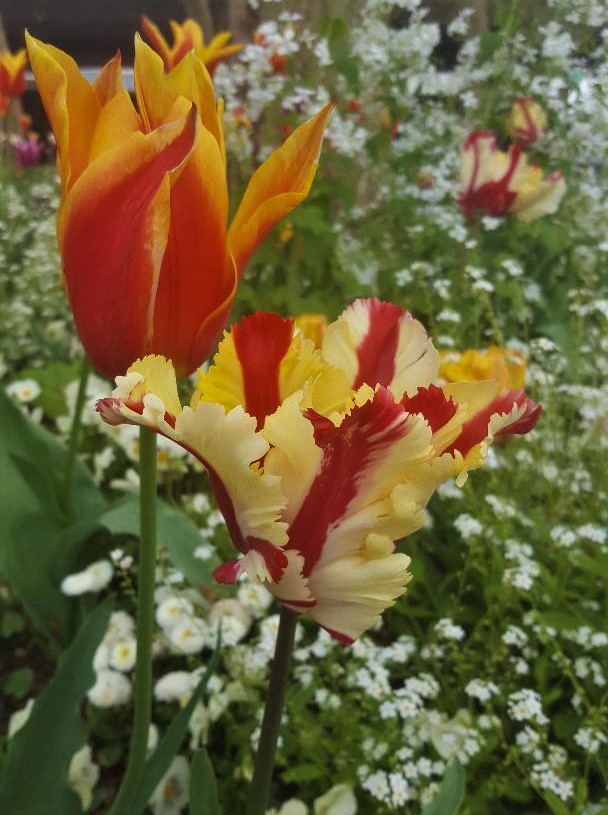
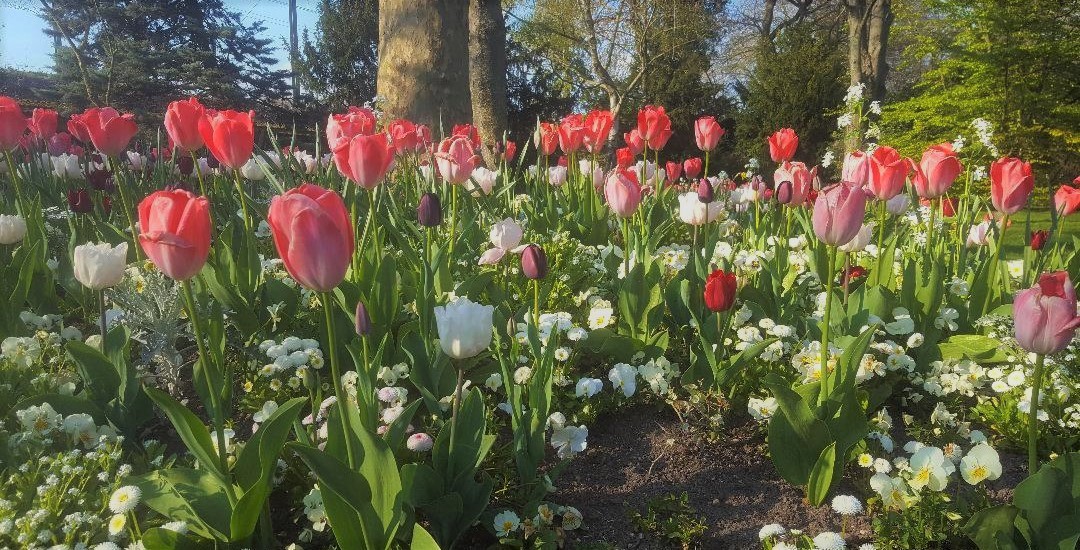
At a set of lights, on my way to work, my eyes generally drift over to the triangular flowerbed that livens up this traffic-heavy, yet otherwise non-descript road junction. For the last week or so, I have watched the tulips progressively rise up and open out - their bright heads a splash of defiance in this sea of concrete and tarmac. I have seen them reveal themselves, with each passing day, ranging from the jaunty traditional forms with smooth rounded petals and warm pastel colours, to the more vibrant shades and streaks with shapes bursting open and spilling out, with lily-fingered flowers and then finally to the mysterious varieties, with curiously ruffle-edged, fringed blooms, unfurling from strangely gnarled buds in dark, unsettling tones.

All this beauty laid out, yet I am not sure how much is even registered by the road-weary drivers and the odd pedestrian or so, all absorbed in daily tasks, eyes invariably blinkered by some screen device or other. And yet if they knew of the covetousness attached to the flowers displayed simply before them, their apparent indifference would surely be blown away. If only these tulips could talk of their rich ancestry and the extraordinary power they have exerted in very different places and periods in time.

Beyond our myopic viewpoint of the tulip, as the humble, reliable staple in shops and petrol station forecourts – lie distant horizons and tumultous times. Below its seemingly unassuming nature, are the facets of a history that need to be peeled back to arrive at the source, just like the tulip’s distinctively robust leaves that rise out of winter soil, yet spring from an obscure bulb. Indeed, the origins of the tulip stretch far further back than the flat expanses of the flower fields in the Netherlands.
These cheerful floral patchwork landscapes, offering picture-postcard views bathed in a quaint and safe atmosphere hide a far more vibrant, perilous past. For here is a flower that inflamed emotions, igniting all-consuming desire and unparalled greed of Biblical proportions.
Originally a wild flower of the Asian steppes, the tulip symbolized the contemplative beauty of the East and all things exotic for centuries. Its very name conjured up mesmerizing images of the Orient; swathes of tulips in the Persian capital of Isfahan, hypnotic whirling Dervishes, Turkish nomads sweeping westward along the Silk Route, the flowing waters of the Bosphorus dividing Europe and Asia. Yet this - the ‘flower of God’ - also witnessed and even instigated struggles for power and wealth.
When the greatest Byzantine city of Constantinople was overthrown in the mid 15th century, giving rise to Istanbul at the heart of the Ottoman Empire, the elegant image of imperial might and culture was the tulip. Indeed, it was named after the Turkish turban – the
tulipan. Cultivated in magnificent gardens and parks, the tulip acted as a precious jewel set in Topkapi palace ; the Sultan’s residence in the capital.
There, the flowers were personally tended to by Sultan Mehmed II himself – the Conqueror of the Roman Empire. Gradually, as the ban on the representation of living things in Islamic art progressively eased with time, the tulip motif appeared in ceramics, literature and textiles – and was one of the decorative symbol of preference in the mosques. The flower’s unique shape and the lettering of the word itself, both recalled the name of Allah in his greatness and growing such a divine flower assured a place in Heaven.
Meanwhile cultivating diplomatic alliances between East and West here on earth elevated the Ottoman empire’s wordly status. Under
Sultan Suleiman the Magnificent, the palatial gardens grew, as did the visits of European ambassadors. Such visitors were shown the magnificence of the tulip displays and the generosity of the Sultan as bulbs were given as gifts to the more important guests. It was in this manner that the Viennese ambassador to the Ottoman Empire is thought to have played a role in the introduction of the tulip to European soil.
Several bulbs were apparently handed over by the diplomat in question to the head of the imperial botanical gardens in Austria – a certain
Carolus Clusius. As a leading scientific horticulturist, Clusius finally became head of the Hortus Botanicus Leiden in 1593 and hence the first tulips were planted for study purposes in the Netherlands at the end of the 16th century. Given their mysterious ability to change colour, the tulip fascinated and puzzled in equal measure. Despite carrying out extensive research in order to understand the miraculous ‘tulip breaking’ that gave rise to such varied colour combinations in the ‘broken’ petal colouration, the process eluded Clusius (it was caused by a virus !). The beauty of this enigmatic flower did not escape the attention of others however.

The rarity of the tulip quickly inflamed interest and desire and before long Clusius was relieved of part of his collection by thieving chancers ! Although an unfortunate loss, this tulip heist resulted in the progressive gain of the flower across the land. Here it germinated in the culture and mindset of the people and took root in the national identity. Despite being far from the fire and passion of its exotic Eastern origins, the tulip’s hold on its host country was just as powerful. Behind the calm exteriors of the lofty Amsterdammer buildings constructed for an increasingly affluent merchant class and within the smokey interiors of shady taverns frequented by the populace, would soon burn a sudden passion, ready to engulf all.

Even without the fascinating fortune of the tulip in Dutch history, the Golden Age of the 17th century Republic never fails to intrigue us. Perhaps this is due to the same unique medley of cultural leads that ensured the flower’s success there from the start. There is something tantalising about the urban landscapes, still lives and portraiture with their play of colour and detail within a somber, sober framework which means that the smallest detail or the slightest touch of blue or yellow grab our attention.

We are literally drawn into the mesmerizing Dutch interiors, with their tranquil yet indefinable atmosphere that is rather unsettling. I remember going to the Rijksmuseum as a teenager and experiencing this strange sensation as we looked at incredible paintings in an equally impressive setting, one cold winter. It is hardly surprising that novels that seek to capture this unique mood and create a similar sensation attract many readers – or at least this one ! The obvious one to cite here is
Girl with a Pearl Earring (by
Tracy Chevalier), although I have to say the impression inspired in me by that book was sadly very far from the one intended. Any recommendations for a better read, gladly welcome…
Following independence from the rule of the Habsburg King, Philip II of Spain, the Dutch arts and science, trade and military forces went on to lead Europe. Maritime and economic power were unparalled during this period. Central to such growth was the establishment of merchant trading links, as Dutch companies sent out ships to bring back the exotic goods from the distant continents and far-flung islands. At the heart of this commercial empire was
The Dutch East India Company - a vast corporation founded in 1602 by the grouping of rival Dutch trading houses. A growing demand for silk, sugar and spice and a multitude of other luxurious commodities from Asia and Europe itself meant that the Dutch republic soon became the world’s commercial hub. Such lucrative trade meant that it soon became one of the richest countries and also the most densely populated in Europe.
As urban populations grew, merchants and bankers began to form a true middle class in the Republic, becoming wealthier and ever more powerful through trade and shrewd investments. How this affluence and rise in social status were to be displayed was perhaps unique to the Dutch spirit and worldview. Whilst they craved luxury, and coveted beautiful artifacts, they were equally fearful of inappropriate self-agrandisation and prideful ‘showing off’. Rejection of papist excess pivoted around a Calvinist condemnation of over-Indulgence (
overvloed) and the wanton conspicuous display of the worldly trappings often associated with it.
Whilst religious painting per se declined, artists were commissioned to show in secular work how overindulgence ultimately lead to decadence and decline. Moralistic genre paintings warned of the temptations of unbridled consumption and greed in the dissolute household, mostly to our amusement today ! If the message was not sufficiently driven home,
vanitas paintings were there to remind the beholder that vanity, generally linked to material possessions and worldly pursuits, would not guard them from inevitable death and decay.
Life’s brevity was underlined in still life paintings bearing references to the cycle of life and the passing of time, alongside allusions to Man’s mortality. Images of fading flora and fruit, caterpillars and butterflies, bubbles, burning candles, mirrors, hourglasses and deathskulls were presented in dissarray in order to highlight the chaos caused in life by vain distractions. Such existentialist messages may be lost on us now but these works still fascinate today since they appear as richly detailed displays of the contents of a curiosity cabinet, muddled with the shelves of grocer’s shop with a butcher’s ware thrown in for good measure ! All rendered in eye-watering precision, of course.

It was not for nothing, therefore, that the Dutch attached great important to pristine white linen on their person and in their environment. Immaculate in every sense, yet costly to maintain meant that their personal whites were quite simply a pure form of luxury ! Starchy, intricate white ruffs on otherwise sober garments spoke volumes without being seen as vain… Nevertheless, Protestant beliefs and practices meant that the rewards of hard work – reaping in the guilders - posed the continual challenge of how to be affluent yet suitably modest. This was largely achieved through indulging safely behind closed doors in the inner sanctum ; the home, garden and one’s domestic life. The display of one’s financial means to a select audience in one’s private space was seen as the perfect balance of modesty and ostentation, free of that shameful trait ; pride. And it is precisely this space that we find so intriguing today – divided as it is between contrasting forces.

Imposing gabled houses composed of immaculate rooms with light playing on walls and tiled floors reflected the ordered, pious restraint that the inhabitants aspired to. And yet inventories of household items drawn up during this period reveal a little more personal ‘clutter’ than the average Dutch interior genre paintings would care to depict ! Indeed, from the lists of household possessions, it would seem that many of the items included responded to more than a purely practical need as expensive commissioned paintings (often idealized portrait), mirrors, books, and clocks were all set alongside furniture and rich furnishings.

One household item that must surely appear to us today as a rather futile, yet again utterly intriguing, were the doll’s house owned by wealthy adult women. These are another example of the unique Golden-age desire to satisfy simultaneous contrasting impulses – moderation and lavishness. These perfect replicas of the various rooms of the affluent townhouse were often given on marriage, symbolic of the life to be built. Presented in a cabinet form, these doll’s houses afforded wives the opportunity and freedom to select and commission the rich objects and ornaments with which to furnish the rooms, at a time when most decisions on any matter in real life were taken by the man of the house. The doll’s house would be displayed in the home, standing at eye-level as a statement objet d’art, presenting an idealized domestic universe of exquisite craftsmanship, beauty and harmony. Guests would thus be encouraged to note the impeccable taste and enviable status of the mistress of the home – both real and miniature.

Purely by coincidence, I happened to finish reading
The Miniaturist by
Jessie Burton, just as the tulips started to bloom. The novel presented the fictive story around one such doll’s house from 17th century Amsterdam, today an exhibit piece at the
Rijksmuseum. Although genuinely excited to read this, my enthusiasm withered and died as the chapters advanced. Just as the few Tracy Chevalier works I have read, this one is built on an inspired theme – brilliant even – but the actual writing simply did not deliver, as far as I was concerned. Unlike
Girl With the Pearl Earring, whose film adaptation redeemed the novel,
The Miniaturist was in no way bolstered by the BBC mini series either. Nevertheless, the book did indirectly draw my attention to the fact that a complete cabinet doll’s house could cost even more than the most expensive canal house in Amsterdam… And yet it was not the only coveted object to do so. Back to the tulip…

As it turned out, there could be no better symbol of the lure of luxury and danger of vanity in the Netherlands than the tulip itself. Its ephemeral, captivating beauty with unpredictable colouration, its scarcity and highly limited supply gave rise to a frenzy of desire and demand. From the 1630s, buyers and sellers alike were driven by a ‘tulip fever’ that only burnt itself out when it had wrought havoc. But what could be more perfect mark of social attainment than the possession of such an elusive bloom ? What other item promised such commercial success to those willing to take a gamble ? Nothing, it would seem , until 1637 that is, when the tulip market crashed overnight. Before that, tulip trading had given rise to the first speculative bubble.

The rarest tulips, with their streaked petals in varied colour combinations were literally worth a fortune. And indeed purveyors and purchasers were soon ready to gamble fortunes via promisory notes on bulbs that had not even been seen in any physical form. Trading took place in back rooms and taverns (‘colleges’), where judgement was clouded by alcohol and the burning, blinding desire to become rich quick through a few smart investments and sale to the highest bidder. Whilst the final possession of such a precious commodity was largely the preserve of the wealthy alone, the exchange of these goods took place between the hands of lower-class citizens. Craftsmen and tradesmen would sell their materials and stock in order to purchase bulbs – or merely their ‘futures’ - to sell on and make a profit. When the bubble inevitably burst, these same individuals found themselves suddenly ruined.

Parts of society were left bankrupt and suicidal individuals threw themselves into the canals in desperation. Yet whilst the situation sent shockwaves through the economy, the country recovered with time. As trading had largely taken place outside the official stock exchange, tulip fever had been broken without ultimately breaking Dutch society. The nobility came out of the whole situation relatively unscathed, albeit a little chastized. As for the tulip itself, it continued to be treasured but no longer in a ruinous manner and many people today are not even aware of this real-life allegory of the dangers of amour fou. One novel that I did greatly enjoy on this whole affair was
Deborah Moggach's
Tulip Fever, read many years ago. Although it seems to have been panned by critics, who (as far as I can see) did not understood the tone of the writing, I loved it. Like a bawdy sketch from a Jan Steen painting, the story develops with the most unplausible plot that neverless depicts historical events that seem improbable from whatever angle they are presented. The film adaptation does the novel or its author’s intentions no justice…
Some 90 years after the initial
tulpenmanie, History seemed to repeat itself and so the third chapter in this story of captivation unfurls, suggesting that perhaps not everyone had learnt from the Dutch example, incredible as that might seem.
Back in the Ottoman Empire, the fascination with the tulip had not in fact subsided since the reign of
Sultan Suleiman the Magnificent in the 16th century. On the contrary, with the years reverence for the divine flower had merely grown, as had the huge variety of cultivars available. From the mid-17th century, classified lists were drawn up, with evocative names that indicate the enchantment the blooms operated ; ‘Increaser of Joy’, ‘Light of the Mind,’ ‘Diamond Envy’, ‘Those that Burn the Heart’, ‘Star of Felicity’, ‘Matchless Pearl’, ‘Delicate Coquette’, ‘Pomegranate Lance’ and ‘Beloved’s Face’.
By the early 18th century, this love had developed into a full-blown obsession in the
Tulip Era under
Sultan Ahmed the Third. Ottoman power and wealth was quite literally represented by the flower in all its forms, with hundreds of cultivars painstakingly developed, with a preference for the dagger-tipped, almond shaped flower as opposed to the wine-glass rounded form that was favoured by the Dutch. An annual Tulip Festival was dedicated to the elegant perfection of the flower and must have been simply magical to behold. Throughout the flowering period, songbirds in gilded cages would fill the air with their music, whilst giant tortoises bore candles on their backs, gently illuminating the evening displays as they wandered through the gardens. Dressed in robes that complemented the colour of the tulip blooms, the festival guests would stroll around the royal grounds and on the given signal, the seraglio doors were opened, releasing the Sultan’s sequestered harem into the garden, with its beautiful female charges ressembling the specially guarded floral specimens in their own right.

I am not sure if a novel about this particular episode in the tulip’s history exists, but it would probably be hard to relate this in a manner which could do it justice. Anyway, not surprisingly, such fairy-tale opulence and expense soon led to plain outrage and revolt in response to the exorbitant national outlay required to cover such indulgence. Whilst Ottoman tulip fever was kept in check by State price regulation, little could contain the Sultan himself who demanded the importation of millions of Dutch and French bulbs to feed his voracious floral habit. Soon bled-dry by this imperial obsession with the tulip, the population finally rebelled and destroyed the gardens holding the flower that had became synonymous with decadence and ruin. For the second time…

And so finally the tulip has maintained a hold over the countries which were its past strongholds - Holland and Turkey – but with none of the destructive passion and perhaps with a little less of the magic too. That this flower should have captivated two such different peoples must have been some form of enchantment or bewitchment. One country apparently dour and disciplined, was briefly rendered mad by a lust for the tulip’s beauty. This was matched by the desire of another - fiery and passionate - yet rendered powerless in admiration of the tulip’s delicate divinity.