Sunday, January 23, 2011

Moon-gazing hares...Full Moon Rhyme.

Masquerade - Kit Williams; Jonathan Cape 1979.
 I looked up from my bed the other night to see a bright full moon. Nothing special in that, I suppose, but it still catches me each time, along with the idea that millions of other people can see that very same moon. A sensation of naïve surprise each month, in fact. This time it reminded me of a poem I came across the other day, written by the late Australian poet Judith Wright... Full Moon Rhyme.


There's a hare in the moon tonight.
Crouching alone in the bright
Masquerade - Kit Williams.
buttercup field of the moon
and all the dogs in the world
howl at the hare in the moon


"I chased that hare to the sky"
the hungry dogs cry.
"The hare jumped to the moon
and left me here in the cold.
I chased that hare to the moon"


"Come down again, wild hare
we can see you there"
The dogs all howl to the moon.
"Come down again to the world,
you mad black hare in the moon."


"Or we will grow wings and fly
up to the star-grassed sky
to hunt you out of the moon"
The hungry dogs of the world
howl at the hare in the moon.

The image of the moon-gazing hare has had a powerful hold on the symbolism of mythology and ancient religions, right up to our modern-day imagination. Over the ages this image has indeed been so widespread that it is to be found around the world, throughout the millenia and while the symbolic meanings may vary, several themes seem to run constant.
Macclesfield Psalter; Fitzwilliam Museum, Cambridge.


In this manner the hare is seen to represent fertility, eternal renewal or immortality. Pliny the Elder stated that  hare flesh could cure sterility and in addition could enhance sexual attraction. In Egyptian belief, hares were intrinsically linked to the moon's cyclical movement - being at once masculine when waxing then feminine when waning. Hares would thus be depicted as alchemists making the elixir of immortality or as messengers of the female moon deity. There were several moon goddesses, the Egyptian Isis is perhaps the best known to us today, but it was the Anglo-Saxon Eostre who was to lend her name to Easter, which is set to coincide with the first full moon after the Spring equinox. For Eostre the hare was sacred, but gradually metamorphosed to become the Easter bunny we find so endearing; the mythical and magical became just plain 'cute'.

www.tomgreeves.org/the_three_hare
Paderborn Cathedral
The association with the moon was significant as the hare also symbolized purity. It was thought that this creature was hermaphrodite, as its lunar masculine and feminine attributes enabled it to reproduce at prodigious rates without bestial copulation. A single hare was often used to signify Mary's virginity, again associated with the moon as a symbol of purity. This was, of course, in sharp contrast to the common rabbit which was easily recognized to symbolize uncontrollable sin!
Just as the hare's symbols waxed and waned in cyclical fashion  - the common view of this creature did so too.While it would be revered in ancient times the hare was later to be regarded with contempt and suspicion in the period of early Christianity. It was considered to be a shape-shifting creature, serving the interests of witches, ready to tempt men to their perdition through their beguiling animal form. In common folklore of the Dartmoor region a hunter fell victim to the vengeful behaviour of a witch who promptly turned him into a pile of stones (the Bowerman's Nose).

A beautiful photo by benjamint.photos@gmail.com
Again the West Country is closely associated with the ancient hare symbol; that of the three hares. This motive is to be found in  many roof 'bosses' in medieval churches of the early 15th century. In these ecclesiastical settings of the Middle Ages the Three Hares represent purity - the Holy Trinity - in a circle. The three hares make up three-part rotational symmetry wherein each hare has but one ear, yet appears to have two.
 This was the inspiration for the research of the Three Hares Project, led by Chris Chapman, which endeavours to track down and relate the earliest traces of the hare emblem. Indeed, it soon became apparent that the symbol was far from restricted to a simple European significance or a uniquely Christan meaning.
The Masquerade treasure.

The same symbol is to be seen in many sites throughout the Middle and Far East, with examples dating back to 6th century AD in Buddhist cave temples in China leading right back to others in Europe - with the Paderborn cathedral in Germany and numerous churches in South West England. In this way the Three Hare symbol is seen in a Christian, Buddhist, Islamic and Jewish contexts. It is believed that these traces followed an ancient trade route bearing from east to west.


In rather more modern times the hare has continued to exert a fascinating power. Naturally we have the excentricity of Lewis Carroll's Mad March Hare, memorably seated next to the Mad Hatter and the poor narcoleptic dormouse! While in fact it is the females who fight and box the males at the height of their seasonal madness - it is interesting that gazing at the moon was believed to lead to insanity - lunacy (the French adjective lunatique means ever-changing).


Masquerade; Jonathan Cape 1979


The beautiful, enigmatic treasure hunt book Masquerade recently celebrated its thirtieth anniversay. As a teenager, the puzzles were sadly far beyond me but the pictures were so vivid and tantalizing - leading the reader on a mysterious adventure trail with real gold at the end of the horizon with an exquisite piece of  jewellery in the form of a hare.


The purity of the creator's aim, Kit Williams, was sadly tarnished by the greed of unimaginative man showing no dazzling moonlight nor any of the ethereal magic of the natural world, just the blinding fascination and greed for filthy lucre. The 'winner' was said to have cheated...which just goes to show that some instincts are eternal....!!!

However, just a look at the beautiful Masquerade treasure is enough to sweep all that aside and to make you dream - and if all else fails we still have the next full moon to look forward to....This is the Chinese year of the Hare, after all.
 My (folded) hare wall hanging.

Sunday, January 16, 2011

Happy Birthday!

Nanny Groves and her brother Charlie as teenagers.
Yesterday was my grandmother's birthday. Sadly she died almost 30 years ago, but we grandchildren still talk about her with great fondness and with much laughter because she was just such a character!
Looking beautiful (and as if butter wouldn't melt in her mouth!!)


She had a wicked sense of humour that was not even vaguely politically correct, a penchant for cigarettes, the odd glass of Teacher's whisky and slice of Battenburg cake! Although she did not really enjoy a robust state of health that never seemed to stop her being great company for us children - even in our teenage years. Watching Top of the Pops with her was great as she'd give a running commentary on all the latest styles - the early 80's being the New Romantic period meant that she had a field day towards the end of her life!


When we moved away from the Midlands to Cornwall at the end of the 60's the highlight of the year would be seeing her again, either in Birmingham or in the Southwest.


Nanny wasn't mad and bad and dangerous to know, she was more a case of 'naughty but nice' and would write to us several times a month to keep in touch, but was just as attentive to her other grandchildren who were closer to hand. All of us grandchildren, near and far, liked getting our hands on, or rather in, her biscuit tin - and her lemon meringue pie was legendary.
On her wedding day with my grandfather (who looks rather like Jude Law).

None of us ever really got to know our grandfather, only the smell of his pipe tobacco - he and Nanny were divorced - but I think she was just so much larger than life for us grandchildren that there was simply no space left to fill! She can't have had much money, because she'd been a cleaner but she always managed to save up to give us grandchildren presents - putting pennies in a big pot. This must have been a pretty effective system because one year she had even put enough money aside to take my brother and I on a helicopter day-trip to the Isles of Scilly. Quite a feat for an old-aged pensioner who'd never left the country, let alone flown!
However, the best bits about her were never really associated with big events - I don't think we ever really saw her in any big social gatherings (apart from her funeral, which seemed such a strange state of affairs all around). She would dance seated in her big armchair, singing to The Fiddler on the Roof - If I were a rich man. We'd beg her to do it each time and she'd usally oblige. Here's a clip of it to refresh memories...

http://www.youtube.com/watch?v=jJ_-CmwHWPo&feature=related
Nanny at a wedding.
Another favourite song was the theme song to Skippy the Bush Kangaroo, but try as we might we couldn't get her to jump around like Skippy for our entertainment although she probably would have done had she been younger! A few years ago I actually had the chance to visit the park in Australia which seemed to be a totally surreal experience, having seen it so many times from a very modest Birmingham terraced house, so long before. So, here's the theme music....

http://www.youtube.com/watch?v=_agtNKbgSfI&feature=related
Another theme tune that just seems to conjure her up straight away was that of Crossroads - we weren't allowed to watch ITV at home - so secretly we children would listen in on it from time to time just to get a dose.
And now for that unforgettable music!

http://www.youtube.com/watch?v=M2zSWQfEsjY
Nanny Groves as an Edwardian child; third person from the left, front row...
Although she has been absent from our lives for so long now - for far more years than those we spent with her - she still seems so real. I just wish my children had met her - they would have loved her! I also wish I had known more about her life, and life in general in the 'olden days' which for a child generally ncluded anytime before the present! The photo above shows her as a mischievious Edwardian child with a group from the Birmingham Naturalist Group (hence the butterfly nets and floral chains), however I don't know anymore about that, or so many other things from her life.


I remember she did enjoy looking at this particular book that I had received as a child for the Christmas of 1973 as it reminded her of childhood in a big city in the first part of the century. The book in question was Miss Carter Came With Us by Helen Bradley, and it was in fact one of several produced by the Lancastrian grandmother precisely to show the youngest members of her family what an Edwardian childhood had been like in the industrial north.

What is truly inspirational, is that Helen Bradley started to paint aged 65, in a style a little like that of Lowry, with his matchstick men, cats and dogs.
Helen Bradley
Many of her landscapes went far beyond the more naïve approach of her human representations and were very atmospheric. Not surprisingly, her books and paintings were a great success and leave a touching, beautiful trace of the past.
Helen Bradley
As corny as it may sound, the role of a grandparent is so important - we spend such a short time with these special relatives who hold a position in our lives unlike any other and who occupy such a huge place in our sentiments.

Monday, January 10, 2011

The Secret Garden - Under the Ivy....


Over the Christmas period we had the chance to watch the 1993 film version of Frances Hodgson Burnett's children's book,The Secret Garden. This film, directed by  Agnieszka Holland, recreates the drama and magic of the book written at the beginning of the last century.


The young orphaned Mary Lennox is sent back to England from India following her parents' death from cholera. In the vast, austere Misselthwaite Manor Mary must spend her time, alone apart from the domestic staff who largely try to adhere to the Victorian tenet that children should be seen but not heard. All the more so since they do not want their young charge to realise that the manor is occupied by the 'invalid' son of the lord of the Manor, Mr Craven.


Banished to a room, leading a bed-ridden existence, the 'invalid' Colin has been neglected by his reclusive father following the accidental death of the child's mother. Father cannot bear to look at son due to a painful resemblance to his late wife.


Over the howling wind that seems to inhabit and haunt the cold corridors and empty rooms Mary hears the eerie cries of the child who, unlike her, can be heard but not seen!

From the initial solemn, self-centred and tantrum-prone infant we first encounter, Mary grows and reaches out to the life around her, largely thanks to her discovery and tending of the hidden walled garden.
Gradually befriending all around her, animal and humans alike, Mary blossoms, and in turn is to lead Colin from the cold, dark sterility of the house to the bright exuberance and vitality of the overgrown garden - a terrestrial paradise and haven of peace. The lost key to open the doors of forgotten gardens and neglected feelings has been found in and through the nature around them.
The barren winter grounds give way to the garden's vegetation luxuriating and flowers' blooming as the seasons change in the magical cycle of life. Finally, father and son are reunited (well, it is a childrens' book, after all!), the healthy course of life and nature is resumed, no longer hampered and stiffled by convention and thwarted emotions. Despite this Happy Ending, the tone of novel and this film alike tries to remain fairly sober, and largely manages to avoid cloying sentimentality and moralising.


The film's haunting score is by the Polish composer Zbigniew Preisner (who also composed for the Three Colours triology of Krzysztof  Kieslowski). Just click on the link below to hear an extrait of The Secret Garden's soundtrack...
 http://www.youtube.com/watch?v=6Gsf26CO42I

However, as much as we all enjoyed the film, I couldn't help thinking of the BBC dramatisation of the book that came out in 1975. I was still at primary school when the series came out, and I had such vivid memories of it that the 1993 film just did not seem to recreate the same atmosphere.... However, I was able to put that theory to the test as I had the great luck to come across extracts of the BBC series, apparently taken from an exisiting DVD of BBC childrens' classics.
Even better, someone has had the great idea of associating images of the dramatisation with one of my favourite songs, Under the Ivy by Kate Bush. Click below for some atmospheric acting from the young actress, Sarah Hollis Andrews, set to haunting music.... With her pale looks, initial aura of loneliness and her immaculate English accent she seems to incarnate Mary, Mary, quite contrary...
http://www.youtube.com/watch?v=geXsE3s1JDU

In fact, over the years there have been several film versions of The Secret Garden - perhaps the most famous of these being that of 1949 starring Margeret O'Brien. Mary's American accent seemed to grate a little, but the magic of the secret garden was brought to life in this black and white film by the use of Technicolor for the garden scenes (in the same manner that it was used in The Wizard of Oz). There was even a sequel to the 1993 film, Back to the Secret Garden (2001) which was greeted with very mixed reviews...Not without reason, perhaps...


So, my final verdict was that the BBC series was the best adaptation of the book in terms of atmosphere and earnestness, and excellent acting from Sarah Hollis Andrews. However, this being a 70's series, presumably on a rather modest budget, it naturally did not have the opulence of the sets and props that the1993 film benefitted from, and of course the drama has a different impact in terms of immediacy due to the fact that a series is simply so much longer than a film.


 Once established and duly recognised in her art Frances Hodgson Burnett (1849-1924) enjoyed a reputation somewhat similar to that of J.K Rowling today. Even if The Secret Garden did not meet the same success in her lifetime as her other books, Burnett had already reached fame for her Little Lord Fauntleroy (1885) and The Little Princess (I loved the BBC adaptation of that too!). Readers awaited the latest magazine installment of the Little Lord Fauntleroy whilst Fauntleroy fashion and associated merchandise was bought up, just as Potter paraphernalia is now.


Again, rather like the life of J.K Rowling, that of Burnett was also a rags-to-riches story, worthy of a film itself. Born in Manchester in the mid 19th century, Burnett and her family were to experience great financial hardship after the death of the head of the household, Burnett's father. As the widow tried to take the reins of the family business Frances was cared for by her grandmother who developed and encouragaed the girl's interest in book and nature. This influence was to continue when the family moved in with relatives living in a house with a large enclosed garden, and was to exert itself on Frances all her life, as her written work testified. Finally, however, the family were obliged to move to Salford.


There the family were to live in an environment whose conditions of poverty and overcrowding were said to be indescribable and were a very far cry from the flowers and greenery of the gardens that the young Frances particularly appreciated. When the cotton industry economy crashed due to the American Civil war the family decided to cut their losses and try their fortune in America, by joining Frances' brother in Knoxville, Tennessee. The outcome of this move was not what the family had planned, for they again lived in impoverished conditions. However it was here that Frances was to encounter the Burnett family, and to befriend the crippled Swan Burnett who she was to marry in 1872. At this early period of her life, still in her late teens, Frances also started to earn her living through her writing of stories for magazines in order to escape poverty and she was to describe herself as a 'pen-driving machine'.


Such was her success as a writer, that Frances was able to return to England for an extended trip, followed by a visit to Paris where she agreed  to marry Swan Burnett. Throughout her life Frances was to spend her time between Europe, particularly England, and the United States.Nevertheless the marriage was not to be a wholly happy one.When the eldest of the two sons developed tuberculosis Frances devoted her energy to finding a cure but none was to be found and he died in 1890, leaving his mother overcome by depression. The marriage broke down and Swan left the family home amid criticism from the press suggesting that the breakdown was largely due to the fact that his writer-wife was a 'new woman' with misplaced ideas of where the duties of a spouse lay and misled by new-fangled concepts of the rights of women. Even if only by her lifestyle and life choices and not through conviction Frances could be considered to be a feminist. She certainly did not rely on a man to keep her, and appears to have made her own decisions, without being oppressed or over-influenced by the men in her life, or over-concerned by the opinion of people in general. She sought and enjoyed a lavish lifestyle - seeking the glittering social life of literary salons, and often filling her own homes with guests. She appreciated rich clothing and encountered her first major disappointment with her future husband when his refusal to postpone their wedding date prevented her from wearing the lavish bridal gown she had ordered.

Frances Hodgson Burnett Memorial Fountain Central Park.

When Frances took up with an actor ten years her junior she met disapproval, and even when she married Stephen Townsend in 1890 he was disparagingly referred to as her 'secretary'. This second marriage did not last and after a year ended in divorce. Frances' literary success met no such failure, however, and her wealth enabled her to realise her dream - that of living in a beautiful manor surrounded by magnificent gardens.
It was at Maytham Hall in Kent that Frances drew inspiration for many works when she lived there from the mid 1890's. The most notable of these works was, of course, The Secret Garden, where the hall's walled gardens and roseraies were given another life within the storyline and also through the written medium itself, enabling the writer to develop therein her own spiritual vision of the world and life.
 

This process of resurrection was replicated in the real life of Maytham Hall and its magnificent grounds since it was requistioned by the army during the Second World War and its gardens were used to grow vegetables in the 'Dig for Victory' campaign. 


Today, Maytham Hall has recovered its former glory.

 Having spent the last stage of her life in Long Island on her death the writer was buried in a cemetery said to resemble a botanical garden. Several years later a fountain was placed in Central Park to commemorate the life and work of Frances Hodgson Burnett.

I think some of the determination and spirit  that Frances Hodgson Burnett demonstrated are reflected in the character of the eponymous book Angel, by Elizabeth Taylor (the inspiration of François Ozon's film with Romola Garai). Nevertheless, I still wish someone would make a film....

Wednesday, December 29, 2010

Christina Rossetti - In the Bleak Mid Winter....


The snow has been back at intermittent periods, followed by icy rain which has created beautiful icicles suspended from every natural and man-made form.


In the Bleak Mid Winter  
Christina Rossetti 
In the bleak mid-winter 
  Frosty wind made moan,
Earth stood hard as iron, 
  Water like a stone;
Snow had fallen, snow on snow, 
  Snow on snow,
In the bleak mid-winter
  Long ago.


Our God, Heaven cannot hold Him 
  Nor earth sustain;
Heaven and earth shall flee away
  When He comes to reign:
         In the bleak mid-winter 
                       A stable-place sufficed
                               The Lord God Almighty, 
                                    Jesus Christ. 

                    Enough for Him, whom cherubim
                            Worship night and day,
                    A breastful of milk 
                         And a mangerful of hay; 
                   Enough for Him, whom angels 
                         Fall down before, 
              The ox and ass and camel 
Which adore.


 Angels and archangels 
  May have gathered there,
Cherubim and seraphim 
  Thronged the air,
But only His mother
 In her maiden bliss,
Worshipped the Beloved 
  With a kiss.
Gargoyles spitting ice.


What can I give Him, 
  Poor as I am?
If I were a shepherd
  I would bring a lamb,
If I were a wise man
  I would do my part,
Yet what I can I give Him, 
                   Give my heart.


In the Bleak Mid Winter was one of the poems written by Christina Rossetti in the latter part of the19th century. It was to be set to music, initially by Gustav Holst and later by Richard Drake and is one of my favouriteChristmas Carols.

Follow the link below to listen to the choir of King's College Cambridge singing it...
http://www.youtube.com/watch?v=_hs9-Sxf9j4&feature=related

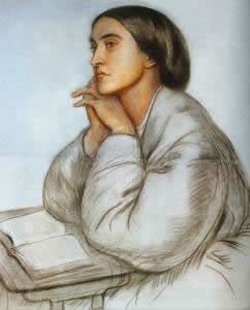
The 29th Deceember is the date on which Christina Rossetti died in 1894, her grave being in Highgate Cemetary. Although Christina Rossetti is perhaps better known as the sister of the Pre-Raphaelite painter Dante Gabriel Rossetti, she was a recognized artist in her own right as a poet.
Christina Rossetti
Despite the fact that her life was dominated by her religious convictions as a devout High Anglican, Christina had a relatively rich existence in the sense that she was able to frequent renowned artists and writers of her epoque thanks to her brother's wide social circle and the fact that she was born into a family of artists, scholars and writers. Swinburne, Whistler and Lewis Carroll were amonst those she would have met, while one of the original founders of the PRB movement, painter James Collinson, had demanded her hand in marriage as did Charles Bagot Cayley. Both men were rejected due to their religious faith, considered incompatible with that of Rossetti. She did herself appear in several of Dante Gabriel Rossetti's works - the most famous perhaps being The Girlhood of Mary Virgin (1849) where she modelled Mary.
The Girlhood of Mary Virgin; Gabriel Dante Rossetti 1848-49
In her writing Christina Rossetti often dealt with sober themes that led her thoughts and life; that of difficult love, death and resignation.
Ecce Ancilla Domini; Rossetti

Elements of repression and restriction are reflected in her fairy story Goblin Market whist her own concerns about female fellowship were put into action through her volunteer work with fallen women at St Mary Madgalene's penitentiary. Rossetti devoted much of her life to her family and not surprisingly she had exacting standards regarding those who were to enter the family sphere.
Gabriel Dante Rossetti

Dante Gabriel Rossetti was forever drawn to the writing of the 14th century Italian poet Dante Alighieri - especially the agonised love between Dante and Beatrice in The Divine Comedy as a source of inspiration to creativity. To a certain degree Rossetti replicated this duality in his relationship with his muse and long-term lover, the model Lizzie Siddal.
Ophelia  - John Everett Millais 1851-1852
It was Lizzie Siddal who was the model for John Everett Millais' Ophelia - a captivating painting due to its intense reality and even more moving since the girl subsequently became ill due to the extended period spent submerged in cold water. Lizzie Siddal was to be plagued by illness for the rest of her relatively short life and her health severely compromised by her addiction to laudanum. Having already had a still-born child, Lizzie again ill, depressed and pregnant  was to die of a laudanum overdose in 1862. Much of this is, of course, discussed in Lucinda Hawksley's biography, The Tradegy of a Pre-Raphaelite Supermodel (published by André Deutsch 2004).
Beata Beatrix 1870
Both Rossetti and Lizzie Siddal having artistic talent and temperament and subject to self-destructive behaviour due to mood swings and bouts of depression, they formed a complicated couple wherein the muse had to wait 9 years before the artist was to 'make an honest woman of her' - through marriage. Rossetti's continual postponing of their marriage and his infidelities did nothing to aid Lizzie, and the reception of Lizzie by the female members of the Rossetti household, when Rossetti finally decided to present her, did nothing to encourage the reluctant man in his obligation. Christina was said to be fascinated by Lizzie Siddal - with her flame-haired beauty, strange aurora, prickly social skills and unconventional lifestyle -  and she could see how her brother was fatally drawn to her. At the same time Christina is said to have received Lizzie with a certain coldness and even perhaps slight hostility towards this bewitching creature who had beguiled her brother and blinded him to the fact that she simply wasn't worthy of him. Nevertheless, Christina's vision of Gabriel Dante Rossetti's relationship with his muse is perhaps quite acurate and was reflected in her poem In an Artist's Studio.
Lizzie; Rossetti

.....He feeds upon her face by day and night,
And she wIth true kind eyes looks back on him,
Fair as the moon and joyful as the light;
Not wan with waiting, not with sorrow dim;
Not as she is, but was when hope shone bright;
Not as she is, but as she fills his dreams.

Despite her own artistic talent, recognized by the art critic John Ruskin, Lizzie's potential was forever hampered by ill health, depression and rather erratic lifestyle.
Lizzie did, however, inspire many works herself, and perhaps the most famous of these was Beata Beatrix, painted after Lizzie's death. Her ethereal beauty continued to haunt Rossetti even after her demise and this haunting image was maintained by legend... Rossetti had her coffin exhumed so that he could recover poetry buried with his muse. The face was said to be ever-beautiful to behold, and the striking red hair had continued to grow after Lizzie had left this world...
Her grave is to be found in Highgate Cemetery, as is that of Christina Rossetti...

Monday, December 27, 2010

Christmas Market - Going, Going... Gone!

Reims Market
I didn't have time to post this before Christmas, but maybe it might make people feel a little curious to visit this market, or any other of the hundreds that animate town centres over France in the weeks leading up to Christmas. Not surprisingly once Christmas Eve has passed, the shelves are emptied as the wares are packed up and the huts themselves are dismantled....So here are some of the goods on offer... Whilst many of the food and drink items have a historical and traditional relevance to the different regions of France, many of the stands offer articles that have a much more international flavour...

The first markets are said to have appeared in 14th century Germany and Alsace with the Marché de Saint Nicolas.

Documents referring toChristmas markets date back to 1434 under the reign of Friedrich II of Saxony, with mention of a Striezelmarkt in Dresden.

This word in turn relates to Struzel or Stroczel cake better known now as Stollen, sold on the market. This, along with many types of biscuit and glazed cakes typical of Alsace figure largely on the modern stands.


This is generally accompanied by mulled wine, although today other variations are available such as hot cider and orange juice. I wasn't even tempted to try these this time because the traditional wine just looked so inviting, especially during the cold spell we've been experiencing, along with the majority of European countries!

Macarons are also very popular here... The exact origins of this almond meringue pâtisserie seem to be difficult to define - some say that the recipe was brought to France with Catherine of Medicis. Others claim to have invented the macaron or at least to have encouraged its popularity. Various pastel colours and differing sizes exist, but the reference for the macaron here in France has got to be Ladurée - known as the Paris Macaron.


In Reims, the biscuit that traditionally accompanies champagne throughout the year and not just at Christmas is the Biscuit Rose - the reference for this being La Maison Fossier...


There are also pâtés en croûte and savoury brioches - which are rather like large sausage rolls with various types of meat filling...

Many forms of ham, dried sausage and smoked meat are also sold on the market. These can all be served with condiments - here are all different flavours of mustard that are produced here by a Rémois company - Clovis...
Clovis mustard and condiments.
There is also olive oil...

Of course these are all presented next to stands selling various different types of wine, spirits and beer....


One of the more colourful stalls sells dried and confit exotic fruit....This fruit comes from the Provençal tradition of the 13 desserts that are served at the end of the Christmas meal, which in France generally takes place on the 24th December, rather than on the 25th as we tend to do in England...

The number 13 is symbolic of the Last Supper with Jesus and the 12 Apostles. Here the sweet offerings are divided into 4 categories - Pâtisserie (Pompe d'olive and Oreillettes); Confisserie (Nougat and Pâtes de fruit); Fruits secs (the 'Mendiants') and finally Fruit frais (fresh clementines, grapes). Les Mendiants (referring back to the Mendicant religious orders dependant on charity for their livelihood) are the most important of the 4 categories and this group is itself divided into 4 groups...
Hazelnuts and walnuts represent the Augustinians; dried figs symbolize the Franciscans; almonds, the Carmelites and finally raisins represent the Dominicans.


Santons de Provence.


 The Santons are used to decorate the crêches, again a tradition from the Provence region in the South of France. It is said that santons flourished in popularity after the French Revolution when churches were closed and Midnight Mass banned, as were all public representations of the Nativity. The small brightly-coloured clay figurines enabled families to celebrate in the privacy of their own homes; in 1803 the first Foire aux Santons was inaugurated in Marseille. Here on the right-hand side of the santons photo above you can see a little person who was drawn to the colourful lollipops also on display....
Looking like brightly-coloured sweets are decorated glass baubles to be found alongside decorations more typical of Eastern Europe... I love the angelic expressions of the smaller Russian doll baubles....


So now we'll just have to wait till next Christmas....