Saturday, June 29, 2024

Art Nouveau Beauty... Bouillon Racine.

In a relatively unassuming side street of the Latin quarter, not far from the Ecole des Mines by the Jardin du Luxembourg, I caught a glimpse of this enticingly impressive façade and having peered in through the beautiful window, decided that I just had to reserve a table to experience a meal there! Although I did not realise it at that moment, the establishment in question was one of a handful of remaining 'bouillon' restaurants in Paris.
With its unique concept, distinct from the typical offerings of a brasserie, bistrot or banal restaurant, the 'bouillon' has always occupied a singular position, even if the profile of today's clientele is surely very different from that of the past.
The term bouillon, meaning 'meat stock', refers to the key item proposed by the founder of the first bouillon etablishment in 1854, a certain Adolphe-Baptiste Duval (1811-1870). This butcher catered to the food porters and general workers in and around the vast parisian market - Les Halles - which Zola depicted as Le Ventre de Paris.
While stock was not a new culinary invention, Duval understood how to present his own signature version to les forts des Halles in an appealing manner, at affordable prices so that demand would grow. Thus he was able to boil down and thus use up the pieces of meat generally overlooked or dismissed by the public (offal and the like...) while vastly improving his takings.
The offering was soon widened to include basic meat dishes of good quality, served in clean settings with quick, efficient service delivered by smartly dressed waitresses - 'les petites bonnes' - and hence the bouillon restaurant was born.
The popularity of this concept was such that hundreds of other restaurants were set up on the same model and so countless bouillons were scattered across the city over the following decades, acting as a 19th century precursor of our present-day fastfood outlets.
Towards the end of the century, the two Chartier brothers, Camille and Edouard, decided to try their hand at a new bouillon restaurant; one that would provide the same renowned and respected menus and service, but in an illustrious Art Nouveau setting in line with the aesthetics of la Belle Epoque that had been displayed in the Exposition Universelle de Paris 1900.
Le Bouillon Chartier Grands Boulevards was opened in 1896, and must have stunned the public with its vast dining area and lavish Art Nouveau decor, with swirling forms and sculpted wood, brightly-lit chandeliers and numerous mirrored surfaces that reflect the facets of the great expanse.
The Bouillon Edouard Chartier Montparnasse saw the day in 1903, followed by the Bouillon Camille Chartier - known as the Bouillon Racine in 1906. It was the latter that I visited and the former that I next intend to experience! And what a lovely experience Bouillon Racine was...

Tuesday, June 25, 2024

Where Time Goes...

Although wisdom is supposedly accrued with the passing of time and life's lessons learnt, the more the years go by, the less tenuous is my grip on the realities of existence. And now, of course, I find myself wondering over the most evident aspects of our spell on Earth, or rather that of those dearest to me, as age and associated illness mark out and define the timeline until it is clear that time does eventually run out on all of us. The thought of a precious being leaving, and becoming a myriad of memories is meagre consolation, all the harder when their own ability to recall the past and retrieve the memories it holds is being stripped away, pushing both them and us into an extended present moment, where time circles back on itself. Perhaps we just need to learn that skill from life; the ability to momentarily seize and appreciate the fleeting pleasures of our lives for the limited time they may last and the capacity to admire the beauty of Life itself.

Sunday, May 26, 2024

Umbels, Florets and Flowers in an Art Nouveau Jewel... La Villa Demoiselle.

Villa Demoiselle is one of the most perfect examples of art and architecture being brought back to life in full glory in a present-day that is often sorely lacking in aesthetic elegance. A visit to this enchanted domaine that lay in ruins following a gradual, steady decline from the interwar period onwards, can only lift your spirits and heightens your sense - even more so, should you take a glass of the Demoiselle champagne afterwards!
Indeed, for decades, Villa Cochet, as it had once been called, had been left in a shocking state of disrepair and must - or should have been - a source of shame and sadness for the Domaine Pommery that is situated across the road. When Vranken bought the domaine from LVMH in 2002, the couple Nathalie and Paul-François Vranken set about restoring the delapidated villa, thus combining their passion for art, culture and the champagne heritage. The result is nothing short of spectacular...
From its 'rebirth' in 2008, almost a century after its initial commission and construction under the orders of Henry Vasnier, Director of the Pommery Champagne Maison, Villa Demoiselle has regularly housed art exhibitions. However, for me, just a tour of the grand house and grounds is sufficient, enabling me to discover new elements each time, just as the sunlight pouring in through the stained-glass windows reveals some other detail of colour or shape in the architectural structure or the furnishings within...
The imposing Art Nouveau fireplace in the main entrance is incredibly majestic as a whole - it was initially exposed at the Exposition Universelle at the turn of the century - however it is the intricate features that draw you closer to admire their skill and beauty. This piece, designed by a pupil of Louis Majorelle from the Ecole de Nancy, is but one of many items of decor and furniture that were gathered by the Vrankens to refurbish the villa that had lost all its original works to theft and acts of vandalism when it stood empty from the 1970s onwards.
The restoration work has been so thorough and thoughtful in its realisation, that one could easily assume that this is how the villa always was, but in fact the Vrankens had little on which to base their plans since rather meagre information remained, barring a few old photos that offered some guidance. As such, the Villa Demoiselle is truly a credit to the Vrankens' determination to see this site relive, literally snatching it away from land developpers who had planned its total destruction.
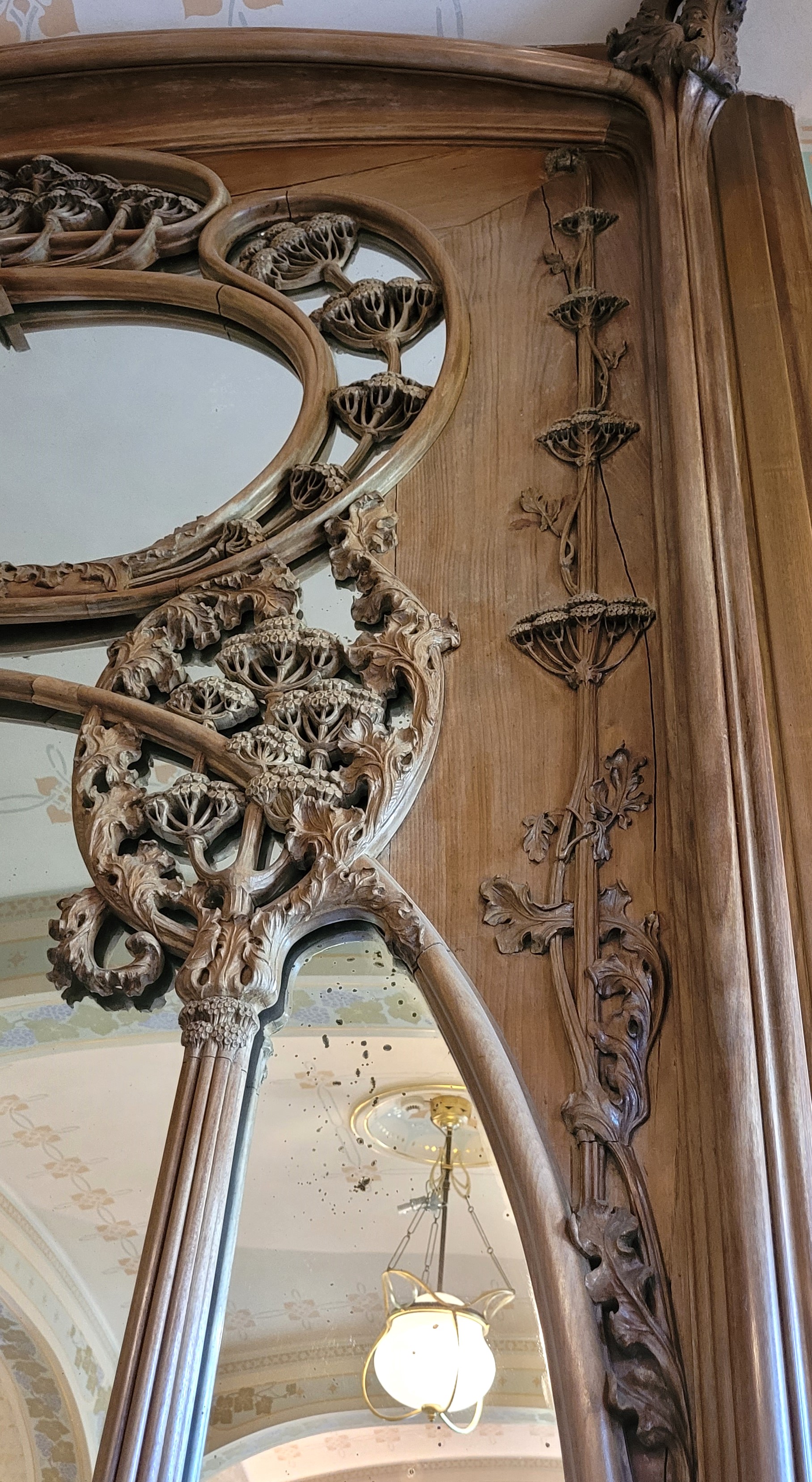
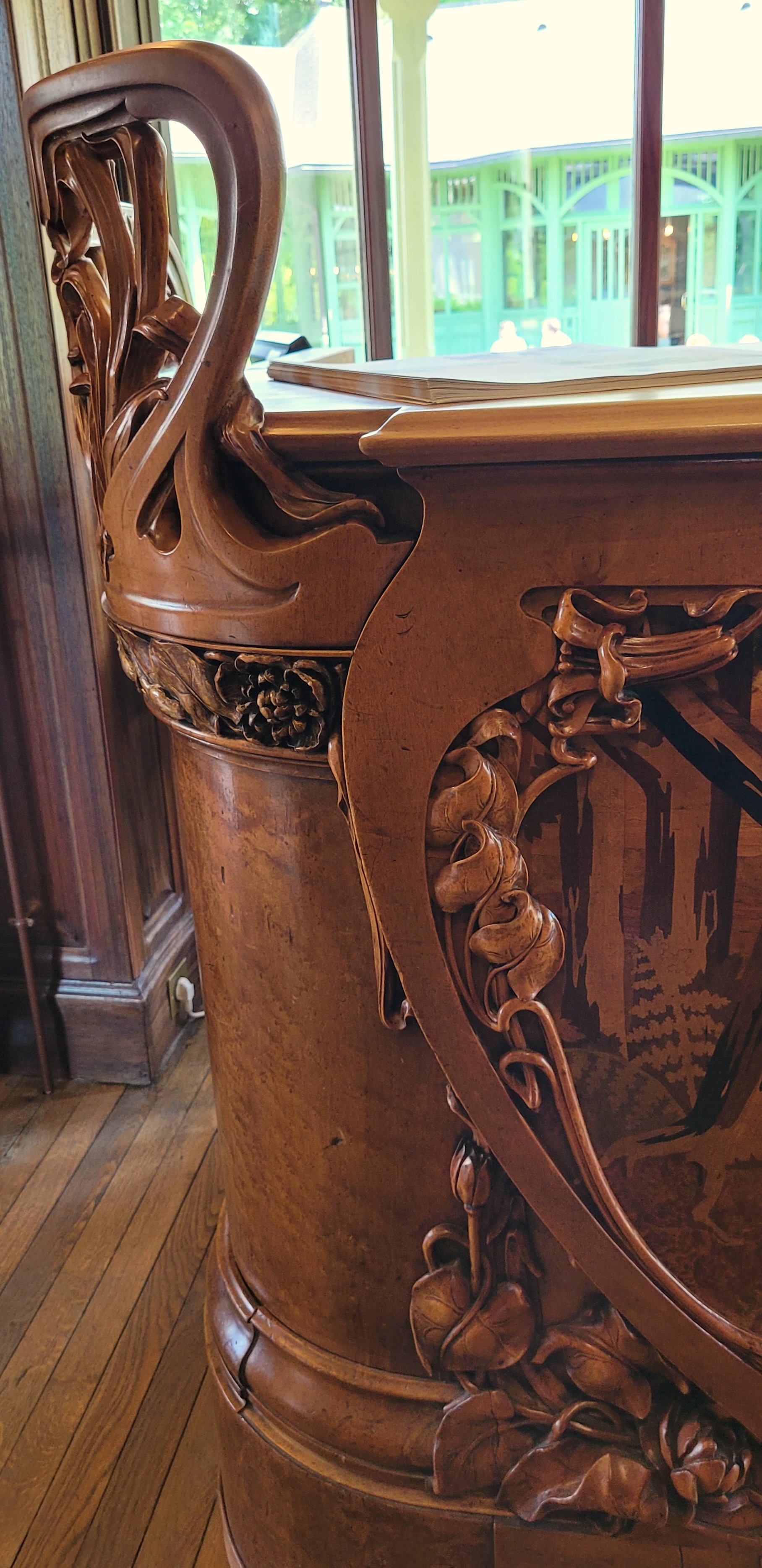
As in most Art Nouveau manifestations, particular importance is attached to the swirling, sweeping forms of a heightened, natural world, with plants, flowers, foliage, insects, snakes and birds twisting, sliding and slithering across sculpted surfaces, paintings, mouldings or furniture itself. Here at Villa Demoiselle it is magical to pick up on these details in all their beauty...
Of course umbellifer plant occupy a central position, with their delicate crown of ribs that radiate out from the flat-topped inflorescence in such a fascinating manner...
These curved and clustered forms were repeated throughout the villa on fireplaces, buffet-bars, cabinets and so on...
Meanwhile contorted, spindly stalks and branches intertwined...
Or lily leaves seemed to melt and flow down the solid forms of furniture in a liquid, vital fashion...
Whilst other objects concealed snails that glide silently on gnarled vines, set alongside smooth marquetry...
Or lizards that are frozen in a furtive, darting movement as they dash across scaly branches...
And in the main hallwall, the stairwell is dominated by the incredible chandelier, with its strange bulbous lights, which emphasises the great vertical drop from the ceiling of the top floor to the ground...
And the vast wrought-iron glass door with its stark, black tendrils that furl out like a spider's web, looking out onto the garden beyond...
Whilst one demoiselle peers on joyfully from a flurry of petals and light!

A Flower's Best Friend...NOT!

Unfortunately, beautiful cut flowers do not last long in my flat, or to be more accurate any home inhabited by a certain character... He may look cute and cuddly, but when it comes to petals, and plants more broadly speaking, he has a fondness which invariably leads to the same result; infuriatingly shredded flowers and foliage of all sorts.
This pretty bouquet was moved from room to room in order to avoid his feline attentions, but to no avail... And even when they had sadly been relegated to the balcony, he still managed to track them down! However, all things considered, I still have more memorable moments from the furry stalker pursuing his latest 'prey' than the bouquet alone...

Beautiful Beasts and Beings at Sainte-Chapelle...

On a bright Spring day, light flooded into Sainte-Chapelle through the blindingly beautiful stained-glass windows in a myriad of dazzling colour. Although not my first visit, I had not yet seen the chapel in its full glory with the effects of sunlight illuminating the glass bays, like a vast scattering of millefiori... However, I will save that for another post.
This time, it was the strange sculpted beasts that lurked across the architectural structure of the chapel that fascinated me the most, with their incredible detail that could easily be overlooked since frequently placed in inaccessible places that lead the visitors to contort the body as much as the beasts portrayed high above them! Many of these beastly beings were set as part of the Last Judgment scenes that play out around the entrance of the upper chapel.
The twisted, grotesque yet humourous expressions and positions of the diabolic figures from Hell are offset by the calm simplicity of the bas-reliefs below, depicting elements from the Old Testament, all treated with the same intricate detail. I love the sheepish look of the dragon in the scene below...
And the following trio of moles, chewing on a worm whilst another docile dragon carries on with its business, regardless...
Meanwhile the animals mount two by two into Noah's ark in this magical representation. A nonchalant monkey looks on, scratching itself whilst observing the other creatures, which either reluctantly climb the ramp (the foxes) or diligently make their way up (the tortoises) or obediently follow the others (the donkeys)...
I initially thought all these sculpted pieces were remarkably well-preserved original work, dating back to the 13th century when Louis IX required a private chapel to house his sacred relics, but in fact they were created some 5OO years later to replace the sculpture destroyed during the Revolution years.
This was the work of the sculptor-restorer, Adolphe-Victor Geoffroy-Dechaume (1816-1892), who used the remaining traces of the original pieces of Sainte-Chapelle, along with copies from cathedral sculpture of the same period - notably Cathédrale Notre-Dame de Rouen. The devotion of this great man to safeguard the traces of Medieval art is incredible, along with the efforts of Prosper Mérimée (1803-1870) - better known as being the author of Carmen) - and Hugues Krafft (1853-1935). Thank goodness for their insight, without which so much precious art would be lost...

Tuesday, April 30, 2024

Exotic Facade Beasts...

Invariably, visiting any city with older buildings and/or a historic centre involves gazing up in order to catch sight of any quirky detail... Lions often adorn buildings of all types, but it is not often that elephants are used as a key feature in the decoration of a facade, but here you have it! How dull and dreary modern buildings are in comparision to those of almost any other century!

The Marvel of Minerals... Ecole des Mines.

A recent congress I attended was held in the Ecole de Mines, tantalizing close to the Jardin du Luxembourg to those of us not entirely mesmerised by the proceedings of the day. Unable to abscond, I instead let my mind wander off around the impressive surroundings of this grand school of engineers, founded by Louis XVI in 1783, situated in the former Hôtel de Vendôme since 1816.
For all around the buildings were old display cabinets of large minerals, extracted from countries all across the world and better still, the Musée de Minéralogie...
Unfortunately, the agenda was so tightly-scheduled that I only had half an hour to visit this beautiful museum and so I had to race around, trying to take in as much as possible in a limited time-slot. However, even if frustating, the visit was magical, in large part due to the fact that the rooms and displays have not been adulterated by some modern gadget/gimmick technology, designed to create some 'interactive experience' involving much tiresome swiping of screens etc.
On the contrary, the beauty of the minerals alone was enough to keep you entralled as room after room revealed itself in sucession, your feet making the wooden parquet creak when peering into the numerous cabinets at the treasures within. There were full written descriptions, of course, but my trip allowing for the bare minimum I had to abandon trying to memorize the wonderfully intriguing names.
Whilst the vast majority of specimens did come from far-flung countries, many were collected far closer to home, so to speak, enabling you to view Europe in a slightly different, more exciting, primal light once presented with the inorganic marvels to be prised from its rock beds, unearthed from the depths of its lands.
The mineralogical terms to describe the 'habits' (appearance) were equally mind-blowing, with an explosion of end-less adjectives to feed the imagination; acicular, foliated, micaceous, dendritic, plumose, reticulated, stellate....
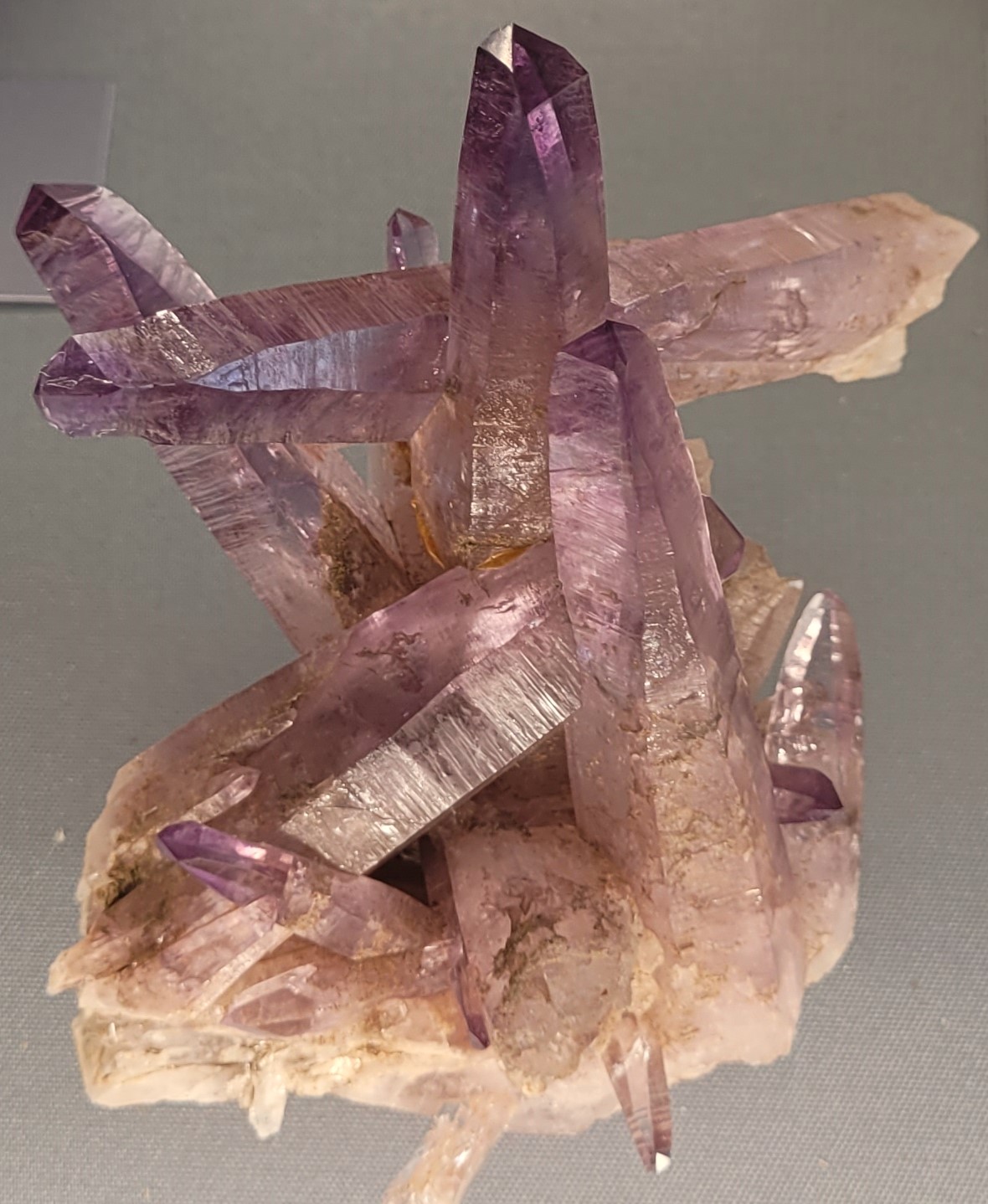
However, even without any description or explanation, the pieces themselves are just incredible...
It is difficult to believe that such wonders are shaped without human intervention since the formations and patterns seem willfully aesthetic...
While some look vaguely familiar in shape and colour to some mineral already seen, others defy definition to the point it is difficult to believe they are even solid matter as opposed to some fluffy substance...
Or formed by molton wax or resin or simply lava...
Others are like clustered plastic spindles, thrown together...
Or tangled, frenzied fibres...
Or shiny, metallic, facetted columns...
Or exploding needle clusters...
Or shards of glass, bursting outwards...
Or clustered crystals...
Or icy blocks, sturdy yet fragile...