Thursday, October 26, 2023

Cast Courts at the V&A...

Over the summer I discovered the Cast Courts at the V & A and whilst I must have visited these lofty exhibit rooms in the past, I had never really considered what was actually on display. As I went around the courts, I was stunned by the size of some of these works, towering above the visitors, and the number of these collection piece, all gathered together to great effect.
I could only imagine how Victorian counterparts must have felt when they entered these spaces - then known as the Architectural Courts - that were open to the public from 1873. It is said that the encounter was comparable to the first sighting of the Mont Blanc mountain in the Alps, leading to "impressions that can scarcely be effaced".
Since the majority of such 19th century visitors were unlikely to have been on a Grand Tour of Europe, with its majestic sights and scenery, they had likewise never had the opportunity to see the great works of art and architects from which the casts were taken.
The courts were initially conceived as part of the Governmental School of Design in 1837, with a collection of casts of ornamental art from across the ages and countries. This was largely in response to a report issued by The Select Committee on Arts & Manufactures in 1835. Therein, significant questions were posed concerning the nation's art, its importance to the individual and usefulness to country as a whole, with regard to the increasingly industrialized manufacturing industry, and more relevantly here, the role art education could play.
Indeed, from the early decades of the 1800s it had been recognized that English manufacturing, although deemed superior to that of other nations, was somewhat 'deficient in taste' in its forms and decoration and that, according to one article in the Illustrated London News , from 1843 "This national inferiority has arisen from our neglect of nature in the education of our ornamental designers, and from a mercenary habit of leaving the invention of our putterns to the accidental, unpaid, and uncultivated imaginations of the poor foremen of factories".
Hence, a number of Governmental schools were established in the great industrial cities of Britain. Whilst the economic success of the land was proven and showcased to international acclaim in the Grand Exhibition of 1851, more discretely perhaps, the School of the Design had marked a milestone in art education and appreciation. Casts were studied in their full dimensions - as opposed to drawings with their obvious limitations - enabling both male and female students to learn from their unique ornamental architectural details replicated from original works dating back centuries to the Renaissance and beyond.
In 1852, the Museum of Manufactures was set up, taking over the cast acquisitions of the School of Design and enlarging the collection since it was now a vital educational tool in the study of art and design. One of its aims was to improve public taste in matters of design and, like William Morris in the Arts and Craft Movement later, to lead the 'application of fine art to objects of utility'.
The collection grew significantly over the ensuing years to include figurative sculpture, with its volume and the size of certain reproductions requiring new rooms for display. When the South Kensington Museum (today's V&A) was created, the museum director, Henry Cole, ensured that the monumental casts were finally placed in the purpose-build rooms that we can enjoy today in their recently-renovated form. The original glazed roofs, ceiling, walls have now been returned to their former stature; the ceramic floor tiles created by Victorian female prison inmates - ironically refered to as an 'opus criminale' by Cole, bring together the whole space.
From 1873, the Architectural Courts displayed the cast collection to great dramatic effect so that pieces could be shown fully assembled rather than laid out in dismembered parts throughout the galleries and corridors. Hence the Spanish 12th century Portico de la Gloria from the cathedral at Santiago de Compostella greets us, as visitors past, to take our breath away by its sheer size and beauty. The spaces were likewise specifically designed to house the vast full-size plaster reproductions of Trajan's Column, towering to 25 metres.
One of the main exhibits in the collection is predictably the cast of Michelangelo's David, his gaze looming over admirers from a 5-metre vantage point. Drawing in the crowds eager for a selfie, with a similar type of hyped fame as the Mona Lisa in the Louvre, David stands proud in all his glory today. Since his arrival in the mid 19th century, he has earned somewhat of a succès de scandale following Queen Victoria's disapproval of his nude form and demand for modesty. An aptly-placed sculpted fig leaf was obligingly positioned to conceal the offending parts from public view...
The skill with which the casts were created largely beggars belief and the fact that these monumental, architectural, ornamental and figurative works are 'mere' reproductions takes nothing away from their artistry. How could such vast pieces be carried out in Victorian times when means were supposedly far more rudimentary than anything we have today? But then that is a question that frequently arises when considering Victorian achievements in almost every field.
The casts were intended to inspire and educate their public, leading Great Britain to attain even greater accomplishments, using the most impressive artwork from other ages and areas across Europe to further jewel the crown of the British Empire. The reproductions reflect the same driving force behind much of the Victorian thirst for culture and knowledge in every possible domain.
Through the quasi-religious study and, above all, collection of artifacts and facts themselves, the Victorians sought to understand and thus master the world around them. In this manner, the very limits of the world were conquered, often using methods and means that demonstrated the very best and worst of human undertakings.
The collection was not, however, safe from the vagaries of time and certainly taste. Already, concern was raised during the acquisiton of the casts in the 19th century, with the fear that the original works would be damaged in the complex casting process of reproduction. Furthermore, changes to the academic study of art - drawing and sculpture - meant that the casts were considered redundant to educational purposes in the early 1920s and were even at risk of being dismantled entirely.
Fortunately, the cast court was maintained and has even gained in importance over time as the original pieces were often destroyed in wartime hostilities, or damaged by the ageing process and the impact of weather extremes, pollution and shoddy or clumsy restoration work.
Finally, the fact that these are 'fake' pieces is irrelevant since they are genuine works of art in their own right and a testimony to the skill and mastery of the Victorian age, which, for all its ills, was capable of marvels.

Sunday, October 22, 2023

Genteel Pleasure; Observing the Tea-drinking Conversation Piece...

On this year’s trips to the V & A and the Tate London, amongst the vast collections of paintings I was drawn to the conversation pieces in their various forms, largely from the 18th century British collection. Characterized by the simple anecdotal quality of their domestic or landscape scenes, with sitters conversing together in small social groups as they share in common activities, these works have a certain intimacy. Whether the individuals portrayed are from the same family, or are friends or members of some group, we catch them in collective gatherings such as tea parties, meals, card games; musical events or hunting. Yet, just as much as we observe them and remark on the often-strange dynamics of the scene, they too look out on us, watching us quizzically or avoiding our gaze defiantly.
This unsettling eye contact, or lack of it, seems to bring another dimension to these works through this odd connection and silent exchange with these figures. Some family members have the same watchful expression, with similar, eerily beady eyes staring out, whatever the age of the individual! Even the horse studies of George Stubbs present magnificent beasts with solitary riders who stare out at us directly in an indefinable manner.
William Hogarth worked in the same genre, and even though his pieces largely pointed to the satire of the given situation and its hapless actors who fell prey to their own shortcomings, this particular eye contact is still present, as seen in his Strode family below. The conversation piece, as indeed the genre of the fictional novel itself, departed from the epic classical themes and forms to focus on the daily existence of the rising mercantile class. Although Joshua Reynolds worked in the Grand Manner, he would do conversation pieces, albeit with vast proportions featuring life-size figures. Meanwhile in France, Antoine Watteau in some ways perpetuated the conversation piece in his fêtes galantes but his characters are typically so engrossed in their amourous antics and caught up in the bucolic scenery that they have little time to waste engaging with us, the viewer! In England, the commissioned conversation piece enabled the rising moneyed classes to indulge in their self-satisfaction at their social position and impress society likewise; the ultimate ostentatious consumption! In the place of the aristocracy’s allegorical allusions to Classical antiquity and its values, was the reflection of genteel contemporary pleasures, focusing above all on those enjoying these activities.
Playing a key role in the conversation piece was the social etiquette that surrounded the ritual of tea drinking. As a genteel social activity, the consumption of tea en famille or preferably with guests was a means of demonstrating social manners, and of course displaying status in society and economic standing. Tea was first introduced to Europe in 1606, when the Dutch established their trade routes to Asia, and a shipment was sent to Amsterdam. In Britain, the rise of the East India Company led to greater imports of such exotic goods and the marriage of the tea-drinking Portuguese Catherine to Charles II in 1662 assured the success of this drink.
By the mid-17th century, tea was thus establishing itself as a genteel beverage in the upper classes. Indeed, Samuel Pepys mentioned it in his diary on Tuesday 25 September 1660, when he was offered a 'Cupp of Tee (a China drink) of which I never had drank before'. As an apparent avid coffee drinker, Pepys was not won over by this foreign import that proved to cost 10 times the price of coffee, although he did laud its reputed medicinal properties. When Thomas Twining, famous tea purveyor expanded his existing store to create the Golden Lyon Tea and Coffee House, he helped change conventions and the role of women. Whilst social taboos prevented the fair sex from entering the typically male domain of the coffee house, women were allowed to shop for the high- quality dry tea offered by Twining. Eager to purchase this fashionable, elitist drink, ladies not only led the craze for social tea-drinking but were at the heart of the tea ritual in the home, when receiving and thus entertaining guests with tea and pretty conversation.
Serving tea was the female prerogative and much importance was attached to the preparation, pouring and ceremony of tea-drinking for this was the perfect way to demonstrate the hostess’s impeccable savoir-faire and enviable social position. As she In turn reflected the power and influence of her husband, only the best would do. Tea was indeed a costly commodity to purchase, and one which also required considerable paraphernalia – tea 'equipage' – in order to serve and drink it in the most fitting manner. The indispensable teapot and tea service had to reflect the excellent taste and limitless means of the lady of the house and therefore, porcelain was de rigueur for elegant cups (bowls) and saucers whilst the teaspoons and sugar tongs would of course have been in silver, perhaps with original designs. Again, women were often given the right to select the family tea equipage and thus expressed their identity through their preferences. All this is apparent in Joseph van Aken’s 'An English Family at Tea' (1720).
To up the ante, a genuine Chinese redware teapot would be used in place of a silver one, alongside a blue-white porcelain tea service whilst the tea caddy, kept under lock and key by the mistress, was typically made of mahogany or leather-covered wood with silver inlay or details in mother-of-pearl or tortoiseshell. In many of the conversation pieces, the caddy has pride of place, in the foreground of the painting, near the hostess... A silver sugar bowl would complete the set and give a final cachet to the whole, all the more so as sugar was likewise an expensive good. The tea table itself was extremely expensive as it was a key statement piece to highlight wealth and taste; usually made of exotic hardwood with carefully crafted legs and inlays designed to impress the guests. Finally, what I found most fascinating in the tea-drinking conversation pieces is that they are almost a mise en abîme; the image of an image of self-glorification coupled with a certain need for validation, in which we play a role too, at a remove of around 300 years! Just take a look again at those enigmatic stares!

Friday, October 13, 2023

Elegant Arms and Engageantes...

In the Georgian exhibition in the Queen's Gallery at Buckingham Palace, I loved looking at the sumptious silks, satins and taffetas on display, either on the actual garments on show or portrayed in the paintings representing the period.
The silk industry was lead by the French city of Lyon, however the silk-weaving district of Spitalfields, London held its own too, producing increasingly rich, detailed fabrics that were coveted more than the finished items of clothing they were used for. The floral and botanic details on the gown worn by the duchess above were woven onto a background of silver threads and the lustre of the silk flowers is complemented by the metallic glint, all of which is captured in the painting.
Sometimes the mastery of the artist in portraying the unique sheen and silken aspects of the clothing seems to surpass the skill of lifelike portraiture, the exception to that being animal studies with their incredible rendition of fur not to mention those expressive eyes!
Lace, flounces, frills and here, ermine trimmings, all seem to have appealed to the artist as a means to demonstrate his great talent as much as to the largely affluent individuals - male and female - who sought to show off their vast wealth and status through such richly decorated garments. You almost want to touch the surface of the painting, so realistic are the textures - look at this gentleman's incredible velvet jacket!
Along with silk, lace was extremely costly since its production was unbelievably long and arduous, demanding great skill. You can sense the pride such lavish, frothy lace details must have inspired in the garment-wearer and their portraitist. And just look at the elegance of the hands with their delicate, expressive fingers, with or without jewellery to highlight their grace.
Beautifully poised fingers and gently intertwined hands are framed by folds and flounces of lace and the purity of skin, untainted by sunlight or indeed a day's work, is highlighted by pearls.
To emphasise the elegance of slender wrists and dainty hands - on both ladies and gentlemen it should be said - there was widespread use of engageantes throughout most of the 18th century. These generally took the form of extended decorative flounces of lace or (another fabric) that were worn underneath existing sleeves of either a dress or bodice if not a man's coat.
The word engageante derives from an old French adjective engageant, meaning 'attractive' or 'seductive'. Certainly, these delicate layers of ruffled lace or linen offset the beauty of the rich material of the main garment in a glorious manner.
These were not false sleeves as such, nor were they loose cuffs or indeed part of any lighter undergarment. They were independant articles used to enhance and embellish outfits already richly decorated with bows, ribbons and embroidery, from the reign of Louis XIV onwards.
Engageantes could be sewn or tied onto the underside of garment sleeves that generally reached elbow-level. They could be removed at will, in order to be cleaned or otherwise exchanged for other styles, in other materials, thus enabling the wearer greater possibilities to adapt clothing to circumstances.
In this manner, elaborate, highly decorative engageantes could give way to plainer, more practical versions for daily routines. Whilst the more ostentatious ones could have up to five layers of ornate lace, the simpler variety were far less voluminous.
Generally speaking, they were longer behind the elbow than in the crook of the arm and thus could hang in a fluid manner.
Gradually, engageantes assumed more modest proportions in accordance with changes in fashion and fell out of use towards the end of the century due to the rise in Neoclassicism with its purity of lines which made excessive detail and decoration redundant.

Saturday, September 30, 2023

Glorious Georgian Gowns...

In the summer, I eagerly queued up to visit the exhibition at The Queen's Gallery, Buckingham Palace; Style and Society: Dressing the Georgians. Looking at the exhibition poster (sadly not on sale), I thought how well the painting by the British School - St James's Park and the Mall - seemed to capture my perception of this period of history. In this work, an animated, joyous throng of individuals of all class and character goes about its social business in this grand setting, unperturbed by the presence of those from wildly different circles with whom they rub shoulders, almost literally. On the contrary, each being, however humble or illustrious their origin and demeanor, wishes to take part in this extraordinary living fresco, to exchange words, parade, preen, pose in public. Meantime, rather lacking in deference to the human counterparts they somehow seem to mirror are the dogs and cows that likewise occupy themselves and the centre stage with a certain insouciance. This strange combination of extremes, contrasts and likenesses is fascinating.
As I gazed at the exquisite clothing, jewellery and elegant footwear of the exhibition, I wondered how articles and artifacts of such intricate beauty and craftsmanship were made (and indeed worn) when the means to do so were limited, relatively speaking, and lives were hard, with or without affluence to ease hardship. Supply was naturally buoyed up on a regiment of ill-paid and poorly-treated workers with deft fingers and so I suppose that the real question that I actually asked myself is what happened to our demand or desire for goods of comparable elegance and originality today, means permitting? I am frequently left choking in dismay and disbelief at the sight of today's vulgar, limited vestimentary selections, all variations of the same trends, coveted by all, regardless of status or wealth. Most of these seem to me dull and unoriginal and I am sadly unable to unsee the very worst modern-day monstrosities, visually fatigued by the sight of all these logos that are branded onto each individual to form a globalized uniform mass. Anyway, an antidote to all that dross clothing and footware were above all these incredible gowns.
Having already seen samples of silk designed and woven in the silk-weavers’ district in Spitalfields, East London, it was marvelous to see more types of garment this was used for in the 18th century. Created at a time when precious fabrics were more valuable than finished gowns, sadly few of these gowns have survived to the present day in their initial state. Many were indeed taken apart, the silk recovered to create further dresses in line with changing fashions over the decades, whilst others with their brocade, taffeta, glossy lustring and damask were used in home furnishing and upholstering. Peering through the display cabinet, I had the impression that the decoration of the fabric was due to embroidered motifs but in fact it was simply down to the rich working of the silk. The delicate botanical patterns and floral details, so characteristic of Spitalfields work, were one of the specialities of Anna Maria Garthwaite, who was a pioneering female textile designer, producing silks from the 1720s. until her death in 1763.
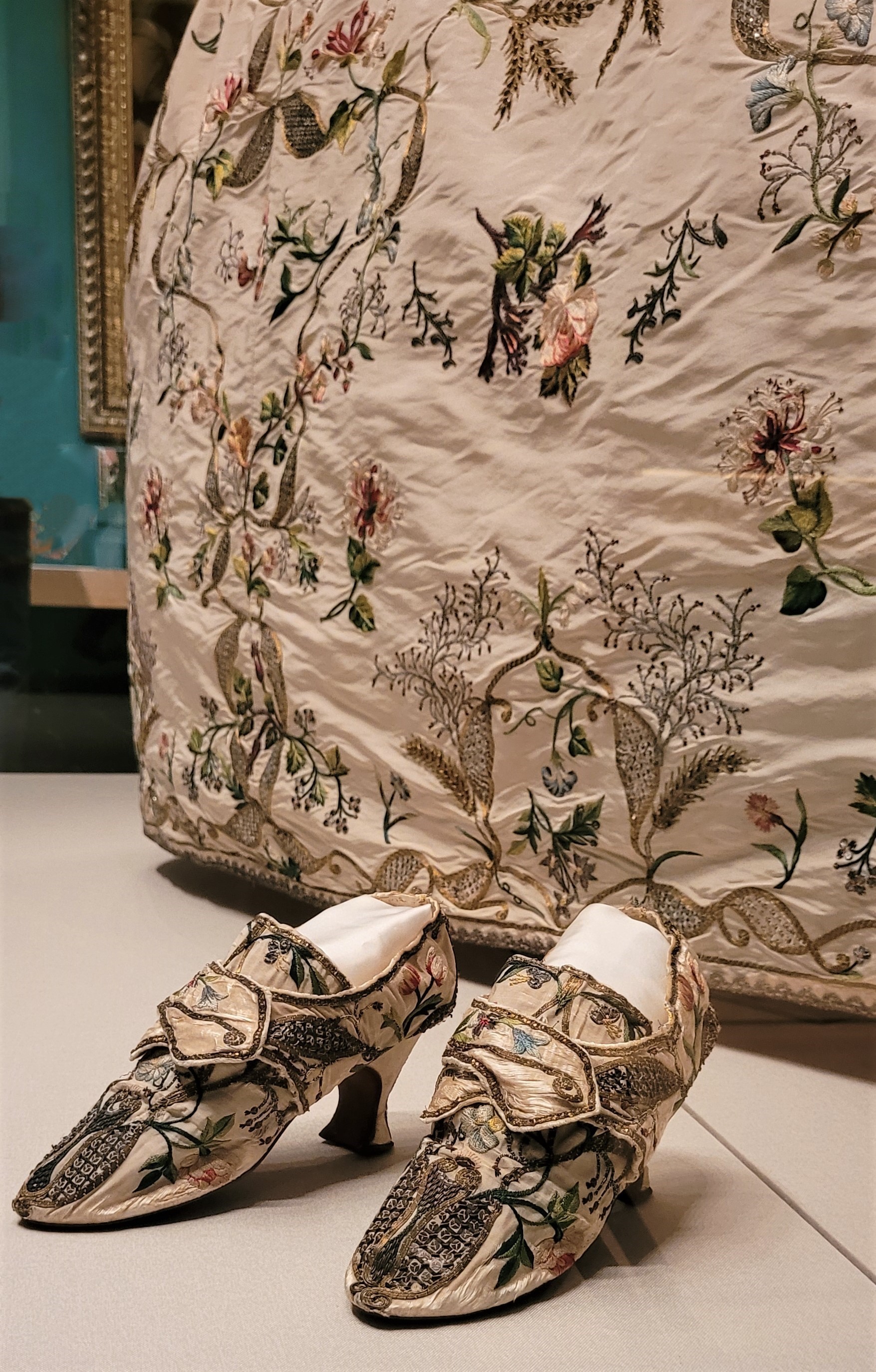
By their very composition and design, these grand ‘statement’ clothes were a powerful reflection of the wearer’s social status, affluence and aesthetic taste. They were worn to enable the privileged woman in question to set herself apart from the others, all likewise vying for the centre stage through the sheer size and splendour of their attire. The stunning piece in the Queen’s Gallery was the magnificent Mantua dress with its intricate floral details displayed across the vast dimensions of this dress unlike any other! With its incredible volume and the perfection of its details, down to the dainty silk slipper shoes that accompany it, this gown is simply spectacular. Possibly named after the Italian city of Mantova, renowned for its silk production, or in reference to the French manteau, the mantua gown represented a significant move away from the restrictive bodice that was a key element in the grands habits in court until around 1670. Indeed, this new form of dress towards the end of the 17th century was in fact more like a coat with its fabric draped and pleated to display the silk and numerous trimmings to their full advantage. Unlike typical formal garments that required careful structuring, the mantua, with its loose coat-like form was cut from one piece of fabric alone with a visible separate petticoat.
In many respects, the mantua was a variation of the banyan worn by men as a form of 'undress'; casual wear. Pleats hung from the shoulders and draped material was bundled up to form a bustle at the back of the gown. Initially, the informal nature of such garments met with disapproval; they could not be worn in the royal courts. Gradually, however, the mantua gown came to be accepted as its style evolved. Indeed, the pleated material at the front of the gown was decreased in size to form robings, and the bodice was opened to insert a stomacher – a richly decorated panel in an inverted triangular shape that gave a more elegant form to the whole. The stomacher was pinned onto the stays beneath the bodice and the robings on each side. The considerable size of the dresses and the fact that the stomacher was not sewn in but merely secured by pins meant that achieving unhampered, pain-free movement must have been quite a feat for the wearer! Not only was the unstructured mantua gown revolutionary for such women, it also radically changed the lot of many female seamstresses (known as mantua-makers) who were able to undertake the sewing of such garments, at a time when tailoring was the domain of men alone. It should perhaps be remembered that all sewing (and indeed tailoring) was performed by hand since no sewing machine would exist until the end of the 18th century..
With time, the mantua gave way to the sack-back gown that was imported from France. Although not as wide as the mantua, this robe à la française was initally voluminous with long box pleats on the back of the neck that led to a train which was obligatory in court. These were famously captured in the paintings of Watteau, hence the name commonly applied to refer to them; Watteau pleats. Gradually these pleats grew narrower and tighter whilst great importance was attached to the trimmings and embellishments of the robe.
Flounces, falbellas or furbelows and fly braiding– were sewn on the front of the dress, and likewise lace, bows and embroidery would decorate the robe or the visible petticoat below. To the long robings at the front of the robe were attached ornate quilles. Similarly, to the elbow-length sleeves would be sewn 3 tiers of scalloped ruffles and separate frills with separate lace cuff details – known as engageantes. Naturally, a pannier or hoops would be worn below the robe to provide characteristic form and volume. Of course, as with the mantua, the effect was stunning but as the Neo-classical movement began to take precedence in the latter part of the 18th century, the sack-back went out of fashion as waistlines grew higher, hoops and stays were discarded and therefore the full, highly decorated robes lost their popularity.

Strange Fruit and Faces...

Autumn again, not that you would truly notice that the seasons had changed if you based your impressions solely on the astoundingly high temperatures that are actually quite alarming. Nevertheless, the leaves are slowly starting to turn and will surely begin to fall in the days to come.
Meanwhile, with a more predictable and reassuring regularity, the ornamental gourds have made their appearance. Known as coloquintes here, these are striking for their vivid, contrasting colours but above all their curiously textured forms and extraordinary shapes. Almost as if Nature were amusing itself, strange horned growths, speckled ridges and weirdly irregular blisters emerge from otherwise smooth surfaces.
Wondering if these could be described as beautiful or somewhat ugly, or rather a mixture of the two, I remembered the unsettling, unparalleled portraits of Italian artist, Guiseppe Arcimboldo (1526 – 1593).
Known for his symbolical paintings of heads, composed largely of flora, flauna and of course vegetables, he created work that specialized in the grotesque presented with great beauty and detail; the inversion of aesthetic norms.
It seems odd that he should have been court portraitist under the Habsburgs but his ability to link nature and mankind, whilst highlighting the emperor’s power over all, surely gained him respect and a unique reputation. Naturally, this same obsessive fascination with the human form composed of elements from the natural world has also led to questions over his sanity ever since, but ultimately that makes his art even more enigmatic.

Sunday, September 17, 2023

Pansies, Pensées; A Penny for Your Thoughts...

The jaunty pansies are out for the harvest season and their strangely cheerful faces never fail to brighten up any mood, chasing away shadows and troublesome thoughts with their delicate simplicity...
The warm, sugary colours here look like something from a pâtisserie window, gently guiding us away from the overbearing (and unbearable) heat and blazing sunshine over the last weeks towards a more autumnal period.
The rounded flowers, gently ruffled, offer up their petals with veins leading to the mysterious depth of the head, or perhaps on the contrary these etched lines burst out from the golden centre, like ink bleeding across wet paper...
Peering up close, a white fringed border is visible just above the heart of each head - the stamen - like a whiskery moustache... Although the pansy does not strike us as a highly-scented flower, its perfume is discrete yet evident when the plants are grouped together and the scent of violet can clearly be picked up.
In French, the pansy is la pensée, and so what are my thoughts on this Sunday evening? My penny's worth; if only the weekend could stretch itself out longer and the working week postponed, but that's life, I suppose!
And finally, one of my favourite pansy paintings; part of one of Louis Wain's cat portraits...