I can no longer recall if I learnt of Spitalfields through
Dennis Sever’s House - 18 Folgate Street - or vice versa, but in fact that is irrelevant since the two are now so intertwined in my mind’s eye. The aspects of the district which I hold onto are a little like the essence that I retained of the museum itself in Folgate Street.
Both the old streets and No :18 present a "still-life drama" (Dennis Severs), being played out in an historical stage set that can be peered into and perused at great length and wonder. Having entered the reality of Dennis Sever’s make-believe world, with its evocative play on all the senses in this beautiful Georgian townhouse, I wanted to go out looking for the traces of other lives over the centuries.
How many other Huguenot silk-weaver families and their descendants, like the Jervis family, are bound up in the fabric of the surrounding Spitalfields ? Behind the façades of similar townhouses, there must be a wealth of stories to be read or narrated, all far richer than our modern-day diet of easily-accessed screen-fodder - swipe-friendly, bite-sized fact and fiction. The addictive facility of streamed TV series that spoon-feed our starved imaginations make the tale of the Jervis family, spun by Dennis Sever, and the story of the actual house itself all the more remarkable.

A visit to No :18 is to walk into an experience that demands total submission. Should you miss or dismiss the sensorial cues of sight, smell and sound, you will not sense the full presence of the family members who have just left the room. These are evasive yet all pervasive individuals with lives that are acted out on the various floors of the house, spanning the 18th and 19th centuries. But this discreet world is only open to those ready to see this imagined reality in the present instant – for here believing is seeing.
No point in trying to relive this at a later moment via video or photograph; no cameras allowed... Without the modern-day props of incessant chatter, bright lights and gaudy visuals, to ‘guide’ and dictate, the visitor must rely on heightened senses and imagination to give belief and body to illusion and suggestion.
Although at best you are merely a voyeur to the lives within No: 18, ultimately you leave its confines with the freedom to feel the potential stories behind and beyond the reality of the world outside… or not. Regardless, Dennis Sever’s ’living museum’ continues to weave its stories of the lives of its inhabitants, and the house itself continues to live on, as living history.
The same is true of the old Spitalfields townhouses, which perdure regardless of present ownership which forms part of a continuum of change. The properties themselves are the main protagonist in this play. Whether purchased or created, as in the house of Dennis Sever, each one is key player and its essence is set by the weight of its own past lives, interwoven with the lives of all its past residents. For over time, each leaves his mark, as a patina on this rich historic mantel which provides life, continuity and community.

The preservation of such townhouses and other civic buildings that make up the urban landscape is essential to maintain the spirit of the place. Whilst the nature of a community may change with the influx of inhabitants – significantly so in the history of Spitalfields – its spirit should not. Integral to maintaining the heart of a community is the survival of the historic buildings and grounds that are central to a collective identity, albeit adapted to changing needs.
Such buildings must still act as backclothes to our lives as living entities in their own right ; we are not their definitive owners but passing custodians. The demands of all-intrusive modernity should not dictate the destruction of all trace of the past, to make room for changing lives and lifestyles that will likewise be replaced by others in the future. Surely redevelopment should not be synonymous with brutal demolition or its hypocritical partner in crime ; facadism.
The area that was to become Spitalfields - one of the city’s oldest industrial suburbs - was initially fielded land belonging to the priory of The New Hospital of St Mary, founded in 1197. It occupied the corner formed by two Roman roads – today Bishopsgate and Aldgate High Street.
St Mary Spital, as it later became known, was one of the largest Medieval hospitals in England. It was however, largely demolished in 1539,victim to Henry VIII’s dissolution of the monasteries.

Subsequently the land was built upon in order to provide residential areas on the very outskirts of the overcrowded City of London and to accommodate the industries that were settling in ‘Spitalfields’. From the Middle Ages onwards, brewing and the clothes trade dominated there. Situated beyond the walls and laws of the comparatively affluent City, Spitalfields had its own vibrancy, becoming home to a steady influx of individuals who converged there by choice or necessity. The industrious shared the area with the impoverished who likewise rubbed shoulders with social outcasts of all kinds, alongside beings of a criminal leaning.

As foreigners were not allowed to live or work in the City, new communities set up in Spitalfields and the surrounding districts, each leaving its mark there, but none so much as the Huguenots. The Dutch Protestants took refuge there from the late 1500s as a consequence of the wars of independance from Spain in the 1580s and Spitalfields silk-weaving started to grow as a cottage industry. It was yet to become the dominant source of employment and revenue in the East End.
In 1685, following the revocation of the Edict of Nantes by Louis XIV in 1685, over 50 thousand Huguenot Protestants fled persecution in Catholic France and many came to London, bringing their own skills, knowledge and customs. Many had already been tied to the textile industries on native French soil, while others had already been directly involved in silk-weaving in Lyon or Tours, but most were now central to the growth of the English specialised silk trade in all its aspects. At one point, a quarter of the inhabitants of the area were said to have French as their mother tongue. Suddenly, the most lavish, sophisticed silks were being manufactured in Spitalfields itself and even their names convey the rich, luxurious nature ; watered silks, paduasoys, lustrings, brocades, coloured mantuas…

The English supply and demand for silk grew exponentially with the establishment of the Huguenot silk-weavers in Spitalfields, to the point that the 18th century was refered to as the ‘Age of Silk’. Despite its availability, silk was not accessible to all and remained firmly a luxury commodity that reinforced social differences. Indeed, according to one proverb of the time, ‘We are all Adam’s children but silk makes the difference’. This use of such fabric to reflect and uphold social standing and hierarchy was not of course new. Already in the Medieval period, sumptuary laws had been introduced to prevent the inappropriate wearing of such fabrics by socially inferior classes of society.

I couldn’t help but think of how today’s most coveted items of clothing and footware – of rich and poor alike worldwide - are made of ubiquitous plastic and synthetic tat. Has this modern tsunami of trainers and sportswear swept away the desire for delicate items made in noble materials that cater for individual aesthetic tastes? Ironically, the fur that was once the preserve of the affluent and the aspiring members of society, worn to mark special occasions and show social status is now used for the cheapest garments and accessories for daily use, without any real value for anybody who wears them but that’s another story…

In order to accommodate Spitalfields’ growing population, streets emerged of terraced houses that reflected the general move away from the Medieval narrow alleys with their densely-packed wooden buildings that had proved to be a veritable tinderbox in the Great Fire of London of 1666. In line with the 1667 Rebuilding Act under King Charles II, stone or brick had to replace highly inflammable wood as the primary building material.
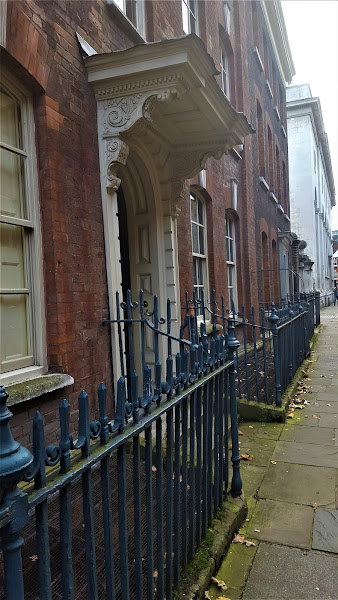
So it was that Spitalfields would grow with the mass construction of brick townhouses, providing tall, elegant yet largely functional homes. From the early 18th century many silktraders and weavers of Huguenot descent occupied these houses, many of which still stand today, spreading across the parish of Hawksmoor’s Christ Church. Weavers were frequently employed from these very homes by silk masters, working on looms that were set up not just for the key artisan, but also his wife and children too.

The upper floors of the townhouses were constructed with this usage in mind, as the high, wide windows running along the length of the facade afforded the luminosity required in these workspaces… Needless to say, the frequent fluctuations in the silk trade would send ripples of unease across Spitalfields, rendering the local economy unstable. The 17th and 18th centuries were punctuated by on-going struggles in the fight against poor working conditions and even poorer wages, and an ever-increasing threat of the mechanisation of the silk-weaving process.
The spectre of the engine loom with its multiple shuttles hovered over the industry, ready to herald the demise of the handloom and make its workers redundant in the process. In later years, the arrival of cheaper woven silk following the repeal of the ban on imported French silk took its toll. It is hardly surprising to learn that many of the criminals executed or deported came from Spitalfields and often from the silk trade itself….

One famous, yet rather elusive figure in the history of Spitalfields silk industry, is the designer Anna Maria Garthwaite (1690–1763). Her prolific output responded to a constant demand for new textile designs and patterns. Born into a good family settled in Lincolnshire, there was however nothing significant in her youth that would point to her artistic prowess as an adult. On the death of her father, she went to live with her married sister near York, where it is presumed that she may have learnt of the textile industry. Both women moved to Spitalfields Princes Street some ten years later in 1729, when Garthwaite’s sister was widowed.

Suddenly, it would seem, Anna Maria started to produce watercolour floral designs to be sold on to silk weavers. The reason for her decision to do so or indeed the origin of her great skill remain unknown to us and are of course open to much conjecture. What is certain, however, is that this individual went on to produce many of the finest designs to be found in Georgian England, in a trade monopolized by men. All this occurred at a time when almost no ‘respectable’ woman earned her own living !

Fortunately, she met with great acclaim during her lifetime as her silks – specializing in brocades - were highly desirable to the wealthy and powerful in both England and America. Her botanically-astute designs earned her recognition in the Universal Dictionary of Trade and Commerce of 1751 for having ‘introduced the principles of painting into the loom’. Whilst much of her work is conserved in the Victoria and Albert Museum, a trip to England won’t be on the cards for the moment but I do hope to get hold of a copy of Portrait of a Woman in Silk: Hidden Histories of the British Atlantic World, by the American historian Zara Anishanslin…

Although the silk trade did eventually decline in Spitalfields, the link to textiles and the garment industry remained as subsequent migrant communities took over and likewise occupied the old townhouses from the end of the 18th century and well into the 19th and 20th. The fate of the latter was far from assured however as these ‘merchant palaces’ slowly slid into disrepair over the long decades.

By the post WW2 years, the area was deemed to offer little but unsalubrious slum housing and by the 1960s demolition thought to be the only viable option. Numerous Georgian townhouses were destroyed in Spital Square and Hawksmoor’s Christ Church was even considered for the same destiny . Fortunately, the public outcry was heard and ultimately gained shape and form with the foundation of the Spitalfields Historic Buildings Trust in 1976. Even if the activists’ means were rudimentary – squatting certain derelict houses under threat of demolition – they were effective since properties were restored and safeguarded.

Today, large parts of the old silk-weavers’ neighbourhood have been gentrified, a trend whose merits are certainly debatable. The prices for property must surely be phenomenaI, ensuring that the possession of a home is truly the preserve of the lucky (fortuned) few. Nevertheless, I enjoyed walking around the streets, looking at the beautifully maintained doorways and trying to (discreetly) peer beyond the intriguing windows to see what domesticity looks like in such rich historical settings.
Fortunately the
Town House in Fournier Street allows you to get a glimpse of this. And so I for one, am just glad that these last remaining streets have been preserved, whatever the means, even if that does involve seeing that tiresome Chanel logo, and others brandished over a store in the ‘Old Spitalfields Market’…But all things considered, what’s a small price to pay..