Wednesday, October 16, 2019

Chapelle Foujita - All Things Great and Small...


I finally managed to visit La Chapelle Foujita, Reims, before its closure for the year. What a beautiful, bright day it was, both inside and outside this remarkable little edifice, whose decoration was the last project of the Japanese-born artist Tsuguharu Foujita (1886-1968) who spent a large part of his life in the country of his adoption, France.


The chapel, known as Notre Dame de la Paix, was a symbol of his conversion to the Catholic faith and a reference to the message of Peace on Earth issued by Pope John XXIII in 1963, with its emphasis on human dignity and equality.


The Romanesque architectural style of the chapel reflects the desire of the artist to recreate an evocative atmosphere of purity and tranquility, whilst allowing Foujita to express the Christianity that was central to his life in later years. Indeed, following a final trip to Japan in the late 1950s, he experienced a mystical enlightenment in the Basilique Saint-Remi in Reims and was baptised at the Cathédrale Notre-Dame there in 1959, some 60 years ago.


He had already obtained dual nationality in 1955 and his art came to symbolise the meeting of Orient and Occident. Spiritual themes are explored throughout the little chapel, with vast mural paintings and stained glass windows depicting scenes from the life of Christ.


"I built this chapel to atone for 80 years of sin" declared Foujita – who took on the name Leonard at his conversion, in honour of Da Vinci and a Japanese Jesuit martyr, Léonard Kimura.


Yet beyond the expression of faith and penance, I would say that this sacred place indeed seems to be above all a testiment to his own love of Life and all its living forms, from the spiritual to the most profane.


The last years of Foujita’s life were spent in the rural setting of Villiers-le-Bâcle, where a ruined country house was carefully transformed to become home and workshop. Designed to his own specific plans, the house allowed Foujita to devote all his time to his final work – the vast preparation of the chapel.

Far from cloistering himself away in cold, austere surroundings, however, in this deeply spiritual period of his life, Foujita seemed to have taken as much pleasure and inspiration from aesthetics as he ever did. His home, now the Maison-Atelier Foujita (awarded the title Maison des Illustres in 2011), is decorated with a wide collection of artifacts and art that were lovingly picked up during his travels, or designed and fashioned by himself.


 These were not selected for any specific monetary value, but were dear to him, satisfying and stimulating the artist’s eye and hand. Thus, furniture, furnishing, crockery, curtains were all confected by this keen craftsman, and found their place next to the eclectic objects and oddities that had caught his eye, such as the door to a Spanish monastery or a Peruvian jar…


As a unrepentant magpie, I find this quality admirable and endearing especially in today’s climate wherein pleasingly aesthetic treasures tend to be dismissed as pointless clutter, so that many homes today resemble bland showrooms for Ikea. Worse still, magpies are made to feel guilty or inferior for their desire to covet and collect…


Already admired for the multi-facetted nature of his talent since the early Parisian years of Les Années Folles, Foujita continued to apply his far-reaching magical artistic and aesthetic touch up to the very end of his life. Referred to as ‘the Lewis Carroll’ of painting by Jean Cocteau, Foujita had been an important figure in the avant-garde art movement, the Ecole de Paris, in 1920s Montparnasse, yet had not limited himself to merely drawing and painting.


Indeed, throughout his life, Foujita continually turned his attention to an array of different activities; engraving, book illustration, sculpture, ceramics, photography, fashion design and the cinema. His very appearance was an art form in itself and his unique style of clothing and grooming made him a highly distinctive, influential figure. The round glasses, earrings, moustache, basin haircut and eye-catching sense of dress left its mark on the café society that artists and writers frequented in the between-war years.


Women were instinctively drawn by his feline grâce, Asian reserve and a certain dandified sophisitication. The name Foujita is often associated with the artists’ model and muse, Kiki de Montparnasse and naturally with the many studies of nude female forms for which he become famous due to the opalescent luminosity of his depiction of feminine flesh.


Nevertheless, his work on cats is also highly valued for its expressiveness and fluidity of the draughtsmanship that convey the softness of feline fur and form. His innate ability to use the rigour and discipline of traditional Japanese linework in drawing and painting was combined with the fluidity and freedom of the Western artists from whom he drew inspiration.


Such influences spanned the centuries – from the great Classicist masters such as his name-sake Leonardo da Vinci to contemporaries like Matisse, Picasso or Modigliani or those much further-afield such as the Mexican muralist, Diego Rivera.


In fact, the chameleon quality of the franco-japanese artist is observed in the extensive body of his work, all of which bears the imprint of the multitude of influences left from his travels, studies and encounters. One constant however, remains Foujita’s love of cats.


Feline forms appear in his work and life, either as detail or main subject, in paintings, drawings, photos and even as a tattoo on his fore-arm. I don’t know if this feline fascination is a particular Japanese trait, as the present-day author Haruki Murakami shares a similar love. Admiration of cats is certainly nothing new in French art and literature – the lives and works of Art Nouveau painter and printer Théophile Steinlen (1859 – 1923) and poet Charles Baudelaire (1821-1867) famously reflect this…

Miké, the stray tabby cat with a protuding canine that Foujita is said to have found around the Parc Montsouris, appeared in numerous self-portrait paintings and photos. For Foujita, this cat as all felines, artfully combined the qualities (often contradictory) that Foujita admired and ultimately embodied himself; fussy and fastidious in grooming yet resistant in hardship, fierce but gentle, both wild and tame, haughty yet warm, approachable yet unattainable at the same time.

Self-portrait in oil paint - Musée des Beaux-Arts Lyon.

He also observed many of these same traits in the females that occupied his life and art and noted that they displayed the same fascinating tendency for duplicity. "I believe that felines were given to Man so that he could learn through them how to behave with women". One of his most famous works is the Bataille de Chats from 1940, that is an allegory of war itself, painted just before Foujita was obliged to return to Japan.

Foujita: Dora Kallmus

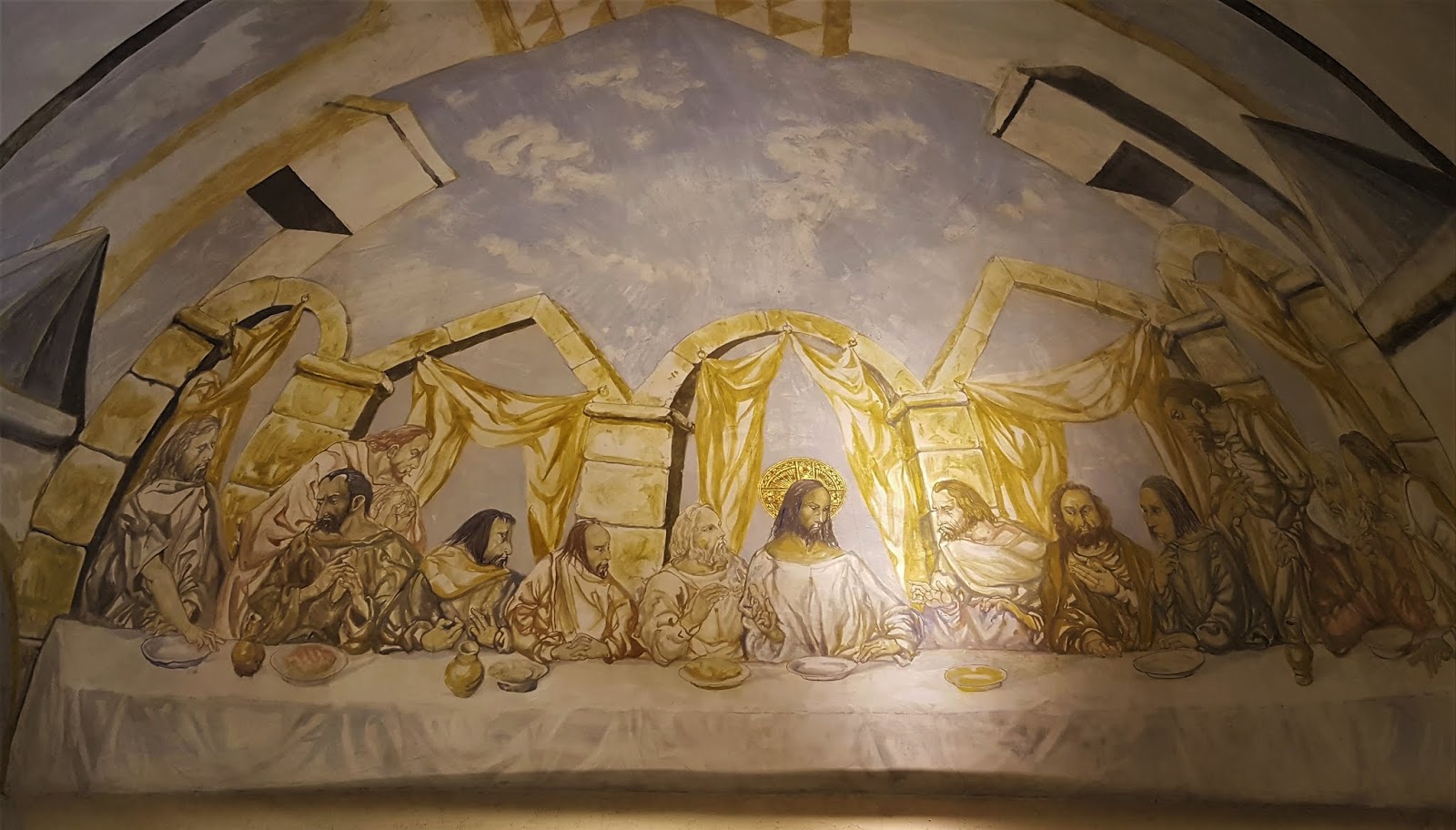
Here in the Chapelle Foujta, the frescos, stained glass and ironwork all focus primarily on scenes from the Bible. References are also made to Kimiyo Foujita, his wife, who is now buried next to Foujita in their final resting place; the chapel itself.


The mermaid plaque at the entrance of the building honours her, and she also figures in a portrait in a fresco scene.


Foujita himself is also presented, as was the commissioner of the work, René Lalou, President of the champagne house Mumm.


The cathedral of Reims, basilica of St Remi and the surrounding vineyards of the Champagne region are also featured.


Throughout the chapel, each decoration – be it mural or window – bears some reference to nature in small but significant detail. Beyond floral decoration, insects, butterflies, fish, warm-blooded animals of all types emerge from the vast surfaces and the smallest too...


Foujita may have devoted his last years to his reverence of Mary, his spiritual beliefs did not exclude the other keystones to his existence, and they actually appear to have embraced these too. Even the small mouse encountered during the painting process and subsequently fed by the artist, appears on a fresco!


The decoration of the chapel was finished remarkably quickly – within two months after the completion of the building itself – with Foujita himself climbing the scaffolding in order to paint his frescos on an area of almost 200 m2. This was no mean feat since he was already advanced in years (80 years old) and would die less than two years later in 1968.


Once started, a mural study would have to be finished that same day which meant that execution of the work allowed for little error or hesitation and demanded deft, light work. The chapel radiates love, light, warmth – even more so when the sun illuminates the natural brightness and colours of the murals and its rays shine through the stained glass, casting beautiful jewel-like colours on the wall and floors.


 The people studied are alive with emotion and movement – with expressions and hand gestures that seem inspired by the elongated forms of Mannerism, for example. The eastern-looking eyes however, are unique to Foujita as is the will to include the collection of creatures that look out at us…


This again, is one of the aspects that I probably appreciate the most about Foujita – the fact that any admiration of the animal kingdom does not need to be explained or somehow apologized for. The love of cats, or any other beast, does not make us any less human ; it makes us more humane. Love for life on Earth does not detract from spirituality – in Foujita’s work it is part of its expression.


Sunday, September 29, 2019

Greenery and Gourds in Le Jardin de Plantes...


A few weeks ago I went back to Le Jardin des Plantes in Paris to check on the progression of the decorative gourds that are the main feature of a number of flower beds there. The most impressive of these herbaceous vines are to be found in a tunnel trellis arrangement along the main path leading to the Muséum National d'Histoire Naturelle.


From the outside, the tunnel appears rather ordinary - like a leafy bunker - but once you peer within and the sunlight pours in between the drapes of greenery, you catch sight of the strangest suspended forms, dangling down, heavily from stalks, defying the laws of gravity and logic too! 


The length and weight of these gourds was truly incredible, as was their shape and the surface of their rind-like skin. Smooth, serpentine fruit hang alongside gnarled, oblong varieties, and odd pendulous clubs. It was difficult to believe that these are the fruit of rather delicate, unassuming flowers.


Gourds come from the Cucurbitaceae family, which also includes squash, pumpkin, cucumber and melon. Whilst most of this group of tendril-bearing plants are grown for consumption, the gourd is generally cultivated for its decorative, ornamental qualities.


However, it also used for its practical usages - as vessel and utensil - and finally as the basis of an amazing array of musical instruments. Some of the names alone are food for thought, with self-explanatory animal references; the snake, hedgehog, buffalo, coyote. My favourite name is, however, the Turk's turban...
I'm not sure what use will be made of the gorgeous gourds at Le Jardin de Plantes, but here are a selection - along with pumpkins and squashes - in my local health food shop.

Monday, September 23, 2019

Green Sheep Grazing...


On the usual dull trip to the supermarket, I was amazed to see a small flock of sheep clustered around trees in the storage grounds of one of champagne houses - Castelnau. I couldn't wait to come back to take a closer look!

These fine beasts have been brought in to operate an eco-friendly grazing mission on the scrubby grass and it is not the first time that these 'green sheep' have been called upon to maintain the land in Reims. The cemetery has already benefited from the services of these live lawn-mowers and trimmers. Sadly, and I think perhaps predictably, this does not always end well for the poor animals in question as there have already been cases in other regions of France wherein the sheep are stolen and taken away for barbeque purposes, or simply butchered on the spot in the most barbaric manner, presumably in the same aim. The joy of seeing pretty creatures pasturing on otherwise non-descript land obviously does not register in the minds of individuals capable of carrying out such acts. Anyway, I was thrilled to see them, and to notice that a number of beehives have been installed in the same area.


Eco-grazing animals also include horses, donkeys and goats, but some tend to get a little too enthusiastic in their feeding habits! The sheep here are Moutons d'Ouessant, a hardy breed originating on the island off the coast of Brittany.


The breed's numbers dwindled dramatically in the early part of the 20th century, to the point that it died out on the island in the 30s. Since the 1970s however, an association - GEMO (Groupement des Eleveurs de Moutons d'Ouessant) has fought to safeguard its existence and support its promotion.


The Ouessant sheep are noticeably small - at about 35-40 cm in height - and therefore do not yield a great deal of meat. A distinctive feature is the horns, possessed by the rams alone. These are impressive, flattened forms that loop around over the back of the head toward their shoulders, growing back toward the face.


The Ouessant fleece is generally dark brown or black but pale cream exists too, as in the sheep in the grounds here. This lighter colouring is said to be due to cross-breeding for increased meat production  and is therefore not characteristic of the pure Ouessant breed. The rams with the intense black wool did look a little sinister from certain angles!  Males also bear a rather impressive ruff of wool around their necks, framing the head.

Although sheep of any breed are not known for great intelligence, I did think these had a rather interesting look in their eyes, which are a beautiful golden colour.

I hope this little flock will stay safe and that this will lead to other eco-grazing projects around the urban landscape.


Saturday, September 21, 2019

In Harmony with Insects - Anima (ex)Musica...


This summer I was curious to see what an exhibition of arthopods in a ‘utopic bestiary’ would entail. Insects, arachnids, myriapods (and crustaceans) belong to this phylum and several imaginary specimens were on display for a few weeks to coincide with the annual classical music festival – Les Flâneries Musicales. Indeed, to celebrate the 30th year of the Flâneries were some of the most cunning creepy-crawly creations ever seen! These were beasts composed solely of the parts of old discarded musical instruments which had undergone the strangest metamorphosis in shape and substance.


Here was a collection of creatures which blurred the boundaries between the worlds of entomology, the plastic arts and music as they moved their long, spindly jointed limbs to produce curious clicking noises as they stretched, undulated, pivoted and shuffled. The most animated and striking of these were eerily displayed in a darkened room, with light projected onto the forms of these breath-taking protagonists.


Large transportation crates were also on show, just as if these were exotic, rather dangerous show animals. Inscribed alongside their images were not only the physical  precisions  – width, height, length and weight -  but also lists of the musical instruments that had been used to give body to these unusual beasts.


Parts of violins, organ pipes, tubas, trumpets, trombones, metronomes, cellos, clarinets, cornets, pianos, pianolas, accordions, zylophones, harmonicas, harpischords, guitars, drums, doublebasses, banjos, bagpipes, bells, string bows, synthesizers and speakers were cleverly recycled to emerge as exoskeletal anatomy. Heads - complete with eyes, antennae, feelers and mandibles - abdomens, thoraxes, wings and jointed appendages took on a whole new dramatic dimension!


Presented on their impressive, sizeable stands were a tropical centipede, giant cigale, Colorado beetle, stag beetle, oil beetle, bug, woodlouse, spider and grasshopper - all given the collective name of Anima(ex)Musica. These are all fascinating representations of the animal kingdom on a very imposing scale but become all the more intriguing as you try to identify the difference components.


Suffice it to say, this exhibition would probably not attract many arachnophobics or indeed anyone with a pathological fear of insects – termed entomophobia. Most people seem to have an instinctive dread of any encounter with a wasp or, to a lesser degree, bees, and their response is generally rather excessive, largely inappropriate and wholly ineffectual. How many times do you risk getting stung due to the dramatic swatting and batting of some third party whose actions only goad the hitherto inoffensive creature to exact revenge on the nearest flesh?


Incidentally, wasp phobia is known by the striking term spheksophobia (derived from the Greek form of wasp – spheco), whilst myrmecophobia signifies the fear of ants; katsaridaphobia is the fear of cockroachers; skathariphobia – the fear of beetles; lepidopterophobia  - the fear of moths and butterflies; scolopendrphobia – the fear of centipedes; orthopterophobia – the fear of crickets; apiphobia – the fear of bees and perhaps the most ‘logical’ of fears - that of mosquitos – anopheliphobia. 


The artists behind the creation of these insect exhibits are perhaps not entomophiles per se, but they certainly understand the importance of these tiny giants. The phylum Arthropoda, is the largest in the animal kingdom with arthropods alone representing 80% of living creatures. Nevertheless, they are generally much maligned and largely misunderstood. The trio of creators – collectively known as Tout reste à faire – have endeavoured to take us into a realm that is usually overlooked since the actors in this theatre are literally too small to scrutinize and are considered to be of little true worth. And yet it was Einstein himself who is said to have warned us that should bees be eliminated from our planet, Mankind would soon perish…


Over five years, Vincent Gadras, Mathieu Desailly and David Chalmain have studied entomological anatomy in order to « make visible the invisible », using the anatomical parts of old musical instruments that are likewise, little known and rarely held up for observation. How often are we able to study the intricate mecanisms and intimate mechanical parts of the instruments that generate the music that surrounds us? Furthermore, this musical recycling also enables the arthropods to find a voice – literally – as they emit strange noises when exposed to the steady flow of exhibition visitors.


The fact that the artistic creators requested the general public to donate their unused and unusable musical instruments by depositing them at the Conservatory of Music in Reims also generated a certain by-word-of mouth ‘buzz’ (sorry !). Finally, Tout reste à faire make clear the aim of this project: to halt the elimination of these tiny creatures that play such a huge role in the eco-system.


Sadly, I have to admit that there are a handful of creatures that I would like to see a little less of in the small universe of my flat and balcony. Insects, bugs and butterflies have come and gone over the months here, but in view of the tattered state of the leaves of the potted plants on my balcony, I feel sure that the vine weevils – beastly black beetles - are still actively feeding on my potted plants during their nocturnal raids, emerging at dusk to reap havoc on foliage and flowers. These resiliant creatures are now simply biding their time, lurking under leaves, fattening themselves up for a egg-laying blitz as they burrow under ground. Once this preparation has taken place, the harm will occur far below the soil surface during the overwintering stage as emerging larvae promptly set about gnawing and boring away at the root systems of my long-suffering greenery until ready to emerge as fully-formed evil weevils next Spring.


An incredibly resistent being, the weevil must be one of the ultimate banes to any gardener since this uninvited guest is unlikely to abandon its host environment, even with the greatest encouragement to do so. They must surely be an example of evolutionary perfection – fit to thrive – and their ultimate sign of defiance is the fact that the female does not need a male to reproduce and can lay hundreds of eggs in one session…


Beetles and bugs are often confused for one another – or are simply referred to as creepy-crawlies and then grouped with spiders, wasps and itchy things as globally-acknowledged unpleasant pests. However, there are distinct dfferences between the two. Bugs, from the Hemiptera order, have sucking mouthparts with piercing ‘stylets’ to feed on sap or nectar. They also have membrane wings, and undergo incomplete metamorphosis to reach their adult phase.


Beetles, of the order Coleoptera, have three distinct body regions – head, thorax and abdomen – in common with all insects, yet these are not necessarily visible when observing from the beetle from above. Transforming from the larval stage to adulthood, the beetle has a complete metamorphosis yet the constant feature throughout each step of their lifecycle appears to be their formidible appetite, aided by munching mouthparts. Powerful mandibles allow the beetle to devour plant or animal substances, as l have learnt from experience and considerable expense. The vine weevil has a strange ‘snout’ arrangement, but that does not make it any more endearing, I have to say.


Meanwhile the other beetle type in this household - the carpet variety – is equally maligned due to the voracious feeding of its larvae – commonly referred to as the ‘woolly bear’. Very little to find cute or attaching in this specimen either – especially once it has pock-marked clothes or any article of animal origin (feather/fur/felt/hair etc), having grown tired of its staple diet; dander.


In common with most adult beetles, the carpet beetle has elytra – hardened forewings that form a shield to cover the membranous hindwings when not used for flight. As the remarkably small adult beetle flies innocently about your home space, it is initially hard to associate this will the greedy grubs that cause criminal damage in the dark recesses of your wardrobe. Just like the vine weevil in your garden, the carpet beetle is devilishly hard to part company with, once it has taken residence in your home and the liquidation of larvae and the bashing of beetles will take up a considerable amount of your time in. All is fair in war, I have no qualms here and take no prisoners.


It seems unjust that spiders should get such a bad press when they do very little damage, destroy insect pests, and spin amazingly beautiful, intricate webs. I had a close encounter with another type of weevil earlier this month – in a Goldilocks moment. « Who has been eating all my porridge ? ». In fact, the offenders were almost eaten by my good self as I mistook the small dark forms in my rolled oats for Chia seeds – until I noticed how they were crawling about my cereal bowl. I resolved there and then to wear glasses for future breakfast preparations!


Living on the fifth floor, we rarely have any truly exotic visitors, winged or otherwise, however there are a few exceptional moments. Few and far between, these visits are of great interest and entertainment to the cats.


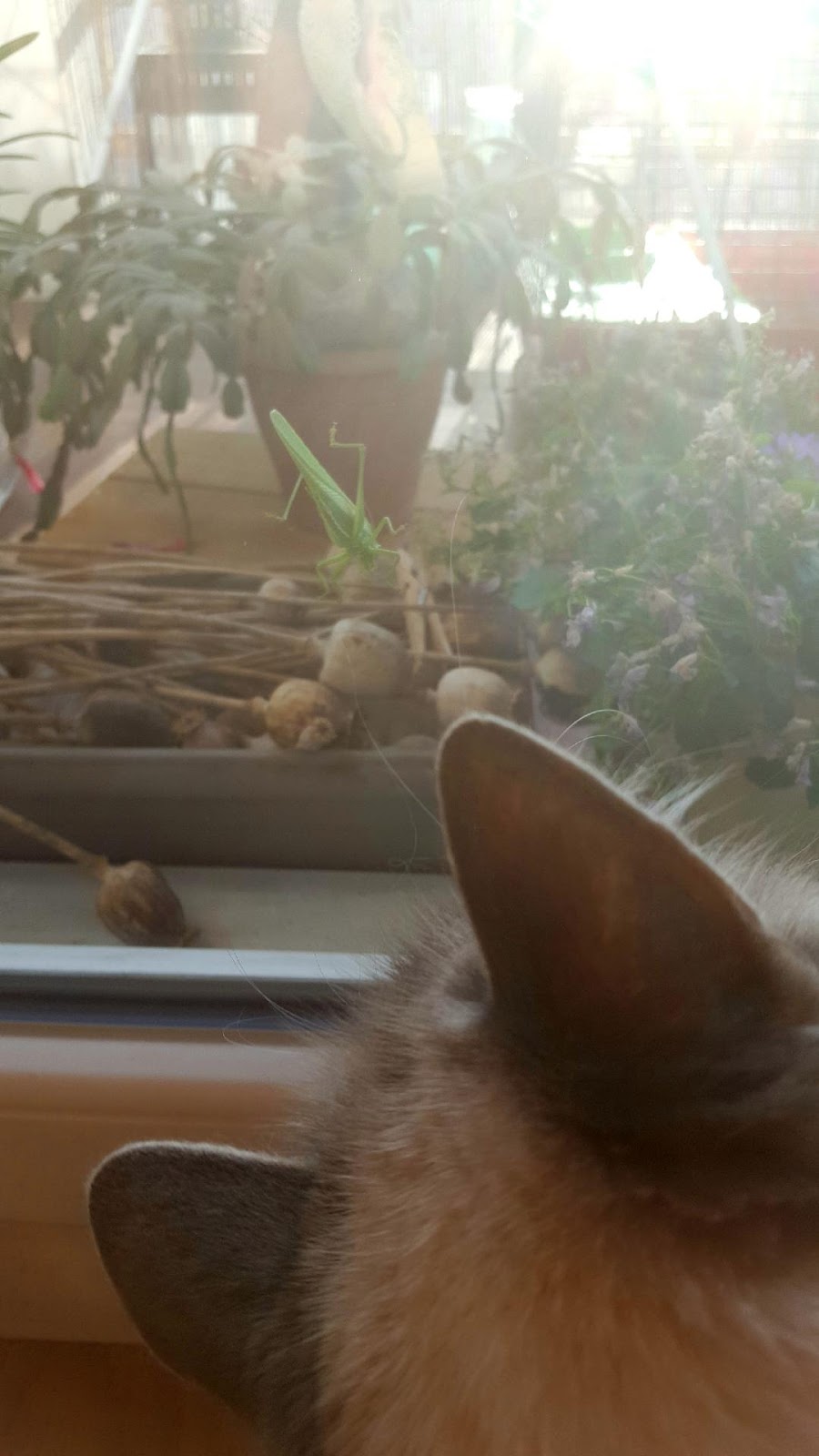
This summer, the arrival of a sizeable grasshopper on the window  was therefore met with astonishment and a certain amount of feline frustration since the beast in question was on the ‘wrong’ side of the glass, and no amount of scratching would deliver it to eager paws and jaws.


Things took another dimension however that same night, when the grasshopper made its way into the flat and was leaping and flying around the confined space, with both cats in hot pursuit. This was definitely one of the highlights of the cats’ summer and yes, the grasshopper did live to tell the tale as we managed to guide it back out onto the balcony.