Thursday, August 15, 2019

Notre-Dame de Paris...


The year here has been one scorched by searing heat and tensions reaching boiling point. The full force of rage and frustration exploded on the street with the continued demonstrations of Les Gilets Jaunes. Initially sparked off by rising fuel prices, the flames of anger were soon fanned by all forms of social, economic and political injustice. This feverish atmosphere seemed to prime the country for the surge in climatic extremes which have surely been some of the clearest manifestations of global warming. However, the image that burnt itself in me is that of Notre-Dame cathedral, engulfed in flames in mid-April.


This was not a human tragedy, comparable to the inferno of London's Grenfell Tower, for example, where the cruel sequence of events led to a devastating loss of life, in unspeakably awful circumstances as the tower was rapidly transformed into a monstrous blazing torch, ensnaring its inhabitants. Notre-Dame de Paris was something else...


The shock and sense of loss reminded me of the scenes from the aftermath of the US-led invasion of Iraq in 2003. This was the very beginning of the Second Gulf War and each day news poured in with accounts of the tragic civilian casualties and the first deaths in the armed forces. These were all harrowing. However, amid all these images of chaos and devastation, appeared the footage of a distraught young man, pleading the international community to help the museums save the precious relics that were being looted. Sobbing, he explained that the identity of Iraq was being ripped away; past, present and the future. Combat was decimating the country around him, reducing civilised life to rubble and now the pillaging of ancient artifacts was depriving Iraq of its very foundation stones, set in Antiquity. Without roots below, stems, branches and growth above, land is but dust., and life is merely survival.

A similar sense of mourning for the loss of heritage seemed to make itself apparent with the unearthly vision of Notre-Dame ablaze. That night, it was not even sure that the last remaining structure of the cathedral – the twin bell towers - would withstand the flames to survive till dawn. Without these structural ‘bookends’, the vaults would surely have collapsed and the entire building lost. Had this happened, the whisperings of this 850-year old building would have been silenced and the vital human traces that have spanned the centuries like a thread or beam of light would have been cut. Although the edifice was first and foremost a place of spirituality – Catholicism – its significance goes far beyond this. Born from a desire to communicate Godliness, Gothic architecture emerged in Northern France, where a new dynasty of powerful French Kings, flanked by bishops, wished to prove their religious devotion and the extent of their unparalleled might and wealth. Through dazzling constructions that would literally reach to the heavens, all viewers were stunned to submission by the dizzying heights, blinding luminosity and vivid colours of these cathedrals and churches. From the emergence of the Gothic style, with the transformation of a large medieval abbey church into the Basilique Saint-Denis in a northern suburb of Paris around 1140, many edifices grew in an unprecedented manner. Each of these was a testimony to the ability, daring and dedication of the hundreds of craftsmen who toiled over the decades to create a vision of divine perfection; architects, engineers, masons, stone-carvers, sculptors, stained-glass artists.


The successful realisation of each work and its survival to the present day is heavy with past sacrifices. Each piece in any cathedral bears its weight in blood, sweat and suffering. Not only were the workers directly involved expected to give their all, but the commoners too, since they were required to pay taxes and tithes to finance these projects, despite their peasant status. From the beginning of its construction in the 12th century, throughout the centurIes up to the extensive restoration work in the mid-19th and beyond, Notre Dame’s history is a long litany of tales of toil and hardship but one also of the glory, beauty and the depth of human creativity and resiliance – both cultural and spiritual. We will never know anything of the lives of these thousands of individuals who contributed to the existence of the cathedral, but their common voice is carried through every detail of the building. In this way, a vital essence of all these beings has been caught and preserved – like an insect in amber - thus creating intransience that reassures us, yet points to our own mortality. Indeed, for the majority of us, our time on Earth will leave little lasting trace, mere footprints in the sand that are destined to be effaced. The cathedral, like the other great edifices of history still standing today offers a ‘whole that is more than the sum of its parts’, to borrow Aristotle’s words. It has created a bond of humanity and spirituality between past, present and future. To behold such an edifice is a humbling experience and therefore to see its destruction is tragic.


On the fateful night of the 15th April, Notre Dame was ravaged by the flames and the subsequent water that doused these; both posed an obvious direct and immediate threat to the entire structure. Without the weight of the roof, parts of the vaulting and the subsequent weakening of the stonework, the intricate equilibrium of the cathedral was fatally disrupted. The whole construction of any of the great Gothic cathedrals is strong through the mutual interactions of all its parts – wherein horizontal force is met and counterbalanced by vertical thrust. Once this play has been compromised, stress is redistributed and the entire structure is at risk of imploding. Notre Dame no longer has the weight of its spire and roofing to act as ballast to withstand the horizontal force of wind, whilst the flying buttresses now exert an unbalanced thrust inwards. This has meant that since April, all measures have been taken to avoid the collapse of Notre Dame rather than commencing concrete restoration work, especially given the extreme heat during this summer’s heatwave which has further stressed damaged masonry. Added to these key considerations, are the major concerns over the hazardous debris that has contiminated not only the area directly surrounding the cathedral, but also the streets around the Ile de la Cité. As tons of lead melted in the blaze, many toxic particles became airborne and were spread freely in the wind, contaminating buildings, soil and the water of the Seine. This exposure to high-levels of lead pollution naturally presents a risk to the on-site workers and local residents of the adjacent streets and will require extensive decontamination measures. In view of these titanesque obligations further compromising a cash-strapped government, spending millions of euros on returning Notre Dame to its fomer glory may seem delusional. It is argued that the cathedral should be secured structurally, but left as a symbolic ruin. But what would it symbolize exactly? Unlike Notre-Dame de Reims, which was devastated in the early stages of the First World War and then heralded as the emblem of the martyred city and country, the cathedral of Paris was the victim of fire. Notre-Dame de Paris did not fall victim to a force majeure or an act of God – but by a presumably preventable incident which was then dramatically compounded by a set of clumsy failures in communication. To say this was unfortunate would be an understatement, but the cause of the fire cannot be attributed to a ‘great’ event, merely a series of errors. So what now?


The weeks and months have now passed; the billowing smoke has long since subsided, the ashes have settled and now scaffolding envelopes the damaged structure like crazy webs, whilst the limbs of giant cranes lean across like predatory spiders. Deprived of its impressive roof and spire, the nave has now become a charred hulk.


From the exterior, the whole structure indeed ressembles an empty vessel - la nef (nave) being the old term for navire or ship, it is now apparent why. The distinctive form of the cathedral apse that stood majestically over the Seine, has been likewise truncated. The gutted interior of the cathedral is still too dangerous for workers to clear rubble, although robots have been able to carry out some work. Meanwhile, the parts of the masonry and sculptures that were intially lined up, like corpses on the parvis in front of the cathedral in the days after the fire, are now securely hidden from sight. Long lines of barriers encircle the grounds, obscuring the view of this crime scene without a criminal. High above, the row of kings gaze down from the main façade, as they always have done, yet now they seemed stunned and glassy-eyed… .


From the outset, money literally poured in overnight as the public mourned the devastation of one of the most important symbols of French history and culture, not to mention one of its greatest places of Catholic worship. Within days, millionaires and key figures in the corporate world were vying with each other to pledge the highest sums of money in order to raise up this 850-year- old edifice, in phoenix fashion. The readiness to give such vast financial backing to this cause soon drew indignation from many quarters. It was remarked that these bottomless coffers which had remained tightly-shut for social issues of a more contemporary nature, were spontaneously thrown open for an ancient monument that had perhaps done its time. Funding Notre Dame’s restoration is now almost perceived as some elitist gesture, for the benefit of the Happy Few. This saddens me since this restoration work should not be considered as being pitted against social causes, in an open competition for financial hand-outs. It is not a case or either/or, wherein the two are presented to the benefactors to select their ‘worthiest’ mission. How many of the wealthiest beings on Earth squander their money without donating anything to any cause whatsover, unless you cite the narcissistic endeavours of their conspicuous consumption?

Surely if these billionaires donated such vast sums, that should, in theory at least, have freed the government’s funds to concentrate on balancing social inequalities. To point out the fact that poverty exists in the streets just beyond Notre Dame seems facile since it always has done, ever since the very first stone was set, however unfortunate that may be. Further afield, the cathedral of Saint Denis is now surrounded by some of the poorest living conditions in the capital but that does not mean the monument is involved in the perpetuation of this sorry state of affairs. If necessary restoration work is refused these ancient monuments, what will remain of our cultural landscape and heritage? Fastfood outlets, bland franchises, discount stores and the like, standing next to banks, estate agents and so on?


Although financial backing is not an obstacle to the Notre Dame conservation project at present, the coming months and years will surely be scattered with doubts and practical stumbling blocks of great proportion. The most significant of these is perhaps finding a manner in which the building should be restored. There is no obvious, ready-made solution. Naturally, traditionalists would like to see Notre Dame resuscitated and brought back to its former pre-fire glory. However, this raises a few points. Many people consider that it would be an error to embark on a restoration project that would faithfully replicate the design of Notre Dame – even if extensive laser imaging from 2015 provides a highly-detailed digital template of the edifice. It is believed that a replica would not be true to the organic spirit of Notre Dame or the cultural history of the capital. A redesign would therefore be more fitting for a past revisited and paid due respect in a unique manner. After all, much of the structure lost was in fact designed by Eugène-Emmanuel Viollet-Le-Duc, in the latter half of the 19th century. The innovative 750-ton central spire covered in lead and the vaulted roof were thus ‘fake’ Gothic since they had themselves replaced the original 13th century work. Viollet-le-Duc himself had incorporated certain modern practices in this undertaking, and in so doing seemed to anticipate the ideas of composer Gustave Mahler - “Tradition is tending the flame, not worshipping the ashes”.


Meanwhile, in the tradition of former French presidents who have embarked on cultural projects, Emmanuel Macron appears to see Notre Dame as his opportunity to leave his political and personal mark on French history. He stated that at the end of an initial five-year deadline the world would discover a "creative reconstruction" of Notre Dame, representing "an alliance of tradition and modernity, a respectful audacity". That particular time slot, set to coincide with the hosting of the 2024 Summer Olympic Games, has been shown to be unrealistic, but ambitious plans are still held for restoration work under Macron. Prime Minister Edouard Philippe announced an international architects' competition for designs in order to replace the 19th century spire. Several highly-original proposals were put forward – most of which are indeed imaginative, audacious and highly inappropriate. I won’t even bother to include any images of the ‘whackiest’ of these, as most seem to be a bid to get world-wide attention and some kind of shock-value acclaim for the individual ‘designer’ prepared to make irreparable changes to this iconic edifice. Buildings such as these, as indeed most artifacts, have been bequeathed to us all collectively by History, and we are duty-bound to honour and pass them on to future generations.

Why are we then talking about mediatized projects which appear to be acts of self-promotion, peddling the whims of personal tastes? Why bother with these ‘exciting’ present-day statements when we could be concentrating on state-of-the-art technology and modern materials to lift the cathedral up again, as in the case of Reims cathedral in the inter-war years? With the financial backing of billionaire American John D. Rockefeller, the whole roof of the Notre-Dame de Reims was replaced by a structure supported by an incredibly innovative concrete framework, invisible between the roof and the internal vault ceilings it supported. This is not so disimilar to the predicament of Notre-Dame de Paris which has lost the original frame that was built upon a complicated lactice structure of centuries-old oak beams - known as ‘the Forest’. Fortunately, Notre-Dame de Paris has the status as a Unesco World Heritage site and a law enacted by the French Senate, concerning the regulation of the restoration work, now has an addendum specifying that this should preserve the "last-known visual condition" of the monument, including the spire. The stained-glass windows will probably be restored and/or replaced too, since many have suffered thermal shock due to the extreme contrasts in temperature during the firefighting. This is indeed an opportunity for contemporary artists, just as it has been in Reims since the First World War. Over the years, generations of master glass artists from the Atelier Simon(Marq) have worked on the cathedral windows, and those of certain churches around the city of Reims. Other artists have contributed too - namely Marc Chagall, Maria Helena Vieira da Silva (Eglise St Jacques) and Imi Knoebel. I am still trying to be won over by the work of that latter maître verrier however...


I don’t know what will happen over the next few months or years. We must hope that this monumental work of restoration will be undertaken by the most capable panel of professionals who understand that they have been entrusted with the task of marking our collective respect for this great edifice for now and posterity. I am not sure what lesson we can draw from the fire in Notre Dame, except perhaps to appreciate what beauty we have, from the most sturdy-looking structures to the most delicate. Before seeing Notre Dame in May, I came across the poppies in Le Jardin des Plantes - the flower beds were aflame!


Monday, July 22, 2019

Lions in London - The V & A Museum...

A bashful-looking lion with its cub.
With a large back-log of blogs that have not materialized, I need to make a move! Here are some of the amazing noble beasts that I saw in May, in the Medieval section at the Victoria and Albert Museum, London. The lions in question were presented in many mediums - sculpted, carved, molded, painted and woven creatures.

Although the mighty lion might well be the king of the jungle, and therefore synonymous with royalty, the range of expressions on show here was quite extensive, and not merely regal or haughty!
Some of the representations were bas-reliefs, as in the above, in stone and then ivory...


The lions looked a little cowed or just plain quirky, but certainly not fierce!
The ones below were carved into stone to form the decoration of well heads, from mid-15th century Venice.


In fact, they often seem to adorn many of the forms of access to water. Below is the detail on a fountain basin from mid-16th century Verona; Italy...


Other lions support vessels and water once spouted from their open jaws...


 The following water spout emerges from a dragon's mouth that initially springs from the lion's mouth (late 15th century Lucca, Italy).


My favourite lions were perhaps those used as aquamaniles (water ewers) for the ceremonial washing of hands. The funny wisened expressions and pigeon-toed stances were unique!


Pillars of stone and wood were held up by valiant lions...


Or ones that looked more sheepish...


The following, rather worried-looking beast has guarded the monument of a Veronese military commander since the early 15th century.


The poor creature really does look as if he has the world on his shoulders - literally, whilst his tail curls beneath his legs...


Other lions seemed more carefree - clambering up pillars with their dense tails furling around them like marmoset monkeys.


Finally, the chivalric representations on stained glass bore the typical lionesque pose...


As did some of the woven and painted works, with lions demonstrating their strength, baring their teeth and powerful claws, ready to strike...


Proving their rightful place in the animal kingdom...


Although sometimes they did not seem too convinced of this themselves, and look on with quizzical expressions!


Monday, July 15, 2019

A Prime Day for Reckoning...

One of my favourite sections from the façade of Reims Cathedral...
Despite appearances, I am not on an Amazon-bashing mission! However, as their Amazon Prime Day is about to take place, for 48-hours of frantic shopping, I wanted to consider a few things that have led to a number of discussions here. The flood gates are set to open, and the virtual cash tills ready to rake in record amounts of money, even surpassing sales for Black Friday and Cyber Monday. For Amazon, there are not only huge gains to be made in revenue, but in loyalty too, with membership numbers increasing as basic customers pay a subscription fee in order to gain elite access to the prime deals. It appears to be a golden win-win situation...

Prime Days occur but once a year, but nowadays, almost on a daily basis we seem to be learning of the dire work conditions at Amazon. The end of year festive period already appears to be anything but jolly for the armies of frenzied workers who pack and parcel in order to honour everyone’s Christmas list requirements. You therefore can’t help but wonder what the peak summer-time Prime Days entail for employees, when the heat is on, in every sense.

The massive Amazon warehouses are ominously-called ‘fulfillment centres’, a term that rather recalls the Ministries of 'Love, Peace, Plenty, and Truth' in Orwell’s Nineteen Eighty-Four. Without a doubt, these centres enable Amazon to meet and go beyond the expectations of its millions of customers, just as it has done since 1994. Its product range, competitive pricing, delivery speed and efficiency mean that Amazon wins hands-down in online retail, across the board. But a dark-side is beginning to emerge that taints the present, and hints towards an troubling future.

Ugly stories of pressurized workers, struggling to maintain seemingly unrealistic, almost inhuman targets, timings and deadlines abound, all along the Amazon chain. Orders must be processed within a set time-limit and the momentum of this giant machine must be kept by each and every cog, in an uninterrupted manner. The storage of products and their efficient distribution requires a formidable organisation at each stage to keep this juggernaut rolling. Standardization goes hand-in-hand with optimization and productivity… Unfortunately, the work force here is largely based on fallible human capital, with its flesh, blood, foibles and feelings – for time being at least. Crushed by restrictive time-windows that open and shut with stop-watch precision, obliged to cut corners at every turn, monitored by Big Brother tracking systems, the employees inside and outside the centres feel the burn. In the drive for efficiency, warnings and terminations are swiftly issued to any worker whose performance fails to hit target after training. Curious names are given to the various task workers that start to resemble humble insects, scurrying and toiling away in a parallel universe, that feeds ours. Unloaders remove goods from the trucks arriving at the centres so that ‘water spiders’ can distribute these to the work stations. ‘Stowers’ then stock this inventory into shelving units referred to as ‘pods’ and ‘pickers’ pluck desired items from these, ready for ‘packers’ to box and load them up, for shipment. The group of workers who intervene in areas where robots are at work are sinisterly known as the ‘amnesty team’. Boxes are finally distributed by delivery men using a hand-held device known as a ‘rabbit’. Naturally, significant parts of this vast process of customer fulfillment relies on intelligent automation – robotics – and elaborate computing. In the search for increased and improved performance, and faced with the growth of scale and pace of its activities, Amazon is surely set to hand-over ever greater responsibility to state-of-the-art technology. Not only will this revolutionize the shop floor for online retaillers, but will also lead the way for their giant bricks-and-mortar competitors such as the mighty Walmart. More important still, this practice will set a pattern for industry and commerce and in general, just as ground-breaking as Ford’s assembly line in production.

 Although Amazon has not yet implemented a management by algorithm system, it is leading towards a structure that relies heavily on I.A and A.I. Indeed, Amazon has already acknowledged that the idea of a ‘lights out’ warehouse is already on the map; for the moment they must wait for high-tech to deliver the means to roll this out. At the dawn of this brave new world, job losses are to be expected, as human workers are let go - their manual tools laid down at the feet of machinery that affords incomparable speed and efficiency. Amazon need not even lay workers off, since the work conditions are already such that all but the most desperate employee would gladly leave of their own accord in many cases. Certainly, given the menial, mind-blowingly repetitive, poorly-paid, often hazardous nature of the work, it would be preferable for all concerned to hand it over to sophisticated automation. Since this work is so dehumanizing, why should a human work force be shackled in this way?

But that leads to the next question; what of the redundant workers? Technological unemployment is nothing new; already in 1930, John Maynard Keynes drew attention to "unemployment due to our discovery of means of economizing the use of labour outrunning the pace at which we can find new uses for labour". Naturally, new jobs will be created in fields that we cannot yet envisage in this unchartered territory, but will these be notably more fulfilling for the individual concerned or yield better results for society overall? For many ways yes, as technology opens up a world of exciting, challenging opportunities to facilitate work and improve conditions. Computors – however smart – cannot, as yet, do everything and will still require human intervention. But that is not the whole story….

Everything is geared towards consumer satisfaction, profit margins and boosting economies, but there is more to life than purchasing goods and services and corporate bottom lines. Society is held together by far more than the latest intelligent device – sociable or not. A small but significant example; the cash tills that are being dropped in favour of scanning decks. Give me a human cashier any day for basic shopping transactions! How is simple human contact going to be maintained through creepy digital personal assistants such as Siri, Cortana and Alexa? What satisfaction can former cashiers possibly glean from standing up all day, supervising the very scanning device that replaced them? Training and education will undoubtedly open many possibilities, but could these cater to everyone’s needs? What of those people who no amount of coaching and teaching could ever adapt to modern work expectations because they simply do not have the intellectual faculties suddenly required? What about workers who were perfectly content and suited to doing the dull, routine work that has been suppressed or is now carried out by some I.A?

No doubt Amazon will break records over the next two days, but I wonder where this will all lead us… and them. It feels as if a day of reckoning or reflection is long-since due. We relentlessly consume to excess and fail to notice that in this process we are perhaps letting humanity get sold short. Ironically, Bezos - occasionally referred to as the 'anti-Christ' of the workplace - initially wanted to name his company 'Relentless', but opted for Amazon instead. Either way, the flow is ceaseless, carrying us along, sweeping away any obstacle that slows it down, but drowning much of what is in its path too.


Sunday, July 14, 2019

They Shall Not Grow Old....


Ever since hearing of Peter Jackson’s 2018 documentary film of the life of the British soldiers on the Front in WW1, I had been very keen to see it. They Shall Not Grow Old was aired on BBC television on the one-hundredth anniversary of the Armistice of 11 November 1918. It came out in France this July…
Stunned viewers are immersed in a first-hand experience of the trenches, based on the impressions left on those who had experienced the «war to end all wars» between 1914-1918. The faded distant past is brought vividly into focus, and injected with colour, sound and lifeblood through the digital restoration and remastering of original 100-year-old footage. Film director and producer Jackson was asked to take on this project which was co-commissioned by 14-18 NOW (the UK arts programme for the Great War centenary) and the Imperial War Museum in association with the BBC. From hundreds of hours of British war footage, taken from the archives of the BBC and the Imperial War Museum, this unique film emerges, captivating us as the voices sound out from the past, and the colour seeps out from the frames to swamp all our emotions.


Not intending to be a historical documentary, with set factual detail of names, dates and place, the film first plunges us into the anticipation and flurried preparation of war. This is presented in stark black-and-white, as hordes of civilians finally set off as ordered troops of soldiers.Veterans’ voices rise up throughout the film, recounting their experience in a harrowingly frank, matter-of-fact way which has not been dulled down and flattened by political correctness. The accents and attitudes vary, yet the sense of camaraderie is overwhelming, uniting a motley crew in the most unlikely manner. As the mud and horror grows in the confusion and inhuman conditions of the trenches, colour suddenly flows into the scenes so that we feel the pulse of life in all this devastation. The red of the symbolic poppies burns out of the dull backcloth of tortured landscapes, just as the blood lies vivid on mud-splattered bodies. All sense of bearings, purpose and logic is lost in the morass of warfare, with its seas of mud, stagnant water and spilt blood. In this blur of lost boundaries and identities, the soldiers start to perceive little difference between themselves and their foe. All are ultimately soldiers in the same war, «getting a job done» on different sides, yet experiencing the same hardships and thus drawing a strange humanity in the most inhumane circumstances.
                               
Horse bust - Birmingham Museum and Art Gallery
Peter Jackson dedicated the film to the memory of his grandfather, but as he said, it could have been created in the name of anyone’s loved one from the Great War, irrespective of class, race or nationality. There have been a number of criticisms directed at the film – from the French public at least – claiming that the work fails to mention les Poilus (French infantrymen) and as such is too chauvinistic. However, this was indeed an English film; the numerous mentions of the nice cup of tea and sentiments towards the battlefield beasts of burden – horses, mules and dog leave the viewer in little doubt of that! It offers an account of the Tommy impressions and images of the Front within regiment, based on many voices, not just one narrator who tells his own story of the war. Yet those impressions and images were shared by all the soldiers of the 14-18 War. Furthermore, this generation which sacrificed so much largely drew the same conclusion ; the Great War had led to unprecedented slaughter and had achieved very little. The cruelty and carnage of war have been captured here in this great film, but so too has humanity and beauty, arising like the light, sound and colour under the master direction of Jackson.

                                   They shall grow not old, as we that are left grow old: 
                                        Age shall not weary them, nor the years condemn. 
                                        At the going down of the sun and in the morning 
                                        We will remember them....
                                                             
                                                  For the Fallen - by Laurence BINYON  (1914)

                                                  
                                                 'Mademoiselle from Armentières'

Sunday, June 30, 2019

Free Trade...


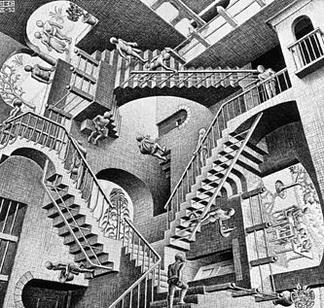
Here is part of another piece of work by the street artist Levalet - this time taking the form of an extensive installation set in the former chateau of Rouen business school. Called Libre Echange, it offers a nightmarish vision of aspects of our modern-day existence which is given over to procurement, served by globalized supply chains and fed and fuelled by 'fulfillment centres'. This might be Free Trade, but these delivery men are caught up in a cycle that is worthy of M.C Escher's staircase, and reflects the illusion of progress that has ensnared us all.

Relativity, by M. C. Escher. Lithograph, 1953.
Goods are being shipped around a closed circuit in a tidal ebb and flow that is gaining momentum as we consume ever more yet get nowhere. With this relentless, unprecedented movement of parcels and packages, it is Xmas everyday and yet the whole process has become somewhat meaningless.


    Gradually, the idea of something – anything – being delivered comes to have more importance than the actual contents of these cardboard boxes. The need to reach an elusive point of fulfilment forces us onto the hedonistic treadmill which speeds up and grows in size as the supply chain becomes a global loop. This in turn becomes a shackle or noose, holding us back while slowly asphyxiating us. Amazon meanwhile, looks on with that enigmatic smile - or smirk - and we should indeed die laughing from the irony, as the company laughs all the way to the bank alongside its stable mates; Google, Apple and Facebook.


Although initially set up as an online dealer of books in the mid-90s, Amazon was never destined to be a one-trick pony. More than merely spreading its wings into other areas of retail as an ‘everything’ store, Amazon has duly branched out into virtually every conceivable domain. It has long turned the page on the plodding, physical world of paper – to the point that few people even know the company was first built on books.

Amazon has turned to domains that would once have been the realm of pure sci-fi prior to the massive breakthrough in internet accessibility and usage in the mid 2000s; e-commerce, cloud computing, digital streaming and artificial intelligence. But even this was not enough...


It has taken on the the biggest and the best in all fields, given all competitors a wild run for their money, and generally won every game, through the sheer scope and scale of its activities. Now the 21st century titan wants to go far further still. Size provides leverage, and Amazon has already demonstrated how it can wield its power and authority in order to transform live on Earth. Today, much like a latter-day Captain Kirk, Bezos wants to steer his travel company, Blue Origin, to boldly go where no man has gone before. With his sights set on the Cosmos, he is investing billions to conquer the final frontier; Space.


Back on the Blue Planet, where is this vision of a Brave New World leading the average terrestrial ? This vast multinational tech company has transformed the dynamics of the marketplace, the highstreet, our consumer expectations and more importantly our habits in the most exciting ways. But I can’t help but wonder if that smiley Amazonian arrow has not just shot us through the heart.
Between them, the giant GAFA has brought about a seachange on every possible level of human activity and behaviour. From cradle to grave, from to A to Z, our lives are being facilitated by the Triple A Triumivirate; Apple, Alphabet (Google) and Amazon. We all benefit from the supply of revolutionary goods and services that tech companies offer. Amazon has put customer satisfaction before profit, understanding that loyalty means growth, and scale yields power. Power means that you are accountable to no one. Amazon fights to charge less, ensuring that the ‘price is right’ and that the purchase conditions are hugely attractive. Nurturing our addiction to knock-down prices, speed and convenience, Amazon offers a deal that is simply too good to refuse. Yet ultimately these companies will get far more than they give - profitting hugely from our custom, now and in the long term. The game has already changed and powerful influences shape account-holders on every level in a world that is ever-more connected but increasingly disconnected from the basics. Most of us are now wholly or largely reliant on the internet and the tech companies behind it for the smooth running of daily life. Could that herald our making or our undoing ?


At a click, we have access to everything. Surely this should make us more more content than at any other moment in human history? The doors are open to a wealth of information, education and entertainment that was inconceivable in the past and yet we do not seem to consider ourselves any richer for it. We have the most perfect tools that seem to have been delivered into imperfect, untrained hands.This, in turn, is corrupting minds that are ill-prepared for such an onslaught of high tech and this is making us vulnerable, not invincible. Even children born with a smart device seem to pay a price that no amount of slick online thrills will ever compensate. While trying to perfect human experience through technology, mere humans are losing what has always separated man from beast, and man from automaton The thirst for convenient, cheap consumption is permeating everything – material and immaterial. Creativity, critical thinking, consciousness are being imperceptibly modified, so that our rough 3D vision of life and ourselves is being smoothed down to arrive at a flatter, photoshopped face-value, Facebook version.
Of course, the positives in this high-tech world are innumerable, offering magical possibilities. And yet, I do not envy anyone born ‘connected’. We have tripped ourselves up and tumbled on this new step of human evolution; momentarily at least….


I have occasionally used Amazon to buy second-hand books  – to my great satisfaction - but the realisation that its business model has rung the death knell for many physical book shops has soured the experience. Worse still, the fact that reading literature – physical or electronic -  has lost out all round in modern-day life is truly saddening. Ironically, it was Amazon - the trail-blazing bookseller offering their wares dirt-cheap- that set much of that process in place. Their innovative business model helped change our vision, on and off-line. Now, our all-consuming devotion to consumption and commodification in the connected universe has left us with little time for Amazon’s initial golden goose; books.


When something is sold cheap, it is ultimately perceived as worth little or nothing.

Outside the amphitheatre at the business school

Poppies along the Canals and Concrete...


Last day of the month again, and yet again a rush to finish off a few posts before midnight...
I have such a backlog of blog material - none of which has taken any form which is even vaguely 'postable'  - so I won't be respecting any real chronological order.


 As I was rowing a few weeks ago, I saw all these beautiful flowers and grasses along the paths and cycle tracks that run parallel to the canal. I went back to photograph them from the safety of dry land!


I was particularly thrilled to see some magical pavots pharmaceutiques which appear to have escaped from the industrial fields scattered around the region. These cultivated poppies are quite hard to locate so this made this encounter all the more special.


The mauve petals were offset by the more common-place red poppies, of course, and their colour was picked up by the violet vetch too. The final effect was even more striking due to the bright green of the canal water in the sunlight. The last yellow flags of Spring were still holding in there, before this week's raging temperatures set in.


Finally, a stunning wildflower field (albeit artificially sown) near the concrete complex that has grown in the most pervasive manner all around the TGV train station. Ironically, just a few years ago the whole area was just simple fields before this ambitious development project took off. Nevertheless, this vast stretch of flowers really was a beautiful sight...


Hexagon Wall-Hanging finished... At last!


Someone has been helping me throughout my crochet sessions on the wall-hanging that kicked off last autumn. This has been a long process and yet someone has taken great pleasure in settling on the wool in its various states, over the many months.


Sometimes alert...


At other moments less so...


Quite hard work, it must be said...  It now just needs to be hung correctly, in its completed state. Here's hoping that neither of the cats try to escalate it once it is finally up!