Monday, December 20, 2010

Plenum gratiae et veritatis...

St Jean; Montmartre
Plenum gratiae et veritatis - grace and truth - comes from the prologue of the Gospel of St John, Verbum caro factum est. Here in this stained glass window from the Evangelist church of St Jean at Montmartre, we typically see the Holy dove - image of the Holy Spirit, and symbol of peace, hope and truth. As one of the four apostles, along with Matthew, Mark and Luke, John was said to be the closest to Jesus Christ and is often symbolized by an eagle, whilst an angel, a lion and an ox respectively represent the former.


 Considered to be the enemy of the snake, symbol of the devil himself, the eagle is able to reach celestial heights, has all-seeing vision and is said to withstand the blinding light of divine truth. It is the eagle which generally supports the lectern in churches and cathedrals and it is the lectern, of course, which bears the Bible, with the Holy word.


The majority of the sacred Christian edifices from the Middle Ages and beyond offer scenes of Judgement Day.

Notre Dame; Paris
From a  Burgundy cathedral
These present in no uncertain terms what will happen to those lesser mortals who have strayed from the Holy word.


Sinners' ill deeds are noticably considered and weighed and those led astray by temptation are separated from the saintly... Some may be cleansed by Purgatory, others not...
Reims cathedral
For those who remain unpurified, evil creatures are at hand to visibly herd them together and haul them off to Hell, often presented as a flame-licked cauldron.
Reims cathedral


The sinners, understandably, look petrified and perhaps a little repentant....


Meanwhile the devil and his fiendish helpers appear jubilant, brazenly looking directly at us as surrounding saints and angels look on with more modest expressions... There seems to be little hope of earthly redemption, as the devil has already claimed the souls of his sinners....
A Burgundy cathedral


Famous for having heard the word of God, and yet being killed for this and her role in leading the Dauphin Charles to the sacred city of Reims to be consecrated King, was Joan of Arc - La Pucelle d'Orléans. Frequently seen as symbolic of the resistance of France against the enemy, Joan of Arc's intervention meant that  the long-standing hostilities between the English and the French took on a distinct religious aspect.
Joan of Arc; Reims
The Hundred Years War had begun in 1337 and were made up of a succession of disputes over the French throne. When Joan emerged on this tinder-box historic scene, the English had virtually gained dual monarchy under English control. When Joan was tried and condemned for heresy and witchcraft the legitimacy of the coronation of Charles VII was questioned, enabling the English to have a claim to the throne. She was burnt at the stake in Rouen in 1431, the body being burnt twice again so that relics could not be collected...
Unfortunately on the photo the national heroine looks as if she's just been struck in the course of a huge snowball fight which doesn't seem very respectful, especially as we English showed her no mercy and certainly flouted all laws....
Palais de Justice; Reims
This weekend I've been marking all my Law faculty students' exam papers....
Lex is the Latin word for law - meaning the system or body of laws, written or unwritten, to be applied to a case or issue. Meanwhile jus is the word for justice which is often  portrayed its allegorical  form on the facades of lawcourts, with the symbol of Justice, Justicia holding the scales to measure right and wrong, legal, illegal, in order to rectify the imbalance. She also bears a sword, ready to cut the line between the parties concerned. In French the verb used to describe the judge's decision-taking is trancher, meaning literally 'to cut'. The Goddess of Justice also wears a blindfold to show that she is not as such blind, simply not blinded by prejudice.

I decided to set a theme I always find fascinating and therefore more interesting to work through - namely the nature and difficulty of the role of the criminal defense laywer...The gut reaction to the ethics of this line of work is often the same, but is generally because we fail to see that the duty of the defense lawyer is ultimately to defend the integrity of democracy and the justice system and thus avoid any individual, be that the accused or the plaintiff, being oppressed or abused by law, and victim to miscarriages of justice. Well, that's the theory, but it does help to bear in mind even if it can often be difficult to comprehend, so I do enjoy reading what the students have to say on the subject, before being obliged to measure their work and give them a final mark.
Reims ( I didn't put it there, honestly! I just love his expression!!)
I myself don't like beer, but a glass of wine after my day's work of  weighing up is welcome!

And just before I finish, in general terms, I suppose it might be appropriate to quote Shakespeare's The Merchant of Venice...

The quality of mercy is not strain'd.
It droppeth as the gentle rain from heaven
Upon the place beneath. It is twice blest:
It blesseth him that gives, and him that takes.
'Tis mightiest in the mightiest; it becomes
The throned monarch better than his crown.
His sceptre shows the force of temporal power,
The attribute to awe and majesty,
Wherein doth sit the dread and fear of kings;
But mercy is above this sceptred sway;
It is enthroned in the heart of kings;
It is an attribute to God himself;
And earthly power doth then show likest God's
When mercy seasons justice.

Monday, December 6, 2010

Le Train Bleu.... Restaurant and Railway Line

Central 'track' of Le Train Bleu restaurant
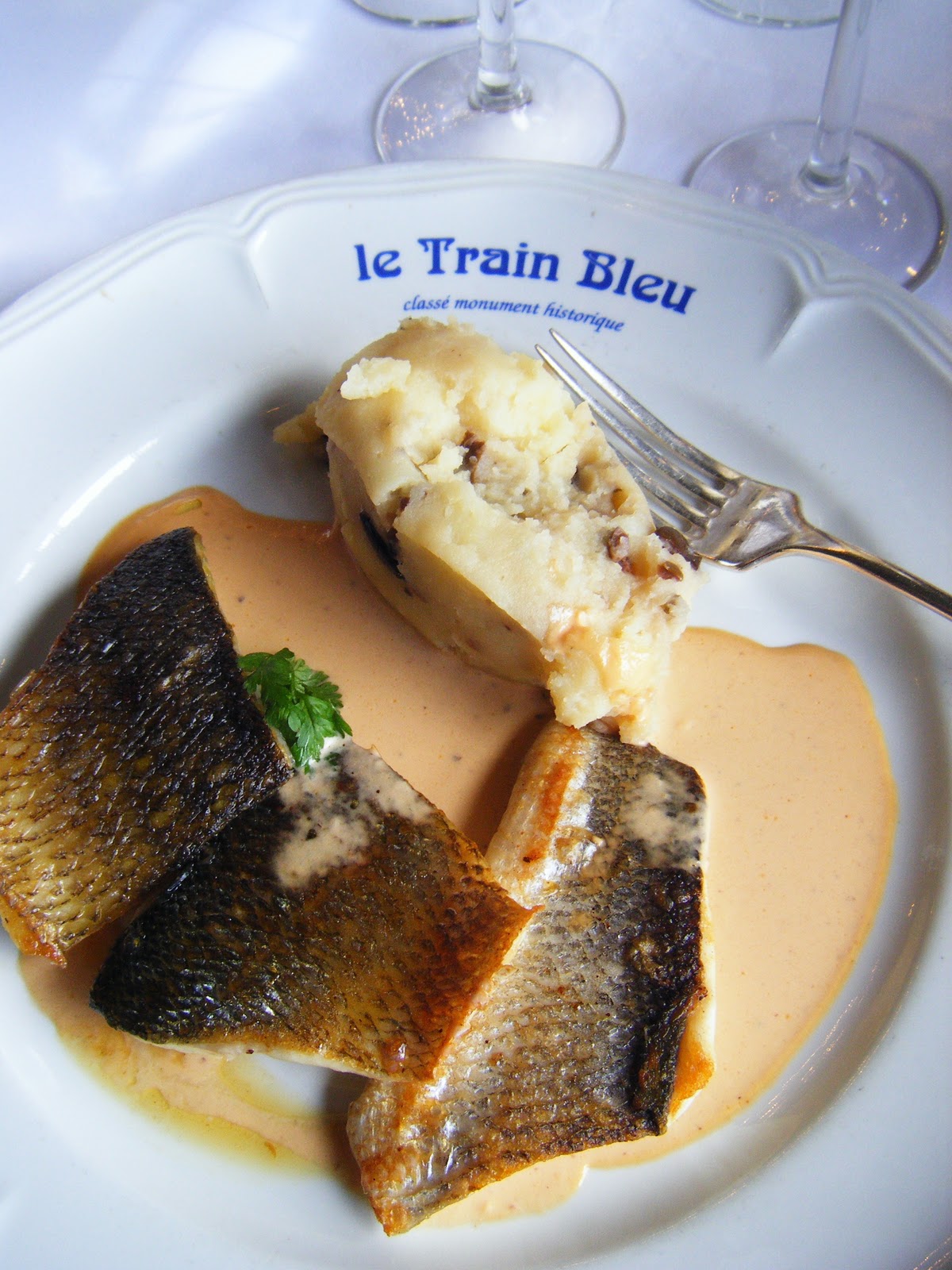
Having repeatedly heard about Le Train Bleu restaurant in the English Sunday newspapers I finally gave in to curiosity and went to pay this renowned historical site a visit a few years ago. I certainly wasn't disappointed and have been back several times.

The Train Bleu Menu
Most of the old European train stations are like vast cathedrals to19th century travel, with their huge vaulted glass expanses and ornate fretwork rising up above like neo-Gothic structures whilst their tracks stretch out before us like veins linked to new lives. However, it is perhaps rare to have an actual glimpse of these potential horizons, savour the mood of other landscapes far from the capital and to feel yourself transported in time and space whilst sedentary in the station itself...
Seascape wall panel
Just above the central platforms of the Gare de Lyon, overlooking the activity and routine of travellers and strictly timetabled trains stands the unchanging Train Bleu.

View onto the platforms and tracks


 Here, you are able to experience not only the majestic, sumptuous decor of turn-of-the-century Paris, crystalised and reflected all around you, but also to sample the azure horizons of the Train Bleu's destinations on the French Riviera.


And that's without mentioning the fact that you do so whilst eating and drinking exquisitely! This strange mixture of elements and extremes forms the magic of this establishment set in a listed monument and also makes Le Train Bleu unique since it is accessible to travellers or the general public alike - even those of more modest pretentions.

The Train Bleu restaurant as we know it today did not bear that name at its beginning in 1900. Initially it was rather modestly and unimaginatively known as the Buffet de la Gare de Lyon. However, the historical context  gives more insight to the decor of the restaurant than its original name on its conception under the Second Empire.


It was constructed for the Exposition Universelle, along with Le Grand and LePetit Palais, le Pont Alexandre, and was decorated in the lavish style of the Belle Epoque for the PLM - the railway company Paris-Lyon-Mediterranean.

The decor is richly ornamented with gold stucco, beautiful crystal chandeliers and wide windows looking out onto the busy Parisian streets of the 12th arrondissement and the tracks themselves fanning out below and beyond the restaurant. The walls and ceilings are decorated with scenes from le Côte d'Azur, representing the play of southern light  which brings out the different colours of the sea and landscapes which offer a foretaste to the South-bound passengers and whetting the appetitite of the city-bound Parisian diners.

The restaurant is set out with original train features or elements that reflect those - from the leather banquettes to the brass luggage racks, however the final atmosphere is in no way cramped since the light-filled restaurant stretches out the full length of the station.

 Indeed, on the far left-hand side as you enter the restaurant  is Le Big Ben café/Bar with its burgundy armchairs and rich curtains creating a relaxed atmosphere, a little like gentlemen's Victorian pubs.
The nearby restaurant toilets are an experience in themselves with their old original ceramics and tiles and a slightly more modern shoe-polishing machine.
Central time piece and the emblematic French cockerel
At the other far extreme is the great buffet piece, mounted by a very proud golden French cockerel. This same Gallic pride is displayed by the in-house buffet cat who can be seen as he non-chalantly makes his rounds, observing the customers with insouciance, ignoring their advances and any petty notions of Health and Safety that seem to plague England.
One of the diners with a little canine company (not the coat!)


I particularly like this more relaxed, tolerant attitude in such majestic surroundings and was delighted to see that one of the elegant, rather well-heeled diners had a small Daschund peeping out onto the table from behind her fur coat and a glass of champagne, which yapped discreetly at regular intervals!


As for the Train Bleu railway service itself, this was initially a luxury train launched in 1922 for a company of sleeper wagons from between Calais and Ventigmiglia. Just the names themselves conjure up the glow and Twenties glamour of the French Riviera - Marseille, Toulon, Saint Raphaël, Cannes, Juan-Les-Pins, Antibes, Nice, Monaco, Monte-Carlo, Menton and San Remo in Italy.....


 The train's name reflected the choice of colour for the decor of the carriages and it was a name that remained whilst the more elitist pretentions of the train did not. Although earlier passengers included Charlie Chaplin, Chanel, Winston Churchill  and Scott Fitzgerald, after the Great Depression of the 1930's there were fewer affluent passengers from America and England. When the Popular Front nationalised the train, second and third class travel was offered to French citizens of a more modest milieu.


The last official Train Bleu ran in December 2007, however the line has been immortalized in various literary, musical and cinematic works -Agatha Christie's The Mystery of the Blue Train being just one such example.


Even if you can't visit the Train Bleu restaurant in person, you can always visit it on the official website - complete with a video.
 http://www.le-train-bleu.com/fr/index.php
Another possibility is to watch the extract from the Mr Bean film - for although it may put you off eating oysters, it will nevertheless whet your appetite for a trip to this fantastic restaurant site which was officially recognized by André Malraux in 1972.
And finally here's a song by France Gall, Cézanne peint, to put a little sun into a cold winter's day.
  http://www.youtube.com/watch?v=NkfLDwaEMrM
Route de Cézanne - Aix-en Provence


Sunday, November 28, 2010

December will be magic again!

So, December will be magic again....Well, that's more a wish than a statement of fact...But before being snowed under by work, and possibly actual snow too, I am determined to make the most of this time of the year, since there are so many things to catch the eye and the appetite in order to savour the season. In fact, although we can now hear the robin singing early every morning there are still some vestiges of the past months...especially here in the Champagne region.
The last remaining grapes - just outside the Management School....

Of course there is also our local Sunday market with all the usual bright colours that seem even more so when the temperature drops and the skies get heavier...
Clementines from the Sunday market...
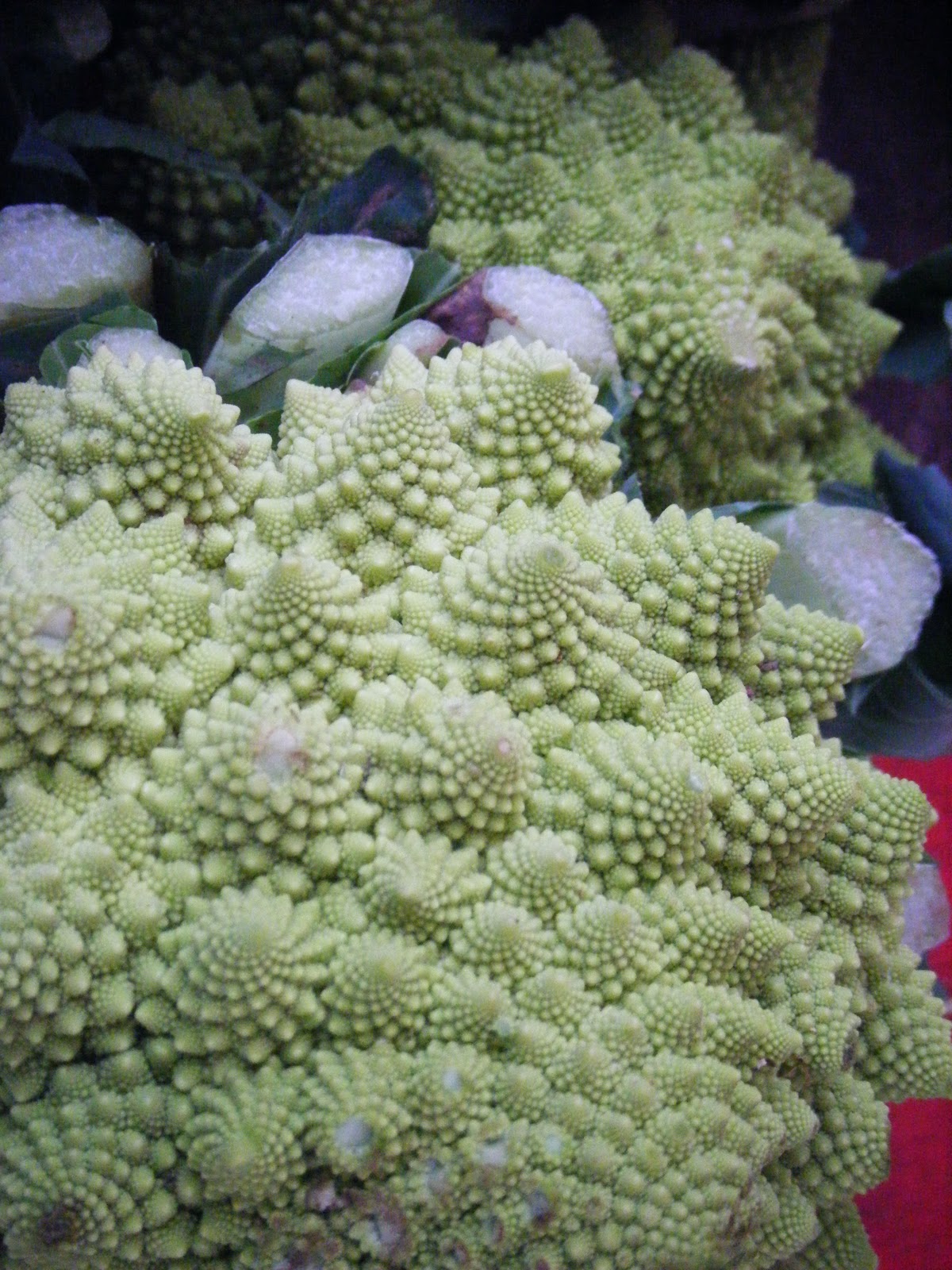
 These just seem to smell of December, along with the roasted chestnuts that are sold on the main place here...The Romanesco brocoli this morning even managed to look like mini futuristic fir trees from a certain angle!
Romanesco brocoli
Despite the cold, there is some activity in the garden, and I love the dew drops on the last spiders' webs - a little like silvery decorations on the Christmas tree, glistening as they catch the light.
Last web from the garden...
So, on that note I am going to start to prepare for the arrival of our own Christmas tree... With a kitten this should prove interesting - quite a feat, in fact. The Christmas cakes were made weeks ago and we're off on our annual day trip to Canterbury to see the pantomime next Saturday. After all, it was perhaps no coincidence that my son was born on Christmas Day!
Here is the link to a track of Kate Bush that I always loved.....December Will Be Magic Again.... Well, what else! Even if my experiences of the season haven't always lived up to my expectations, this song never disappoints!
http://www.youtube.com/watch?v=UVd4PIL4jSk

Saturday, November 13, 2010

Green glass beads.... Elusive green to die for.

Reims cathedral
Green glass in all its forms and colours catches my eye and draws me in everytime, but especially when there is a play of light or reflection. One of my favourite views is that seen through the transept of cathedrals and churches in faded light which gives a sense of watery depth.
Greenhouses and their reflections, Jardin de Plantes; Paris


This same effect can be seen here, in what was sacred place of discovery and display in Victorian times; the greenhouse.
 Autumn raindrops in the garden
From around the newt pond this summer
Growing in the pond


However, nothing can have quite the same effect as green glass beads...
Glass bracelet I made using Swarovski beads, and black 'seeds'


Handmade earrings and  Swarovski ring...
With its green glass beads stolen from the moon, I loved this poem, Overheard on a Saltmarsh, when I was a child and even today it still has a magical feel. It was written by Harold Monro (1879-1932), with the illustration by W. Heath Robinson.

Nymph, nymph, what are your beads?
Green glass, goblin. Why do you stare at them?
Give them me.
No.
Give them me. Give them me.

No.
Then I will howl all night in the reeds,
Lie in the mud and howl for them.
Goblin, why do you love them so?
They are better than stars or water,
Better than vocies of winds that sing,
Better than any man's fair daughter,

Your green glass beads on a silver ring.

Hush, I stole them from the moon.

Give me your beads, I desire them.
No.
I will howl in a deep lagoon
For your green glass beads, I love them so.

Give them me. Give them.
No.
In fact, green has always had a certain hold over humanity, said to symbolize the greenery of paradise in Islamic culture and today emblematic colour of all environmentally-friendly issues.
Tea room in La Grande Mosquée; Paris
One stable, unchanging fact in the history of this colour and Man's desire to reproduce it synthetically is its very instability and elusiveness! Since the Italian Renaissance artists have endeavoured to recreate the vast range of greens in paint, pigment and dyes yet their attempts, even when initally successful, usually led to faded, discoloured, leached shades. The vibrant blue of the Medieval tapestries that inspired William Morris' wallpaper in the19th century, had in fact been green.
Not only has green proved to be elusive, but as a result of this it bears what has aptly been referred to as a 'noxious heritage'. Quite simply, synthetic green has a degree of toxicity that makes it very 'un-green' since it contaminates all in its contact. The consequences of our goblin greed for green has at times been lethal, but never more so than in Victorian Britain, as the book The Arsenic Century by James C Whorton demonstrates.


'Scheele's Green' was a copper arsenic-based  pigment invented by the chemist K Scheele in Sweden in the 1770's which was to replace the older, less effective colourants based on copper carbonate. As a natural by-product of the metal mining industry, arsenic was in a ready supply -  especially during the Industrial Revolution - and much of it could be found in Britain itself.
Contrary to our understanding of arsenic  today, the Victorians believed that arsenic had many beneficial properties, despite being an effective, inexpensive rat poison! Indeed, it was used as a medical answer to many health issues - Charles Darwin is said to have used it to treat eczema, whilst many men would use it as a form of Victorian Viagra. However, it had a wide range of usages in Victorian manufacturing as an ingredient in cosmetics, cigarettes, alcoholic drinks, paper, paint and candles. Arsenic in one form or another played a daily role in the Victorian household - with varying noxious consequences...

With this new pigment many aesthetic possiblities were offered and so was born a desire for all things green, using a pigment ever-cheaper to manufacture. Nevertheless it gradually became apparent that people would pay the real price with their health and lives...
Levant mine; Cornwall
Scheele's Green was soon improved upon to become more durable as the pigment was stabilized further using verdigris. It was now to be known as 'Schweinfurt Green', after the German town where it was invented, or more commonly, Emerald Green or Paris Green, but whatever the name given, the pigment was to bear the same deadly characteristics.
It is reported that during the mid 19th century, up to 100 million square miles of arsenic-based pigment wallpaper adorned the British home as the demand for bright green decoration increased daily. Even cakes and confectionary were coloured green to satisfy this hunger for the verdant colour; absinthe was often fatally coloured to give it an attractive tint. Likewise, the textile industry witnessed huge enthusiasm for Emerald Green, and while ladies ostentaciously waltzed and paraded in green ballgowns and excessive daydresses, even wearers of discrete socks, stockings and underwear opted for shades of green, whilst more visible hats and gloves were, needless to say, green in colour.

Although the Victorians were aesthetically blissful in their ignorance, the effects of arsenic pigment soon exposed themselves. Damp wallpaper would decompose and release toxic arsenic vapours that smelt strangely of mice-droppings or garlic but would surely lead to serious intoxication through inhalation. It is indeed said that Napoleon Bonaparte may have died of such arsenic fumes in his wallpapered cell on Saint Helena island in 1821.
Those working in manufacturing industries reliant on arsenic suffered from chronic arsenic poisoning, often death, but similarily, those using their products had their health severely impaired too. The magnificient Emerald Green clothes liberated noxious particles that affected all those around them giving the beautiful wearers a lethal beauty. One perhaps to even die for...

Despite growing awareness and ever-increasing warnings about the noxious quality of arsenic-based pigment, these largely went unheeeded. In fact, arsenic production increased significantly so that Victorian Britain was to be the largest producer and consumer of the substance. Whilst the French and Germans took note of the hazards involved and introduced legislation accordingly, the British did not curb their appetite and despite safeguards recommended by the National Health Society, none were enforced by law.

Little by little, fashion dictated other aesthetic ideals and Emerald Green fell from grace, leaving behind it a trail of devastation and many fashion victims, although Scheele's Green itself was continued to be used as a highly effective insecticide until the 1930's.
The ultimate green-eyed monster who just loves causing havoc on a laptop keyboard!


Sunday, October 31, 2010

Blue...blue and more blue...

It just seems there is no time to do anything other than work (usually marking others' work...) so little by little I'm getting fed up and feeling more and more removed from the things that I enjoy the most. The blues, I suppose, except that I do actually like blue which in all its variety generally makes me feel good...

 As corny as it might sound, I always give the following advice to my children when they're down - to think of all their favourite things - which naturally brings to mind... The Sound of Music!!!

Nevertheless there is certainly wisdom therein, so I like to look at a few of my favourite objects, since the rest seems to be pretty inaccessible for the time being....


So, along with the kittens' whiskers and some other things on Julie Andrews'  list..... I'd add...
Blue Morpho and peacock feathers for their irridescence and the sheer magic of nature that I could never grow indifferent to... Even the humbler Blue Chalk butterflies....

Chalk Blue and opals
Peacock feathers and Pedro


Handmade blue Swarovski bead necklace, with ring and brooch

Blue glass beads (well, any beads actually) would figure there too.....


La Samaritaine; Paris


....Art deco tiles and mozaics for their discretion - often hidden away in obscure places and at great height...
You often fail to notice the beauty that is just out of reach, almost as if the aesthetic pleasure was a
hide-and-seek game for the artist...


Advert for a variety of Lu biscuits; Reims
Meanwhile old mural advertisements now pass for decoration.... And this is my favourite one that I always look out for as I'm trudging into town....
Le Ballon des Ternes; Paris

Concerning beautiful old tiles, I liked these rather devious-looking birds, that look like a cunning take on William Morris' 'The Strawberry Thief' and have a slight hint of one of my favourite birds - the Jay.

William Morris


Jay feather

....The Jay would be on my list because with its seemingly modest dusty pink/grey plummage contrasting the bright blue wing feathers that flash as they fly past with their strange 'prehistoric' calls, they seem such strange birds. I found this feather in woodland in the South of France at the end of the summer, while the Forget-me-nots are from the garden...


Finally as grey gives way to blue, I'd add open leaden skies that lead onto silver linings...
Here is one of the older squares in Reims seen in reflection - with the twin towers of the cathedral visible on the skyline.
Window display in a florist's; Reims


And to end, here is St Michael's Mount, seen from Mousehole, Cornwall, this summer...
From Mousehole to Marazion, Cornwall

Then, to accompany all of that I'd add 'Symphony in Blue', by Kate Bush....
http://www.youtube.com/watch?v=anukPD5A2R4&feature=related


                I spend a lot of my time looking at blue,
               The colour of my room and my mood.
               Blue of my walls, blue out of my mouth,
               The sort of blue between clouds,
               When the sun comes out,
               The sort of blue in those eyes you get hung up about.


               When the feeling of meaningless sets in,
               Go blowing my mind on God,
               The light in the dark, with the neon arms,
               The meak he seeks, the beast he calms;
               The head of the good soul department.
               I see myself, suddenly,
               On the piano, as a melody.
               My terrible fear of dying,
               No longer plays with me,
               For now I know that I'm needed,
               For the symphony.....


Sunday, October 10, 2010

Scarlet in glorious technicolour... and colourful character.


At the end of the summer we watched Gone with the Wind because it's such a cult film, ideal for an autumn evening and in addition I know a little person who seems to have certain aspects of Scarlet O'Hara in her character! All those little carefully studied expressions, crafty, beguiling mannerisms, calculated manoeuvres and cunning feminine ploys to obtain the desired effect!
I had forgotten just how feisty and determined the heroine is, driven by her survival instinct. How original she must have seemed at that time - 1939, in fact. This makes Gone with The Wind a contemporary of Disney's masterpiece Snow White (1937) - however while that film's eponymous heroine is the sugar-sweet character many little girls aspire to resemble - Scarlet herself is almost like an anti-heroine in some respects or at least she rejects and explodes the mould of the dainty, self-effacing 'little lady'. Rather like the film itself - the details of Scarlet's behaviour seem a bit clunky at times - how could she possibly devote so much time and energy to Ashley Wilkes? However the whole carries a character and message that time hasn't tarnished or weakened. On the contrary, Scarlet seems to explode off the screen all the more since she seems so much more original, 3-dimensional and beautiful than many of the insipid heroines we have seen over the years since Gone with the Wind bust the box office sales all those years ago....

I had also forgotten how vivid and vibrant were the colours of the film itself.  All the drama of the Old South and the Civil War are reflected and magnified by dense, richly-coloured over-the-top sets that are all enhanced, of course, by the beauty of Vivien Leigh's Scarlet and her larger-than-life persona and ....Her costumes!

Who wouldn't be won over by Scarlet in her array of beautiful gowns and dresses that, like their wearer, seem so stunning and exaggerated that they appear to be tongue-in-cheek? This is offset by the chemistry of Scarlet and Rhett, the latter being perfectly able to see through Scarlet's moves and manoeuvres, but drawn to her both despite this and because of this.
Maybe this dual effect reaches its height in the jail scene where Scarlet schemes to seduce Rhett, attain his submission and gain his financial assistance in order to reach her objective.

To do so, Scarlet wears that dress - the green 'portières' gown rustled up using the heroine's ingenuity, Mammy's marked sewing skills and Scarlet's mother's old faded curtains in times of severe deprivation.
The drapery dress does its work on every level, as does Scarlet with her perfectly apparent duality of caring companion/scheming minx. Like Scarlet herself, the trimmings from her dress, with tassles and brocade so visibly borrowed from the original curtains yet used to such effect create a fascinating and irresistible whole.
Rhett admiring the Portières dress
Apparently the costume itself was very heavy to wear (a third of Vivien Leigh's body weight) due to its double velveteen skirts and is today a museum piece in a rather sorry state. The colour of the dress was carefully chosen to suit that of Vivien's eyes and to meet the specific needs of filming in glorious technicolour.
Indeed, it was 'Glorious Technicolour' that produced the rich, vivid colours in what was called the 3-Strip process - which was so rigorous that it required a colour supervisor to oversee the filming and ensure that the costumes, materials and sets met the requirements. The equipment needed to carry out the filming was not owned by the studio itself, but was hired out by Technicolour Co - the machinery being very noisy and incredibly heavy. David Selznick apparently used Technicolour's entire stock to film Gone with The Wind...


The resulting colours remind me of another film that I love, namely The Wizard of Oz which also dates back to 1939 and then Peau d'Ane (1970) by Jacques Demy, starring Catherine Deneuve in a selection of resplendent fairy-tale gowns in breath-taking, yet camp sets!

While I was won over by the duality and bitter-sweet quality of Scarlet/Vivien, my daughter wasn't entirely impressed....and thought she wasn't "very nice" - unlike Snow White and Dorothy!

Monday, September 27, 2010

Seriously sweet Siberian...

Noggin
Our Siberian kitten has finally arrived! I went to collect him this weekend and he seems to have occupied most his time since then appropriating the house and contents - which amongst other things has entailed rearranging soil from plant plots, ravaging leaves and flowers, racing up and down the leather sofa - leaving fine scratch marks in his wake, depositing fiendish-smelling 'accidents' in obscure places, dislodging any spiders and cobwebs from under furniture, trying to catch the cursor on the computer screen and fishing for my feet under the bedclothes (he caught them!). However, above all else he has been seriously sweet - and now it's the childrens' turn to get to know Noggin the Nog - their new partner in crime!

Noggin (foreground) with a half-sister
Well, as I write Noggin has made his way up my back - baby claws out and is now rummaging around in the fireplace eating something...Just when you're exhausted cats seem to get a burst of inexplicable energy so this promises to be an eventful night!

The mother