Far from the beach, but still surrounded by treasure of all kinds just ready to be found, looked at, gloated over, gleaned and swiped or simply created! Here are my latest finds....
Monday, May 29, 2023
Brave New World... Foolhardy Future?
While societies in the Western world seem to be tearing themselves apart over identities, labels, rights and wrongs of all kinds in a great endeavour to be more inclusive and fair to all, something even more important and frighteningly insidious is taking place and I wonder if we will actually open our eyes and react to this in time, before it is too late.
From January this year, Chat GPT suddenly seemed to burst onto the scene - in academic circles at least - and became a name to be reckoned with. Heralded as a game-changer in accessing and assimulating data, and therefore opening up opportunities on many levels in virtually every domain, this latest AI baby has been welcomed with open arms. But not by the Luddite in me... A feeling of redundancy is already bearing down along with a growing sense of dismay. Although this incredible tool could or should give rise to marvellous outcomes in learning, communication and creation, I feel that this smart chatbot may ultimately cost us dearly and will ruin us players as it rewrites the rules of the game; any game for that matter. Diderot's encyclopedia fed the Enlightenment and fostered social advancement in 18th century France but that has not been paralleled in the digital world so far and I am not convinced this will ever be the case. As AI becomes increasingly powerful and effective, we humans appear to be dumbing down and growing utterly dependant on some screen or another for basic cognitive tasks. Our brains are no longer stretched and challenged, thus risking decline just as the underexerted muscular system in the human body without sufficient physical effort. Screen life linked to social media takes up so much time in the average individual's daily life that there is far less to devote to other activities and fewer means and little will to do so in any case. A glut of artificial stimulation - largely thanks to videos - seems to have led to complacency and boredom rather than fully inciting our curiosity in the world around us and the people that inhabit it in tangible form. Excessive social sharing is making us ever more image-conscious and self-centred yet ignorant of who we really are and even less aware of who the others are.
How can we be so jaded when so much is offered to us through this vast, magical Pandora's box; internet? Endless, mindless chat has taken the place of meaningful conversation, and concrete discussion and full-blown debate have been thrown out for fear of saying something inappropriate. But now we do not even necessarily need to reflect on any particular subject in any great depth because Chat GPT will readily do it for us, so it seems. Who needs to learn or think something over in any academic sense? Why bother? And who can teach students who have understood this state of affairs? Yet for me, ingrained Luddite, the latest, most potentially devasting AI creation to enter the arena has a physical form and its own name; Ameca. This short, modest name belies the vast capacity of this fully interactive humanoid robot, which is without rival in the field of robotics technology. Chat GPT3 has enabled Ameca to reproduce human facial expressions, move its body and engage freely and intelligently on any given topic; the stuff of Sci-fi dreams. However, are we mere humans really ready for this when even the engineers do not know the full implications of this new venture into an unfathomable brave new world? Ameca did not appear by stealth; we were probably too busy entertaining ourselves on TikTok or whatever to even notice its arrival and yet it will change our lives and human existence itself. What fools we are, for indeed one day soon we will not be fussing and squabbling about 'content' and arguing about social labels but asking ourselves serious questions about the integrity of the human species and how to define a human being. PS Excuse the lack of paragraphs....
La Guirlande de Julie...
Last year, when I was looking into the lives of the queens of France following a visit to Le Jardin du Luxembourg, I learnt of La Guirlande de Julie. Intrigued, I ordered a copy of the book, presented by Irène Frain (the following photos come from this work). The initial 17th century French manuscript is an example of la littérature galante, offering a unique illustrated collection of short lyric poems (madrigals), conceived by a determined suitor as the most perfect gift to win the heart of his intended ; Julie d’Angennes (1606–1671).
Zephyr, god and personification of the West wind in Greek mythology holds a floral crown – la guirlande - whilst blowing a shower of 29 flowers which are described in the 61 madrigals of the final work in order to highlight the unparalleled qualities of the Julie in question. Heralded as a galant creation of great ingenuity, after endless years of fruitless and frustrating pursuit, this poetic bouquet of flowers was in fact the last resort for its devisor, Charles de Saint-Maure, le marquis de Montausier (1610–1690). The ‘divine’ and ‘incomparable’ demoiselle, daughter of the marquis and marquise de Rambouillet, had proven to be somewhat recalcitrant in romantic matters, preferring to remain resolutely independant, free ; unmarried. And so it was that La Guirlande was conceived as the final trump card…
While La Guirlande de Julie is noted for its originality, the main protagonists behind its creation - the marquis de Montausier and Julie-Lucine d’Angennes - were themselves very much creatures of their specific milieux and of their time. Both suitor and his intended were of aristocratic birth. The marquis was of Huguenot faith and was somewhat in the shadow of his elder brother, Hector, who was renowned on the battlefield during the Thirty Years' War and had a certain facility in society. Montausier himself apparently lacked the skills, charm and charisma of his sibling and was described as rather guff, determined and having the character of a ‘bunch of stinging nettles’. Perhaps not the most winning of attributes after all, although no one could question his determination !
Having crossed Julie d’Angennes path just once, he was smitten and doggedly went on to pursue her hand in marriage until she finally acquiesced; 14 years in total! In the intervening period, Montausier had tried to prove his worth in war exploits, through galant letters and by converting to the Catholic faith to remove this potential obstacle. So was it really the beautiful manuscript that finally incited Julie to give in to his demand ? Had La Guirlande really operated its magic, making the woman who wanted ‘no master’ succomb to his long-protracted attentions , to grant him his wish ? Julie, meanwhile, was the eldest of 7 offspring in the Rambouillet family and while said to have been no remarkable beauty, she possessed incredible charm, poise and elegance – all fully demonstrated in dance and in refined social intercourse. Montausier was certainly her most earnest and obstinate suitor, yet he was not alone.
'Princesse' Julie moved in the most sophisticated circles of la vie mondaine that enabled her to attract numerous admirers with impressive titles and birthrights – the King of Sweden being the most notable of these. Indeed, sophistication, wit and appreciation of literature were in Julie’s blood for she had been raised in the most influential household in Paris. Her aristocratic mother, née Catherine de Vivonne, had retired from court life in 1608 and began to receive intellectuals of the artistic and literary world in her Parisian home, with her chambre bleue setting the example to others to set up their own salons in France and beyond.
The Rambouillet salon was the first of its kind, and all the more unique since a significant number of its refined guests were women, des femmes savantes, who all shone out through their breeding, wit and intellect. One such guest was the poetess Madame de Scudéry who later founded her own literary salon wherein préciosité was perfected (and later satirized by Molière in Les Précieuses Ridicules of 1659 with his bas-bleus caricatures). Indeed, in the salons of the nobler, more refined strata of 17th century French society, préciosité thrived and spread out further afield. Social expression and relationships were altered accordingly ; forms of language, emotional responses and behaviour grew elegantly affected – maniéré - measured and precious.
The grande salonnière Catherine – or Arthénice as she was referred to as an allusion to a nymph – would receive her précieuses and précieux from her bed, not unlike Louis XIV himself with his courtiers… Julie aided her mother and was thus well-versed in the elegant language and manners of salon life, and naturally her vision of love and courtship was largely coloured by the précieux standards that were explored and expounded in the parlour games, literature and word play in the Rambouillet salon.
A devoted, courtly love was expected, with the galant acting in the appropriate manner in order to gain his lady’s favour through beautiful words, elegant gestures and noble acts that were neither hurried nor too spontaneous. In some respects this galant veneration must surely have resembled an updated version of la fine amor of Medieval literature, with fairy-tale-like quests and tasks set. To guide hapless, aspiring lovers along the challenging path to love, the Carte du Pays du Tendre was drawn up by Catherine de Vivonne herself and Madeleine de Scudéry, in order to make clear the different stages to respect in matters of galant courtship. This whole affair seemed to be a rather complicated game, not unlike Snakes and Ladders, with one clumsy or hasty move resulting in a cold dip in the Lake of Indifference or extended stay on the turbulent Sea of Danger.
Devising his floral oeuvre, Montausier was playing his last card in this courtship game and naturally pulled out all the stops. He commissioned the greatest flower painter – Nicolas Robert – to carry out the illustrations, the best calligrapher (Nicolas Jarry) to produce the manuscripts and above all asked the most renowned writers to create the madrigals, whilst writing a number of these himself. We do not know how Julie reacted on waking to find the manuscript by her bedside table, but she did take another two years to accept his offer of marriage so it can probably be assumed she was not entirely bowled over by the offering.
Just like her suitor, Julie was clearly stubborn and headstrong – her personal motto was Immota; Unchanging. She had even been acclaimed as a ‘living goddess’ for her feat of great bravery during the plague years when taking care of the Rambouillet household. Finally, at this late stage in this fruitless courtship Catherine herself apparently intervened to sway her daughter’s mind. In 1645, aged 38, Julie became the wife of Montausier.
And so the couple went on to have several children and to live happily ever after in marital bliss. Or did they? Contrary to what may have initially been expected, Julie proved to be a devoted wife and mother who later became governess to the King’s children and the first lady-of-honour to Queen Marie-Thérèse. As it turned out, patience and devotion were indeed required of her since the impassioned Montausier appears to have indulged in some form of dalliance with Julie’s maid – Pelloquin – shortly into the marriage. He not only sired two extra-marital children with her but also allegedly went on to earn himself the reputation of being a flighty husband. A dark horse indeed!
Nevertheless, he remained a devoted albeit unfaithful husband, if rumour is to be believed. Montausier died some 19 years after his wife’s demise in 1671 whilst of course the legend behind his masterpiece, La Guirlande de Julie lives on. Already in the 17th century, playwright Molière had drawn inspiration from aspects of Montausier and Julie d’Angennes for the characters of Alceste and Célimène in his work Le Misanthrope so it could surely be an interesting basis for a pithy historical film today…
Saturday, May 27, 2023
Recovered Clematis...
These magnificent clematis were ones that were being sold off during the first COVID lockdown as they were dying off in the local supermarket... I thought that they would never recover, but they did and have flowered beautifully ever since.
Saturday, April 29, 2023
Dandelion Delight...
April is coming to an end, and unfortunately the vast expanses of dandelions that left the roadsides a flurry of gold have been unceremoniously mown. What a shame that the presence of this remarkedly robust plant is seen as so undesirable because once you overcome the 'weed' aspect, these golden flowers really do brighten the early spring days. And then, of course, they lead on to these marvels; the dandelion clock. How can anything be so perfect?
The Enduring Beauty of the Butterfly...
As Spring wakes up, it is magical to watch the different forms of life likewise emerging and to think about those which will
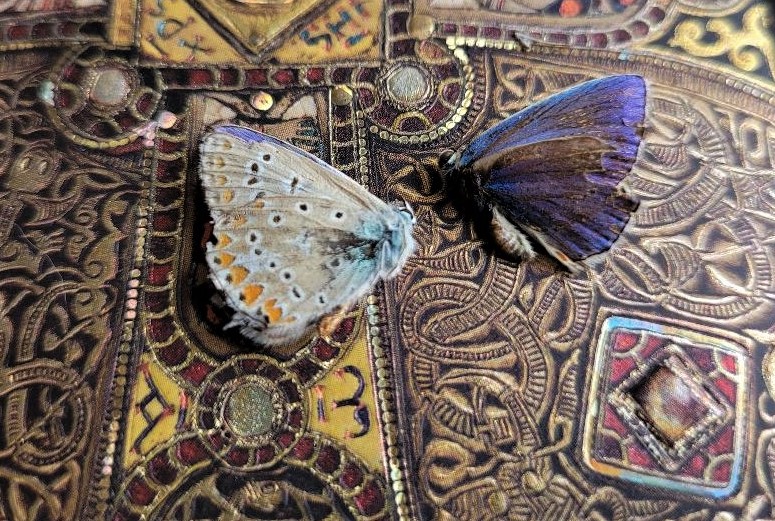
soon make their appearance, however fleeting, as the months go by. One of the most magical of these has to be the humble butterfly.'Humble', as they once seemed such a familiar sight, yet these modest, little creatures of great beauty now appear to be getting rarer and their delicate presence can no longer be taken for granted as a staple of the sunnier months of the year. All these specimens here below are precious finds - found dead, I should add - that date back years and decades even. Although some of these - the Red Admiral, Peacock and Tortoiseshell - are still to be found in the wild, I wonder if they are commonplace today?
Clouds of butterflies fluttering around flowering plants and bushes were truly mesmerizing in my childhood but now I have to content myself with my old, tattered collection! Some of my butterflies are now over forty years old, but the magic endures. How can Nature be so perfect? Of course such perfection and the magical metamorphosis that leads to the emergence of such beauty have always fascinated Man and given rise to mythological and spiritual beliefs that have intertwined in such a manner that even pure logic and the rationality of science cannot dismiss. Even today, many people believe that the butterfly has some rather 'other-wordly' significance to the extent that a specimen that suddenly wakes up in Winter must surely represent someone or something 'other'...
In fact, the full life cycle of the butterfly, from the order of Lepidoptera (from the Greek 'scaly wings') is seen to reflect Man's transformation from earthly to spiritual Life itself, commencing with the caterpillar that symbolizes the ties of our physical needs. Following this comes the seemingly lifeless chrysalis phase, referred to by the Ancient Greeks as nekydallon, meaning 'the shell of the dead'. Indeed, the creature lies dormant in this sarcophagus which will finally split open to reveal the fully-formed adult within; a butterfly ready to unfurl its wings and fly free of all the physical binds of life. Again, this transformative stage is drawn upon in Buddhist belief; 'What the caterpillar perceives to be the end, to the butterfly is just the beginning'.
Set free from an earth-bound existence and mortal death, the body breaks away and upwards, soaring to the heavens. Not surprisingly, the word for butterfly and soul in classical Greek is psyche; the soul of the dead. Anima is the Latin word for 'soul' and 'breath', with the air-borne butterfly coming to symbolize the soul’s exit from the body.
The ancient myth of Psyche and Eros signifies the soul, the butterfly and divine love that must endure the hardest tests before attaining unity and immortality. It is based on the fable of the Latin prose writer Apuleius, from The Metamorphoses and tells of the trials and tribulations that this beautiful young mortal girl must undergo in order to be with her beloved Eros. Having drawn the ire of the Goddess of Beauty, Psyche is set on a long, convoluted journey that is both hindered and helped by various different gods - Aphrodite, Apollo, Zeus, Zyphyr, Persephone and Hermes being just a few who figure in this meandering tale...
Punished for her beauty by the jealous Aphrodite, Psyche is sent on a mission to the dark abyss of the Underworld before falling into a state of permanent sleep until she is eventually brought to life again by one of Eros' arrows. Finally given ambrosia, Psyche is granted immortality as winged goddess of the soul and from her union with Eros was born Hedone, the goddess of pleasure. Strangely enough, I don't think I was even familiar with this particular myth, and yet it was a source of inspiration for much later works of literature and flights of fancy such as the fairy tale of Beauty and the Beast and likewise Shakespeare's A Midsummer Night's Dream.
Wednesday, April 19, 2023
Ordinary Exotic...
As always at this time of year, the local garden centre is ablaze with the most amazing displays of exotic flowering plants, and true to form, I just can't help being drawn to them.
Each year, I just gaze at these incredible forms, with colours that defy description, as if I had just discovered them for the first time.
And yet varieties of these plants can be found for sale anywhere and everywhere, sold off to the public at cheap prices that seem an insult to the beauty of these exotic specimens.
As a consequence, these extraordinary flowers have become seemingly commonplace...
And yet nothing could be considered ordinary in these beautifully complex living forms.
Even the simpler varieties are little works of art...
And then the most extreme are just astounding!
Friday, March 31, 2023
A Gentle Escape...
As I wandered around the Tate Britain a few weeks past, I felt as if I were again encountering and reconnecting with what had once been the foundations and fabric of so much that I had loved in art. Looking at the paintings that had so fascinated me all those years ago, I had the impression I was revisiting places or people precious to me. Stepping out of busy 21st century London streets, and into this vast art gallery enabled me to escape from the less savoury aspects of modern life in a realm far removed from the pettiness, paltriness and often plain ugliness of today’s civilized society. There was something soothing and gratifying to be surrounded by the art of centuries past, a reflection of History that gives the present day, our lives and even mortality itself another perspective. Like Nature itself, History just is; and as such is deaf and blind to our perceptions and reactions to rights and wrongs; the good and the bad that punctuate its substance finally seem to highlight the words 'This too shall pass'.
In one of the rooms, a small painting caught my attention with its curious jewel-like quality and tranquil air. Coming from Evening Church by Samuel Palmer (1805–1881), painted in 1830, somehow seemed to possess a strange essence unlike any other of the works that were familiar to me and were certainly more well-known. Its combination of tempera, chalk, gold, ink and graphite on gesso creates an almost enamel aspect, and the colours both calm yet curiously vibrant, with ocre, reds and dark blue in the clothing of the procession of worshippers winding their away towards us, away from the church. The latter has a bizarre almost childish cone-form nave, that is repeated in several other oddly-shaped buildings, but its spire stands tall, moonlit in the night sky. The whole scene is framed by trees with delicate leaves and branches that are silhouetted against the huge full moon which is set in skies that are pale blue, in contrast to the stark forms of dark green bushes and outlined trees. In the background, strangely steep hills tower up with their undulating forms that pick up the curves and rounded shapes in the valley scene below, and of course the moon itself. The gallery inscription next to the painting cited Palmer himself - describing the work of William Blake (1757–1827) - pointing out that these words could indeed be applied to his own art and vision; “There is in all such a mystic and dreamy glimmer as penetrates and kindles the inmost soul”. Samuel Palmer was an admirer of Blake’s visionary art, and is known today for his images of rural scenery that were based on an imagined, sensory reality rather than disciplined observations of landscape before him. Born in London in 1805 to a bookseller father and a devout mother, Palmer grew up with literature but had no formal academic artistic training as such, yet at the age of 14, his work was exhibited at the Royal Academy. Despite this achievement, he himself was increasingly inspired by art that seemed to flout a staid, conventional approach and he was influenced in part by work displayed at the British Museum.
Key influence on his early life was his meeting with landscapist John Linnell (1792-1882) in 1822. Linnell not only saved the young artist from “the pit of modern art” by enabling him to learn from ancient Italian and German masters, but more importantly introduced him to William Blake. Palmer’s vision thus grew from art “as old as time”, with Gothic art and the Northern Renaissance artists such as Van Leyden and Dürer but also Turner and Blake himself. Wishing to experience the same spiritual visions as Blake to fire his art, Palmer earnestly devoted himself to his work, becoming a member of the Ancients, an artistic brotherhood that preferred a more primitive approach to life and art over the slavish, descriptive Classical pieces so favoured by the Royal Academy. He moved to Shoreham, Kent in 1827, where he produced his most other-worldly images of the rural lands that he found more mesmerizing than any other. Drawn to the night skies, moon and stars, he and his fellow Ancients wandered in the dark to capture the nocturnal landscapes. With Palmer dressed in archaic clothing, complete with flowing beard and a Christ-like allure, the group must have made quite an impression on the locals who referred to them as ‘astrologers’!
The seven-year period in Kent were in fact to be his most productive as he was drawn to the mystic, Romantic qualities of nature, seeing the spiritual all around him, transforming the visible through the lens of his heightened imagination. He mourned the demise of the pastoral way of life and the land itself that was being transformed by the Industrial Revolution. Having returned to London, his subsequent marriage to Hannah Linnell (daughter of John) in 1837 marked the beginning of a new stage in his life, and indeed his art… Unable to support his family, Palmer sought to pursue a more conventional approach to his art, and was obliged to pander somewhat to public taste and give private lessons to increase his income. His mature work – often watercolour – was artistically accomplished but never quite captured the same sensory essence as his Shoreham art and Palmer was largely a commercial failure during his lifetime. Much of his work and studies were lost due to their destruction by his son, after Palmer’s death, in the belief that “…no one would be able to make head or tail of what I burnt; I wished to save it from a more humiliating fate". And so one individual’s decision to whitewash the past deprived the world of a piece of collective history. Hmmm...
Subscribe to:
Posts (Atom)