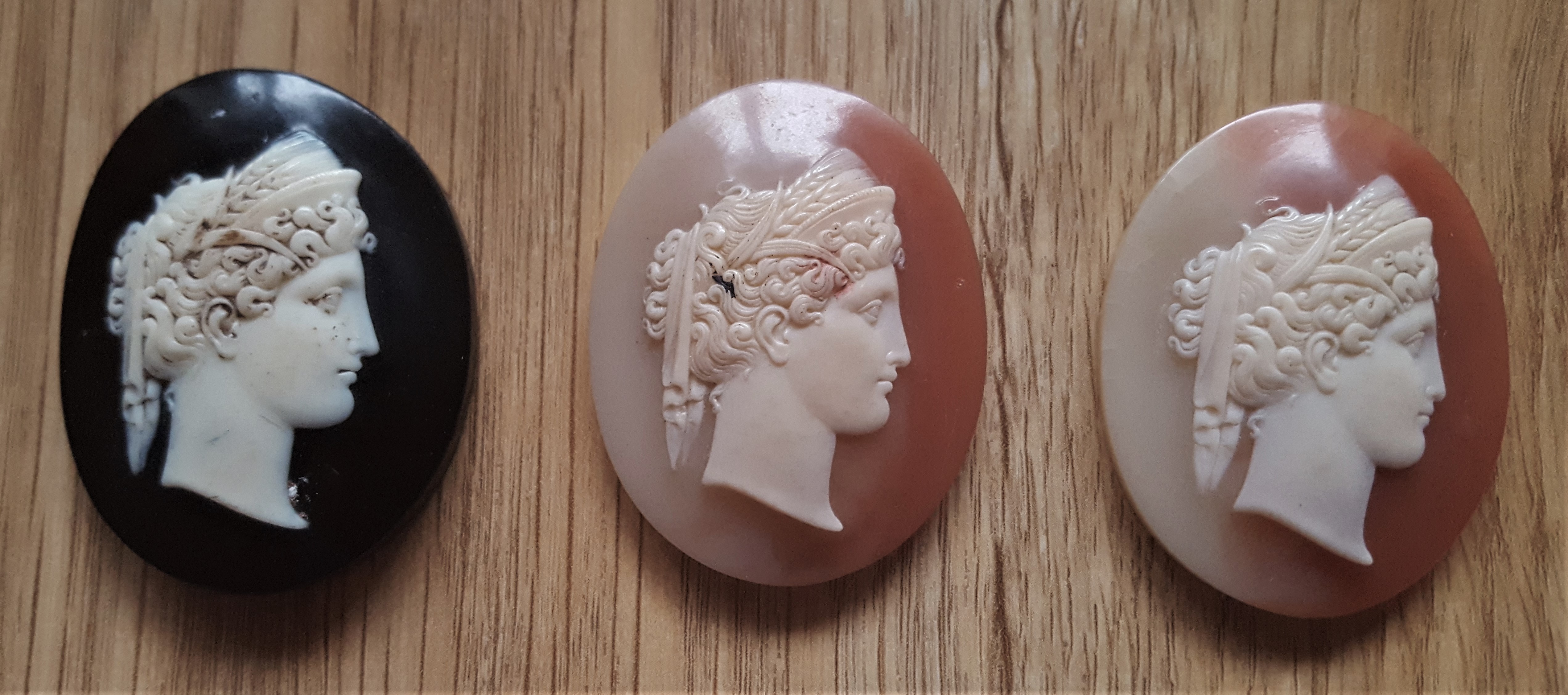
When I was a child, I used to love touching the packages of semi-precious gemstones that had been ordered and sent from the suppliers. Unassuming folded white paper could be opened out so that fingers could delve and filtch out the jewels within, running these over the palms and letting them tumble down in a strangely fluid movement ; amethysts, garnets, citrines, moonstones That flowing sensation, with those rich colours delicately glinting in the light has never left me. In other types of package, meanwhile, would emerge the cameos and yet somehow these never left any impression on me at all, except disinterest. Face after face of some classical beauty or other would stare out but I was certainly not interested in returning their gaze and could never fully understand the allure of the resulting rings, earrings, brooches and pendents. How our preception of things changes with age !

Whilst my childhood collection of flawed and thus commercially-worthless gemstones still operate their magic on me, so too do the cameos, as it happens. And surging back came those greedy magpie urges to touch and treasure the beauties on display !!! Being told to simply ‘take what I wanted’ were words almost too magical to be hear, when faced with numerous cameo specimens of varying sizes, some too beautiful in their craftsmanship to even behold ! However, take I did, for fear that this treasure would one eventually end up unloved and lost in a world that does not appear to treasure their understated elegance. Of course, there are still periodic bursts of interest in this centuries-old art. There are an abundance of cameos featuring busts of women in their décolleté finery – typically with carefully arranged hair swept up into sophisticated styles, possibly held by a headdress or left flowing down the nape of an elegant neck to the shoulders.

Many of these are original Victorian pieces, mid 20th century versions of the same or are simply (rather shoddy) modern-day equivalents. Historically, the cameo is synonymous with more Classical themes, with scenes from Greco-roman mythology with their corresponding figures – both male and female. Gods and goddesses were frequently depicted but so too were portraits of politicians, or images of historical or religious figures, many of which, incidentally, would be shown facing to the right. Of the many cameos that have been passed on to me, my favourite is the double profile -
capita jugata – which shows two superimposed busts in stunning fine detail, as in the style of the famous
Gonzaga Cameo which itself exchanged hands many times before finally becoming part of the Hermitage collection. It seems to me that the majority of pre-21st century cameos are destined to become inheritance pieces, one way or another, to be cared for and handed down to the next generations in a timeless process.
Understandibly perhaps,there is a wish to bring the style and content of the cameo into the new millennium with a more modern approach. Somehow these updated ‘edgy’ versions with trendy images - often machine-carved or laser sculpted - do nothing for me whatsoever. I cannot imagine such pieces having any lasting hold or attraction in time or space but rather will appear outdated in the years to come. Why would you want a cameo of a skull or monkey anyway, I wonder, but each to his own, ultimately…
However, with an art form that has been so intrinsically linked to certain types of image and imagery – be that quaint Victorian
belles or bellicose emperors, gods or goddesses – how do you move towards the future in a credible, relevant, aesthetic manner? I have often asked myself why many ultra-realist pieces of sculpture simply do not work as pieces of art and maybe modern-day cameos face the same difficulties. How to display stature and meaning in modern times without looking like dull 3-d print-outs without artistry or aim ? We can surely admire cameos from decades and centuries past, and certainly do, but I am not sure how the form can evolve.

In my childhood indifference to the cameo, I never bothered to find out how they were made or where, beyond the basic knowledge that they were in effect carved from shell. Looking now at the artistry in each piece, I cannot believe I was so underwhelmed, for they are indeed, miniature sculptures and some are truly tiny in size and yet all the details are painstakingly worked to scale. Whatever the proportion, a cameo is a form of glyptography, from the Greek word meaning ‘to carve’. They are hand-carved in relief –
relievo - from the Italian
relievevare, 'to raise' and as such are the opposite of the
intaglio, which is an indented or sunken engraving, often employed as a seal and means of identification.
Although most commonly associated with a shell medium, cameos may also be carved from a layered stone such as agate, onyx, or sardonyx, with the different coloured layers highlighting the sculpted forms ; cornelian, coral, lava and jet have likewise been used. Work on bone, resin, amber or glass is not, however, considered to be genuine cameo artistry and nor is the excessive reliance on modern sculpting techniques such as laser-carving and ultrasonic milling. The subsequent mass production of perfect yet bland, soul-less pieces has done the art of the cameo a disservice and the practice of assembling these from separately carved relief and background - composite cameo-making - is considered by some to be ‘cheating’….

One of the pieces that my aunt still treasures is one that I remember from years ago. In hommage to Botticelli’s 15th century painting, Venus is represented borne on a shell, her goddess form having emerged, quite literally from the shell on which it has been carved in relief. With such a work there can be no doubt as to how a cameo is made and indeed very little has changed in the ancestral technique employed by traditional shell carvers, despite the passage of time.
Generally, the ‘cup’ of the shell – the superior convex part -is cut and divided in the ‘
scoppatura’ process by carvers using a tool known as the ‘
bullino’. The shape of the future cameos is marked out on the inside of the cup during the ‘
aggarbatura’, and the subsequent oval and round forms are fixed onto a wood baton, allowing the hand carver sufficient movement and grip to chip the shell exterior and then sculpt the surface below. Although each piece is unique in its own right, carvers have traditionally repeated styles, in addition to perfecting their own ‘signature’ details. The skill involved is immediately apparent, since one false move would wreck the whole since there is no way of correcting an error, as is the case in a full-scale sculpture. With the cameo, however, the tiny proportions require the most accurate and intricate of carving in order to create a work that is well realised and aesthetically pleasing.

For shell cameo carving today, the African Carnelian shell is apparently the type most commonly used, along with the sardonic shell from the Caribbean or Bahamas, both offering optimal contrast in colour to emphasize the bas-relief. Traditionally, the Black Helmet and the pink and white Queen’s Conches were the main medium, both in plentiful supply along the Italian coast – the geographical heart of cameo production. Indeed, for over two hundred years, the coastal town of
Torre del Greco a commune of Naples, has been the focal point for the art of shell carving.
A number of the establishments there have been run by the same families, generation after generation, one of the oldest of these being
M+M Scognamiglio, set up in 1857. Over a hundred years later, it would be a descendant of the founder, who would come to visit my jeweller family to display and sell his wares. According to both my aunt and father, the
signore in question cut a very dashing figure in a 1960s Birmingham that was not accustomed to the sight of immaculately dressed business men, with impeccable taste and manners. Some of the cameos ordered all those years ago are now in my proud possession, to be treasured and later passed on to future generations. My aunt also confided in me that as some of the fine women’s profiles often had rather prominent noses, she would carefully chisel some of these down to a more suitable size and slant !

Although Torre del Greco established itself the centre of cameo manufacturing, it would be a mistake to assume that the cameo originated there. It is in fact an art that finds its origins in prehistoric petroglyphs from around 15,000 BC with figures carved into rock. The Mycenaean civilization followed with the carving of gems, a technique continued in Ancient Greece and perfected by the Romans. The skill of cameo-making spread itself throughout the Ancient Mediterranean cultures via the trade routes running across and between Egypt, Greece and the Roman Empire, with work sculpted on varied types of medium. The mastery - and monopoly - of shell-carving in Torre del Greco would come about considerably later, through the convergence of several economic, cultural and geographical factors.

Cameos appear to have been less commonly used as a means of portraiture or allegoric representation during the Middle Ages, but rather employed as amulets (thus similar to Eygptian scarabs), seals and reliquary ornamentation. The cameo gained ground and popularity in the Renaissance, albeit amongst individuals of means and therefore status. Lorenzo de’Medici was a great collector of cameo pieces, as was François I of France. Reflecting the ultimate power and prestige of royalty and grand political personas alike, through allusion to classical figures of antiquity via portrait, cameos could be exchanged, displayed or worn as jewellery of all kinds. Charles IX dedicated a gallery in the Louvre for the engraved gems brought to France from Italy by his mother, Catherine de Medici. The taste for cameos soon passed beyond Italy and France and specialist engravers (generally of Italian origin) were summoned to other courts around Europe. In Tudor England, Elizabeth I commissioned carved gems with her portrait to be set in brooches and pendants. In order to meet high demand, and a lack of gems to engrave, shells began to be used for cameo work from the 16th century.

Early 19th century France was the heyday of the cameo when Napoleon Bonaparte -great collector of intaglios and cameos – recognised how the latter would enable him to display his imperial might as founder of the newly established French republic. Associating his image with those of Roman Antiquity, the cameos served as the ultimate emblem and trophy for the triumphant emperor of France as a political, propagandistic and diplomatic tool of great beauty. His coronation crown (1804) was set with cameos as is the Cameo Tiara, part of a collection of cameos Napoleon gave to his wife, Josephine. He set up a
Prix de Rome for gem engraving, alongside those awarded for sculpture, architecture and painting and also created a school devoted to the art of gem-cutting and goldsmithing.
Later in the century, it was of course Queen Victoria who would continue this devotion to cameo art in the era of the British Empire, and propel this to unprecedented levels of popularity and mass production in an age of industrialization. While Victorian cameos initially dealt with the customary neoclassical themes, often linked to the profile of the Queen herself, towards the later period, they focused more on idealized feminine profiles to decorate all kinds of objects of jewellery and ornamentation for both men and women.
But back to Torre del Greco… Situated near the currently dormant Mount Vesuvius, the town ‘
Greek man’s tower’, had once been part of
Magna Graecia, the Southern coastal area colonised by ancient Greek settlers. It is thought to have been a suburb of Herculaneum in Roman times, with its fate tied to the volcanic activity from which is has suffered and indirectly benefitted over the centuries. Acting as a beautiful and seemingly benign backcloth to the whole area, this huge sleeping beast infrequently awakens itself to spew lava and ash down its flanks and across the surrounding area. It mocks Man’s arrogant attempts to manage the land and tame Nature. The seismic tremours that pulse through the region today as always, are the erratic heartbeats of a timeless bestial force, lying beneath our paper-thin layer of modern civilisation ; dormant not extinct. Vesuvius famously preserved the nearby ancient towns of Pompeii and Herculaneum under a shroud of volcanic debris as proof of its power in AD 79. Torre del Greco itself did not escape the wrath of the land either, as the volcano cloaked the town and its surroundings in a mantle of ash in the 17th and 18th century and thousands of locals were killed or left homeless in the 1980 Irpinia earthquake.

For better or for worse, the town has plunged its roots deep into the land, like some crazed dysfunctional marriage that draws its lifeblood from the good times and glosses over threatening, volatile reality.The town’s proximity to the volcano has shaped its evolution and identity, just as it has those of the art of cameo-making itself. Since Torre del Greco was the closest town to Vesuvius, it became the touchpoint for visitors wishing to set out to see the volcano first-hand. Since the discovery of the ruins of Pompeii in 1748, sudden interest in the area led to a steady influx of affluent gentlemen travellers, eager to include this on their Grand Tour of Europe. It was, of course, the foundation of Thomas Cook’s travel agency, with its ‘package’ tours of such sites that led to the term ‘tourism’. Such tourists, wishing to take home trophy souvenirs of their adventures far afield led to a trend in glyptic art with petrified lava cameos taking centre stage as a portable, wearable memento for both men and women.The Neoclassical Movement allowed the glyptic to come back into fashion and an observation made in the
Journal des Dames (1805) pointed out that « A fashionable woman wears cameos on her belt, necklace, bracelets and tiara ».
By the turn of the 18th century Torre del Greco had already long established itself in the trade of ‘red gold’ ; coral. As in other coastal towns around the Mediterranean, the residents had been diving for the abundant supply of red coral since the Roman times. From the 15th century onwards, their skill in harvesting their ‘maritime gold’ was such that they were referred to as ‘
corallini’ and production of carved coral and shell jewellery was the keystone of the local economy. From the beginning of the 1800s, however, the processing of coral grew further in stature with the founding of a royal-ornament business -
Real Fabbrica di Coralli – in 1805 by a certain Frenchman, Paul Barthèlemy Martin.
This coral broker from Marseille was accorded a ten-year exclusive licence to deal in the manufacture of coral artifacts and jewellery on the understanding that local artisans would be trained in the art. Thus, the working of coral and shell was transformed into a highly specialist domain, of which Torre del Greco was at the forefront. Yet as demand for red gold grew, so did the competition from other coastal areas which began to enter the coral market. As this situation coincided with an ever-increasing supply of shells from Africa, Torre began to focus on shellwork to assure their income ; the cameo.

Just like numerous other artisanal family enterprises still running today, the Scognamiglio family initially specialized in coral work, with Michele Scognamiglio (born in 1815) setting up a coral factory in 1857. Over the decades however, generation after generation of workers became master artisans in cameo carving. Whilst most artisans learnt their trade from their fathers and grandfather, some also attended the
Instituto Statale d’Arte. Established in 1878 with the patronage of the royal family, this public school was dedicated to the carving of cameos, coral, lava. Freelance artists still work from home to the present day – generally carving on their verandahs which offer the best natural light. Coral and shells are now both imported from other countries as acidification of the Mediterranean waters has led to dwindling supplies and endangered species in need of preservation.
In view of all of the above, I am certainly very happy to be the current owner of the collection of cameos in my care…