Monday, February 28, 2022

From the Spitalfields Silkweavers to the Silk Snippets of Beatrix Potter...

Returning to Spitalfields in the Spring break, I wanted to wander around the old streets again, in the district where the 18th century silk weavers worked from the grand townhouses that still stand, despite the encroaching ugliness of 21st century ‘development’ schemes. I noticed that some of these projects, whose progression I have observed with dismay over the last 3 years, were nearing completion having successfully wiped out yet another swathe of collective history and culture…
I particularly wanted to gaze up at the house from which Anna Maria Garthwaite (1688 – 1763) had worked. Although not of Huguenot extraction herself, she set up home within the community largely composed of French Protestant refugee silk weavers and merchants to practice a trade for which she in turn would be renowned as silk designer.
The house is situated in what is now known as Princelet Street (formerly Princes Street) and Anna Maria would have been able to see the steeple of Hawksmoor’s Christchurch from her attic workshop, as would many of the other silkworker households. She was buried in that same imposing church on her death in 1763. Today, the ominous sight of developer’s cranes spoil the skyline.
What I wouldn’t do to look around her home today ! As that isn’t possible, on a quiet, cold Sunday morning I was able to look around the streets that she had once inhabited.
Whilst there, I did speak to a home builder/decorator who has been doing restoration work on the townhouses for the last few decades, having initially just come to the area ‘for a week’ ; such is the magnetic pull in this incredible setting.
Creating intricate floral woven designs that combined a rich Roccoco style with a more typically English penchant for intricate flowered clusters, Anna Maria Garthwaite responded to the fashion for beautiful gowns, accessories and even furnishings in lavish silks, featuring damasks and brocade, often using silver thread for greater effect.
This time I made sure that I saw some of her work on display in the Victoria and Albert Museum and I was not disappointed. Lavish garments and dainty, decorative footwear that were assembled using the delicate silks from 18th century Spitalfields were shown in their own section of the museum as well as part of a clothing-over-the-centuries exhibition.
Several of the pieces were by Anna Maria – with swatches of silk and the final exquisite gowns and ‘sacks’ (loose, tent-like robes), all carefully sewn. Not only could you see what the 18th century lady wore on her feet – with elegant slippers that were worthy of a fairytale - you also got a naughty glimpse of what she wore beneath all that material ! More precisely, how the more extravagant dresses maintained their desired shape whilst worn…
Panniers or side-hooped undergarments of impressive width were exposed, revealing how robes such as the Mantua were carried, rather than worn. Gentlemen were no means less soigné in their dress code and beautiful waistcoats and jackets were equally as stunning as the ladies’ gowns.
The delicate embroidery and buttonwork put me in mind of The Tailor of Gloucestor by Beatrix Potter, with the missing cherry-coloured skein of silk for the Mayor’s garments of silk ‘embroidered with pansies and roses’. Having failed to get an online ticket to the Drawn to Nature exhibition, I was thrilled to get to visit all the same!
And so it was, to my great pleasure, that I saw similar garments that had inspired Beatrix Potter in the watercolour illustrations that I had loved so much as a child – with the mice discretely collecting the snippets of fabric under the watchful guard of Simpkin the cat, and finally completing the tailor’s order with skill.
After all these exquisite pieces from the past, I couldn’t help but wonder what happened to our desire to wear beautiful, carefully crafted garments and shoes, apart from the obvious and real limitations imposed by financial considerations. But why is it that a large majority of the population, regardless of age or situation, opt for the same kinds of clothing and foot attire that have become a virtual uniform ? How would Anna Maria Garthwaite regard today's staple ensemble of sneakers and jeans ?

Sunday, February 27, 2022

Angels in the Metropolis... Brompton Cemetery.

Tired of letting myself be drawn down the retail route – shops - I decided to explore one of the Magnificent Seven satellite cemeteries set around the capital in the first half of the 19th century. In fact, this was to be a commiseration prize to offset my disappointment at not being able to visit the Beatrix Potter exhibition at the Victoria and Albert Museum on on my recent trip to London...
Following my visit to Highgate cemetery a few years ago, I was eager to see how Brompton would hold up against its incredibly atmospheric, slightly older sister. Indeed, opened in 1840, Brompton closely followed Highgate (1839) but was some years behind the first great cemetery, Kensal Green (1833).
Greatly appreciated for its impressive architecture, imposing monuments and stonemasonry, I was particularly drawn to Brompton for its tombstones and the ‘contained and maintained’ wilderness that reigns throughout the site. Not surprisingly, the cemetery has featured as a backcloth in televised works and of course, the cinema, as has Highgate.
The peaceful, tranquil air of these sacred grounds devoted to past lives is magnified by the vibrant yet calming effect of the greenery of trees and plants which quiver with the life of the present. Early Spring sees the buds and flowers bursting out in defiance of the cold winds and rain of the winter months, as Life takes over from Death once more, in the eternal cycle.
Bold snowdrops and daffodils rise up again, bringing out the colour of the surroundings. Add to this the resident wildlife, and the magic is complete, with the plainly-visible robins, crows and squirrels of the daylight hours replaced, come nightfall, by a host of more elusive nocturnal creatures, when imaginations and spirits are free to wander. Whilst all share this sprawling territory with human populations, here is a haven for nature as much as a place of eternal rest for the Dead.
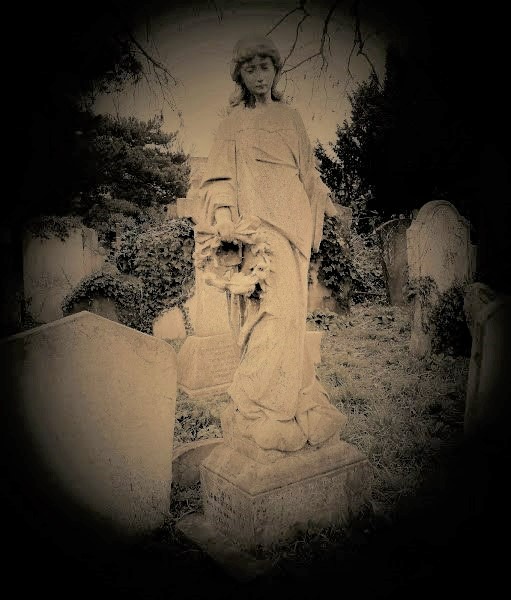
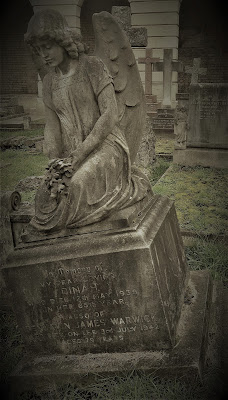
Whilst my thoughts and impressions ran free as I explored the alleys and somewhat overgrown plots, the phone (camera) simply ran out of battery. Infuriated, I had to resort to desperate measures and as the final photos did no justice to the unique mood and beauty of Brompton. I decided to use a special filter to mask the imperfections and try to make the best of a very unfortunate lot as my photos were so disappointing! Even if the result is rather eerie, not to say downright ominous, that was not necessarily intentional, and nor is it strictly representative of the atmosphere on a bright and blustery Spring day. Far from it, indeed!
Although a cemetery is burial site, and therefore intrinsically linked to loss and mourning, I find the older graveyards to be restful places that commemorate life past, enabling us to come to terms with life and existence itself and to understand social history more clearly. The atmosphere surrounding these old graves devoted to the long-departed is unique. The ageing stonework fittingly reflects lives ended centuries before ours were commenced. Names and dates that are barely visible today are often all that remain of lives forgotten, buried in time and blurred by anonymity. And yet they should remind us of the human condition, with regard to life and death.
We somehow forget that these beings were all individuals whose lives may mean little or nothing to us today, yet each had a life that was meaningful to them, however paltry it may have been. Each one experienced emotions, hopes and ambitions as we do today but we assume that these were somehow vastly different to ours today due to the different social and historical context. Shockingly high mortality rates in Victorian Britain meant that life for all was fragile and often short, whilst abject work and living conditions for the masses imposed a hopeless existence. Despite this, all individuals still clung onto life itself and were generally mourned when they left it.
Old cemeteries have always attracted me like a moth to candle-light, yet I had never known that there was actually a term for this – taphophilia – a ‘fascination and fondness for death rituals, funeral rites and cemeteries’. My attraction limits itself to the latter and only when the graves date back at least a century, preferably more. Any more recent, and the pain of loss pervades the atmosphere and seems to wind itself through the surroundings whereas the long-departed have long since been joined by their grieving loved ones. Furthermore, while I love to observe the inscriptions and symbolic decoration of graves and monuments, those from the 20th century generally do not have the same effect on me, possibly because timeless, flawless marble does not age or invite the growth of ivy, moss or lichen.
In Brompton, full Victorian symbolism is employed to reflect life, love, purity, death, loss, the soul and resurrection. Elements from the natural world, rich in meaning in previous centuries flourish in sculpted form with daffodils, lilies, birds, butterflies and snakes,to name but a few, all carved onto stone. Broken columns, inverted torches, draped urns and joining hands symbolize our earthly demise, the cycle of life and death and the journey to the afterlife. The traditional religious symbols abound, of course, with the Christian cross and the stepped cross, frequently inscribed with IHS but there are also many references to Ancient Egypt with obelisks, hieroglyphs and pyramidal forms. Unashamedly, I admit that one of my favourite symbols is the angel and I hoped that the ones here would be as evocative as those I saw in Birmingham, or indeed Highgate.
Behind the peace and beauty that we enjoy today in London’s garden cemeteries lies a less tranquil history. Indeed, these sites designed to honour the dead and soothe the living were born from a far less attractive need. The unprecedented population surge in early 19th century London meant that just as the city-dwellers were cramped together in dire, insalubrious conditions, so too were the deceased - piled together in vile, pestilential funeral grounds. Land, water and air were contaminated by putrid bodily fluids and infested by vermin which plagued the living and defiled the deceased.
Inspired by the impressive Parisian cemetery Père Lachaise of 1804, the seven large-scale funeral metropolis were designed to house London’s dead in a respectful, religious manner. Thus the construction of the Magnificent Seven was authorized by government, and commercial companies set about the task, eager to profit from a public prepared to pay the price for suitable burial plots to reflect social standing. Incidentally, I find it quite interesting that Paris should have been a source of inspiration in the solution to burying London’s dead, while London would later serve as a model for Baron Haussmann’s vision of a modernized Paris to accommodate the living!
Unlike Highgate, with its steep paths, slopes and meandering tracks that all add to its mystery, we still sense that Brompton cemetery was indeed constructed on flat land that had once been used for market gardens. Despite the numerous trees and undergrowth that conceal the skyline, the regular layout of the grounds makes itself apparent, underlined by the central tree-lined avenue that leads from the entrance on Old Brompton Road. In order to attract investors and customers, the design of the cemetery sought to impress, using features that recall St Peter’s Basilica in the Vatican. The neoclassical Great Circle, with central symmetrical colonnade, catacombs and chapel follows on from the avenue that acts as a nave. The eight-sided, domed chapel in yellow stone is at the heart of the cemetery’s design but was initially designed to be accompanied by two other chapels on both sides of the Great Circle.
Lack of sufficient funds skuppered these ambitious architectural plans and in fact the cemetery was forced to open in 1840 before the completion of the main chapel. Further financial difficulties arose when the catacombs failed to attract potential customers and shareholders were dismayed to have no return on their investment. Finally the Metropolitan Interments Act 1850 designed to enforce better provision for the internment of the dead enabled the government to buy Brompton, the first London cemetery to be nationalized. It is now managed by The Royal Parks and as such is the property of the Crown.
I was very pleased with my visit, especially as it made me appreciate just how much each cemetery has its own unique character and atmosphere and although the mood and magic of Brompton won me over, nothing for me so far could match Highgate and no angels have been as moving as the ones that mourn those departed in Yardley, Birmingham. Just as I left the cemetery, my digital camera suddenly gave up the ghost, and it started to pour with rain so I felt that my trip to Brompton had somehow been blessed. Perhaps there was an angel on my shoulder, though I would have settled for the jaunty little robin below! My good fortune did not end there either; I was able to go to the Beatrix Potter exhibition after all… It always pays to ask!

Monday, February 21, 2022

Glorious Gold, Stashes and Caches of Treasure...

I had forgotten just how beautiful the humble daffodil is, with its glorious gold set in seemingly simple, unassuming forms - yet with its bold 'trumpet' heralding the arrival of Spring. How these blooms manage to emerge from their tight, spear-like buds seems a most improbable feat, and yet emerge they do, in defiance of the winds and rain of the early months of the year, with their unique scent that defies description.
Returning home, I was suddenly reminded of the beauty of the daffodil and the fact that Spring is indeed on its way - accompanied by snowdrops and primroses. Nothing can be comparable to seeing these all growing wild, especially in the magical settings that I had taken for granted for so many years and now can only treasure from a distance... Glorious gold indeed!
Also in bloom were the 'Cornish roses' - Aeonium - the very hardy succulents that send out their ambitious stalky stems, outwards and upwards as a challenge to gravity and gusts of wind, bearing their golden clusters...
Likewise facing the elements, off I went in search of my own hidden treasures - seaglass! Although becoming increasing rare, I did find a few nubs and nuggets of weathered, frosted glass. This has become pure gold in itself, given the proliferation of plastic for packaging and bottling and the growing number of like-minded beachcombers, intent on seeking out these magically polished 'pebbles'. While I do have a specific, 'secret' beach for this - discovered through trial, error and elimination - the location appears to be common knowledge amongst fellow magpies who converge here from near and far. All are drawn by that irrepressible urge to find this unique treasure, one that has been etched by time and tide and eventually washed up on the shore. Each being is driven, to greater or lesser degree, by their private need to quench this quirky thirst, an almost primal covetousness. For this is a little object of desire with a strange hybrid beauty, created when Nature takes over what is Man-made, hiding the past under rounded forms and smoothened surfaces.
There is a certain camaraderie to be found nevertheless, amongst all these coastal scavengers and chancers, and the overall atmosphere is one of tranquility, punctuated by that keen determination to pick out the perfect piece from amongst the sand, seaweed, flotsam and jetsam swept by the tides. I have to admit that there is precedence in my 'Gollum-like' glee when procuring coastal treasures and the gloating, greedy satisfaction when running my finds through my fingers, in a jumble of colour and shapes. All is closely tied to one of my guilty childhood pleasures....
Having illicit access to enveloped packages of semi-precious gemstones in my early years, thanks to the family trade, I would happily let the jewels trickle down over my hands, in a magical flow that gleamed and glistened in the light. However, that could not satisy any hunger and merely stoked the fire to possess a secret, sinful stash to keep all to myself. Inevitably caught red-handed, I was promptly banished from the jewellery workshop and was rarely given the opportunity to play with the cracked, chipped stones that were of no commercial use but were tantalizing left to one side; worthless but priceless to my craving eyes. It was therefore with pleasure that I was finally able to get my greedy fingers on those caches of gemstones, after decades of coveting... Amethyst, peridot, citrine, garnet, moonstone and opal poured over my palms once more, but so did a few tears for the acquisition of this treasure heralded a greater loss and the rich, bright, sparkling hoard was weighed down by a certain sadness. But just look at how they glint and glow...

Sunday, January 30, 2022

Beloved Beasts of Present and Past...

I often wonder how a seemingly simple creature as the cat, of somewhat modest size and stature, should be doted with so much personality. Most felines share many of the same attributes - both negative and positive, demonstrate similar quirks in behaviour - as infuriating as they are endearing, and display identical character traits. Despite this, each and every one ultimately manages to be unique and true to its self; less creature than its own 'perfect creation'. One could perhaps say much the same of the majority of we human beings, but I imagine the same psychological make-up as that of the average cat (if such a thing existed) would give rise to a wholly eccentric individual, little appreciated by the others. Not so the cat, who not only garners respect from all, if only for its independance, but also actively attracts legions of cat lovers worldwide!

Animal, Insect or.... Orchid?

Although it may only be the end of January, the daylight hours are already starting to extend, and the birds sing... A few plants are even beginning to send out tentative buds in response to what has been, so far, a remarkably mild winter. In the garden centre, of course, the outside temperature has little effect on what is on display.
Today's visit plunged me into an exotic universe, at once both subtropical, equatorial and even aquatic, with the most beautiful collection of orchids that seemed to draw far more on the animal kingdom or the marine world than that of plants...
Some of the blooms seemed to have the flesh and form of sea creatures - perhaps anemones, coral or crustaceans - with plump, bulbous shapes and strange tentacle-like shoots and delicate hairs...
Others looked more like seaweed or algae, or perhaps part-fantasy fish with bizarre fins and gills...
And all were lit up with the first Spring-like light... Beautiful!

Saturday, January 15, 2022

Palais du Tau and Notre-Dame de Reims... Jewels in the Crown in the Cité des Sacres.

As time goes on, I find myself turning to time long gone by, as all the traces of centuries past seem to offer far more beauty, interest and intrigue than the offerings of today. The peace and tranquility that many of the historic pieces of art and archictecture appear to exude in the present day does, of course, belie their tumultuous past. Nevertheless, simply being surrounded by the solidity of age and the fluidity of evolving aesthetics over the eras is far more calming and enriching than any of what our frenzied click-and-swipe screen culture provides.
We are being devoured by our dependancy on these high-tech mirrors that offer a distorted and distorting vision of ourselves and the world about us. Gazing down into these modern looking-glasses, we lock ourselves in a present moment which has to be fun and bite-size, or for fear of losing out on ‘likes’ from being too dour and fatiguing ‘friends’ by being too long-winded. I won’t bother about being wholly guilty of both !
Preening and posing for the camera in the reality of this largely visual virtual world, where words are used as mere captions to accompany some photo or other, we may soon lose sight of where we have come from and what we are and relinquish all curiosity to find out. And so on a bracing cold Sunday a visit to one of the city’s oldest architectural sites – le Palais du Tau – seemed to be a curative solution to my latest bout of 21st century screen-induced disenchantment.
This was certainly not the first time I had visited the building which has been listed as UNESCO World Heritage since 1991. Not only does the Palais du Tau house the musée de l’Oeuvre, acting thus as museum to the artwork and treasures associated with the ceremonial role of the site, along with a display of the original statuary and tapistries from over the centuries, it also hosts many contemporary cultural events.
Naturally its cour d’honneur is used during the Fêtes Johanniques, when the procession of Medieval characters – and mostly significantly Jeanne d’Arc and Charles VII – converge on the cathedral in the annual commemoration of the 1429 coronation.
In addition, the truly marvellous international marionnette festival, Orbis Pictus, has been held to great effect in the halls and chapels of this monument since 2010. Likewise, many exhibitions have been set out here over the years and the association Carnet de Bals has organised Second Empire-themed dances to tap into a spirit of living history.
Simply approaching the palais du Tau from the back of the cathedral with its apse still feels a little magical. The 800-year-old Notre-Dame de Reims stands proud against the afternoon skies with its intricate flying buttresses, pinacles and spires rising upwards. The palais du Tau is not itself a vast monument however, either in height or size, considering the symbolic and functional role it has played in the religious and monarchical history of France.
Set to the right, southern flank of the cathedral and its main doorways, separated by the cour d’honneur, the palais allowed access to Notre Dame during the grand ceremonies. Its chapel runs perpendicular to the cathedral but is far more sober in style.
Although the palais du Tau was initially the palace of the Archbishop of Reims, it went on to play a significant part in the coronation of the kings of France – some 33 in all – in the succession of sovereigns from 816 to 1825. Following the baptism of Clovis, the first king of all the Franks, by Saint Remi cerca 500, subsequent monarchs sought to be annointed with the Holy oil, thus uniting temporal and sacred power. The palais thus became the residence of future kings, prior to the elaborate crowning, and Reims became la cité des sacres.
The sacred and sovereign significance of the cathedral and thus the palais du Tau too, is reflected in the gallery of Old Testament kings. These massive figures tower over us from their vantage point above the rose window on the western facade and set at the centre is the baptism of Clovis.
The incredible height of these sculpted forms (4.5 metres and 6 tons each) is apparent in the palais as many of the cathedral’s original works are now kept there for conservation. What we see on the monument, meanwhile, are reproductions, capable of withstanding the elements and that modern-day blight ; air pollution…
The city had nevertheless been of great importance even before its regal associations. Originally known as Durocortorum (‘round fortress), Reims was the second largest city in Roman Gaul and operated as a hub during the Roman Empire. The palais du Tau was in fact built on the site of a Gallo-Roman villa that was still in place in the 7th century but was finally replaced by a Carolingian palace and later given its Greek name (tau) in reference to the T shape of its ground plan.
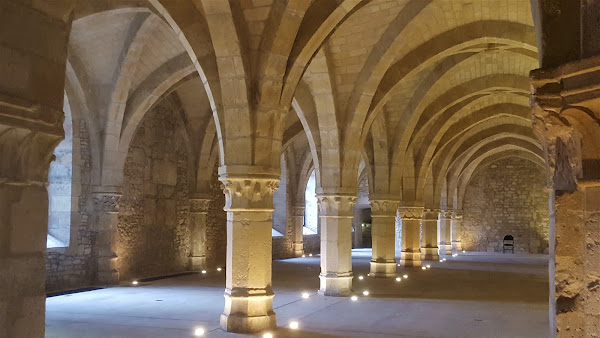
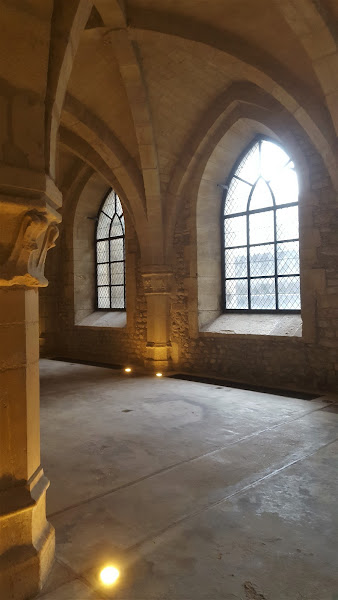
Although most of this early architecture was lost, the 13th century Palatine chapel remained and the rest of the building was rebuilt in the Gothic style in the late 15th–early 16th century. The grand Medieval banquet hall – initially known as the Salle Du Tau or the Salle des Festins – is intact today with its high wooden-vaulted ceiling in the form of a boat’s hull, although sadly only two of the original six vast wall tapestries are still present today.
Towards the end of the 17th century, a large part of the building was transformed by modification made in the Classical style, under the direction of Louis XIV’s first architect, Jules Hardouin-Mansart.
With the dramatic end of the Ancien Régime in 1789 the palais du Tau evidently fell into disgrace. Its close association to the union of sacred and sovereigny – with the altar and the throne - meant that it represented all that the French Revolution sought to overturn. In 1790 it was confiscated and became state property for use as a law court, prison and stock exchange.
Under the Restoration years, the bishop returned and the palais itself recovered some its former pomp and ceremony during the coronation of Charles X in 1825. Nevertheless, it suffered the indignity of being used as lodging by Kaiser William following France’s humiliating defeat in the Franco-Prussian war in 1871
The separation of Church and State in 1905 ended the occupation of the palais du Tau by the bishops of Reims and site was classed as a historical monument in 1907. Unfortunately that status in no way spared it from the ravages of World War so that by the end of the four-year hostilities, only the walls and the chapel were left standing.
The cathedral suffered catastrophic damage from the very onset of the war, and quickly became the symbol of ‘La France martyre’. Such was national outrage that reconstruction commenced in 1919, whilst the palais du Tau had to wait until 1950 for restoration work to be carried out. Not that you would notice any of this today, thankfully, as you wonder around the various atmospheric halls and the corridors adjoining them, especially at nightfall when you imagine the weight of the past.
The palais du Tau became a museum in 1972 and so now the Holy ampula, the royal chalice and even the talisman of Charlemagne that were once actively used in les sacres are set in glass cabinets as beautiful display pieces only. Nothing can dull the radiance of the cathedral though- the best jewel of all!