Wednesday, July 29, 2020

Watched From Above... Friend, Foe or Freak on the Façades?


As I am currently plant-sitting, in order to set about my daily watering duties I have to wander along the same city-centre streets each day. On pavement level, these are not necessarily the most interesting to stroll along - no cafés or restaurants, few shop windows, a number of closed shutters.


Pedestrians tend to shuffle along, eyes bolted on their phone, minimal attention paid to the other individuals around, just enough not to run into them. Here is social distancing, but not quite as meant by the health authorities in response to Covid 19...


It is not entirely surprising that no one seems to notice the swallows that nest in the stonework of the buildings all around, shrieking and swooping along the streets, in search of insects in hot summer air. Of course the architecture that acts as the backcloth to all these daily activities - pedestrian or airborne - likewise goes unnoticed.


And yet, above the doorways and on the façades of the older buildings there is invariably a world - or bestiary - of human and animal forms. Sculpted beings gaze down
on us lesser mortals in the same manner as they have for almost a hundred years. For indeed, most of the architecure  - including its sculpture -  was built during the reconstruction of Reims, following the First World War.
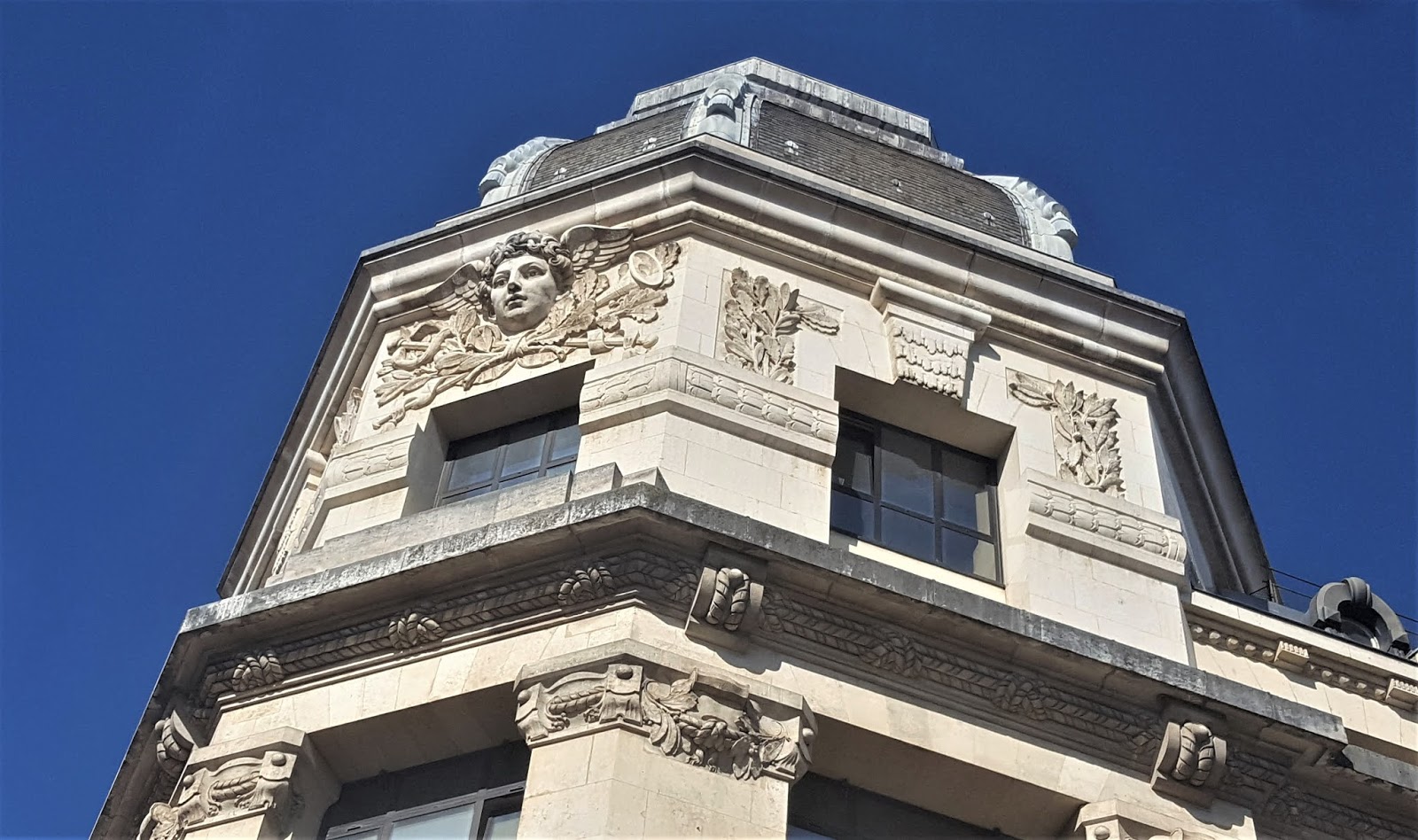


These sculpted figures could tell a tale of two but their expressions are often enigmatic - as if they were amused by our behaviour, or in turn bemused by it! I think they are taking things quite well, considering the events that they have witnessed first-hand over the years, or the injustices they have been subjected to. The Belle Epoque beauties still smile sweetly and strike their poses, despite the layer of city grime that now coats them and the general indifference shown them, with or without the dust and soot. Similarly, these braves belles brush off the fact that they now rub their delicate shoulders with a fine example of mid-20th concrete ungainliness. 


Truth be told, my favourites in this façade parade are far less the fawning, female figures than the faces of freaks and weirdos who gurn and gawp at the ignorant passers-by below! I did not include any of the putti carvings here, I am afraid to say. Give me a scrawny, malevolent gargoyle any day over some plump, winsome cherub...


There is often more social exchange between this mischievous bunch than there is between any of the pedestrian screen zombies that trudge along, oblivious to all and everything other than their phone.


Naturally, the combination of screen addict, eyes riveted downwards, and façade aficionado, head lifted up (and camera too, it should be said....) sets all parties on a collision course - quite literally - as nobody is actually navigating the pavement ahead.


I do wonder for whom these marvellous, monstrous creatures were intended - solely for the pleasure of the eyes, but whose? If it was then considered to be of civic importance to commission and carry out art work -  aesthetically and socially-speaking - when did this no longer apply?


Tastes change, that's normal but if it is mostly down to financial issues, it's enough to make you scream.


Monday, July 27, 2020

The Abbey of Vauclair...


At the centre of the ‘mystic triangle’ formed by the cities of Reims, Soissons and Laon, within the ancient provinces of Champagne and Picardy lie the grounds of Vauclair. Surrounded by forest, set in the valley of the river Ailette are the ruins of the 12th century abbey ; L’Abbaye de Vauclair


I had not even been aware of its existence, although it is situated just a short d istance from a Center Parc site. Therefore, having deposited the young ones in my charge for their day of swimming and sun-bathing, I retraced my steps back to the road sign indicating Vauclair, and set off to explore…


The peace and beauty of the region today belies the brutality of its not-so-distant history ; this was the scene of some of the worst losses in the First World War. Not that you could even imagine such a dark, monstrous past now, especially given the present context, as the greenery, sunlight and warmth are in total constrast to our drawn-out weeks and months of Covid confinement.


The wooded landscapes and rolling farmland have long since erased the ghastly images associated with the inhumanity of the ‘war to end all wars’. The deathly, pock-marked lunar landscape of the trenches have long been cloaked over with life and vitality and the enchanting name of Chemin des Dames has recovered its initial, pre-war prettiness. It should have been of no surprise, I suppose, to learn that the fate of Vauclair Abbey was decided by the insanity of war, just as countless other sites which were fatally damaged or even obliterated during the 1914-18 hostilities.


Initially a Neolithic settlement on marshy land that was later inhabited during the Gallo-Roman period, Vauclair was founded by Saint Bernard of Clairvaux in 1134. The name (Vallis Clara) was a direct reference to the mother monastery itself (Clara Vallis) – Vauclair being the 15th daughter house. Both sites benefitted from sunlight all day, due to their positioning, and during my visit this was no exception, with light pouring onto the grounds, heating up the stonework, drying already parched grassy stretches. 


Prior to the foundation of Vauclair, the site was known as Curtmenblein and possessed its own parish church, the rights of which were handed over to Bernard. A group of monks from Clairvaux, took possession of the site and under the direction of its first abbot, an Englishman no less, erected the Cistercian abbey of Vauclair. The abbey rose and ran along the lines set out by the precepts of the  faith – for prayer, work, contemplation and community life. 


Vauclair was soon recognised as one of the high places of Christendom and as it prospered, the construction of a greater abbey was deemed appopriate in the mid-13th century. Ironically, the stone required for the edifice came from the quarry within the Caverne du Dragon (along the Chemin des Dames), the very cave that would offer protection to the soldiers of both sides during the Great War. Wartime hostilities ultimately led to the devastation of this same masonry as Vauclair was in the direct line of artillery bombardment. While Vauclair abbey was inaugurated in April 1257 - some 660 years later - in April 1917, little remained of the site but rubble.


Vauclair had, of course, been beset by other issues during the intervening centuries. Plague had killed off a certain number of monks at the beginning of the 15th century whilst the Hundred Years' War, the 16th-century French Wars of Religion and the pillaging of Spanish all took their toll. Nevertheless, it managed to survive until the French Revolution in 1789, when the monks were dispersed, and the site was finally divided up and sold off as ‘national property’ to become a farming hamlet for commoners. The laybrothers’ building was listed as a Monument Historique in 1911 but to no avail for it was destroyed by the Nivelle offensive in 1917, along with the remaining Cistercian architecture – including the, chapel, sacristy, abbot's chapel, monks' hall, gatehouse and dovecote.


Vauclair was classified as part of the Zone Rouge of North- eastern France in the post-war years – deemed too hazardous for any human activity and thus leaving nature free to take the upper hand. When excavation work was carried out at Vauclair almost fifty years later by a local association – Les Sources – led by a young Belgian Jesuit, Père Courtois, the site had been long overtaken by plants, trees and greenery.


Simply clearling the site of this unwanted vegetation must have been a mammoth task, of which we have little appreciation when we stroll over the grassy expanses today. The Sources’ archaelogical mission followed the work of predecessors who had likewise wished to make Vauclair reveal its history. 

However, this project went far beyond previous attempts, going up to Courtois’ death in 2005 and continuing in the present. For over thirty years, Courtois devoted himself to this endeavour, living in the woods on site, in the shadow of the Cistercian monks and soldiers of the Great War before him. 


The site was classified Monument Historique in 1970. The mid-70s saw the re-establishment of an arboretum, conservatory orchard and medicinal herb garden in the abbey grounds. This was in keeping with the custom of Medieval monasteries to care and cure pilgrims and peasants alike of their ailments and injuries, with the careful cultivation of herbs, medicinal plants and roots to enable them to do so.


The garden today is laid out according to the design of the first monastic physic plots – largely based on the chessboard lay-out from the Saint-Gall abbey in Switzerland.


Each square is separated from the others by a stone slab, enabling ease of movement to those tending to the plants – or simply admiring them !  The grounds of the garden here are divided into four sections – for medical plants ; shrubs and bushes, plants of the shade and undergrowth and aquatic plants and pondlife. 


Unfortunately the museum was shut when I visited so I will return, preferably in the autumn or winter, as shrouds of mist, frost or snow would create the most haunting atmosphere! 


In the meantime, the sunlit garden and grounds alone are magical, with the busy insects’ hum uninterrupted by the intrusive noise of traffic.


Saturday, July 25, 2020

Taking a Plunge....

Levalet - Le Plongeur - First 'message'...
I keep coming across images, captions and quotations with the same basic message; Set your sights and then take the plunge! This has not fallen on deaf ears or averted eyes, but it invariably appears easier to be pushed than to jump, even if that means giving up all sense of control and security, precisely what led to hesitation in the very first place! Crippling are the doubts and fears, based on potential risk in situations where stakes are high. Invariably, it seems wiser to just play safe rather than to take a gamble, especially given the current climate. But is it?

Second... Taking risks.
However, surely the Covid crisis has underlined, if nothing else, the brevity and value of Life? Why toll away at an increasingly thankless professional activity that is becoming progressively less palatable as the months go by? Why shackle yourself with a grinding routine, or follow a lifestyle bound up by restrictions and non-choices? On the other hand, there is an obvious need to be grateful for every little thing in our lives, and for Life itself, above all now. We are living through times when instead of judging the situation through either a glass-half-full or glass-half-empty perspective, we should be glad to simply have a glass at all. But if we have a life, surely it is our duty to live it as fully and positively as possible? To do so, it is necessary to leave the safety of a comfort zone - or at least one of familarity - that is surely stultifying and stifling us, wholly or partially. After all, familiarity is said to breed contempt. But how do you navigate a path through huge stretches of the unknown? Where do you start, and how?

Third...How do you find your way?
My professional survival was solely down to the scrambled adoption and shaky use of the devices, platforms and apps that became so commonplace during lockdown that their very names now function as verbs and adjectives in everyday speech. I have been aware and grateful for that but I relish the widespread rolling-out of these into every crevice of life far less. Most of us have been too busy tackling the challenges of the first half of 2020 to take measure of this new 'connected' state of affairs, this other 'New Normal' that is here to stay. We were literally plunged into this new screened/screen existence as we dutifully shut ourselves away over those long months and have now emerged to a world where life and work will be traced, reflected and run along lines compatible with our internet connection.

Fourth...What happens if you don't try.
I do not follow the 5G conspiracy theories, but my heart sank earlier this week on learning of the further grip that this fifth generation of mobile communication services will have on young people... Physical school manuals are no longer required in the teaching profession in this part of the country, following 'greatly encouraging' results of a pilot test carried out here on the exclusive use of computers in class and home for schooling. Certainly, there will be numerous advantages to be had, for pupils and teaching staff alike, but I personally do not feel the glow of enthusiasm at the prospect of the academic years to come. Having a gadget that has largely become a portable, artificial brain means less need to cram and learn facts in an actual biological one. What effect does that have on our mental and intellectual capacities, imagination and curiosity? I too would dismiss such questioning as mere Neo-Luddite ramblings and fear-mongering, but having seen enough first-hand, I do worry about this along with the odd situation wherein all words, ideas and beliefs must be weighed for fear of offending. If uncensored, 'unsafe' discussion and debate are effectively discouraged or disciplined, what is left? Real-time, face-to-face socialising has already taken second-place to incessant screen chatterings on social media, so what chance has the average teacher got to engage a classroom (present or digital) of youngsters, each equipped with a screen provided by the local education authority?

Time to jump?
So, all in all, Covid 19 might give me the shove that I need to move on to something else. I'll see how the land lies over the next academic year and then maybe take the plunge in a different direction...
However, knowing me I will probably get distracted by some detail, meander off in some other aimless direction/directionless aim and end up treading water. Still, that is preferably to drowning, I suppose.

Lost in detail...

Tuesday, June 30, 2020

From Douanier Rousseau to Séraphine; Flora and Fauna...


Before the heavy, grey mist of lockdown descended in early March, I was lifted into a universe of light, bright colour ; the exhibition From Douanier Rousseau to Séraphine at the Musée Maillol in Paris. Brought together for this experience of a world parallel were the paintings of the artists collectively referred to as ‘modern primitives’ or les NaïfsKey to the exhibition was the art of le Douanier-Rousseau and one of his jungle scenes figures on the poster, already setting the tone. His name alone is familiar to us today – curiously synonymous with the exotic, painted in a bold, direct manner. The glaring, bestial eyes that peer out from luxuriant yet oddly flattened undergrowth, with their expressive yet undefinable gaze no longer have the shock of the new, but still mesmerize us, drawing us in, with the same power as William Blake’s poem The Tyger. Here, however, were the exhibits of other Naïve artists, assembled as a stunning whole, largely from the collection of Dina Vierny (1919-2009) - creator of the Musée Maillol - Fondation Maillol – and private collections. 
Rousseau - Détail Deux lions à l’affût dans la jungle - 1909
Overlooked for many decades, the unique artistic vision and productivity of these other grands maîtres naïfs is brought to our attention. These were artists living some hundred years ago in unprecedented times and often extreme circumstances, and their lives fascinate us today. Séraphine de Senlis (1864–1942) is a case in point. Dazzling portraits of flowers, fruit and foliage burst out from the canvas, all born from the humble hand of this recluse whose existence was one of drudgery and ended in the confines of a lunatic asylum. Yet her vision soared high and free and found expression in a form of art unlike any other. Over the last decade, Séraphine has risen out of oblivion, largely thanks to the 2008 film, Séraphine, and the display of her art in Musée Maillol and in her home town, Senlis, where I first saw her paintings. With this latest exhibition, at the Maillol, other great artists are now able to shine out, their art illuminating the rooms on a dull winter’s day ; André Bauchant, Camille Bombois, Ferdinand Desnos, Dominique Peyronner, Louis Vivin, Jean eve and René Rimbert. I definitely had a weak spot for Bauchant’s myriads of beautiful flowers and jewel-like birds !
Séraphine - Pomme aux Feuilles - 1928-1930.
The work of these modern primitives is displayed as a retrospective whole ; all is different, yet characteristics overlap. Dizzying colour arrangements abound – either subtle, monochromatic tones, or bright, blazing colours ; odd perspectives puzzle us whilst unsettling content focus troubles our assumptions ; a wide range of theme and subject matter nevertheless lead us to a shared response of questioning. As the references we expect to find are absent, or are used in a seemingly non-sensical manner, we wonder what the artist is driving at. Is there a message to be read ? If so, how do we interpret it ? Or are we quite literally been led up the garden path – as in the case of Bauchant’s work ? Are we permitted to just enjoy art, without finding a meaning ?
Séraphine - Pomme aux Feuilles - 1928-1930.
In fact, we are fascinated by an artistic approach that is not part of an acknowledged school. These artists brought together here for our benefit were not actually affliated to some established movement at a set moment in time. Rousseau may have been considered lynchpin to this naïve artistic style, inspiring many over the decades, yet he was not necessarily a recognized catalystic inspiration for all the artists featured in the exhibition. 
We might now identify common traits and shared elements in the art displayed, but the individuals themselves did not openly exchange ideas and aspirations in their lifetime. Each worked in isolation, having their own personal agenda which was in turn affected by their own specific circumstances – both material and private. Many of them were self-taught, coming to art at a later stage in life, having no artistic background or formal training and certainly did not refer to themselves using the naïve label. The absence of inflated theories and set terminology adds to the strange charm operated by this unique artistic style and merits the play on words used to describe its creators ; des génies ingénus.
Rousseau 
Gauguin described the primitive as being ‘the milk of sustenance’ for art. Without a reliance on the academic, the paintings of the modern primitive artists were not weighed down by strict, normalising codes in terms of content or technique and could grow unfettered. From such freedom rose a certain legerity ; modern primitive art flows towards other spaces, places and values. The artists’ vision of the world around them is reflected in a figurative manner ; it is representational, not realist or symbolist. Furthermore, the customary references that prop up our typical experience and understanding of a piece of art become mere visual props, providing no real guide as to how we should actually read the work. Unsurprisingly, an anthropocentric world view is largely absent here. Equal importance is placed on inanimate objects , static urban scenes, the natural world and the animal kingdom. 
André Bauchant - Oiseaux Exotiques - 1947
In the realm of Naïve art, Man does not necessarily reign absolute. As a result, the key actors in the various settings are not pinned down by meaning and we too are liberated from it. We instinctively understand that this apparent ‘artistic anarchy’ does not hide some heavy message or secret agenda. There are none. Just as the artists, we too enter a naîve world of simple observation and appreciation. We may not know where the objective ends and the subjective starts in this imaginary, dream-like world that resembles our own, but we can simply enjoy our experience of it. Without needing to justify ourselves, or act as responsible adults we are likewise free to meander, child-like, from A to Z in a naïve aesthetic. In 1891, the artist Félix Vallotton drew attention to this very quality in Rousseau’s work; a juvenile self-sufficiency. He went on to  declare that Rousseau’s Surpris ! (1891) was ‘the alpha and omega' of painting. 
André Bauchant - Ours dans la Forêt - 1925
Just as some of the paintings are lifted by an almost spiritual quality, the devotion of these artists to their art transcended the constraining practicalities of life. And yet he majority of the primitifs modernes did not come from privileged backgrounds – far from it - and had to work hard all their lives. Frequently beset by financial concerns, they were only able to paint at night, on Sundays or later in life on retirement. Often, they barely managed to make ends meet and had to make personal sacrifices and/or impose these on their families. It is difficult to know how far the different milieux and life experiences formed and forged the art of these artists and vice versa, but these individuals frequently followed a trajectory peppered with events that would be deemed ‘colourful’ by anyone’s standards. 
André Bauchant -
Traits of quirkiness, blatant eccentricity, or plain insanity often governed the artists’ lives. These implacable artistic impluses led them to create their art regardless of their situation in life – to remarkable ends. Like the incomparable home of Picassiette or the Facteur Cheval’s ‘ideal palace’, their artistic careers were constructed piece by piece, built up stone by stone. 
Rousseau never failed to believe in his own legend, despite the indifference or scorn that his work actually inspired in the art world for most of his life. His stubborn view of his own worth and capacity developed undaunted, as did his devotion to his art, even when he had to resort to busking as a violinist to survive. His mythomaniac proclamations merely added to his reputation as ‘un original’, both endearing and well-meaning.
André Bauchant - Tigres - 1925
His few, fervent supporters from the art world even perpetuated the myth – notably the poet Apollinaire who had been captivated by the work, Le Rêve (1910). This avant-garde talent was finally recognized by the German art collector, Wilhelm Uhde, in 1907, and likewise drew the attention of Picasso who acquired several of his works. Nevertheless, Rousseau’s real success was to be posthumous. Whilst Uhde and Apollinaire were obliged to organise an auction of Rousseau’s art to pay for funeral costs on his death in 1910, within several decades, the price of his pieces had exploded. The fact that Rousseau never actually ventured onto the exotic soils of distant Mexico now seems irrelevant and makes of him an even greater figure that, like his art, defies categorisation. 
André Bauchant - Self-portrait - 1938
In André Bauchant (1973-1958), the art collector Uhde identified an artist with ‘le cœur sacré’ ; a pure and pious heart like Séraphine. His profilic creativity that had started during his involvement in the First World War led to work covering numerous themes. Most of his compositions, however, present intricate static scenes that use strange perspective which lead to a unique enigmatic mood, close to the mystical. For Uhde, Bauchant’s art bore the primitive simplicity of the Middle Age artists, and was reminiscent of quattrocento frescoes and in particular the work of Giotto. He was one the first painters in this style to be noticed by Dina Vierny and she supported his work over the years, exhibiting it in the inauguration of the Musée Maillol – Foundation Dina Vierny in 1995.
Originally a gardener/ horticulturist, he turned to art in his late forties and vibrant, jewel-like studies of flowers frequently feature in his work – especially dahlias. His beautiful bird portraits create the same calm quality as in his other pieces, with ‘frozen’ feathered forms floating on the foliage. Many of these were apparently inspired and copied from stuffed birds in a nearby aviary. Like many of the other Naïfs, he would use sources where he could find them, thus gaining access to the most exotic realms from the most humdrum. 
In the 1920s, Bauchant worked in collaboration with the Delamain brothers for the publishing house Editions Stock, with a project to illustrate a book on ornithology. Although this was never actually realised, the studies were exhibited by Jeanne Bucher, the art gallerist who had already held exhibitions of his work in the late 1920s. This connection enabled Uhde to make his discovery of this unique ‘jardinier-peintre’ and brought the artist to public attention.
André Bauchant 
The architect Le Corbusier went on to become a collector of Bauchant’s art whilst Diaghilev commisioned works for his ballet stage sets. Unlike Rousseau, Bauchant indeed gained notable recognition and acclaim during his lifetime, in spite of living a largely isolated life. Discovering that the war years had led to his wife’s insanity, he set up home in an old mill in the middle of woods in the Indre-et-Loire region and devoted himself to his painting. Surrounded by nature, his artistic career seemed to flourish just as the plants that he had tended from his early years, and just as the flowers he painted, his life was pervaded by a mystical air.

 Ferdinand Desnos - Sangliers au Clair de Lune
Ferdinand Desnos (1901-1958) was likewise drawn to a strange ‘otherness’ and a similar overriding need to follow his artistic instinct, despite all the obstacles that poor health, poverty and relative obscurity lay before him. Like Séraphine, he was one of the most spiritual primitive artists. His work evokes what is hidden behind the visible and shifts the hierarchy of content to enigmatic effect.
Ferdinand Desnos - Portrait Paul Léautaud et Chats - 1953
A love of nature and animals is evident, however, and infuses everything. His portrait of Paul Léautaud and his cats 1953 focuses our attention on the antics of the rather sketchy felines that stare out at us blankly, as does a monkey ! So too in his self-portrait, where the artist does not truly reign centre stage, although I would conclude that here was a man who certainly knew a thing or two about cats. Rousseau likewise gave as much detail and importance to the odd-looking domestic (sour) puss at the feet of the protagonist in his Portrait of Madame M (1890). 
Rousseau - Chat sur Coussin - 1890
In fact, before turning to the drama of exotic beasts in jungles real and imagined at the turn of the century, Rousseau seems to have painted a number of curious pets – from rather lumpen hounds and somewhat mishapen moggies. Nevertheless, It is the creatures depicted in Louis Vivin’s paintings which take animal portraiture onto another level entirely, with a naive approach that attracted Uhde from the outset. 
Louis Vivin - La chasse aux Sangliers - 1926 
Sadly, neither these nor the cityscapes, painted from all manner of supports brought him success, either then or in the ensuing decades. His devotion to his art had been total, all the more remarkable since he had no formal training as such, had never been to an exhibition nor had he ever read any art criticism. It was in the last years before his dealth that he finally become known at the art market (foire aux croûtes) at Montmartre. 
Camille Bombois - Nature morte au Homard - 1932
Animals and flowers also feature in the large repertoire of themes covered by the ‘gentle giant’, Camille Bombois (1883-1970). He followed a different approach to the others, however. Whilst Rousseau was attracted to the somewhat surreal, Bombois favoured everyday scenes. He had worked as a farm labourer before joining the circus as a strong man and then being mobilized in the First World War. He was the only modern primitive to paint nudes, and each portrayal of ‘flesh’ creates a strange atmosphere.
Camille Bombois - Fillette à la Poupée - 1925
The well-built, young girl carressing the odd-looking doll whilst disproportionate cats watch on reminded me of the edginess in Balthus’ work. His use of dense black as a colour, next to red and green, produces a striking effect – rather as in Manet’s work - and I loved the delicate poppies by the robust female form in Nu de Face (1935). Such contrasts seem to reflect and run through the artist’s life too, the powerful man who would execute flower paintings with grace, or paint still lives of such intense, blinding colour that they are almost animate. 
Camille Bombois - Nu de Face - 1935
The exhibition was a feast for the senses in every sense. The weird simplicity of the pieces was invigorating and uplifting. While you initially wonder if these Naïve works really are as simple as they appear to be, you ultimately learn to experience them as you wish to. In response to the remark that ‘anyone’ could paint like this, it is worth remembering that few people actually do, to such natural effect. You cannot force freedom and few of us are able to let go spontaneously, but this exhibition helps to liberate us. 

Camille Bombois - Gerbe de Fleurs -  1932