Thursday, March 31, 2016

White-washing...


After my ranting and raving of the earlier post, and before the end of this month in a couple of hours, I'll blank out the last few weeks with some beautiful shades of white and whitewash over all the dingy stuff of late.


Here are some of the flowers from the garden centre, while I wait for all the colours to come out on my balcony.... Namely the anemones that I planted at the New Year and the snake's head fritillary from the previous spring.


Actually, I nearly washed out the grey in the canal yesterday evening. Literally... As I was rowing along in the scull, 'my' musk rat emerged from the bank and began swimming along behind me. Magical, as was the evening bird song and the peaceful atmosphere on the water. I was so eager to get a good look at it all that I momentarily lost balance!


All We Ever Look For... All They Ever Want For You...


I wonder if we are, collectively, letting our children down? The received idea is that you're supposed to give them (access to) things that you never had. In many ways, very generally speaking, that seems to have been achieved in most Western households. Many of the objects and gadgets that have become mainstream over the last ten years and are now mainstays to the majority of kids' routines today, would not even have been part of the farthest stretches of my imagination as a child -  just as Man's landing on the moon would have been utterly inconceivable to the generation just before mine... It probably goes without saying that most of these present-day staples in a 'normal' existence are based on electronic technology and usually present themselves in the form of one screen or another, ever enhanced with a myriad of network, apps and so on. Looking at the wide range of 'stuff' available to children and teenagers alike, I wonder what I would have thought of such things at that same age, and how amazed I would have been if I'd had a glimpse of what would be commonplace to my children...

Extract from the children's book - 'What Makes it Go?' - Joe Kaufman - Hamlyn Publishing Group - 1972
But for all this wealth of digitally-enhanced information, communication, education and entertainment, strangely enough, I envy this modern take on childhood and youth less and less as things progress. This array of fast, efficient devices that have streamlined lives and lifestyles to perfection does not seem to have actually delivered the perfect, dazzling life that it may suggest. The endless talk of opportunity and openings promised to the young by the digital era seems to gloss over what is being shut off in the process. The possibility to surf over those enticing, shiny, slippery surfaces of the internet provides so much, but has rendered so much else rough, dull and seemingly redundant in comparision. Little by little, a whole host of other, older objects and activities have come to seem clunky, shabby and senseless next to this mesmerizing modernity. But for all its magic, this modern wizardry isn't truly conjuring up anything enduring. It seems to leave many of its younger users spellbound by its illusory depths and wealth which are not, in fact, that enchanting. It seems to be blinkering off so much of children's vision, extinguishing so many sparks to their imagination and snuffing out chunks of their creativity and curiosity that children are born with.

'What Makes it Go?' -  Computers aren't even mentioned in it! 
Our days might be getting busier and ever richer with vast ranges of options, but our existence is getting weighed-down with light-weight noise and visuals that impoverish us in many ways. These endless choices have a tyrannical hold over us all and we are forever tempted to click ever beyond in the search of something that is ever elusive. These incessant processes dictate our moves. Why do we burn to check a message just received, and why would this urge to consult some screen be more compelling than the desire to maintain, uninterupted, the conversation or activity already taking place? Has the state of the remote and/or virtual gained more weight and 'reality' in our lives than what is actually real? There is surely a price to pay for this clicking and checking. When you can click on and off endlessly, there is little demand on your attention span. You move on freely, with or without reason, in an activity that never taxes patience or requires sustained effort. We want instant gratification and our devices promise the never-ending means to search other means for this. Here we have a game of mirrors to ensnare we skylarks and turn us into bird-brains. Perhaps part of the beauty, and most of the challenges, of Life itself are based on the now-devalued art of perseverance or the ability to tolerate plain tedium. What will our cultural, social and personal landscape be like, once vast numbers of public libraries have disappeared, handicrafts and manual skills have become quaint activities of the former generations, perceived as sadly lacking our glorious technology, and when all contact with the outdoors has become standardised and sanitised? All of this has simply provided a brilliant coating that can soon be scratched, just like the supposedly indestructable CDs that sneeringly replaced the laughably old-fashioned audio cassettes and vinyl records. Yet little is left once that sleek sophistication has been chipped or scraped - the illusion is broken and nothing can hide the fact that there's little left below the surface - like ultra-white veneers bonded onto neglected teeth beneath. An extensive, sustained powercut would leave us deprived of this technological tat  - revealing the true extent of our dependancy to it and the void it has actually created in our social and creative approach to our world and our very identity therein.

Extract from 'Charlie and the Chocolate Factory' - Roald Dahl - Unwin Ltd - 1972
Furthermore, the ironic thing with the old clumsy 'stuff' we used to have - the sellotaped audio and VHS cassettes, battered and beaten books and scratched and warped records - still worked when no longer brand-new, Just try coaxing a bit of life out of a damaged DVD, CD or USB key. Have fun! In addition, the jolts, bangs, faults and short-comings of the now extinct species were part of their very charm and are woven into our memory of the experience of reading/listening/watching. And since, most of the time these were are hard to come by, due to limited finances and accessibility, they seemed special - objects of value. Today we really have become spoilt for choice, but we are spoiling our children's lives with this. We want the best for them, but why is this whole area so blurred that we cannot see what we're giving them? Is that all we ever wanted for them?

I have grown increasingly tired of 'teaching' (trying to teach) young adults who are continually drawn to and ever distracted by their 'smart' phone.... Dumb, damn phones. The dimmed down, device-drugged expressions as they are forced to respond to my intrusive physical presence whilst itching to get back to the latest message, selfie, link or whatever. It's not these young people who are the cause of my fatigue, it's just seeing how jaded a lot of them seem to be. They appear to get little enjoyment from things that aren't experienced through some form of device, or doesn't link back to that universe. Worse again, they don't actually seem to be getting any real happiness from this electronically-geared existence. But the worst thing? All of this is seen as 'normal'.

Roald Dahl's tirade against the television... What would he have thought of today's equivalent, I wonder?

Friday, March 11, 2016

Daffodil Gold...


The clump of daffodils that I espied at the top of an embankment during the daily tram ride to work this week reminded me of the famous line "There's gold in them thar hills". I'm not sure if this is actually a quote dating back to the Californian Gold Rush years, or is simply a saying refering to the need to glean any benefit from whatever life throws your way; good and bad. Either way, as this is never my favourite week of the year, I decided to follow the golden trail and duly raced out of work one lunch time, scrambled along the (very muddy) slope to get to the beautiful flowers in question. Just after I'd reached the daffodils, the wind started to build up and it promptly started to rain, so I arrived back looking the worse for wear, but feeling great!

Went back again - blues skies, but clouds in my mind... Oh well!

Monday, February 29, 2016

Bright blue skies, bracing temperatures and Gothic beauty... Noyon Cathedral.


I recently had the chance to visit the town of Noyon, in the Picardy region of France. The skies were a comic-strip bright blue, but the temperature was no laughing matter. I was freezing and couldn't hold the camera properly for any of the settings!


I hadn't even heard of Noyon prior to the visit, and was quite surprised to learn that this seemingly unassuming town had such an odd past of uneven notoreity; backcloth to key events in history and then falling into relative oblivion...


The town was founded as Noviomagus (Celtic for 'New Field' or 'Market') by the Gallo Romans and was built along the Via Agrippa and acted as a commercial crossroads around the Oise river.

Where Roman and Gothic meet...

In the same manner as many other Northern towns, Noyon has ramparts dating back to the 3rd century, installed to protect it from Germanic attacks and giving the town its circular aspect.


Situated along the route for the  foires (fairs) of Flanders and Champagne, Noyon provided a suitable resting point and the town grew in status during the Middle Ages with the emergence of a bourgeoisie that had developed around burgeoning trade.


In the early 12th century, the town was granted certain privileges under commercial charters and soon became one of the first communes in Picardy - ie a self-governing corporation, swearing allegiance of mutual defense . However, commercial success was only part of its renown...


From the Merovingen period, Noyon had indeed distinguished itself from other towns when the diocese from transferred there, from Saint-Quentin. With the anointing of  the new bishop, Saint Eloi, pilgrims flocked to Noyon from 640s onwards to see the holy relics.


The town's importance was further established when it hosted the crowning of Charlemagne in 768 and the coronation of the first king of the Francs, Hugues Capet in  987.


In order to show the power and prestige of the Capets, along with the force of the Christian faith, the bishop Simon de Vermandois ordered the construction of new cathedral to replace the former Roman edifice that had been destroyed by fire in 1131.

Chapelle de Notre-Dame de Bon Secours - Renaissance period
In fact, the cathedral that we see today was the fourth to be built on the same grounds, on the highest point of the town, and architecturally marks the transition between the Roman and early Gothic styles.


It was built after the Basilica of Saint-Denis and the cathedral of Saint-Étienne in Sens and represents one of the first finished examples of an elevation on four levels.


Its use of ogival forms of architecture was inspirational and indeed, is erection was followed by those of the other notable cathedrals in Northern France - such as Senlis and Laon (Canterbury cathedral dates back to 1174).

Tympanum after the ravages of the Revolution years
Construction was ended around 1240 - a few decades after the building of Reims cathedral commenced, but again fire caused considerable damage.


Indeed, the history of the town has been highlighted by repetitive offensives, incursions and intrusions over the centuries; the cathedral has been witness and victim to many of these.


The second cathedral was destroyed by Normans. Then, during the Hundred Years' war, Noyon was under Burgundian attack in the first quarter of the 15th century and in the mid-16th century faced onslaughts from Hungarians and Spaniards respectively and was later besieged by the troops of Henry IV.


Noyon was also the birthplace of Jean Calvin (1509-1564), the 'father' of the Reformation. The ensuing religious reform that swept across Europe was justification for the destruction/dissolution of many ecclesiastical edifices, and the all-encompassing upheaval of the Revolution years in France caused further devastation.


The social, political and relgious turmoil of the end of the 18th century saw Noyon lose its diocese and the cathedral transformed into horse stables and storerooms. The sculptures of the tympanum above the main entrances were smashed, leaving the scarred, barren spaces that we see today.

Library - from 1506
The occupation of the town by the German army just over one hundred years later, during almost the duration of the Great War, left the cathedral in a state of devastation. And yet, it, like the town itself, managed to survive those cruel years, and the pitiless ruination of the World War 2 period also.


The cathedral, even today, is surrounded by many of the other original buildings that formed part of the canonry and the episcopal quarters. One of the most notable of these is the library, largely built of wood, that dates back to the early 16th century.

The 16th century library with 21st century pilgrim....
Looking at this, as the rest of the cathedral, is quite a humbling experience. Somehow, visiting sites of such age and stature, helps you relativize your own problems and realize how insignificant your life actually is in the greater scheme of things and the mass of Time...

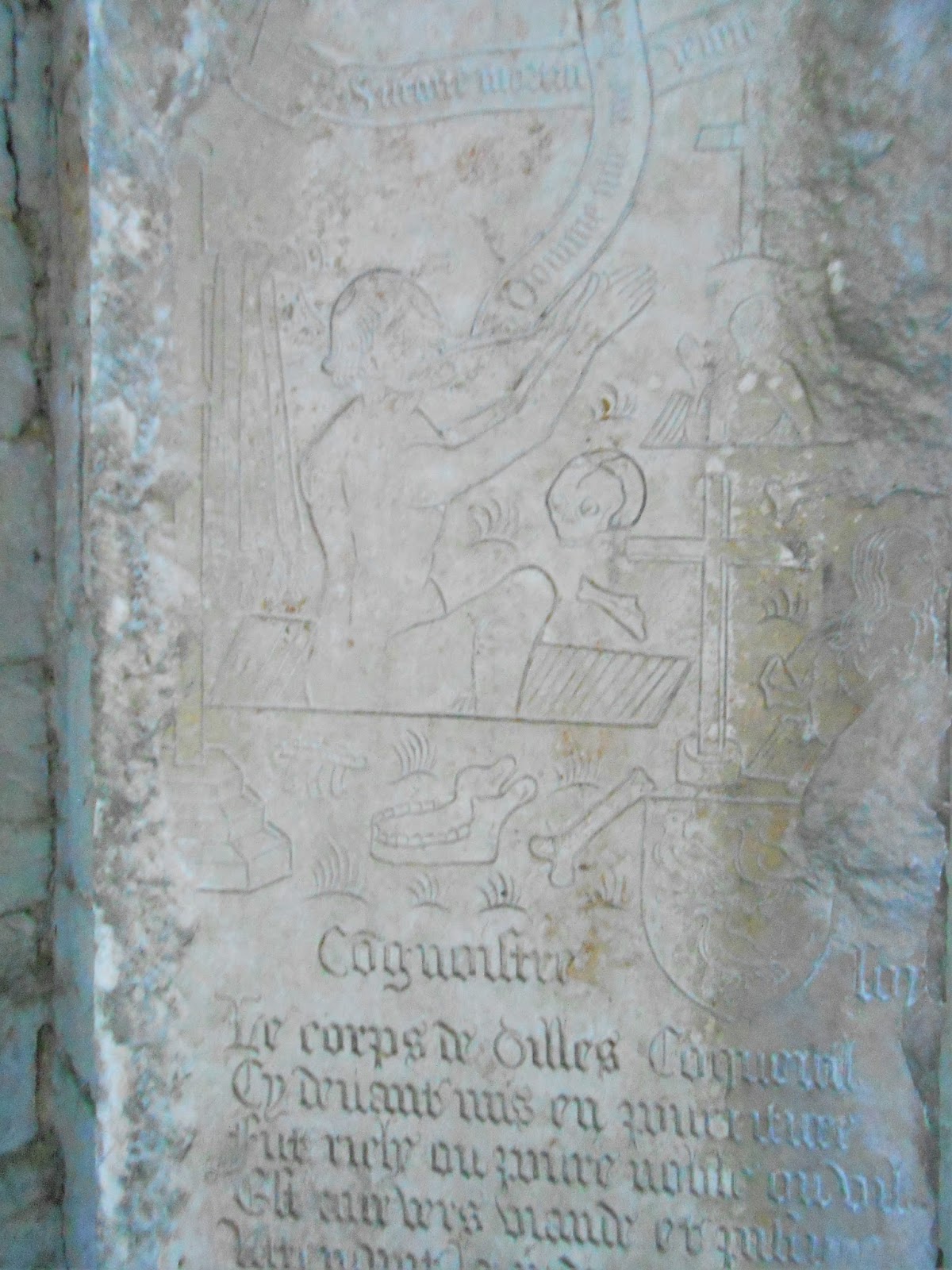
I love that jaw bone!
As always, whilst amazed by the architectural and sculptural sophistication of the monuments, I was amused by the relative simplicity and virtual naivety of other works...


Tuesday, February 23, 2016

Spring blossoming...


Well, no it's not officially Springtime yet, but the minute that I hear birdsong, notice the evenings growing lighter and see the shoots and petals bursting up and out, it is something very much like... Meanwhile, the month of February has almost shot by....


Sunday, February 21, 2016

A Spice of Life Project... with a feline touch.

The two separate Spice of Life projects
As I have always wanted to crochet, but just couldn't get to grips with it despite several attempts, when I saw a notice in a nearby shop for a class to learn precisely this, I jumped on the opportunity. What the French call a mercerie, and that I myself would call a sewing-and-handicraft shop, those in the know refer to as LYS (local yarn stores). Crochet appears to come with its very own terminology in English, but even without this I'm having to switch from French to English, and vice versa with each new stitch description.

Second Spice of Life project - pre-frogging...
Since mid-January, we learners have been huddling over balls of wool and little by little the crochet project at hand has been taking form. In fact, it seems we are following the Spice of Life design and this was a large CAL (Crochet Along) which turned out to attract many aspiring and confirmed crocheters around Britain, and via various social media has now become an international success.

First Spice of Life project - WIP
Curiously, the act of ripping out offending rows of stitches is called frogging, and believe me there has been a great deal of this on my WIP (work in progress). Crochet has actually proved to be far easier, and more accommodating of the beginners's errors than knitting, but I still haven't mastered the art of creating a straight edge. Far from it - so I feel another frogging session coming along...


This particular moment is hugely popular with the cats, who just love wool in any size, shape and form and take great pleasure in rolling in the metres of yarn as it is unravelled, spaghetti-style. This thread-fest has extended to doing a bit of independant DIY feline frogging, stealing balls of wool, , sleeping amongst them or on the wool bag itself, and should any of these activities fail to provide full satisfaction, running off with the crochet hook itself.


Of course the question of colour choice has been the trigger for numerous bouts of frogging. As the colour combination possibilities are vast, so is the desire to experiment. The official Spice of Life CAL project uses 14 different colours... I've finally stayed with my original choice for the first piece, with a very limited range of five colours and it is the parallel work that will be more adventurous - once I've frogged those offending initial rows...

Tuesday, January 26, 2016

La Maison des Musiciens in Reims...

The mysterious gap in Rue Tambour - Reims
When I lived in the old part of the city - around Place du Forum - I used to look up at the amazing buildings that had somehow managed to survive to the present day - unlike the majority of the architecture of Reims which had been flattened and/or burnt to the ground during the First World War.

Façade Hôtel des Comtes de Champagne
The few that had indeed made it through the centuries are now either surrounded by the odd mix of architectural styles that were part of the ambitious project for "une réconstruction aux multiples visages" from the end of the war years in the early 20s, or are cornered in or crowed out by far more recent 'compositions' that seem to have little to offer, except generate a sizeable revenue for those concerned, I presume. Better that than demolition, however.

Hôtel des Comtes de Champagne
One of the curious, cobbled streets that branch out from Place du Forum has one such site of destruction, where some old building has been ripped out, like an old tooth from a jaw. All that remains now is a jagged line of stone stubs in the previously-adjoined edifice next to the void, that itself is concealed behind a non-descript concrete wall.

Hôtel des Comtes de Champagne
I always wondered what building had stood there prior to this clumsy excision, and why the site had not yet been reclaimed by the city council or some construction firm.

Void on left-hand side, direction Place du Forum
When I visited the Musée Historique Saint-Remi during the Journée du Patrimoine back in September, I finally found about that mysterious gap in Rue Tambour.

Detail of Hôtel des Comtes de Champagne 
What I had taken for the work of some recent demolition job, was in fact the result of the destruction of the Great War, and therefore dates back some hundred years. Until then, the street had borne some of the most beautiful Gothic buildings of the town, and housed some of the more illustrious individuals.

Maison des Musiciens - Reims 
Rue Tambour is fairly narrow, and therefore it is hard to believe that it was once the main Roman road (cardo), leading towards the Forum. Indeed, we are more accustomed to seeing the wide axis of the city that was part of the post-war Reconstruction years, based on the plans of the American urban architect John B. Ford.

Print of Maison des Musiciens - Musée Saint-Remi
It is said that when the royal procession headed towards the cathedral for the coronation of Charles X in 1825, via Rue Tambour, any façade statue that risked catching the royal standards and banners was amputated of its offending appendages. The evidence of significant damage is visible today...

The Four Musicians and the Bourgeois - Musée Saint-Remi - Reims
From the Middle Ages, this street indeed played an important role in the city and is said to have offered money-changing services; essential for travelling salesmen who would move from the various commercial fairs of the region (les foires de Champagne) or would visit the city during the Coronation of the successive kings of France. In the 16th century, an apothecary plied its trade in the street,  public sales took place there towards the end of the 17th century and at the advent of the 20th century, a hardware store proposed its goods to the rémois. 

Base of Statue
When I arrived here twenty-odd years ago, Rue Tambour was known for its Asian restaurants, but that has gradually changed and the street seems to be embracing its ancestral roots à la française. The use of its last remaining Gothic building for private receptions and cultural functions seems to highlight this. Indeed, the Hôtel des Comtes de Champagne, is the illustrious survivor of the same war years to which the missing building fell victim.

The Rebec Player
Built in the 13th century, this hôtel is said to have been the periodic residence of Thibaud 1V (1201-1253), one of the Counts of Champagne, based in Troyes. It now belongs to Champagne Taittinger and so continues to retain a certain note of elitism and ever possesses its marked element of beauty. Similar high-ceiled ceremonial reception rooms, ornate pointed-arch windows (en ogive), sculpted fireplaces and doorways graced the interiors of the building next to the hôtel. No trace of these exist today, of course, but the key features of this missing edifice have survived.

The Harp Player
The vast Gothic statues for which this building was renowned - the Four Musicians - were removed in 1917, in order to preserve them from the destruction that duly visited Rue Tambour shortly after that date. These figures can be seen today in the Musée Saint-Remi, having spent years in the Musée des Monuents Français in Paris between the two world wars, and having almost been purchased by the USA at the beginning of the 20th century. This Maison des Musiciens would certainly have been the oldest private edifice in Reims, had it not been destroyed. What is less certain was its actual function and whether its distinctive ornamentation served to highlight a concrete musical status. Was this a site for a corporation of  musicians (ménestrels/ménétriers), similar to those later known as La Ménestrandise in Paris? Its name is often linked to the Eglise Saint-Julien des Ménétriers, itself destroyed during the French Revolution... Or was this a lavish reception hall for musical events or finally was it merely the expression of the particular aesthetic taste of a rich bourgeois who aspired to be part of the social elite?

The Bourgeois Owner
Whatever its purpose, the Maison des Musiciens combines traits of a wealthy bourgeois dwelling and an urban palace, through structure and features. According to prints and photographs, the house had a façade composed of two distinct styles. The bottom was used for commercial ends; small shops were set between the relatively narrow windows that bore rounded, Roman arches, alongside a large rounded porch. On the first floor, the imposing musicians occupy the tri-lobed arched niches, which in turn are set beside vast rectangular stained-glass windows. The roof slopes down at an impressive angle, with mansard windows piercing the surface, giving a typical 'Medieval' air. The vivid expressions of the musicians add to the overall impression, although we have to rely on the setting at the museum to sense the atmosphere they originally created, of course.

The Chevrette (bagpipe) Player
The four statues make up an orchestra - with players of a rebec (a Medievel stringed instrument, played below the arm), harp, chevrette (similar to a bagpipe) and a tambourine/flute -  and a fifth (central) figure, said to represent the bourgeois owner himself, bearing a falcon on his leather-clad arm. Each character has his own traits yet together they form a harmonious group. It is said that the Maison des Musiciens has links with Reims cathedral, whose imposing northern flank you encounter by simply following the Rue Tambour, crossing Place du Forum and Place Royale. The similarity of the stone used, and the quality and character of the statues might suggest that the same sculptor carried out work on both façades, but as you often have a certain feeling of déjà vu around these incredible works of art, it is difficult to know...

The Tambourine/Flute Player
So I finally discovered what lies behind the void in Rue Tambour and yet again, I wished I could travel back in time to visit the pre-1914 Reims.

Detail - Façade Hôtel des Comtes de Champagne