Saturday, October 31, 2015

The Rood Screen at St Etienne-du-Mont in Paris...


As I had the opportunity to go to Paris for a very fleeting afternoon visit, I decided to see the church of St Etienne-du-Mont, whose rood screen is one of the very few in France that still remain intact and in their original place.

Side view of St Etienne-du Mont
The church is in the 5th arrondissement, near the Panthéon and the Jardin du Luxembourg, and draws its name from the fact that it is set on the Sainte Geneviève mountain. The latter is a modest 61 metres above sea level, but the edifice of St Etienne is rather imposing and certainly appears to draw in the visitors, if their numbers yesterday were anything to go by… Unfortunately, they, like me, had to wait until four o’clock before being able to enter the church, but it was worth the wait.


In fact, crowds are nothing new to the area, once site of the Abbey of Saint Geneviève. Indeed, the église St Etienne-du-Mont was initially built in response to the needs of the ever-growing worshippers who came to offer their devotion to the female patron saint of Paris. Geneviève had symbolized courage and piety during her lifetime, having bravely defended Paris, and stood up for its people, thus thwarting the intentions of Attila the Hun to seize city. Following canonisation after her death in the early 6th century, prayers to Saint Geneviève offered the faithful citizens hope of salvation from the plagues, flooding and general misery that visited the city in biblical proportions. The Merovingian king Clovis and his wife Clotilde ordered the construction of the church dedicated to St Paul and St Peter on a former paleochristian cemetery that eventually became the church and abbey of Saint Geneviève. The crypt and church itself became the royal necropolis for the first Merovingians, including Clovis and his wife, and drew pilgrims in large numbers. The sacred remains of Geneviève, carried each year by procession to the cathedral would lead to numerous miraculous occurences but themselves fell victim to the violence of the Revolution years at the beginning of the 18th century, as too did the eponymous abbey.


Having emerged alongside the north wall of the abbey of Sainte Geneviève, the church that would become St Etienne-du-Mont grew in size, stature and structure, a process that took many, many years. Authorisation was given to establish this autonomous church, devoted to Saint Etienne (St Stephen in English), the first martyr of Christianity. This indeed became a truly independant edifice on the destruction of the abbey in 1808, along with the creation of the road Rue Clovis. All that remains of the ancient abbey of Saint Geneviève is the tower – la Tour de Clovis - which now forms part of the Lycée Henri IV. The church of St Etienne-du-Mont finally inherited the relics of Saint Geneviève.
So it is that the church we see today was built over a considerable period of time, although the most intense activity was the hundred odd years between the architectural direction under Viguier and the posing of the façade stone by Marguerite de Valois in 1610. Naturally, the time span is reflected in the composite form of the church, its structure and decoration. This commenced with the Gothic apse from the reign of Charles VIII and ended with the Renaissance with its greco-roman porch of the façade, finished in the years of Louis XIII, and restored by Baltard during the Second Empire in the 1860s. Inside the church, the pointed Gothic arches give way to rounded arches in the nave which turn are echoed in the rounded forms of the ornate gallery that runs along the choir area and high altar. Striking Renaissance ornamentation is offset by the delicately decorated keystones on the vaulted ceilings, high above.


And of course, there is the rood screen. Built in white marble, constructed and sculpted by Biard Père in the early 16th century, there are few of the features that characterize the roodscreen of Sainte Madeleine of Troyes (cerca 1517). In Troyes, the intricacy and density of the sculpture is just breathtaking, here in Paris, the sheer mass and dramatic forms are otherwise striking. The ‘screen’ is a huge single arch that spans the choir area, with two spiral staircase forms on either side, leading up to the gallery above and the crucified Christ that towers above us. The geometric sculpted formations and interlaced patterns of the staircase demand our attention.


Unfortunately, a great deal of the ornamentation was difficult to approach as everything had been cordoned off for Mass, I imagine, and rightfully so. In addition to this, just as a bad workman always blames his tools, I wanted to jump up and down on my camera from frustration as it would not deliver its usual Luddite-friendly promise of point-and-click reliability. It really did not appreciate the limited overall lighting, combined with the shards of light beams coming through the stained-glass windows.


However, if truth be told, the whole experience of visiting St Etienne just made me realise how marvellous my visit of Sainte Madeleine had been. I was not disappointed to see the rood screen at St Etienne-du-Mont, but Classically-inspired art and architecture rarely move me the way those of the Medieval/early Renaissance period can. All those quirky details of human fallibility and the glimpses of the humanity - warts and all - within each being, seem to reach out over the centuries to make you feel the vitality behind them. Every gurning Gothic gargoyle seems to tell a story, a knowing wink from times long past, but the narration does not seem so distant. I duly admired the beauty within St Etienne, for beautiful it is, but I missed the unique atmosphere of Sainte Madeleine. This, of course, probably stems from the fact that I do not actually have any religious affiliations at all, and as much as I love visiting all these incredible ecclesiastical edifices I do not actually have any true spiritual connection. I do feel like an intruder, but if the aesthetic beauty and peace of a church or cathedral can draw you closer to Man and Nature, it surely can’t be all bad.


St Etienne-du-Mont continued to act as necropolis to great men, but finally the construction of a vast Neo-Classical edifice in the latter part of the 18th century – the Panthéon – took over this function. With the inhumation of Victor Hugo in 1885, the Panthéon ceased its own function as a church and became a temple devoted to the glory of the Nation. Although it had been decided that the relics of Saint Geneviève would be housed there too, but this was not realised and so the annual procession of Saint Geneviève still sets out from St Etienne-du-Mont to the Cathedral of Notre Dame as they always have. Notre Dame itself is built on the grounds of the initial cathedral of St Etienne…

Beautiful blue skies before opening hours...

Tuesday, October 27, 2015

Along and on the Autumn Canal..


The autumn crept up whilst the weeks have sped by, even if weighed down by heavy workloads and plain old hassle. No time for bike rides or blogs even if I had always sworn that I'd try to post something for the latter, three times a month, just to keep my head above water and to prove to myself that I hadn't gone under!


So, nearly the end of the month of the October...


Despite everything, I still have been able to appreciate the beautiful colours of the autumn months, at close quarters and float along all the same, in more ways than one!


Having spent so many years walking across the canal and riding along it, at the beginning of September I joined one of the local rowing clubs and so now I am able to actually go on it. No photos of that feat for the moment as I take minimal belongings with me, knowing that there is quite a good chance of my ending up in the canal waters; the camera stays at home, along with my watch and phone!


It is interesting to see the familiar habitat of all those creatures that live along the canal, from a very unfamiliar angle, but most of the birds and beasts seem very indignant to have such an intrusion made upon their territory.
'My' muskrat...
Rats race along muddy tracks worn into the banks and ducks scatter in the most disgruntled fashion, squawking in that mocking way they must have perfected just to scorn beginner rowers. The human fauna - in the form of fishermen - just look up to the heavens as yet another boat veers towards their tackle.


As the clocks went back this weekend, but the cats' timing did not adjust accordingly, I decided to ride along the canal after having been woken up in the rather early hours. It was beautifully murky in places...The misty conditions concealed much of the industrial backcloth that surrounds parts of canal landscape and seemed to muffle the noise of the growing rush-hour traffic.


Like the water-based wildlife of this environment, I am learning to focus on the natural world around me. I largely block out the concrete, tarmac and metal from my vision or try to find a certain beauty in their vast forms, silhouetted against the sky line or reflected on the water. However, the barges that transport material along the canal for the manufacture of the glass bottles for the champagne industry, no less, serve as a reminder that you may well encounter a bigger water-borne beast than yourself on the canal. The eight-rower boat (the 'octuple scull') might make you feel like an invincible Viking, but you would still be no match against the massive barges that make their way silently towards you!


From the cycle path, I managed to see a very sizeable muskrat industriously getting on with his business, oblivious to all those people racing off to theirs. At first I thought it was either a coypu or a young otter, but even if it was 'just' a rat, I was thrilled to see it. A feeling certainly not shared by the moorhen nearby...

Monday, October 26, 2015

M'asseoir sur un banc...


Old photo, old times.... 
The 'Mistral Gagnant' of the song's title referred to a type of sherbet dip in which you would find a paper indicating that you had either got the winning ticket which enabled you to have another 
Mistral Gagnant 'for free' or you had lost out.... 
Renaud wrote this song for his daughter many years ago, and it was voted 'Chanson préférée' of the French in 2015. 

 Produced by Renaud Séchan - Virgin FRANCE 1985


Mistral Gagnant seems to have a bitter-sweet, evocative flavour that never fails to move whoever hears it.

Tuesday, September 15, 2015

The Paintings of Jean Marrel...Nature in Art, Art in Nature...


While visiting the town of Troyes in the Champagne-Ardenne region at the beginning of July, I noticed a poster for an art exhibition that literally made me stop dead in my tracks. I often see things that make me pause, but the total stand-still moments are a little rarer. The vivid colours and evocative forms in the poster reproduction of the plant painting caught my attention straight away.


I was very pleased to see that the exhibition was still being held at the Maison du Boulanger, one of the many Medieval buildings in the heart of the old town. Unfortunately, the opening hours being incompatible with my timetable, I wasn’t able to see the amazing work of the artist in question; Jean Marrel.


To say that I was disappointed is an understatement, but I vowed there and then that I would come back before the end of the month just before the final days of the exhibition… That project lost a little momentum as I went back to England, but then I resolved to return to Troyes as soon as I got back to Reims. And indeed, this was a trip that I certainly did not regret, despite a wait of 6 hours for the exhibition opening (3pm)!


Troyes is a town simply full of the most incredible churches, edifices and museums, whilst the whole of its historical centre is crisscrossed by streets and meandering alleys composed of buildings that date back to the Middle Ages.

Suffice it to say that I had no trouble passing the intervening hours…

With its typical colombage troyen, the Maison du Boulanger is a suitable setting for any exhibition; calm and peaceful, with its centuries-old wooden beams creating a unique atmosphere.


Access to the first floor is at the back of the building, via a wooden staircase that overlooks a tranquil courtyard and leads onto the subdued lighting of rooms illuminated in this case by the colour of these works.

Jonchée 3 - Jean Marrel - Exhibition at the Maison du Boulanger - Troyes
The poster that so mesmerized me on my first encounter was but one of this artist’s many studies of floral and vegetal forms to be seen at the Maison du Boulanger. More of Jean Marrel's work can, of course, be seen on his site (www.jean-marrel.fr).
Most of the photos below in this post are details of the full paintings. As the original works themselves are often quite large, that magical quality is magnified all the more....


The imposing forms of exotic amaryllis and iris lead onto flurries of nasturtium, the ‘stencilled’ starkness of flowering courgette, the dense bodies of ripe figs and the dramatic stalks, leaves and petals of other more unassuming plant types. All of these seem to vie for your attention; their bold contours and colours drawing you in. At this point, you are caught by a strange quality.

Deux Iris - Jean Marrel
Indeed, while these works are realistic in that you can ‘sense’ the vital essence of each plant, this is no slavish, faithful reproduction of the each detail. However, this is no impressionist approach either; it goes beyond a fleeting impression of vitality.

Fleurs de Courgette - Jean Marrel
While I could not appreciate this quality from the street poster alone, I was able to 'live' it in the exhibition. Be it the spindly roots of a radish plant or beet; the twisted, convoluted leaves of garlic; the radiating stalks of an umbel; the bulbous forms of quince fruit or the pitted skin of a lemon, each study makes you ‘feel’ the life of the subject both from a distance and at close quarters.

Detail of Le Bal des Capucins - Jean Marrel
Viewed from afar, the essential shape of each subject with its defining characteristics is rendered. This is just as valid for the plant studies as for those of the farmyard chickens, for example. Sadly, the latter were not part of the exhibition, but can be seen on the artist’s site.

Jean Marrel
As you will see there, Jean Marrel’s paintings of hens truly capture the busy, bossy, no-nonsense aspect unique to such birds, intent on going about their business, head cocked, feet strutting… and yet without a single discernable feather!

Jean Marrel
Apparently the artist does not seek to represent a 3-dimensional reality that is reliant on perspective and detail, but instead leans towards a more 2-dimensional approach that recreates the vital essence of the subject, be that flora or fauna.


In some ways this reminded me a little of the Japanese woodblock art that Baudelaire termed “the Asian image d’Epinal technique” with its evocative forms and blocks of colour.


However, that would not be sufficient to fully describe the studies here.

Capucins - Jean Marrel.
Apparently, Jean Marrel frequently presses his plants and flowers to produce a 2D view that he then recreates on a given medium. Dramatic contours, sinuous lines and bizarre shapes are captured in the flattened version of the original subject, but this process also releases a new energy and creates new forms that may lead onto other interpretations.


Far from being caught prisoner on canvas, with their life suspended, the subjects seem to germinate and metamorphose. They indeed grow outward, with the rustle of intertwining shoots and leaves, a flourish of petals that float and dance and often seem to assume the billowing outlines of human forms or the flight of birds. Rather than a dull study of nature morte, these paintings ultimately have a poetic force of their own, like a form of static electricity that catches you unawares.

Ciel - Jean Marrel
Although the English term, 'still life', is more appropriate than the French nature morte, it still falls short as a description of this work…. This is no trompe-l’oeil to show the transience, futility and Vanity of our existence. Indeed, this deceptive ‘flat’ approach produces a depth that serves to emphasize the hidden existence of all things in the natural world and their gradual growth and transformation towards new forms and movements.

Detail Amaryllis - Jean Marrel
Central to this process of contemplation and recreation, is the actual technical aspects of the creative process. Jean Marrel’s work does not simply create an overall image of vitality at a distance, which dissolves into a seemingly haphazard group of paint strokes and layers when seen up close. Indeed, here the painting technique become an essential part of the subjects’ vitality.

Amaryllis - Jean Marrel
The paint work and its reworking, the contrasting textures, effects and responses of the materials used, are at the heart of this organic process of creation, and thus seem to become a living part of the organism studied. In this manner, the rough surface acquired by several applications of paint or from scraping, scratching or worrying the paint layers, may either be harnessed to reflect the essential vitality of a living form, or may actually ‘lead’ the artist in his design.

Detail of Amaryllis - Jean Marrel
Rugged edges followed by smoother patches may represent silky petals with their strange veins and markings; ridges may become essential in the portrayal of stalks; cracking, spotting and stress may highlight leaves, seeds and pods… Likewise, the texture of the paint itself seems to emphasise the vitality of the colours employed. In this way, smooth liquid paint seems to bring out the fluid vibrancy of certain tones; chalky mediums highlight contrasting colours; dull milky layers of paint underline the enameled shine of other areas. It goes without saying that the colours themselves are just beautiful…

Detail Amaryllis - Jean Marrel
The whole of this approach creates an art that I thought was really unique and I spent quite some time looking at these works, from near and afar, appreciating their skill. These works make the viewer ‘feel’ the vital tension within, and the life force that radiates out. The whole visual experience stimulates other senses; in a strange form of synaesthesia, I suppose. As I love some of the weirdly beautiful forms to be found in the plant world, precisely for this same quality, this exhibition was really interesting.

Physalis (photo)
Jean Marrel’s art seems to have no dark undertones. However, the hidden vitality of his subjects, their capacity to assume almost human forms and above all the disconcerting ability of the art to mimic life and the organic living process reminded me a little of the novel by the fin-de-siècle writer J.-K. Huysmans (1848-1907) – A Rebours – which was published in 1884. It must be said that the morbid, extreme aestheticism and the premise of the supremacy of cold artifice over Nature of Huysman’s writing finds no trace in the paintings of Jean Marrel; quite the contrary.

Detail of Jonchée 3 - Jean Marrel

Nevertheless, Against Nature (the English title) is a novel well worth reading, with the ultimate message that you cannot go against the current of the life forces of Nature or those of (the Catholic) faith; these will all inevitably overpower you. The story focuses on the withdrawal from bourgeois society of its protagonist, Des Esseintes, into a world of Decadence. This universe of mystical symbolism, aesthetic and intellectual (over)stimulation eventually implodes, leading the anti-hero to flee this stifling, bewelled anti-life…


Below is part of the description of the exotic plants Des Esseintes has chosen precisely for their ability to go ‘against nature’.

This wonderful art had held him entranced for a long while, but now he was dreaming of another experiment. He wished to go one step beyond. Instead of artificial flowers imitating  real flowers, natural flowers should mimic the artificial ones.
He directed his ideas to this end and had not to seek long or go far, since his house lay in the  very heart of a famous horticultural region. He visited the conservatories of the Avenue de Chatillon and of the Aunay valley, and returned exhausted, his purse empty, astonished at the strange forms of vegetation he had seen, thinking of nothing but the species he had acquired and continually haunted by memories of magnificent and fantastic plants.
The flowers came several days later.
Des Esseintes holding a list in his hands, verified each one of his purchases. The gardeners from their wagons brought a collection of caladiums which sustained enormous heartshaped leaves on turgid hairy stalks; while preserving an air of relationship with its neighbor, no one leaf repeated the same pattern.
Others were equally extraordinary. The roses like the Virginale seemed cut out of varnished cloth or oil-silks; the white ones, like the Albano, appeared to have been cut out of an ox's transparent pleura, or the diaphanous bladder of a pig. Some, particularly the Madame Mame, imitated zinc and parodied pieces of stamped metal having a hue of emperor green, stained by drops of oil paint and by spots of white and red lead; others like the Bosphorous, gave the illusion of a starched calico in crimson and myrtle green; still others, like the Aurora Borealis, displayed leaves having the color of raw meat, streaked with purple sides, violet fibrils, tumefied leaves from which oozed blue wine and blood....


As I said, this decadent vision of Nature is far removed from the world view that sems to emerge through Jean Marrel’s work. The artist here appears to view Nature as a means to embark on an almost spiritual quest of vitality, using art to embrace life in all its changing forms.

Again, if you want to see the 'real thing', just check out those chickens!


Friday, September 11, 2015

Le Tréport and Mers-les-Bains - Seaside Beauty from the Belle Epoque...

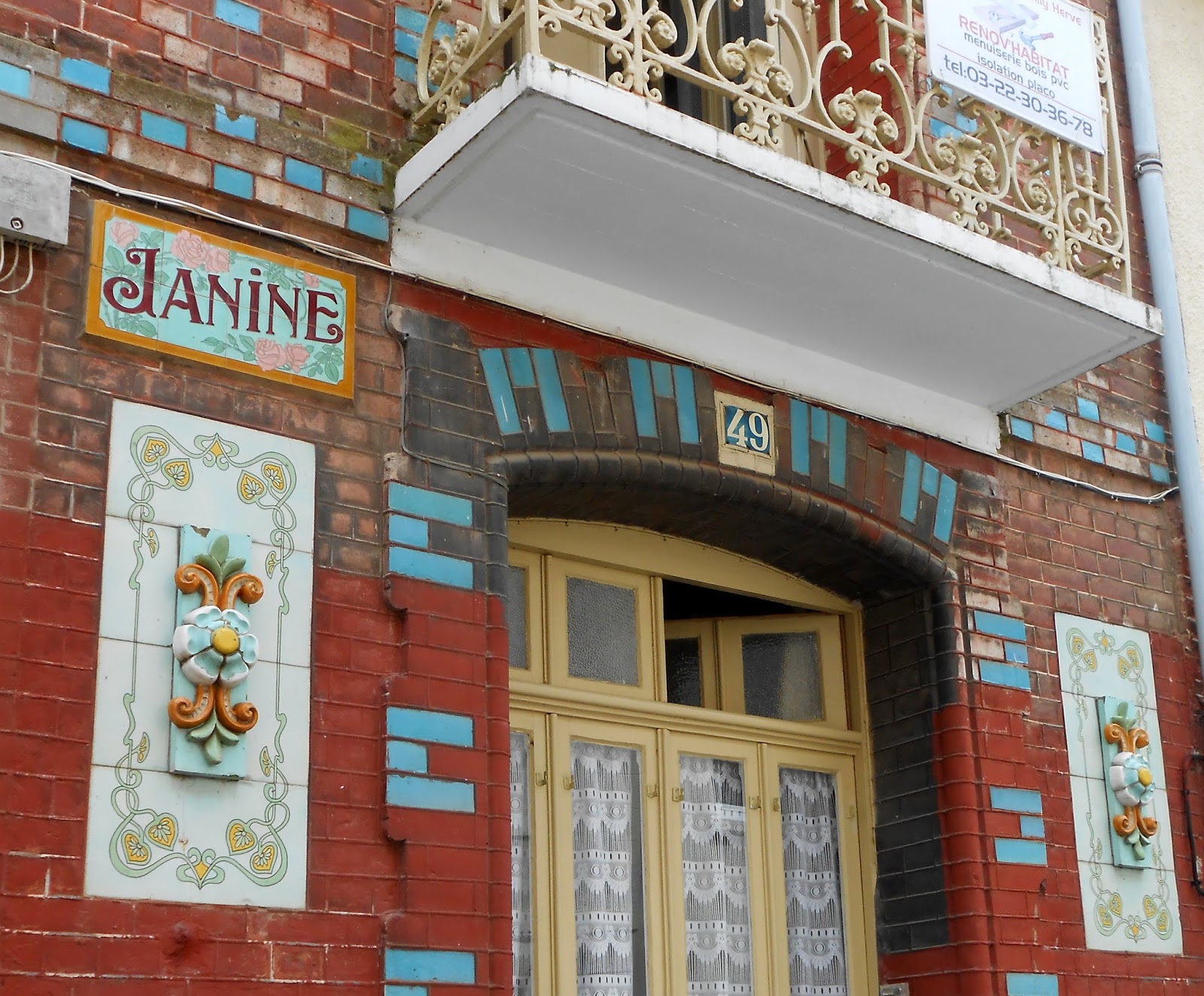
Ceramic name plaque...
Over the summer, I decided to make the most of a special day-trip offer, care of SNCF (the French rail service) to Le Tréport, on the Côte d’Albâtre.

Cliff top view over to Mers-les-Bains
After a train-ride, at a reasonable price, city-dwellers are given the opportunity to spend some time visiting the seaside resorts of Le Tréport and Mers-les-Bains, set alongside the highest cliffs of Europe.


In fact, the cliffs here belong to the same geological system as those at Dover; the name ‘Alabaster’ referring, of course, to the white chalk composition.

View of the port of Le Tréport
It came as no real surprise that the train was full of families eager to pass the day by the sea, even if the weather was rather bracing at times. What I did not know, is that such day-excursions to Le Tréport-Mers-les Bains, are part of a long shared history between the town and the railway.

La Bresle river - Le Tréport
In fact, this particular part of the coastline has been attracting English visitors for many, many centuries...

Cliffs beyond the esplanade at Le Tréport
Such visits have either taken the form of marauding acts of retaliation, following the Norman conquest of England in 1066; the more genteel type with guests such as Queen Victoria to mark an entente cordiale; or that of Allies during the Great War years with the cliff-top English military hospital or finally the pebble-pinching day-tripper category to which I belong…

Quartier des Cordiers - Le Tréport
Nowadays, Le Tréport is automatically associated with the neighbouring Mers-les-Bains, and in turn both of these are linked to the town of Eu. Together, these are collectively known as the ‘Three Sisters’, set along the chalk valley landscape that has been carved by the river Bresle.

Funicular - Le Tréport
The river also acts as the divider between the regions, with Mers-les-Bains attached to Picardy in the département of the Somme, and Eu and Le Tréport in the Upper Normandy region, département of the Seine-Maritime. Although ‘siblings’, the three towns have their own distinctive character, derived of course from their respective history formed by their cultural and economic functions.

Harbour area of Le Tréport
Eu, an ancient gallo-roman river port takes its name from the Latin – Auga –later changed to ‘Ou’ in the Middle Ages, the initial name of La Bresle. The town grew significantly in importance following the construction of a Benedictine abbey, L’Abbaye Saint Michel, in the early 11th century under Robert 1st, Count of Eu. With this imposing edifice and L’Abbaye du Mont Saint Michel that we know so well today. the Duchy of Normandy was protected from inroads made by Britany and Picardy, Although the abbey of Saint Michel was destroyed during the Revolution – (1789-1799), Eu had already been long established as a town of prestige. Indeed, it was there that William the Conqueror wed Mathilde de Flandres in 1050. The town assumed an aristocractic quality, with an architecture that rivalled that of Rouen.
The majestic Château d’Eu was built at the end of the 16th century under the orders of Henri de Guise and Catherine de Clève and would go on to receive nobility and royalty alike up to the end of the reign of Louis-Philippe (1830-1848), King of the French.

View over the jetties at Le Tréport
During the years of the July Monarchy, the royal practice of spending the summer season at Eu was established. It was this new pattern that brought about the most significant changes to the neighbouring towns of Le Tréport and Mers-les-Bain.

Quartier des Cordiers
Le Tréport had long been a fishing settlement - its name coming from the Celt word traez – ‘shore uncovered at low tide’ and the Latin word ‘portus’.  The Romans used the name Ulterior Portus to designate it – meaning ‘maritime port beyond’ the river port of Eu.

Typical wrought iron balconies at Le Tréport
From the 12th century onwards, numerous attempts to consolidate and fortify this port largely failed. Unfortunately, the invasion of silt and sand of the Bresle and the pillaging English hampered its evolution. Finally, the count François 1st of Clèves, launched a more successful project, with the deepening of the zone, the construction of quays and a wooden jetty and the erection of a large stone tower as a defense to the town.

Ornate brickwork of fishermen's homes
Nevertheless, Nature got the upper hand as the port was soon invaded by pebbles whilst all that remains now of the old tower is the vaulted door of the former town hall. Undaunted by the failure of these earlier schemes, the last Count of Eu embarked on his own programme and went on to build a lock on the river in order to have a greater control over the sediments in the harbour.


It was under Louis-Philippe that commercial activity developed significantly. This was facilitated by further work on the existing port, in addition to the improvement of the canal that linked Eu to Le Tréport.


Alongside this commercial maritime success was the emergence of the new social phenomenon of the seaside resort which was set to become an institution in its own right. Indeed, during their summer residence at Eu, the royals led and encouraged the enthusiasm for the benefits of sea water and the appreciation of bathing.

Example of an original balcony (right) and a modern-day replacement (left)
It was Louis-Philippe himself who ordered the construction of the first of the seafront villas – the Pavillion d’Orléans in 1831 and had a project to create a marina for recreational boats near Mers-les-Bains.Thus the fashion for the seaside holiday was born.


Le Tréport sought to meet the requirements of this new type of visitors – les baigneurs. For the large part from wealthy backgrounds, the latter had the means to benefit from the town’s new amenities– the vast casino being just one example of what was proposed. However, the town soon found itself submerged by visitors and had to expand in order to follow demand.

Oriel windows at Le Tréport
The wealthiest members of the Parisian bourgeoisie soon started to have large villas built on the sea front just along from the cliff face, in order to enjoy summers by the beach. Behind these villas were rows of traditional houses of the old fisherman’s quarter – les quartier des cordiers – so called because the inhabitants were too poor to use full fishing nets and were obliged to use simple lines -les cordes.

This 'cordier' accommodation would be rented out to the less affluent baigneurs. Such guests would inhabit the upper floors of these tall, rather thin buildings, whilst the cordier family would live in the basement rooms throughout the summer months.

Typical name plaque at Le Tréport
Walking along the cordier streets, you can often literally see through the entire depth of each house, from the front entrance to the back door, which likewise leads onto another street. Sometimes this openness gives you the feel of a dolls’ house that you simply cannot resist looking into, even if you know you shouldn’t! In general, however, there is little that rests of the original intereriors, with the exception of some of the beautiful tiled flooring.


The open accessibility of these fishermen’s homes was key to their function and was typically reflected in their décor too. To enable inhabitants to communicate with each other along and across these streets, balconies were built as the main feature on the façades.


Little by little, these practical uses became standard, adopted by the grander villas so that people could see and be seen by the others and gradually it became integral to the aesthetic appeal of the whole. Parallel to this was the use of oriel windows, with their decorative corbels and bow windows which afforded the same advantages as the balcony, but offered protection from inclement elements for the more genteel public.


The houses in the modest fishermen’s quartier and the lavish villas that once stood along the esplanade of the beach did indeed share some of the same features. Both groups had the characteristic wood work on the façade balconies and eaves of the roofs, generally painted then, as now, in bright colours.


These same shades would be brought out again or complemented by the rich ceramic plaques and cabochon features that decorated the façade and served to distinguish the different buildings.


The vibrant name plaques of every house emphasize the singularity of each while conforming to a tendency to give names of flowers, birds, or simply the first name of the inhabitant.

An example of a villa similar to the type originally to be found on the esplanade at Le Tréport
Intricate wrought iron was also used for façade features, yet was not standardized in design so that each appeared to grow organically from house to house, painted in rich colours that differed accordingly. Whilst stonework was more highly valued, such an ornate treatment of brick work brought out its own unique charm.

Art nouveau building near the station at Le Tréport 
Inevitably, Le Tréport simply could not follow this ever-growing demand for holiday accommodation. In order to absorb the waves of visitors, Mers-les-Bain was developed from a tranquil fishing town to become the seaside resort par excellence.

Villas along the esplanade at Mers-les-Bains
The popularity of this coastal site simply exploded at the beginning of the Belle Epoque with the creation of the railway line Paris- Le Tréport in 1872. Suddenly this highly-desirable destination became accessible to far greater numbers of Parisian families via a mere 3-hour train ride.


From the cliff at the far end of the beach at Mers-les-Bains, new houses sprang up next to the scattering of original dwellings. Large plots of land were sold off to promoters with speculators quick to spot the lucrative potential such development offered.


The elegance of the rows of villas that we see at Mers-les-Bains today belies their less sophisticated origins. Indeed, some of the land had initially been rather marshy, whilst others plots were the subject of heated arguments between the two towns concerning, amongst other things, the grazing rights of cattle.


Terrains were built to respect the public’s need for perpendicular access to the seafront, whilst satisfying the desire of each proprietor for a sea view. Within these plots, further sales were made, leading to the construction of houses that were fully characteristic of this mersois architecture and yet that were each of a wholly unique character. Double or triple villas were common. These were considerably cheaper to build as the same architect would follow the same plans and yet the final impression was far from commonplace.


None of the rows of buildings led to tedious repetition; far from it. Many of these houses were destined for the inhabitants of Mers-les-Bains – les mersois – or as second homes for the moneyed classes from other regions.


These were quickly labelled ‘villas’ in order to distinguish them from the other categories of property. Indeed, a large proportion of the latter group were immeubles de rapport, that is to say ‘revenue properties’ intended to be rented out to accommodate numerous tenants– on a short or longer-term basis.


Needless to say, hotels and guest houses also flourished during this extended Belle Epoque period – one of the most famous being the Hôtel des Bains.


In 1902, the inauguration of the tramway service Eu-Le Tréport- Mers linked the ‘three sisters’ and facilitated the democratic movement of visitors yet class distinction certainly remained as important as it ever had. Mers-les-Bain was the place to be, and the place to be seen in all one’s glory.


The hierarchy of property – from private use by the owner in question or to that of money-making rental schemes – is matched by a sense of hierarchy within the buildings themselves.


The floors that afforded the best views were naturally the most prized, and were reserved for the ostentatious reception rooms that served to reflect the social standing of their occupants.


The ‘ground’ floors of the villas were generally elevated to heighten the building to aid visibility and to ‘make a statement’.

Steps led up to the main entrance and thus separated the villas from the street level and protected them from eventual storm flooding.


The two ‘noble’ floors were therefore the higher ones, with a rich decoration that emphasized this importance, whilst the highest floor, often reserved for domestic service was somewhat sparse in comparison.


Looking at the seafront today, it would be easy to believe that these magnificent buildings were constructed over a limited period but in fact this activity spanned more than twenty years.


This is reflected in perceptible changes in architectural detail, with the differing emphasis on the Napoleon III style, the neo-regional and anglo-norman styles. Despite this, the overall impression remains one of unity amid a mass of individuality.


More striking, is the fact that anything of Mers-les-Bain’s glorious architectural heritage should have survived to the present day.


There has obviously been the continual erosion of coastline by wind and water since time immemorial, leading to the eventual destruction of buildings above and below the cliffs, now as much as In the past. Likewise, the rigours of the coastal climate and sea conditions have never ceased to cause structural damage to property, but most of the Belle Epoque architecture has been able to weather through these. Far less forgiving, however, were the war years…


The Great War of 1914-1918 led to the conversion of suitable sites to meet the requirements of the military – with tank training camps and hospitals - however the twin sisters of Le Tréport and Mers-les-Bains were able to resume their seaside resort status once the hostilities had finally subsided. Indeed, with the introduction of the ‘train service for the paid holiday leave’ in 1936, a new flood of visitors emerged. From that moment on, working-class holiday-makers were able and eager to experience the seaside pleasures that had been the privilege of the former generations of baigneurs.


Sadly, the Second World War was far less kind to the two sisters. Le Tréport was so severely maimed by the war years that the town lost most of its beautiful land-mark villas and hotels. It is only when we look at Mers-les- Bains today that we can really have an idea of what the architecture of Le Tréport had once been.


One of the most dramatic single losses of the wartime years was that of the incredibly imposing
cliff-top Hôtel Trianon-les Terrasses. This vast edifice of over 300 rooms dominated the port below on its construction at the end of the 19th century and was used as a British military hospital in the Great War.


The Trianon was obliterated in 1942 during the German occupation of Le Tréport that lasted almost all of the war years. Its destruction must have left a huge void on the site at the time. All that remains today of this wartime loss is a tiny part of a terrace, which I initially thought was part of a concrete wartime bunker.


During this period, seven bomb attacks destroyed around 30% of the town’s buildings and those on the seafront were totally destroyed, along with the impressive casino. The latter was replaced, although the one we see today is rather insipid compared to the original.


The beautiful seafront villas were not restored.... In their place today, we see this vast concrete building that stretches the full length of this expanse like some kind of soviet bloc accommodation, running like a scar along the esplanade area. I don’t know when exactly this was built, but it is a construction that in no way reflects the former elegance of the town, but presumably that was the intention and/or the means were simply not available to recreate this.

Le Tréport esplanade
Fortunately, the Belle Epoque architecture of Mers-les-Bains managed to make it through these years of devastation , albeit far from unscathed. With the hostilities, the beautiful rows of villas not only became little more than empty shells as the interior woodwork was burnt as fuel by the German occupants, they were finally reduced to their ornate façades. Like spaghetti western towns, the buildings were virtually cardboard cut-outs that enabled soldiers to move from building to building undetected, hidden by these elaborate theatrical exteriors. The streets were closed off, high walls were erected to block off access to the sea front and huge anti-landing devices were placed along the beach to prevent Allied attacks.

'Mini' Mers-les-Bains!
Once the conflict finally came to an end, the authorities of Mers-les-Bains were agreed that all the damage suffered by the town’s architecture should be repaired. Although some buildings were lost – the casino, for example - a vast programme of structural restoration and reconstruction returned the majority of the villas and hotels to their pre-war state- approximately 600 in all. The architectural heritage of the town has been under the protection of the Loi Malraux since 1966 and the council of Mers-les-Bains takes measures to assure that this is actively safeguarded... Some villas do look a little weather-beaten, however... The hideous 'breeze block', situated on the seafront just next to the cliff, must have been built before this law was passed - I cannot even imagine how it managed to obtain planning permission.

Beach huts at Mers-les-Bains with Le Tréport backdrop
Walking along the promenade and through the side streets it is indeed very hard to believe that this town had suffered so much. Throngs of people enjoy all the staples of seaside tourism, much as they would have done in the Belle Epoque.

Mers-les-Bains with its (white) beach huts
Beach huts are still an important feature –some 400 of them today – to the extent that there is a waiting list to gain possession of one’s own and another casino (the seventh, apparently) has been set up. Even today’s beach-combing pebble collectors fit into the old scheme of things as the trade of flint pebbles from the area was a significant source of revenue from the 19th century onwards. Used for their rich silica composition, the pebbles were utilized in the production process of Wedgewood porcelain, but also found their way into toothpaste too!


Hundreds of visitors still follow the cliff top paths, leading away from Le Tréport on the left, when facing the Channel, or along the original ‘chemin des douaniers’ on the right, from Mers-les-Bains. Many more are able to use the restored funicular train which links the lower parts of Le Tréport to the spectacular cliff tops above, and had initially been created for the benefit of the Trianon guests in 1908.


The past was symbolically linked to the present in 1989 with the bicentennial celebration of the French Revolution that saw the cliffs at Le Tréport draped in huge tricolour netting to represent the French flag. For the last 13 years, the end of July sees the commemoration of the Belle Epoque of Mers-les-Bains with the Fête de Baigneurs. The costumed participants of this event stroll along the promenade in their 19th century finery, and many more bathe in the sea, wearing traditional bathing attire.


At the end of the day’s trip to Le Tréport I was exhausted from having traced the Belle Epoque archictecture and trekking along both cliff tops. As I didn’t have time to visit Eu, the third ‘sister’, this will be the perfect excuse to return next summer on the good old SNCF train!