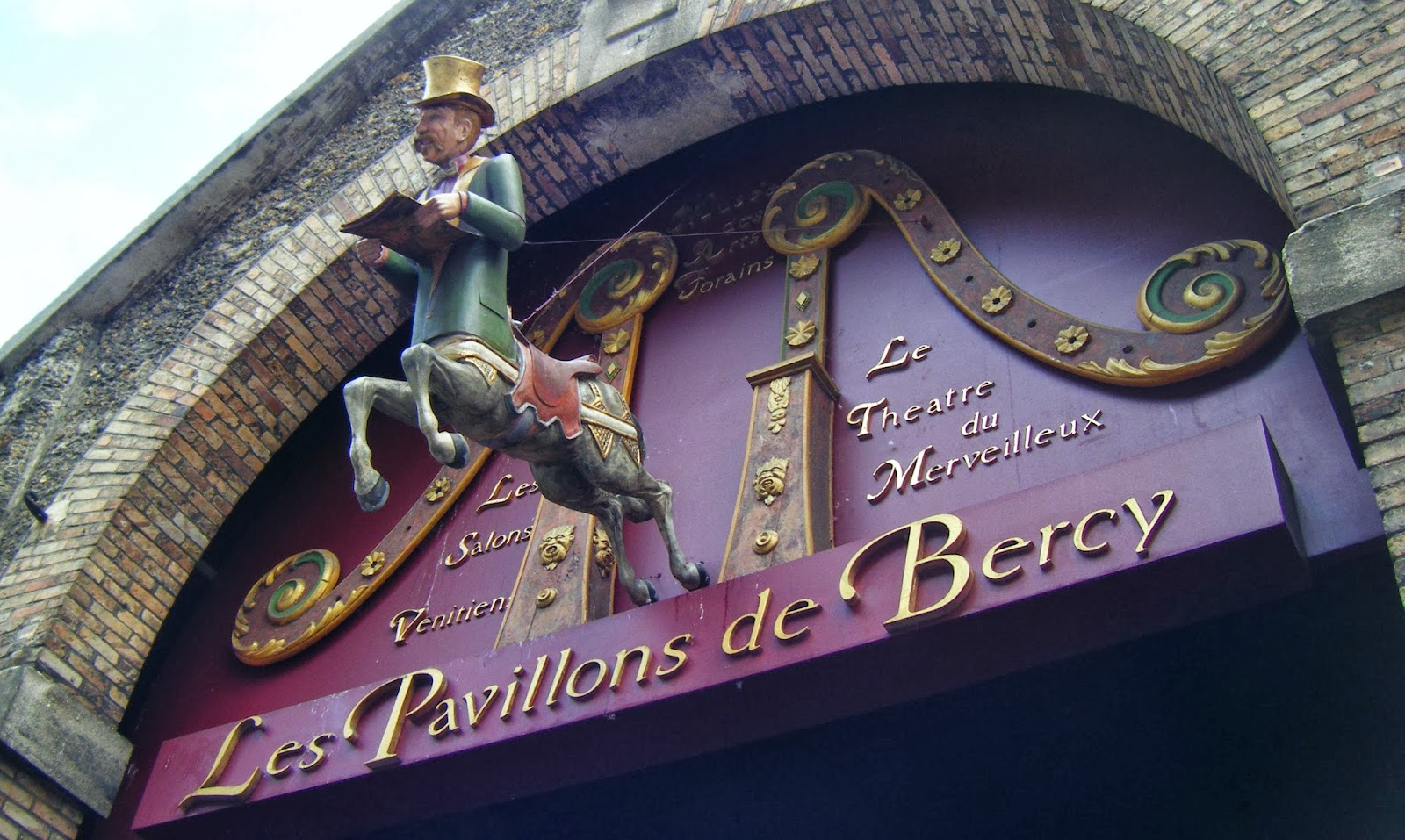
I recently had the great luck to visit a marvellous site in Paris, and this experience proved to be truly magical and certainly most unexpected indeed. In fact, we were summoned to the inauguration of an ambitious scheme at work. Well, work is work, and business is business, neither of which play any part in my blog world. However, on this occasion they really did...

It turned out that the Théâtre du Merveilleux had been chosen as the venue and it
certainly lived up to its name. This is, in fact, part of the Musée des Arts Forains which is situated
in the Pavillons de Bercy. These
particular industrial warehouses were built in 19th century by a student of
Gustave Eiffel and had been used to hold the wine reserves of Le Chais Lheureux. The various rails tracks
for transporting goods, the pulleys systems on the brick facades and stock
windows are all that remain of the Pavillons' initial use. Likewise, the
district of Bercy today is more easily associated with the vast sports and
concert stadium than its historical association with wine which dates back to
well before the Revolution, offering Parisians tax-free purchase.


Since 1996, Le Théâtre de Verdure has reigned alongside three other universes; Les Salons Vénitiens, Le Musée des Arts Forains and, of course, Le Théâtre du Merveilleux . Unfortunately, I didn't manage to visit these during our time there, although I did get tantalizing glimpses through heavy, draped curtains... I will be back for a full visit, of that I am sure... Hopefully with a camera that isn't playing up...
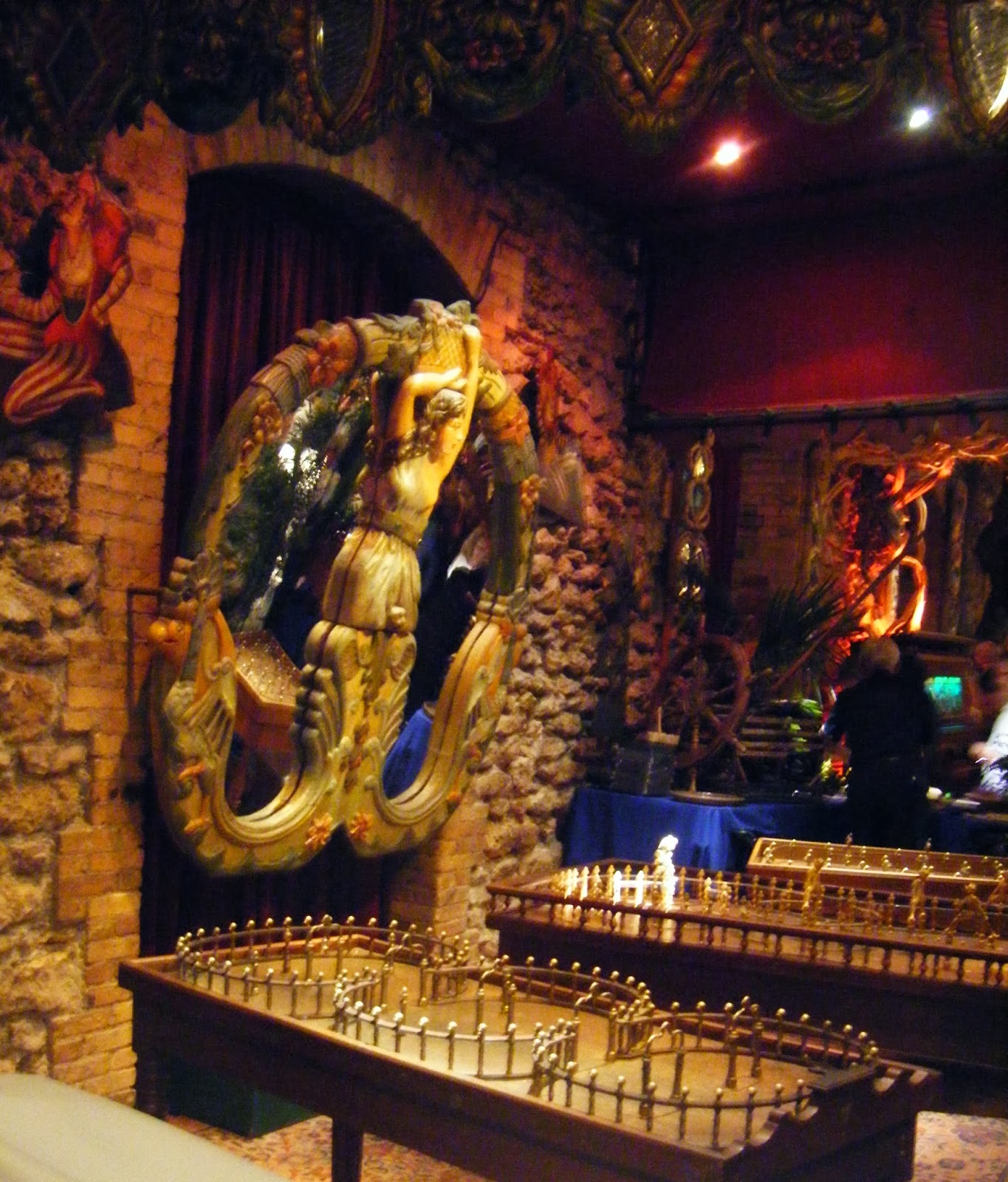
Within the Théâtre du Merveilleux, reality takes on a dream-like form as the visitor is led on by illusion so that dreams and the imaginary become real. In this collection of spectacular artifacts and objects, a fantastic realm is created, a large-scale Cabinet of Curiosities which looks like an enormous prop box for Terry Gilliam (minus the dark edge, however...).

Jean Paul Favand has sought to revive and animate the world of the spectacle and the travelling showcase, the Cabinet Fantastiques, by using the play of light, virtual technologies and digital images (video-mapping) projected onto the forms of his curiosities. 'Naturalias', plays on the strange, stunning forms from the plant and mineral world; 'Artificialas' uses bizarre human inventions whilst 'Virtualias' gives life to automated musical and visual instruments. There is literally no place where the eye can just look blankly; this is visual heaven, but all the other senses are summoned too! I actually felt exhausted after a short period because I just couldn't take it all in. In this marvellous setting, Tzigane music and dancing were being performed live, vast quantities of champagne, wine and exquisite food were all being served without moderation!

As said, much of the extensive collection that is
housed at the Pavillons de Bercy is
dedicated to fairground arts from the mid 19th century onwards and reflect the
glory days of this glorious art form. The ground-breaking discoveries in
technology, science and travel from the 1800's onwards literally opened up the mysterious
world to an eager public.
The fairground universe not only wished to reflect and capitalize on these new horizons that went beyond the limits of the imagination, it also sought to mirror and utilise these technological advances to its advantage. However, this fluid, adaptable capacity of the fair has been a constant throughout its long history, and fortunately still exists today.
The fairground universe not only wished to reflect and capitalize on these new horizons that went beyond the limits of the imagination, it also sought to mirror and utilise these technological advances to its advantage. However, this fluid, adaptable capacity of the fair has been a constant throughout its long history, and fortunately still exists today.


Initially the various displays of physical prowess, the
exhibition of oddities and exploits, and the demonstration of theatrical,
musical and dance skills ran parallel to the main business taking place in the
wooden stands. Jesters, jugglers, actors, acrobats, bear-tamers, beasts,
freaks, fire-eaters, fortune-tellers, marionettistes and illusionists were just
a few of the background staples to the key mercantile activities. Gradually
these crowd-drawing performances grew in importance, as showmen would increasingly
vie with each other to attract a paying public into stalls.

The separation of the Church and the State in the wake of the French Revolution meant that there were fewer religious celebrations and festivals in the year. On the one hand, this left a certain void in public customs and rituals and on the other offered greater freedom to the pursuit of less spiritual matters. Little by little it became apparent that there was indeed, no business like show business. The traditional fair shows are behind the majority of today's vivid performances; those of popular theatre, vaudeville, pantomime, music hall, cabaret, magicians and illusionists all have roots therein. It was, however, the Industrial Revolution that drove the transformation on both sides of the Channel and gave rise to the greatest social phenomenon in entertainment in the 19th century; the funfair.


The separation of the Church and the State in the wake of the French Revolution meant that there were fewer religious celebrations and festivals in the year. On the one hand, this left a certain void in public customs and rituals and on the other offered greater freedom to the pursuit of less spiritual matters. Little by little it became apparent that there was indeed, no business like show business. The traditional fair shows are behind the majority of today's vivid performances; those of popular theatre, vaudeville, pantomime, music hall, cabaret, magicians and illusionists all have roots therein. It was, however, the Industrial Revolution that drove the transformation on both sides of the Channel and gave rise to the greatest social phenomenon in entertainment in the 19th century; the funfair.

The revolution changed the landscape of the cities and
countryside forever, and Man's relationship to both. Social demographics were
radically altered as a result of huge changes in work practices and a growing
need for workers to feed this vast industrial machine. Progress in travel
literally opened up new highways as the improvement of road systems,
development of new canals and the introduction of the railway led to
unprecedented mobility. The population of rural areas converged on growing
cities, lured by the prospect of work in the expanding manufacturing and
production processes.

The urbanization of cities further transformed the life of citizens. The more affluent were able to benefit from the homes built under ambitious housing projects, whereas the impoverished masses had to experience the dire conditions of overcrowded slum areas. Both rich and poor felt a growing need to escape from the constraints of city life. Largely speaking, both the well-off and the poor could afford to use the railway network. Train services now linked the major industrial cities, and more importantly, offered day-trips to seaside towns, causing seaside resorts to flourish.

For those unable or unwilling to travel, yet wishing to free themselves momentarily from the confines of humdrum or soul-destroying routine, the fair became the perfect means of escape. Indeed, here the population could shake off constraints and starchy social etiquette as it lost itself in a fantastic universe, far removed from grim reality that generally offered very few dreams. The fair opened up visions and reflections of the real world to those who had little notion of what lay beyond their immediate sphere, and certainly no means to explore it themselves. The miracles of the world, real and imaginary, were brought directly from town to town via the fairground stands and shows that enthralled the audience.

Here was a form of entertainment, and even education, that was not the preserve of a privileged elite, but open to all and sundry. Before the 'invention' of tourism with Thomas Cook and his Grand Tour the fair enabled an immobile public to travel to the four corners of the world, viewing exotic curiosities from the safe ground of their home town.
The fervour for all things oriental, and the expansion of the colonial territories meant that wild beasts from distant lands were increasingly paraded and exhibited in the fairground menageries. George Wombwell, one of the most famous animal exhibitors and 'wild beast merchant', even managed to flog tickets to the public for the great privilege of seeing his dead elephant at Bartholomew Fair.


The urbanization of cities further transformed the life of citizens. The more affluent were able to benefit from the homes built under ambitious housing projects, whereas the impoverished masses had to experience the dire conditions of overcrowded slum areas. Both rich and poor felt a growing need to escape from the constraints of city life. Largely speaking, both the well-off and the poor could afford to use the railway network. Train services now linked the major industrial cities, and more importantly, offered day-trips to seaside towns, causing seaside resorts to flourish.

For those unable or unwilling to travel, yet wishing to free themselves momentarily from the confines of humdrum or soul-destroying routine, the fair became the perfect means of escape. Indeed, here the population could shake off constraints and starchy social etiquette as it lost itself in a fantastic universe, far removed from grim reality that generally offered very few dreams. The fair opened up visions and reflections of the real world to those who had little notion of what lay beyond their immediate sphere, and certainly no means to explore it themselves. The miracles of the world, real and imaginary, were brought directly from town to town via the fairground stands and shows that enthralled the audience.

Here was a form of entertainment, and even education, that was not the preserve of a privileged elite, but open to all and sundry. Before the 'invention' of tourism with Thomas Cook and his Grand Tour the fair enabled an immobile public to travel to the four corners of the world, viewing exotic curiosities from the safe ground of their home town.
The fervour for all things oriental, and the expansion of the colonial territories meant that wild beasts from distant lands were increasingly paraded and exhibited in the fairground menageries. George Wombwell, one of the most famous animal exhibitors and 'wild beast merchant', even managed to flog tickets to the public for the great privilege of seeing his dead elephant at Bartholomew Fair.

Alongside the marvels of the animal kingdom were displayed the exotic and the eccentric of human civilisations near and far, either 'in the flesh' or through dioramas, cycloramas, bioscopes or simply photographs. Exploiting the exotic, extravagant, bizarre and baroque, the fair played on the excesses of the five senses so that each visitor was mesmerized by the experience. To do so, all artistic styles were drawn upon, mixing neo-classicism, baroque, romantic, folklore and the symbolic to create a heady cocktail.
 Just
as the frequent use of trompe-l'oeil in the decor would send out an illusion of
reality, the fairground was used to convey an image of modern-day life with its
aspirations to happiness and well-being. Social improvement was linked to a
general notion of Progress in every domain that governed from the mid 19th
century onwards and images of new advances were reflected on each level of
activity and aesthetics at the fair. Indeed, each visitor underwent a shock of
stimulants to the mind and senses alike via the amazing microcosm of the
universe that the fair proposed thanks to modern technology.
Just
as the frequent use of trompe-l'oeil in the decor would send out an illusion of
reality, the fairground was used to convey an image of modern-day life with its
aspirations to happiness and well-being. Social improvement was linked to a
general notion of Progress in every domain that governed from the mid 19th
century onwards and images of new advances were reflected on each level of
activity and aesthetics at the fair. Indeed, each visitor underwent a shock of
stimulants to the mind and senses alike via the amazing microcosm of the
universe that the fair proposed thanks to modern technology.
The fair offered the ultimate voyage of discovery,
using the stalls, stands, shows , rides and attractions to lead the public into
new domains and sensations. Technology and new sources of power enabled the
fair to develop entertainment that literally left the participant breathless.
 Indeed, while traditional shows and performances were still a mainstay of the
fair environment, the developing rides brought a new dimension to the fair
universe; active visitor involvement in an invigorating physical adventure.
With advances in machinery and mechanical devices, the fair could now offer
unique experiences that relied on (relatively) dizzying speed and daring to
thrill and enthrall a public that was avid for this type of entertainment.
Indeed, while traditional shows and performances were still a mainstay of the
fair environment, the developing rides brought a new dimension to the fair
universe; active visitor involvement in an invigorating physical adventure.
With advances in machinery and mechanical devices, the fair could now offer
unique experiences that relied on (relatively) dizzying speed and daring to
thrill and enthrall a public that was avid for this type of entertainment.

The use of steam to power machines meant that rides could now greatly overtake the plodding speeds provided by horse or man-power.
Freed from the limitation of mere muscle-power, the carousels with their wooden 'gallopers' could carry off their riders to great effect, while the newly-fangled bicycle could likewise be sampled in this risk-free environment. Indeed, after its invention in the 1860's, there were more bicycles to be found on the 'Velocipede' bicycle-powered roundabout than on the actual roads themselves.

However, the visitor was no longer an earth-bound individual, but could travel with others, through the air on swings, experience 'water rides' on swinging yachts and above all fly through illusion and fantasy, with the guaranteed thrill of sensation... Some of the more impressive 'Venetian' carousel-salons took on huge proportions, and these travelling palaces would encompass a dance hall, bar, showroom along with the ride itself, all of which would require 18 train carriages for transportation.

The aesthetic design of all fairground stands was
already considerably more eye-catching than anything comparable in sedentary
commercial stalls, however with the new fairground attractions this décor took
on a whole new exuberance. As travelling fairs needed to assembly and dismantle
with speed and efficiency, the consequent rides were required to meet these
practical demands. The need to hide the functions and mechanics of these
dream-machines meant that their construction and decoration evolved
significantly.
Each structure had to be robust, yet sufficiently manageable to transport whilst still displaying a wealth of decorativeness to feed the imagination of a public thirsty for fantasy. Typically, the dramatic pose of the galloping mounts was born of a practical need to enable the workers to stack and pack the horses with greater ease. Likewise, the heads of certain mounts could be folded back to facilitate manoeuvres and presumably repair work.
Each structure had to be robust, yet sufficiently manageable to transport whilst still displaying a wealth of decorativeness to feed the imagination of a public thirsty for fantasy. Typically, the dramatic pose of the galloping mounts was born of a practical need to enable the workers to stack and pack the horses with greater ease. Likewise, the heads of certain mounts could be folded back to facilitate manoeuvres and presumably repair work.

All the wood carvings and panels were highly ornate, decorated with the twisting forms of shells, leaves, feathers, scrolls, columns, billowing material, swirling ribbons and completed with mirrors that reflected the whole to dizzying effect. Figures and creatures from mythology and popular folklore featured throughout, as mermaids, unicorns, winged horses, griffins, dragons, chimeras, centaurs and sphinxes found their place alongside more humble farm yard beasts.
In this manner, it was not unusual to find transmogrified references to mythical characters next to those of contemporary society, with notable military subjects used to reflect the patriotic spirit of the times. Here was a luxurious display of polychrome and gold leaf used to dazzling, regal effect in an environment where the visitor was king for a day. Key to this creation, of course, were the master carvers; Orton & C.J Spooner Ltd (Burton-on-Trent) and Anderson's of Bristol in Great Britain, and Gustave Bajol, of Angers in France.

Parallel to the visual experience was that of the barrage of noise. This would be generated by the bells, drums and cymbals used to attract the public and announce a forthcoming event alongside the cries and claims of hawkers and the hypnotic patter of showmen, promoters and entertainers.

Music organs evolved from being mere accompaniments to shows to becoming complete 'orchestras' which were magnificent art pieces in their own right - taking up the whole show stage. The introduction of the Gavioli patented 'music book' organs in France of La Belle Epoque. These ran using the perforated card system that was the basis of the Jacquard weaving process, and effectively replaced the old 'metal-tooth' system.

As technology developed, the sensation rides took
precedence over the other shows. Impressive roundabouts, referred to as Scenic
Railways took the place of more traditional shows. The advent of the circular
steam 'switchback' system brought a whole new set of thrills to ordinary
platform rides.

With the undulating movement over the tracks, powered by the centrally-positioned engine run on steam, the fairground experience became all the more invigorating. Progress was seen in the mounts and seating of the rides themselves. Indeed, the Venetian gondolas and royal chariots finally gave way to motor cars and aeroplanes, whilst the ghost trains and 'dark rides' gained in popularity, as did the Big Wheel from the end of the 19th century. ( Interestingly, the Ferris Wheel was created to mark the 1893 World Exposition in Chicago, and was devised to rival Gustave Eiffel's contribution of 1889...)

With the undulating movement over the tracks, powered by the centrally-positioned engine run on steam, the fairground experience became all the more invigorating. Progress was seen in the mounts and seating of the rides themselves. Indeed, the Venetian gondolas and royal chariots finally gave way to motor cars and aeroplanes, whilst the ghost trains and 'dark rides' gained in popularity, as did the Big Wheel from the end of the 19th century. ( Interestingly, the Ferris Wheel was created to mark the 1893 World Exposition in Chicago, and was devised to rival Gustave Eiffel's contribution of 1889...)
In a New Year card for 1909, Gustave Bajol noted:
Qui veut son
aéro n'a qu'à me faire signe,
Je suis un créateur rapide ; jour et nuit
Mes sujets guillerets marchent sans rouspétance
Et leur chant de victoire en se mêlant au bruit
Accompagne, joyeux, l'inlassable cadence.

Je suis un créateur rapide ; jour et nuit
Mes sujets guillerets marchent sans rouspétance
Et leur chant de victoire en se mêlant au bruit
Accompagne, joyeux, l'inlassable cadence.

The introduction of electricity to power the rides heralded a new era. The greater possibilities offered by such energy was somewhat offset by the knock-on effect of other advances in technology. The arrival of permanent motion-picture theatres led to a decline in interest for fairground image displays and performances which could no longer compete or claim to be the 'greatest show on Earth'. Later, the advantages of gramophone and amplified means of music meant that there was little call for the large organs which were costly to transport and maintain. Similarly, the traditional fairground artistry began to change, either in accordance with changing tastes or simply out of practicality.

When cartoon characters emerged in popular culture, they were soon adopted by the fairground milieu, ever-eager to reflect the latest eye-catching trend. Unprotected by royalty regulations, these new figures proliferated to the detriment of the traditional images and symbols. Intricate relief and sculpture work was gradually replaced by a more modern use of painting, and much later fibreglass moulding would replace carvings. Naturally, the adaptability of the fair was its strength, yet even the greatest showman, such as P J Barnum could recognize the difficulty of satisfying the whims of the crowd.

"'The public is a very strange animal, and
although a good knowledge of human nature will generally lead a caterer of
amusement to hit the people right, they are fickle and ofttimes perverse."
Today, tastes have changed considerably so that the
fairground no longer draws in the public in the same manner. Much of this
phenomenon can be explained by the fact that the fairground is no more the key
purveyor of multi-sensory experiences. Television, theme parks, amusement
arcades, computer games and the internet all offer the public an endless supply
of entertainment, ready to be consumed as either a solitary pursuit or a group
activity. Our fun has become more interactive on a global scale, yet far more
anonymous too.


Our drives and desires are increasingly heightened through over-stimulation and yet we have become somewhat jaded; blasé and difficult to please. Greater humanity towards man and beast alike, and a politically-correct stance means that the' living novelty acts' of yester year are no longer be acceptable. The demise of the inhumane menagerie and mercenary display of human 'curiosities' can only be positive; adieu performing bears, caged lions, Siamese Twins, limbless human 'trunks' and the Elephant Man himself, to mention just a few...

However, we really do need all the fun of the fair, just as much today as we did in the past - surely nothing can beat the Dodgems, and even the humble slot machines and shooting galeries have their merits. But somehow we tend to neglect the fairground today, despite all it has to offer. The view over the town from the Big Wheel last year was incredible, even in the rain. But more than anything else, I'm waiting to go back to cast my greedy, beady eyes over the Musée des Art Forains...


