Sunday, November 28, 2010

December will be magic again!

So, December will be magic again....Well, that's more a wish than a statement of fact...But before being snowed under by work, and possibly actual snow too, I am determined to make the most of this time of the year, since there are so many things to catch the eye and the appetite in order to savour the season. In fact, although we can now hear the robin singing early every morning there are still some vestiges of the past months...especially here in the Champagne region.
The last remaining grapes - just outside the Management School....

Of course there is also our local Sunday market with all the usual bright colours that seem even more so when the temperature drops and the skies get heavier...
Clementines from the Sunday market...
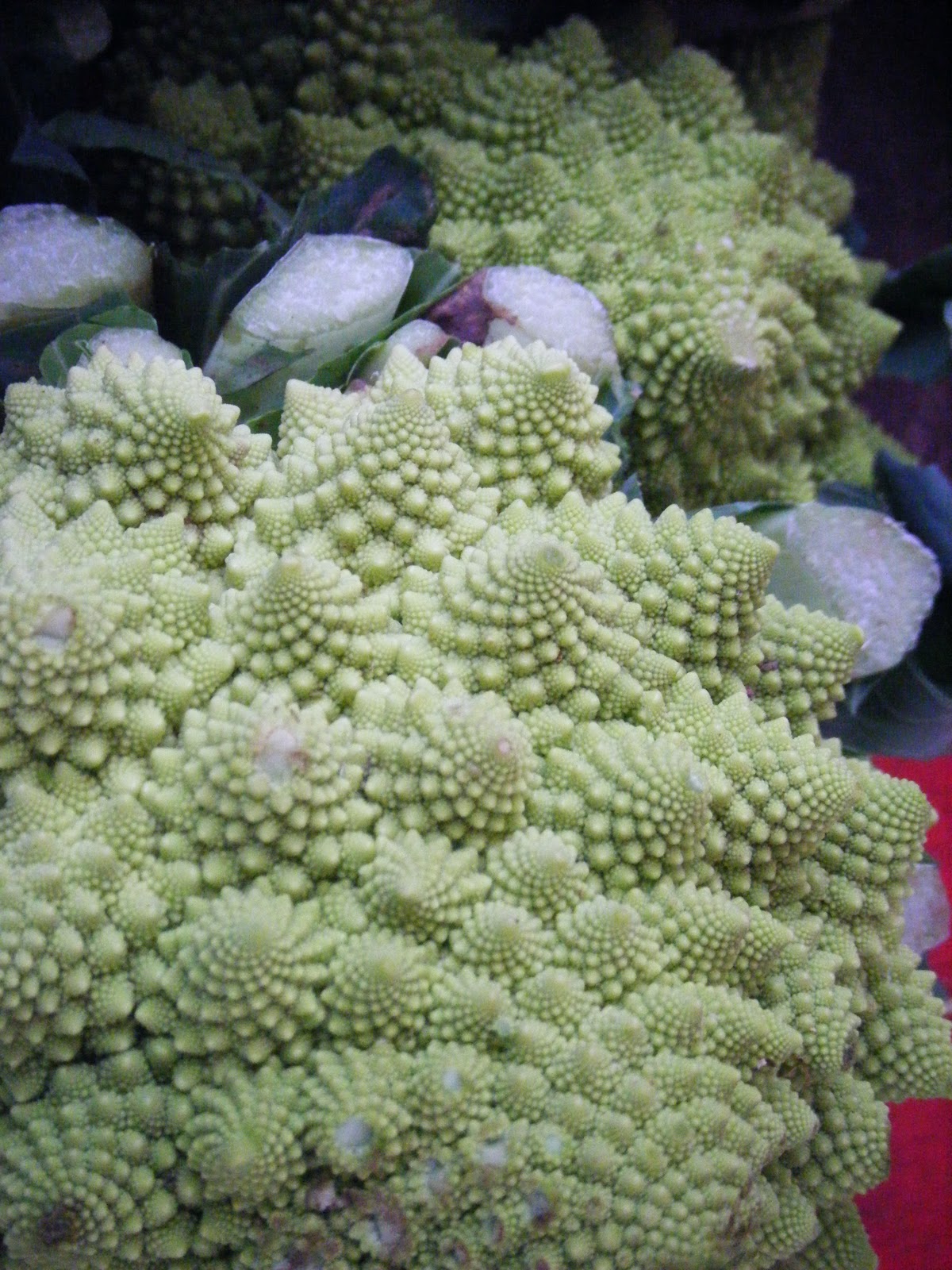
 These just seem to smell of December, along with the roasted chestnuts that are sold on the main place here...The Romanesco brocoli this morning even managed to look like mini futuristic fir trees from a certain angle!
Romanesco brocoli
Despite the cold, there is some activity in the garden, and I love the dew drops on the last spiders' webs - a little like silvery decorations on the Christmas tree, glistening as they catch the light.
Last web from the garden...
So, on that note I am going to start to prepare for the arrival of our own Christmas tree... With a kitten this should prove interesting - quite a feat, in fact. The Christmas cakes were made weeks ago and we're off on our annual day trip to Canterbury to see the pantomime next Saturday. After all, it was perhaps no coincidence that my son was born on Christmas Day!
Here is the link to a track of Kate Bush that I always loved.....December Will Be Magic Again.... Well, what else! Even if my experiences of the season haven't always lived up to my expectations, this song never disappoints!
http://www.youtube.com/watch?v=UVd4PIL4jSk

Saturday, November 13, 2010

Green glass beads.... Elusive green to die for.

Reims cathedral
Green glass in all its forms and colours catches my eye and draws me in everytime, but especially when there is a play of light or reflection. One of my favourite views is that seen through the transept of cathedrals and churches in faded light which gives a sense of watery depth.
Greenhouses and their reflections, Jardin de Plantes; Paris


This same effect can be seen here, in what was sacred place of discovery and display in Victorian times; the greenhouse.
 Autumn raindrops in the garden
From around the newt pond this summer
Growing in the pond


However, nothing can have quite the same effect as green glass beads...
Glass bracelet I made using Swarovski beads, and black 'seeds'


Handmade earrings and  Swarovski ring...
With its green glass beads stolen from the moon, I loved this poem, Overheard on a Saltmarsh, when I was a child and even today it still has a magical feel. It was written by Harold Monro (1879-1932), with the illustration by W. Heath Robinson.

Nymph, nymph, what are your beads?
Green glass, goblin. Why do you stare at them?
Give them me.
No.
Give them me. Give them me.

No.
Then I will howl all night in the reeds,
Lie in the mud and howl for them.
Goblin, why do you love them so?
They are better than stars or water,
Better than vocies of winds that sing,
Better than any man's fair daughter,

Your green glass beads on a silver ring.

Hush, I stole them from the moon.

Give me your beads, I desire them.
No.
I will howl in a deep lagoon
For your green glass beads, I love them so.

Give them me. Give them.
No.
In fact, green has always had a certain hold over humanity, said to symbolize the greenery of paradise in Islamic culture and today emblematic colour of all environmentally-friendly issues.
Tea room in La Grande Mosquée; Paris
One stable, unchanging fact in the history of this colour and Man's desire to reproduce it synthetically is its very instability and elusiveness! Since the Italian Renaissance artists have endeavoured to recreate the vast range of greens in paint, pigment and dyes yet their attempts, even when initally successful, usually led to faded, discoloured, leached shades. The vibrant blue of the Medieval tapestries that inspired William Morris' wallpaper in the19th century, had in fact been green.
Not only has green proved to be elusive, but as a result of this it bears what has aptly been referred to as a 'noxious heritage'. Quite simply, synthetic green has a degree of toxicity that makes it very 'un-green' since it contaminates all in its contact. The consequences of our goblin greed for green has at times been lethal, but never more so than in Victorian Britain, as the book The Arsenic Century by James C Whorton demonstrates.


'Scheele's Green' was a copper arsenic-based  pigment invented by the chemist K Scheele in Sweden in the 1770's which was to replace the older, less effective colourants based on copper carbonate. As a natural by-product of the metal mining industry, arsenic was in a ready supply -  especially during the Industrial Revolution - and much of it could be found in Britain itself.
Contrary to our understanding of arsenic  today, the Victorians believed that arsenic had many beneficial properties, despite being an effective, inexpensive rat poison! Indeed, it was used as a medical answer to many health issues - Charles Darwin is said to have used it to treat eczema, whilst many men would use it as a form of Victorian Viagra. However, it had a wide range of usages in Victorian manufacturing as an ingredient in cosmetics, cigarettes, alcoholic drinks, paper, paint and candles. Arsenic in one form or another played a daily role in the Victorian household - with varying noxious consequences...

With this new pigment many aesthetic possiblities were offered and so was born a desire for all things green, using a pigment ever-cheaper to manufacture. Nevertheless it gradually became apparent that people would pay the real price with their health and lives...
Levant mine; Cornwall
Scheele's Green was soon improved upon to become more durable as the pigment was stabilized further using verdigris. It was now to be known as 'Schweinfurt Green', after the German town where it was invented, or more commonly, Emerald Green or Paris Green, but whatever the name given, the pigment was to bear the same deadly characteristics.
It is reported that during the mid 19th century, up to 100 million square miles of arsenic-based pigment wallpaper adorned the British home as the demand for bright green decoration increased daily. Even cakes and confectionary were coloured green to satisfy this hunger for the verdant colour; absinthe was often fatally coloured to give it an attractive tint. Likewise, the textile industry witnessed huge enthusiasm for Emerald Green, and while ladies ostentaciously waltzed and paraded in green ballgowns and excessive daydresses, even wearers of discrete socks, stockings and underwear opted for shades of green, whilst more visible hats and gloves were, needless to say, green in colour.

Although the Victorians were aesthetically blissful in their ignorance, the effects of arsenic pigment soon exposed themselves. Damp wallpaper would decompose and release toxic arsenic vapours that smelt strangely of mice-droppings or garlic but would surely lead to serious intoxication through inhalation. It is indeed said that Napoleon Bonaparte may have died of such arsenic fumes in his wallpapered cell on Saint Helena island in 1821.
Those working in manufacturing industries reliant on arsenic suffered from chronic arsenic poisoning, often death, but similarily, those using their products had their health severely impaired too. The magnificient Emerald Green clothes liberated noxious particles that affected all those around them giving the beautiful wearers a lethal beauty. One perhaps to even die for...

Despite growing awareness and ever-increasing warnings about the noxious quality of arsenic-based pigment, these largely went unheeeded. In fact, arsenic production increased significantly so that Victorian Britain was to be the largest producer and consumer of the substance. Whilst the French and Germans took note of the hazards involved and introduced legislation accordingly, the British did not curb their appetite and despite safeguards recommended by the National Health Society, none were enforced by law.

Little by little, fashion dictated other aesthetic ideals and Emerald Green fell from grace, leaving behind it a trail of devastation and many fashion victims, although Scheele's Green itself was continued to be used as a highly effective insecticide until the 1930's.
The ultimate green-eyed monster who just loves causing havoc on a laptop keyboard!


Sunday, October 31, 2010

Blue...blue and more blue...

It just seems there is no time to do anything other than work (usually marking others' work...) so little by little I'm getting fed up and feeling more and more removed from the things that I enjoy the most. The blues, I suppose, except that I do actually like blue which in all its variety generally makes me feel good...

 As corny as it might sound, I always give the following advice to my children when they're down - to think of all their favourite things - which naturally brings to mind... The Sound of Music!!!

Nevertheless there is certainly wisdom therein, so I like to look at a few of my favourite objects, since the rest seems to be pretty inaccessible for the time being....


So, along with the kittens' whiskers and some other things on Julie Andrews'  list..... I'd add...
Blue Morpho and peacock feathers for their irridescence and the sheer magic of nature that I could never grow indifferent to... Even the humbler Blue Chalk butterflies....

Chalk Blue and opals
Peacock feathers and Pedro


Handmade blue Swarovski bead necklace, with ring and brooch

Blue glass beads (well, any beads actually) would figure there too.....


La Samaritaine; Paris


....Art deco tiles and mozaics for their discretion - often hidden away in obscure places and at great height...
You often fail to notice the beauty that is just out of reach, almost as if the aesthetic pleasure was a
hide-and-seek game for the artist...


Advert for a variety of Lu biscuits; Reims
Meanwhile old mural advertisements now pass for decoration.... And this is my favourite one that I always look out for as I'm trudging into town....
Le Ballon des Ternes; Paris

Concerning beautiful old tiles, I liked these rather devious-looking birds, that look like a cunning take on William Morris' 'The Strawberry Thief' and have a slight hint of one of my favourite birds - the Jay.

William Morris


Jay feather

....The Jay would be on my list because with its seemingly modest dusty pink/grey plummage contrasting the bright blue wing feathers that flash as they fly past with their strange 'prehistoric' calls, they seem such strange birds. I found this feather in woodland in the South of France at the end of the summer, while the Forget-me-nots are from the garden...


Finally as grey gives way to blue, I'd add open leaden skies that lead onto silver linings...
Here is one of the older squares in Reims seen in reflection - with the twin towers of the cathedral visible on the skyline.
Window display in a florist's; Reims


And to end, here is St Michael's Mount, seen from Mousehole, Cornwall, this summer...
From Mousehole to Marazion, Cornwall

Then, to accompany all of that I'd add 'Symphony in Blue', by Kate Bush....
http://www.youtube.com/watch?v=anukPD5A2R4&feature=related


                I spend a lot of my time looking at blue,
               The colour of my room and my mood.
               Blue of my walls, blue out of my mouth,
               The sort of blue between clouds,
               When the sun comes out,
               The sort of blue in those eyes you get hung up about.


               When the feeling of meaningless sets in,
               Go blowing my mind on God,
               The light in the dark, with the neon arms,
               The meak he seeks, the beast he calms;
               The head of the good soul department.
               I see myself, suddenly,
               On the piano, as a melody.
               My terrible fear of dying,
               No longer plays with me,
               For now I know that I'm needed,
               For the symphony.....


Sunday, October 10, 2010

Scarlet in glorious technicolour... and colourful character.


At the end of the summer we watched Gone with the Wind because it's such a cult film, ideal for an autumn evening and in addition I know a little person who seems to have certain aspects of Scarlet O'Hara in her character! All those little carefully studied expressions, crafty, beguiling mannerisms, calculated manoeuvres and cunning feminine ploys to obtain the desired effect!
I had forgotten just how feisty and determined the heroine is, driven by her survival instinct. How original she must have seemed at that time - 1939, in fact. This makes Gone with The Wind a contemporary of Disney's masterpiece Snow White (1937) - however while that film's eponymous heroine is the sugar-sweet character many little girls aspire to resemble - Scarlet herself is almost like an anti-heroine in some respects or at least she rejects and explodes the mould of the dainty, self-effacing 'little lady'. Rather like the film itself - the details of Scarlet's behaviour seem a bit clunky at times - how could she possibly devote so much time and energy to Ashley Wilkes? However the whole carries a character and message that time hasn't tarnished or weakened. On the contrary, Scarlet seems to explode off the screen all the more since she seems so much more original, 3-dimensional and beautiful than many of the insipid heroines we have seen over the years since Gone with the Wind bust the box office sales all those years ago....

I had also forgotten how vivid and vibrant were the colours of the film itself.  All the drama of the Old South and the Civil War are reflected and magnified by dense, richly-coloured over-the-top sets that are all enhanced, of course, by the beauty of Vivien Leigh's Scarlet and her larger-than-life persona and ....Her costumes!

Who wouldn't be won over by Scarlet in her array of beautiful gowns and dresses that, like their wearer, seem so stunning and exaggerated that they appear to be tongue-in-cheek? This is offset by the chemistry of Scarlet and Rhett, the latter being perfectly able to see through Scarlet's moves and manoeuvres, but drawn to her both despite this and because of this.
Maybe this dual effect reaches its height in the jail scene where Scarlet schemes to seduce Rhett, attain his submission and gain his financial assistance in order to reach her objective.

To do so, Scarlet wears that dress - the green 'portières' gown rustled up using the heroine's ingenuity, Mammy's marked sewing skills and Scarlet's mother's old faded curtains in times of severe deprivation.
The drapery dress does its work on every level, as does Scarlet with her perfectly apparent duality of caring companion/scheming minx. Like Scarlet herself, the trimmings from her dress, with tassles and brocade so visibly borrowed from the original curtains yet used to such effect create a fascinating and irresistible whole.
Rhett admiring the Portières dress
Apparently the costume itself was very heavy to wear (a third of Vivien Leigh's body weight) due to its double velveteen skirts and is today a museum piece in a rather sorry state. The colour of the dress was carefully chosen to suit that of Vivien's eyes and to meet the specific needs of filming in glorious technicolour.
Indeed, it was 'Glorious Technicolour' that produced the rich, vivid colours in what was called the 3-Strip process - which was so rigorous that it required a colour supervisor to oversee the filming and ensure that the costumes, materials and sets met the requirements. The equipment needed to carry out the filming was not owned by the studio itself, but was hired out by Technicolour Co - the machinery being very noisy and incredibly heavy. David Selznick apparently used Technicolour's entire stock to film Gone with The Wind...


The resulting colours remind me of another film that I love, namely The Wizard of Oz which also dates back to 1939 and then Peau d'Ane (1970) by Jacques Demy, starring Catherine Deneuve in a selection of resplendent fairy-tale gowns in breath-taking, yet camp sets!

While I was won over by the duality and bitter-sweet quality of Scarlet/Vivien, my daughter wasn't entirely impressed....and thought she wasn't "very nice" - unlike Snow White and Dorothy!

Monday, September 27, 2010

Seriously sweet Siberian...

Noggin
Our Siberian kitten has finally arrived! I went to collect him this weekend and he seems to have occupied most his time since then appropriating the house and contents - which amongst other things has entailed rearranging soil from plant plots, ravaging leaves and flowers, racing up and down the leather sofa - leaving fine scratch marks in his wake, depositing fiendish-smelling 'accidents' in obscure places, dislodging any spiders and cobwebs from under furniture, trying to catch the cursor on the computer screen and fishing for my feet under the bedclothes (he caught them!). However, above all else he has been seriously sweet - and now it's the childrens' turn to get to know Noggin the Nog - their new partner in crime!

Noggin (foreground) with a half-sister
Well, as I write Noggin has made his way up my back - baby claws out and is now rummaging around in the fireplace eating something...Just when you're exhausted cats seem to get a burst of inexplicable energy so this promises to be an eventful night!

The mother

Monday, September 20, 2010

Here comes the sun!...

Well, actually the sun might not be on it's way, but in order to face another week, hopefully not like the last one - here's something to put a bit of warmth, brightness and appetite into this evening which is starting to feel decidedly autumnal. What better way than with some photos of Provençal markets! Everything felt light-filled, colourful, perfumed and humming with people and wasps when I took the photos, and seems all the more so now as the seasons change.

Open-air food markets seem to be an integral part of the French lifestyle, in a way that doesn't seem to find an equivalent in England, or perhaps just in the lifestyle I had in the U.K! In France such markets can be found in every village, town, city - with many larger towns (Reims being one of them) having a market in different quartiers each day of the week - each market having its own character and 'flavour' adapted to the demands and tastes of the clientele. There are, of course, usually covered permanent market halls to be found too, with buildings generally situated in the town centre.
 Wherever the site, wandering around the market is a pleasure that seems to be instinctive. However, the markets in the South of France have the added benefit of the sun and luminosity (in winter, when the temperature isn't always that warm!) that also leads to more exotic food stands.  

 
 Ironically, just after coming back from the south, a Provençal market was set up here for the weekend - so
some of the warmth made its way up here to the north-east.
While going to the markets is a fantastic experience of the senses, it goes without saying that it does serve a concrete purpose. From the moment the stands are installed early in the morning, professional caterers and restauranteurs do their rounds to get the best produce.
Local producers, paysans, supply fresh products, seasonally or throughout the year. In the winter, when  temperatures fall wherever the market, the stall holders still handle and serve their goods with weathered hands, regardless of the cold, even when chopping up resistant pumpkins.
  
As the French countryside tries to withstand the industrialisation of the landscape fortunately the markets
still serve as an outlet to producers who would perhaps find it difficult to make a livelihood, faced with the competition from the large supermarkets which try to cash in on this desire for produce of  les terroirs.

Nothing can really take the place of fresh produce that isn't shrouded in plastic, shrink wrapped or
doused in preservatives.
There's also the added bonus of being able to taste the goods before buying - rows of jam and honey, syrup, biscuits, wild-boar ham, olive oil and much more besides....My children had a field day!


Friday, September 10, 2010

Sculpted lions...

Auguste Caïn;  Hotel de ville, Paris


Over the summer I tried looking out for different forms of sculpted lion and the variation in artistic interpretation and media was fantastic!


 Caïn; Jardin des Tuileries


I have seen lions represented on door knockers, capitals of columns, facades, fountains and of course numerous sculptures.


Some have demonstrated their majestic force or have been ferocious in their feral nature...


Others just plain frightening...


These are ones that nightmares are made of....
Facade, Reims


Others regal and dignified, ever watchful...

La Rotonde;  Aix-en -Provence


Certain ones comic - looking heavy-browed and perplexed...

Troyes


Some appeared rather sheepish...


Others appeared astounded or angered...

Paris
Place Royale; Reims


Some seemed very subdued - symbols of power, tamed and docile!


Aix-en-Provence


Some seemed to have almost human features with Baroque flowing locks rather than a lionesque mane...


And finally more again seemed barely recognizable as lions!


Needless to say, the lion has always fascinated man - throughout the ages the king of the beasts has been a creature of legend, symbolizing royalty, stateliness and noble bravery.

Associated with the notion of protection and linked to the image of loyal guardian the lion appears in many forms. As a sphinx, half-human, half-lioness it looks over the pharaohs, while as Bastet, the ever-watchful goddess of the rising sun it guards the dead. Much later in Medieval times the lion continued this vital role as it protected the entombed knights by lying at their feet (incidentally, dogs symbolizing loyalty slept at the feet of the knights' wives, and unicorns at the feet of virgins!).


Fontaine du Palmier; Place du Châtelet, Paris


The lion was indeed believed to sleep with its eyes open, and so could therefore keep guard over those who had entered the realm of eternal sleep. In addition to this, it was said to be doted with the power of ressurection since it allegedly re-animated lifeless lion cubs.

In mythology and the Bible the lion was used to reflect the superiority of deity. When man was bestowed with the divine power he could overcome the king of all the animals, as was the case of Hercules, whose strength was shown through the slaying of the Nemean lion.

The lion was one of the four sacred winged animals of the Bible and is specifically associated with the Evangelist Mark, reflecting energy and undaunted courage. Indeed, the Greek lions of the Arsenal in Venice symbolize St Mark, the patron saint of la  Serenissima. In Christianity the lion would frequently be used to portray Jesus, assuming a Messianic figure.


In the Middle Ages the lion was a principal element of heraldry, depicted in many significant positions including; rampant (raised up on back legs, ready to attack); passant (with forepaw raised); sejant (sitting on haunches); couchant (lying down, yet awake).

Despite the great symbolism of the lion, few Europeans had actually seen the real creature and for many people this was simply a legendary beast, much like the dragon or gryffin.


The realism of the lion's portrayal suffered somewhat as artists tried to improvise - using artistic licence - namely their imagination! These must be my favourite lion representations... Nevertheless, over time lions would be seen in Medieval bestiaries and royal menageries.


When the greatest sculpteur animalier of 19th century France, Antoine-Louis Bayre (1795-1875) created his greatest pieces he had already studied big cats in the zoo at the Jardin des Plantes, alongside the Romantic painter Eugène Delacroix.
Henri -Alfred Jacquemart. Jardin des Plantes; Paris

Antoine-Louis Bayre


The realism of Bayre's work was such that when Le Lion au Serpent, commissiond by King Louis Philippe, appeared in the Jardin des Tuileries it was met with much indignation since it was felt that the gardens were "being taken for a menagerie".


Maybe you can have just too much realism. While the animal essence and force is present in the work of the great animaliers, the artist himself is waylaid and seems to disappear behind his work. I would love to see the craftmen who created the naïve beauty of the lion on this cathedral door.